By Brenda S. Cox
“Netherfield is taken by a young man of large fortune from the north of England . . . he is to take possession before Michaelmas.” –Pride and Prejudice, chapter 1
“People did say you [Mr. Bingley] meant to quit the place entirely at Michaelmas . . .” –Pride and Prejudice, chapter 53
Today, September 29, is Michaelmas (pronounced MICK-ul-muss). In the church calendar, for Catholics and for Anglicans like Austen, this is a “holy day” (from which we get our word holiday). It commemorates St. Michael, the archangel.
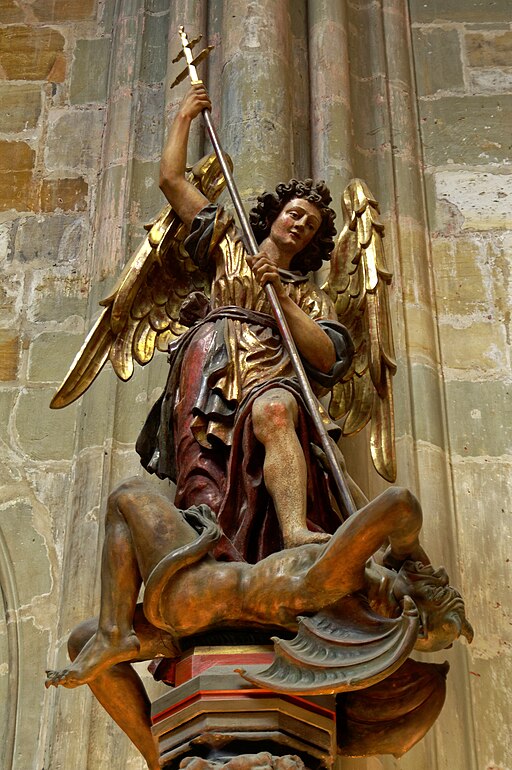
Photo by Jakub Hałun, CC BY-SA 4.0
Sometimes other angels are also commemorated on this day: “St. Michael and All Angels,” or specifically Michael, Gabriel and Rafael, the three angels mentioned by name in the Bible. The word “saint,” from Latin “sanctus,” means “holy one,” so the holy angels of heaven can be considered saints.
“Michaelmas” means the mass of Michael, as “Christmas” means the mass of Christ. Mass is the Catholic version of what Anglicans call the Lord’s Supper or Holy Communion, the ceremony where Christians eat unleavened bread and drink wine together to remember Christ’s suffering and death on the cross.
On the Calendar
In earlier times, the church and community were closely intertwined. Church holidays gave the year rhythm and consistency. Judicial, financial, and academic schedules came to revolve around four “quarter days” of the year. For England, these were Lady Day, Midsummer Day, Michaelmas, and Christmas.
March 25, Lady Day: Austen mentions this in her letters as the day when an allowance of money was to begin for her brother James, and as a day when someone was moving houses. In the church, it was the Feast of the Annunciation, when the angel Gabriel announced to the Virgin Mary (the “Lady”) that she would have a child, Jesus.
June 24, Midsummer Day: In Emma, Jane Fairfax is supposed to leave at Midsummer, though she gets delayed. The Box Hill picnic takes place at “almost Midsummer.” Midsummer is capitalized, so it means a specific date. On this date, the church celebrates the birth of John the Baptist, who prepared the way for Jesus’s coming.
Sept. 29, Michaelmas Day is mentioned in all of Austen’s novels except Northanger Abbey as a date when things happen. Mrs. Jennings thinks Colonel Brandon will be married by Michaelmas. Mr. Bingley is to take possession of Netherfield at Michaelmas, and rumor has it he will leave by the next Michaelmas. In Mansfield Park, Mrs. Norris has been doctoring the coachman for rheumatism from Michaelmas through the winter, and Henry Crawford expects to have a small home nearby at Michaelmas, obviously hoping he and Fanny will be married by then. In Emma, Harriet Smith is amazed that Mr. Elton could be in love with her, since she hardly knew him at Michaelmas. It is probably November when she says this. The Crofts take possession of Kellynch Hall at Michaelmas, and Anne tells her father that Mary has been in “good looks” since Michaelmas. In Sanditon, Lady Denham brings Clara Brereton from London at Michaelmas.
Dec. 25, Christmas Day. In Austen’s novels and shorter works, she mentions Christmas 41 times and Easter 18 times by my count. They often serve to mark dates and times of year.
(For some purposes, Epiphany (Jan. 6) was a quarter day instead of Christmas, and Easter instead of Lady Day. But Midsummer and Michaelmas were still the other quarter days.)
Around these four quarterly dates, rents and payments came due, leases of lands and houses (like Netherfield) began and ended, servants were hired, and local courts held “quarter sessions.”
The academic year also revolved around church dates. The fall term at both Oxford and Cambridge is called Michaelmas term. I was surprised when I was at Cambridge two weeks ago, in mid-September, that the colleges were not yet in session. Then I realized it was not yet Michaelmas. This year’s fall term starts just after Michaelmas, on Oct. 8.
In the Church
The Book of Common Prayer (BCP), which gives daily worship services for the Church of England, includes a calendar of saints’ days. By Austen’s time, special services for most of those days were not commonly held in country parishes unless they fell on a Sunday. Christmas Day, though, was celebrated with a church service. In Emma, the weather keeps Emma from going to church on Christmas.
For each saint’s day, the BCP gives relevant Bible readings and a collect (pronounced KAH-lect) prayer for that day. Austen was likely very familiar with these, hearing them every year. For Michaelmas, the clergyman could choose from these readings about angels:
Revelation 12:7-12. “War in heaven”; “Michael and his angels fought against the dragons” [the demons]. Satan is cast out of heaven, but those who believe in Christ “overcame him by the blood of the Lamb, and by the word of their testimony; and they loved not their lives unto the death.” Many depictions of Michael show him defeating Satan, sometimes in the form of a dragon.
Matthew 18:1-10. Jesus says not to despise children, for “their angels do always behold the face of my Father who is in heaven.”
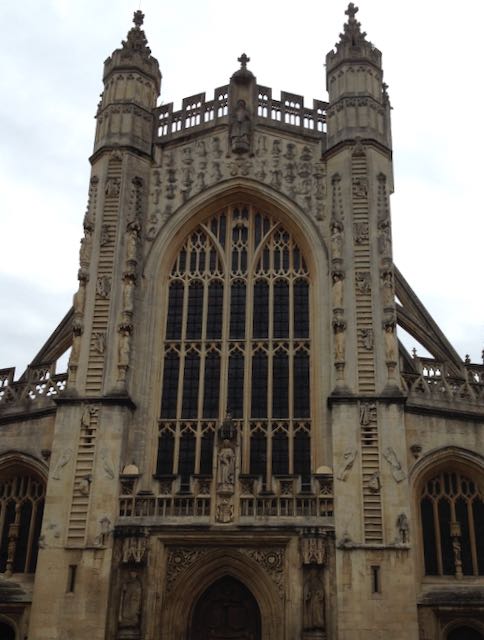
Genesis 32. Jacob wrestles with an angel. This is the same Jacob who earlier saw a vision of a ladder to heaven, with angels going up and down it. The front of Bath Abbey, which Jane Austen must have seen many times, pictures that ladder.
Daniel 10:4-14. An angel sent to Daniel was delayed by the prince of Persia, apparently a demon, until the archangel Michael, “one of the chief princes,” came to help him. The angel looked like a man “clothed in linen, whose loins were girded with fine gold of Uphaz: his body also was like the beryl [a gem, possibly an emerald], and his face as the appearance of lightning, and his eyes as lamps of fire, and his arms and his feet like in colour to polished brass, and the voice of his words like the voice of a multitude” (Daniel 10:5-6). This angel doesn’t sound much like today’s usual pictures of angels!
Acts 12:5-18 An angel rescues the apostle Peter from prison.
Revelation 14:14-20 Angels pour out God’s wrath and judgment on the earth.
The Collect prayer read on Michaelmas requests the help of angels for those on earth:
“O everlasting God, who hast ordained and constituted the services of Angels and men in a wonderful order: Mercifully grant that, as thy holy Angels always do thee service in heaven, so by thy appointment they may succour and defend us on earth; through Jesus Christ our Lord. Amen.”
Nowadays most Anglican churches use the more modern Book of Common Worship, but a traditional BCP service might still use this prayer and some of these Bible passages.
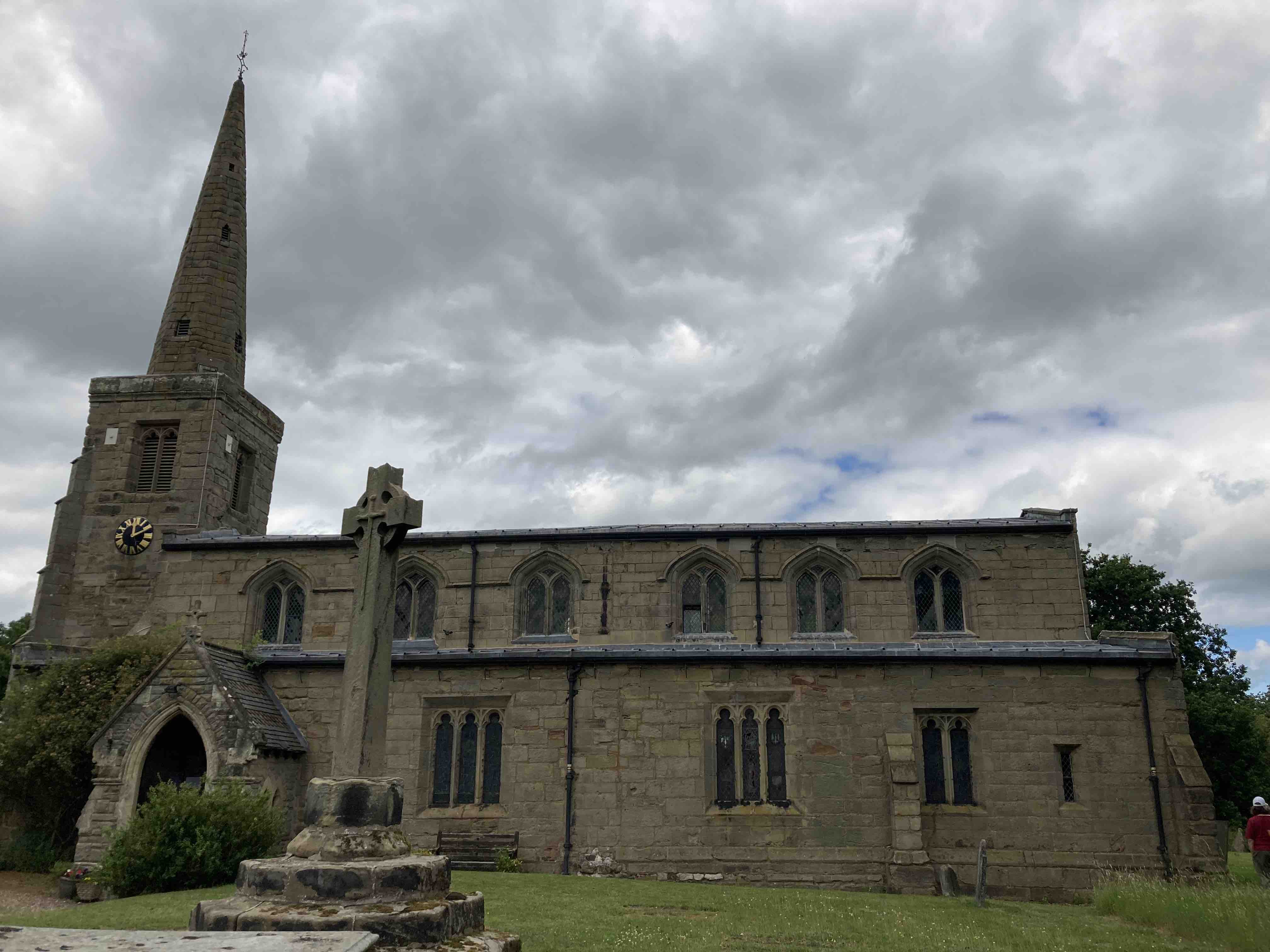
Photo © Brenda S. Cox, 2023
The church of Austen’s first cousin, Edward Cooper, in Hamstall Ridware, is named after St. Michael and All Angels. Their service this Sunday will be a celebration of Harvest (the British equivalent of America’s Thanksgiving) as well as a “patronal festival,” since it is the day of St. Michael, patron saint of the church. The clergyman, Revd. Jeremy Brading, told me, “The aim of these occasions [patronal festivals] is to celebrate the life of the local church on the occasion of its saint’s day. The celebration is for all that has gone previously, thanking God for his work through the local church. [Just] as important, is praying to God for his leadership and guidance for the future, that the local church might serve him faithfully.”
In Popular Culture
While Michaelmas is not much celebrated in today’s Anglican church, it was a great religious feast day in the Middle Ages, and traditions grew up around it. Michaelmas comes at the end of the harvest and the change of the season. A few old English traditions:
Eating goose and doing good: If you ate goose on Michaelmas, it was supposed to protect you from financial need for the next year. One writer says, “On Michaelmas, families spend the day doing good, dancing, singing, and at the end of the day, sharing a feast of freshly baked bread, roast goose stuffed with potatoes, veggies, and herbs.”
Picking blackberries: According to legend, when the Archangel Michael, with his flaming sword, cast the devil out of heaven, the devil landed in a thorny patch of blackberries. He was so angry that he spat on the blackberries and even urinated on them to make them unfit to eat. Thus blackberries picked after Michaelmas are considered inedible. Since Michaelmas originally fell in what is now mid-October, until the calendar changed (from Julian to Gregorian), that was pretty much the end of blackberry season.

Photo by Björn S…, CC BY-SA 2.0
Michaelmas daisies: An old rhyme says,
‘The Michaelmas daisy, among dead weeds,
Blooms for St Michael’s valorous deeds.
And seems the last of flowers that stood,
Till the feast of St Simon and St Jude.’
Michaelmas daisies are asters, star-shaped flowers in lilac, blue, pink, or white. The peak of their bloom is around Michaelmas, though many are still blooming at the feast of St. Simon and St. Jude on Oct. 28.
Lawless Hour: An odd custom from Worcestershire: “In Kidderminster the Monday after Michaelmas had Lawless Hour between 12 pm and 1 pm, in between the old constable stepping down and the new one taking office. This led to an hour when people couldn’t be arrested, so groups would fight by throwing cabbage stalks and other fruit and vegetables at each other. The authorities mostly turned a blind eye, but by the mid 19th century this practice ended as it was considerate inappropriate.” Other local areas have their own Michaelmas traditions.
We don’t know what Michaelmas traditions Jane Austen kept. But she did mention Michaelmas 15 times in her fiction, and now you know what it meant. Happy Michaelmas to you all!







 Jane Austen's World
Thank you. Enjoyed reading.
This is very interesting! Thank you so much for this article. Greetings from Germany :)
I’m glad you enjoyed it. I gave a talk on Michaelmas this weekend for my JASNA Georgia group, and we made bouquets of flowers similar to Michaelmas daisies; apparently asters aren’t blooming now in Georgia!
what a wonderful and informative piece.
Thank you! I had a brief notion of what it was after reading it mentioned in books, but it’s always nice to know all about it.
denise