This Jane Austen blog brings Jane Austen, her novels, and the Regency Period alive through food, dress, social customs, and other 19th C. historical details related to this topic.
“At the end of the sixteenth century there was living at Horsmonden—a small village in the Weald of Kent—a certain John Austen. . . . a man of considerable means, owning property in Kent and Sussex and elsewhere . . . including in all probability the manor house of Broadford in Horsmonden. . . . [His wealth was] doubtless derived from the clothing trade. . . . John Austen died in 1620, leaving a large family. . . . The fifth son, Francis, who died in 1687, describes himself in his will as a clothier, of Grovehurst; this place being, like Broadford, a pretty timbered house of moderate size near the picturesque old village of Horsmonden. Both houses still belong to the Austen family.”—Jane Austen, Her Life and Letters, 1913, chapter 1 [A “weald” is a heavily wooded area.]
George Austen’s family hailed from Horsmonden, a village in rural Kent. Its name means “horsemen’s woodland pasture.” It is 12 miles from Tonbridge, where George Austen grew up, and 29 miles from Godmersham, where Jane’s brother inherited an estate from their Knight relatives in Kent.
The Horsmonden church, St. Margaret’s, looks much the same as when the tower was completed in the late fourteenth century.
Inside of St. Margaret’s Horsmonden church. The rector gave the parish this brass chandelier in 1703. It holds candles.
Horsmonden Village
St. Margaret’s church is about 2 miles outside of the village. The village has been a center at various times for different industries. Their ironworks supplied weapons and ammunition for the English Civil War in the mid-1600s. Earlier in the 1600s, Horsmonden’s clothworks produced Kentish broadcloth, mainly as a cottage industry in weavers’ homes. The Austens were the “clothmasters,” living in homes called “halls” that combined private residences with offices and warehouses. Later the area became known for growing hops, used in brewing beer.
The Austens at Horsmonden
Flagstone on floor of St. Margaret’s Horsmonden commemorating John Austen I (1560-1620) and his wife and children, Jane Austen’s ancestors.
The first John Austen and his son Francis are buried in the Horsmonden church. As the historian who authored St. Margaret’s Church Horsmonden wrote, “This was the family, let it be noted, from which sprang the immortal Jane.” John Austen I was Jane Austen’s grandfather’s grandfather’s grandfather.
Railed tomb in St. Margaret’s churchyard for a number of Austen ancestors, with the letter A in the fence.
The Austen lineage:
John Austen I (Jane’s great-great-great-great-grandfather, Horsmonden)
—Francis I (great-great-great-grandfather, Horsmonden)
—John Austen III (great-great-grandfather, Horsmonden)
—John Austen IV (great-grandfather, Horsmonden)
—William Austen the surgeon (grandfather, Tonbridge)
—Rev. George Austen (father, Tonbridge, Steventon)
—Jane Austen (Steventon)
Stained glass window in St. Margaret’s Horsmonden, showing St. Paul and St. Cecilia, inscribed to the memory of John Francis Austen (1817-1893) and his daughters Georgiana (died age 15) and Charlotte.
Historic St. Margaret’s, Horsmonden
The porch, built in the fifteenth century, has many of its original timbers. It was used as a lych gate, where the coffin and coffin-bearers rested before a funeral. Before the Reformation, weddings were held there, and the first parts of the baptism and funeral services.
Brass flagstone at St. Margaret’s commemorating Rev. Henry de Grofhurst, rector 1311 to 1361, who directed the building of the church we see now. Earlier church buildings occupied the site from at least 1100.
A “parclose screen” from around 1500, inscribed in Latin, “Pray for the good health of Alice Sampson.” It would have screened off one of the smaller chapels in the church, which were devoted to various saints. This screen was likely originally painted in bright colors with gilding. Alice’s will (she died in 1508) requested that she be buried in the churchyard within sight of her home.
St. Margaret’s has had bells since at least 1528. Some of the current eight bells date from 1737 but were later recast. This photo shows their positions when not in use.
92 steps lead up to the roof of the tower.
We stopped about a third of the way up (whew!) in the ringing chamber.
A sign at St. Margaret’s celebrating the bell ringers who rang “a peal of 5024 Cambridge surprise major [a complex bell ringing pattern] in 3 hours 18 minutes” and commemorating the death of one of their members whose family included “a line of ringers unbroken since 1799.”
You can see where stone workers finished these Wealdon sandstone stones for the church. On one, someone inscribed his name in 1777. A little Georgian graffiti, apparently!
Stained glass window showing St. Margaret and Sir Galahad (I suppose because he was a knight/soldier) in St. Margaret’s Horsmonden to the memory of Major Simon Willard (1605-1676), who emigrated with his wife to the American colonies. He was the founder of Concord, Massachusetts and served as a soldier under Governor John Winthrop.
The baptismal font, where babies are christened and adults can also be baptized, dates from the early 17th century but was copied from one in the early fifteenth century. The designs on the side alternate between shields and floral figures.
I had to include this tombstone for a William Collins, died 1863, age 74, so he was born when Jane Austen was about 13 or 14.
This lovely organ at St. Margaret’s Horsmonden was built in 1837.
A little science from Austen’s time: A memorial in the church to John Read (1760-1847), a local man who invented a stomach pump (saving many lives), a fire escape, and “many other useful implements for the benefit and relief of suffering humanity. Of humble origins, he yet possessed talents which would have done honour to the highest station.” He used them for doing good “in submission to the will of the Great Creator.” Read’s Stomach Pump
St. Margaret’s Horsmonden Today
The parish includes over 2,000 people. Only about 40 regularly attend services in the church, while another 60-70 watch on YouTube. Many are in the church’s WhatsApp group, supporting one another in prayer. Much larger crowds, up to about 150, attend the church for weddings, funerals, baptisms, and holidays. On Good Friday they put up three crosses on the village green and have a large service there.
The church also hosts community events including concerts, popular speakers, and Jane Austen readings, and they go into the schools once a month to “open the Book,” teaching the Bible to school children. St. Margaret’s varies their services, offering traditional and modern communion services, family-oriented services, outdoor events, a café, and an informal worship time. Modern Anglican churches can range from very formal Anglo-Catholic styles to more relaxed evangelical styles. Horsmonden tends toward the more “low church,” evangelical approach.
The “living churchyard” of St. Margaret’s encourages a biodiverse habitat around the church. The church is part of Eco Church, “a Christian environmental movement encouraging church communities to make changes to their worship, teaching, land and buildings management, community and global engagement, and lifestyle to reflect God’s care for the Earth.”
St. Margaret’s supports a number of charities, both local and abroad, and encourages recycling and avoiding waste. Another notice board says the church is known for supporting the surrounding community and being welcoming, friendly, and prayerful.
Peaceful
Historian Anthony Cronk closes St. Margaret’s Horsmonden by saying:
“Today St. Margaret’s is essentially a parish church and a place of regular worship . . . it also attracts visitors from far and near. In this rural spot, away from the bustle of everyday life, one can spend a quiet moment savouring ‘the peace which passeth all understanding’. Jesus himself was referring to the need for this kind of occasional withdrawal when ‘he said unto them, “Come ye yourselves apart into a desert place, and rest awhile:” for there were many coming and going, and they had no leisure so much as to eat’ (Mark 6:31).
“Worship needs its focusing points in time and space; there must be holy places as well as holy days—places set apart for ever because of some association, hallowed by age-long custom—where people expect to find something inspiring and are not disappointed.
“One such place is St. Margaret’s, Horsmonden.”
Gentle readers, may you find such a place of peace and inspiration wherever you are.
“We dined at Goodnestone, and in the evening danced two country dances and the Boulangeries. I opened the ball with Edward Bridges . . . We supped there, and walked home at night under the shade of two umbrellas.”—Jsane Austen, Sept. 5, 1796.
More than thirty times in her letters, Jane Austen mentions Goodnestone (pronounced “GOOD-nuh-stun” or “gunston.”) The original name was Godwynestone, after the Anglo-Saxon family who lived in the area from before the Norman Conquest until the reign of King Henry VIII. The founder of the family, Earl Godwyn (or Godwin), was the father of King Harold II, killed in the Norman Conquest.
The estates of the area passed through a few other families. They were eventually acquired by Brook Bridges, Esq. in the early 1700s. He built Goodnestone Park. His son became a baronet, like Sir Thomas Bertram and Sir Walter Elliot in Austen’s novels. He passed that title down to his descendants, a Brook Bridges in each generation.
Jane Austen visited Goodnestone several times, and often refers to the comings and goings of her friends and relations there. What was her connection to this place?
Goodnestone Park and Farm and Rowlings
Last month on this site we “visited” Godmersham, home of the Knight family who adopted Jane Austen’s brother Edward. Edward Austen married Elizabeth Bridges, daughter of Sir Brook William Bridges, owner of the nearby estate of Goodnestone. When Edward and Elizabeth were first married, they lived at Rowling, about a mile from Goodnestone. Their first four children were born there. Jane Austen visited them there, socializing with Elizabeth’s family at Goodnestone Park. (See “A Walk in Kent” for photos of Rowling.)
Goodnestone Park, where Austen danced with Edward Bridges. Photo by Nick Smith / Goodnestone House, 2007, CC BY-SA 2.0
Goodnestone Park in the 1770s Public domain via wikimedia
“The Mrs. Finches were afraid you would find Goodnestone very dull; I wished when I heard them say so that they could have heard Mr. E. Bridges’ solicitude on the subject, and have known all the amusements that were planned to prevent it.”—Aug. 24, 1805, from Jane Austen at Godmersham Park to Cassandra Austen at Goodnestone Farm, Wingham
Edward and his wife inherited Godmersham and moved there at the end of 1797. Jane and Cassandra continued to visit other Bridges family members at Goodnestone Farm. Her nephew described Goodnestone Farm as “a comfortable house very near the great house, which has generally been inhabited as a dower house or by some younger member of the Bridges family, to whom it belongs.”
Jane’s friend Harriot (or Harriot-Mary), one of her sister-in-law Elizabeth’s younger sisters, insisted Jane stay longer on a visit in 1805. In the following year, Harriot married Rev. George Moore. He was the son of an archbishop and held four church livings. One of Elizabeth’s younger brothers, Rev. Brook-Edward, was perpetual curate of Goodnestone from 1802-9, as well as holding five other church livings at various times. His older brother, Rev. Brook-Henry, held two church livings. (They did like hyphenated names.) The Bridges family apparently had “considerable patronage in the church,” like the Darcys of Pemberley, or at least they had close connections with families who had patronage (the right to assign church livings).
The dower house at Goodnestone, where Jane Austen stayed on later visits to the Bridges family.
Holy Cross Goodnestone church
On her visits, Austen must have attended the local church, Holy Cross Goodnestone. This is now considered an “Austen Family Church,” like others we have visited in this series. Jane’s brother Edward married his wife Elizabeth in this church in 1791.
Holy Cross Goodnestone church
Faced flints (chipped or “knapped” to make them flat) cover the south wall of the Goodnestone church, giving it a unique appearance.
View of the Goodnestone church tower from one of the many beautiful gardens. Once used as a beaon tower and fortress, it is still a bell tower, with four bells, one of which was made in 1628. The church now has six “Ringers” who ring the bells on special occasions. A single bell is rung for church services. Photo by Adam Hincks, CC BY-SA 2.0
On one face of the Goodnestone church tower, a sundial, shown here, was inscribed “Every hour shortens life,” though the markings are very worn now. On another face is a Victorian clock, which has to be manually wound every eight days. Detail of photo by Adam Hincks, CC BY-SA 2.0
Holy Cross Goodnestone church interior
The interior of the church was remodeled in the Gothic Revival style in 1841, so it looks different now than it did in Austen’s time.
An inscription over this arch commemorates Sir Brook William Bridges (Edward Austen’s father-in-law) who rebuilt the nave and chancel of the church in 1841.
Monuments on the church walls, and flagstones on the floor, still commemorate influential families. This is a monument to Sir Edward Engeham, who purchased the estate from the de Godwynstones, and his family. He died in 1636, age 65, a year after his wife’s death at age 52.
In Austen’s time, the nicer pews would have been rented or owned by wealthy families. These Goodnestone church pews are Victorian, and the organ dates from 1904, restored and augmented in 2014.
The Goodnestone organ also has wooden pipes, for the pedals.
Jane Austen may well have read these engravings on the wall, similar to those in many English country churches. The left side displays the Lord’s Prayer, the right side lists the Ten Commandments.
“We have walked to Rowling on each of the two last days after dinner, and very great was my pleasure in going over the house and grounds. We have also found time to visit all the principal walks of this place, except the walk round the top of the park, which we shall accomplish probably to-day.”—Jane Austen at Goodnestone Farm writing to Cassandra at Godmersham, August 30, 1805.
Church and Community
A congregation of about twenty people gather for Sunday services at the church (fewer when their excellent choir is not singing). But they may have 100 to 120 participants at services for holidays and weddings.
Like many country churches, the Goodnestone church is also used for various community services. Concerts are held there regularly, and the choir is excellent. They have sung Evensong in cathedrals as well. Schoolchildren come to the church once a week from the Church of England primary school in the village. The church even serves as a post office, open two mornings a week.
News article about the post office being opened in the Goodnestone church.
Goodnestone is part of the Canonry Benefice, which includes seven churches in East Kent. The vicar and other clergy for the benefice serve all the churches, at services alternating between the churches. For example, during the upcoming Holy Week, from Palm Sunday to Easter Sunday, fifteen church services will be held at the various churches (at least one per day). Three of them will be at Holy Cross, Goodnestone.
The church is well worth seeing if you visit the area. It is generally open during daylight hours. You can contact the church if you have questions. Jane Austen enjoyed the gardens and walks in the area, and you can also walk through the lovely gardens and the “Serpentine Walk.” See Visitor Information. Goodnestone Park is now used as a wedding venue.
Goodnestone Park Grade II* listing (Grade II* means a “particularly important building of more than special interest.” Listed buildings require special permissions before any significant changes can be made.)
A few days ago we “visited” Godmersham, the estate of Jane Austen’s brother in Kent. Today we’ll continue that visit with the church she attended while she was there. Like so many English churches, it is named after a Christian saint.
St. Lawrence the Martyr: Who Was He?
More than 200 churches in England are named after St. Lawrence. The church at Godmersham, where Jane Austen often visited her brother Edward, is one of them, as is the church at Alton, closest town to Austen’s village of Chawton.
St. Lawrence the Martyr, parish church of Godmersham, which Jane Austen often attended.
The original St. Lawrence’s story is inspiring but rather grisly. He was a deacon in charge of the treasures of the church, and of distributing alms to the poor. When the Roman Emperor Valerian demanded that Christians sacrifice to the Roman gods or else be killed, they refused. Pope Sixtus II and his deacons were beheaded. Lawrence was told to hand over the church’s treasures. Instead of bringing gold, he brought in many of the poor and said they were the church’s treasure.
Valerian supposedly commanded that Lawrence be roasted on a gridiron, and Lawrence even made a joke as he was dying. (Some think he was actually beheaded and the gridiron is a transcription error; scroll down at this link.) He became the patron saint of comedians and poor people as well as those who work with open fires, such as bakers, and those who fear fires, such as librarians.
And, guess what else? He’s apparently the patron saint of barbecues. On August 10, St. Lawrence’s Day in the church calendar, many churches like this one celebrate by having a community-wide barbecue. Okay, that’s the grisly part. Moving on . . .
Godmersham Church and Jane Austen’s Family
Godmersham church plaque mentioning Jane Austen
Memorial to Jane Austen’s brother, Edward Austen Knight “of Godmersham Park in this parish, and of Chawton House in the country of Southampton,” and his wife Elizabeth. It tells about Edward’s name change and inheritance. Edward is described, “Living peaceably in his habitation, he was honored in his generation, a merciful man whose righteousness shall not be forgotten.” (This combines verses from Ecclesiasticus 44:6, 7, 10; Ecclesiasticus is a book of the Apocrypha.)
Memorial in the Godmersham church to the Knights that Edward inherited from, cousins of the Austens. The broken pillar symbolizes the end of the Brodnax family they were descended from. Thomas Brodnax, who built Godmersham Park (which was originally called Ford Place) in 1732, changed his name to May and then to Knight in order to inherit fortunes from distant relatives. His son, also named Thomas Knight, adopted Edward Austen as his heir.
Jane Austen, in a total of ten months staying at Godmersham, must have attended this church at least forty times. More likely eighty times, if they had morning and evening Sunday services as many churches did at the time. So she would have known it well.
In her time, the chuch had a triple-decker pulpit: a high wooden pulpit with a sounding board over it (a wooden structure reflecting the sound forward), from which the vicar would preach. Below that was the vicar’s “prayer desk,” from which he would lead the service, reading prayers and Scriptures. And below that, the “parish clerk’s pew,” from which the church clerk would lead congregational responses. (These are the three “decks” of the pulpit.) (See another example here.)
Across the church from this pulpit were two huge “box pews” for the major families of the parish. These were on top of burial vaults, so Austen would have walked up five steps and through an arched doorway to get to the Knight family’s “pew,” actually a separate room which enabled them to see over everyone’s heads to the top pulpit (See pages 70 and 73–pp. 26 and 29 of the pdf file– of The Parish Church of St Laurence). Quite a different experience than her tiny churches at Steventon and Chawton, where only the squire of the area and his family would have a box pew, on a much smaller scale.
Box Pew at Steventon Church, for the squire of the area and his family. The box pews at Godmersham were much larger and more ornate, but were demolished in the 1860s.
While the Godmersham church’s triple decker pulpit is gone, like most of this era, you can still see a triple-decker pulpit at the John Wesley’s New Room Chapel in Bristol. The congregation heard preaching from the top level, Scripture reading and prayers from the middle level, and responses led by the parish clerk from the lower table.
Like so many of the Austen-era churches, the Godmersham church was remodeled and expanded in the 1860s. According to the “Souvenir Guide” for the church, at that time “The Georgian furnishings (triple-decker pulpit, parlour pews, western gallery and box pews) were swept away and the entire building restored and refurbished.”
Interior of Godmersham church, much changed from Jane Austen’s time
This chapel under the tower of the Godmersham church was built in the twelfth century. Next to it hang ropes for ringing the bells in the tower. The eagle lectern, a stand for reading the Bible, is typical of English churches.
Church Bell-ringing is a challenging skill to learn. Five bells in the Godmersham church tower were cast in 1687, while a sixth was added in 1999.
Vicars
The Godmersham church had vicars over the centuries. English churches traditionally either have rectors, who received all the tithes of the parish, or vicars, who received only part of the tithes. For a church with a vicar, a nominal rector elsewhere received the main tithes. The only vicar in Austen’s novels is Mr. Elton, who thus received a lower income and needed to marry money. (Tithes are ten percent of the income of the people of the parish; in Austen’s time, it was legally required that this be paid to the parish priest, in either cash or in agricultural produce. The system and these definitions have changed, of course, in modern times.)
The Vicars of Godmersham Church
The “rector” of the Godmersham church, who received most of the tithe money, was the Dean and Chapter of Canterbury Cathedral, meaning the leaders of the Cathedral: the dean, canons, and prebendaries. Much of the parish income went to them, but some went to the vicar, who performed the daily responsibilities of the church and preached and led services. In Austen’s time, Francis Whitfield was vicar (1778-1811), then Joseph Godfrey Sherer (1811-1823). Jane visited Mrs. Sherer, and said in a letter that she liked Mr. Sherer very much (Sept. 23, 1813). She wrote to her brother Frank (Sept. 25, 1813):
“Mr. Sherer is quite a new Mr. Sherer to me; I heard him for the first time last Sunday, and he gave us an excellent Sermon—a little too eager sometimes in his delivery, but that is to me a better extreme than the want of animation, especially when it evidently comes from the heart, as in him. The Clerk is as much like you [Frank] as ever, I am always glad to see him on that account.”
Here we get a personal view of what Jane Austen liked in sermons: not too much emotion, but enough to show that the preacher is speaking from his heart. It reminds me of a section in her unfinished novel The Watsons, where Emma’s father, a clergyman, commends the sermon of the local minister (Emma’s love interest). Sermons were generally “read”:
“He [Mr. Howard] reads extremely well, with great propriety, and in a very impressive manner, and at the same time without any theatrical grimace or violence. I own I do not like much action in the pulpit; I do not like the studied air and artificial inflexions of voice which your very popular and most admired preachers generally have. A simple delivery is much better calculated to inspire devotion, and shows a much better taste. Mr. Howard read like a scholar and a gentleman.”
Mr. Sherer would have lived in this vicarage (also called a parsonage) close to the church. It is possible that Mr. Collins’s rectory is partially based on this building. It was enlarged in the 19th century.
Austen continues in the same letter,
“But the Sherers are going away. He has a bad Curate at Westwell, whom he can eject only by residing there himself. He goes nominally for three years, and a Mr. Paget is to have the Curacy of Godmersham—a married man, with a very musical wife, which I hope may make her a desirable acquaintance to Fanny.”
A curate was an assistant or substitute clergyman, generally paid a low salary. Mr. Sherer will hold the office of vicar of Godmersham for life, unless he resigns it. But he can hire a curate to take his place while he resides in another parish for which he is presumably also rector or vicar.
Austen mentions several more visits by the Sherers until on Nov. 7 she says they are actually gone, although Mr. Paget has not yet come. As we often see in Austen’s novels, the clergyman was a central person in a country community.
Like so many English churches today, the Godmersham church is now combined with several other churches in the area, and they take turns hosting services. Our guide estimated that there are about three hundred people in the parish, and only 15 or 20 show up for regular Sunday services. However, larger crowds show up for events such as weddings, funerals, baptisms, and church holy days. The church is blessed to have funding from wealthy former owners of Godmersham Park who left money for the church.
Our guide said he loves the peace and quiet of the church area, and enjoys the changes in the seasons, seeing the snowdrops, the daffodils, and the holly berries. The Pilgrim’s Way from Winchester to Canterbury brings modern-day pilgrims down a path next to the church, where they can enjoy it also.
Detailed history of the Godmersham church (pp. 66-77, “The Church in Jane Austen’s Time” includes sketches of the church interior as Austen knew it. Note the huge box pews on p. 73. Austen would have sat in one of these when she was visiting her Knight relatives.)
The reference to Mr. Sherer’s church at Westwell may refer to this church in Kent.
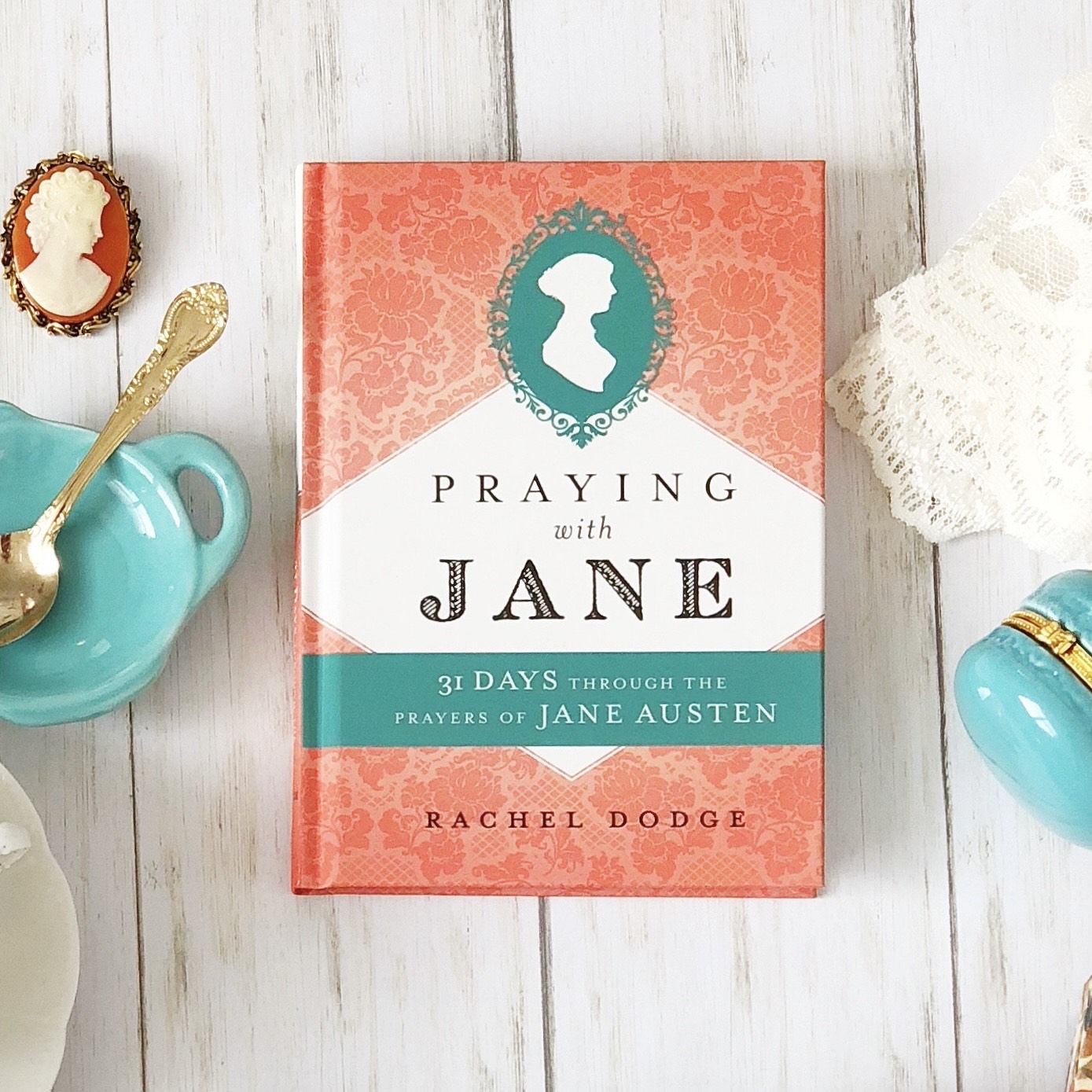
In honor of Jane Austen’s 250th anniversary year, I’m happy to announce a new audiobook project: The Praying with Jane Audiobookfeaturing narration by actress Amanda Root and author Rachel Dodge (yours truly). Published by ONE Audiobooks, this title is available on all major audiobook platforms.
Amanda Root is best known by Austen fans around the world for her starring role as Anne Elliot in the acclaimed 1995 BBC adaptation of Jane Austen’s Persuasion. Root claimed audience hearts opposite Ciarán Hinds, as Captain Wentworth, and has held them ever since.
Proceeds from this anniversary project will be donated directly to the Jane Austen House Museum to further Jane Austen’s lasting legacy.
Persuasion film adaptation with Amanda Root (1995).
Amanda Root and Rachel Dodge, Kansas City AGM.
Audiobook Description
In this 31-day devotional, you will get an in-depth look at Jane Austen’s prayers. Her faith comes to life through her exquisite prayers, touching biographical anecdotes, intimate excerpts from family letters and memoirs, illuminating scenes from her novels, and spiritual insights. Austen’s prayers read by British film and voice actress Amanda Root; text read by author Rachel Dodge.
You can listen to a sample of Jane Austen’s Prayer 1 here, read by actress Amanda Root:
Proceeds will be donated to the Jane Austen House Museum.
Amanda Root Bio
Amanda Root is an English stage and screen actress and a former voice actress for children’s programs. Root is known for her starring role in the 1995 BBC film adaptation of Jane Austen’s Persuasion, her role in the British TV comedy All About Me (2002), as Miranda, alongside Richard Lumsden in 2004, and for voicing Sophie in The BFG (1989). She trained for the stage at Webber Douglas Academy of Dramatic Art. (IMBD Mini Bio)
“As soon as he can light upon a bishop, he will be ordained. I wonder what curacy he will get!”–Anne Steele, about Edward Ferrars in Sense and Sensibility.
A few days ago, I told you about a fascinating new book on Henry Austen. The author is a retired Church of England bishop, living in Farnham, where Henry Austen served as perpetual curate of the parish church. (A perpetual curate was a curate, substituting for the rector or vicar holding the living of that church. “Perpetual” meant that he could not be fired; he could keep his job for life, just as a rector or vicar did. However, his salary was still only a portion of the tithes that supported the main, absentee clergyman.)
I asked the Right Reverend Dr. Christopher Herbert, who is now a Visiting Professor of Christian Ethics at Surrey University, about his journey in writing this book.
Jane Austen’s Favourite Brother, Henry, was written by an Anglican bishop, Christopher Herbert
Rev. Herbert: In retirement I live in Farnham, Surrey, only a few miles from Chawton. I am the Patron of the Farnham Castle Trust; Farnham Castle was once one of the major homes/palaces of the Bishops of Winchester. At a Trustees’ meeting, discussing how to attract more visitors to the Castle and Farnham, I wondered if there might be some connection with Chawton and Jane Austen. The other Trustees did not know of any, but a friend pointed out an article in the Farnham Herald mentioning a man called Henry Austen christening a baby in the parish church of St Andrew’s. [JAW: This story opens Herbert’s book.]
I followed this up, checking the Parish Registers at the Surrey History Centre, and found many signatures in Henry’s hand—and of course, he was Jane’s brother. I was fascinated. Who was he? How did he become a Perpetual Curate in Farnham? What was his story?
At that point, all that I had were his dates of birth and death, and a few insights from Wikipedia. I had no intention of writing a book about him, but the more I researched his life, the more intriguing Henry became. By the way, my book’s publication in the 250th Anniversary Year was pure chance. I had no idea that was coming up when I raised my initial question!
JAW: How long did it take you to research and write the book? What were some of the most interesting sources you found?
I took well over two years to research and write the book. That might seem a short period of time. However, in my earlier work as a diocesan bishop, with over 400 churches in my diocese, plus membership of the House of Lords and other national and international responsibilities, I was accustomed to working very rapidly to fulfil all my duties. I also read for [pursued/studied for] an MPhil [Master of Philosophy] and a PhD in Medieval Art History at the University of Leicester whilst I was a bishop, and again, had been able to read and digest and write rapidly. So, I had some of the requisite research skills, and I loved the research process—that joy of discovering new and unexpected jewels.
My most useful primary sources were obtained from the Hampshire County Record Office where I was able to trawl through a great deal of original material, plus similar material such as the Parish Registers of St Andrew’s, Farnham, at the Surrey History Centre.
For secondary sources, I read biographies of Jane Austen by people such as Claire Tomalin, and David Cecil, and accessed the huge online resources of JASNA, etc. I was helped greatly by the staff at Jane Austen’s House, Chawton, and, of course, re-read all of Jane’s novels, plus the utterly invaluable edited version of Jane’s letters by Deirdre Le Faye and invaluable and scholarly papers by people such as yourself [Brenda Cox], John Avery Jones, et al.
Of course, as is often and frustratingly the case, after my book had been published, I came across some more primary material at Winchester College. The researcher’s life, as you know, is littered with ‘if onlys’. [I encouraged him to find a place online to publish his further research.]
Amongst the most interesting material were the Parish Registers of Bentley and Farnham. Those gave me enlightening insights about the lives of Henry and his parishioners.
JAW: What did you learn about Henry that interested you the most?
Apart from my obvious personal affinity with Henry as a clergyman, it was his time as a dealer in Army Commissions, a Banker, and a Tax Collector which I loved researching. I am not an economic historian and so my research in this area was very challenging. I would need to re-train in economic history to begin to fully understand every detail. This was the most difficult part to write, trying to get my head around the economic and financial landscape within which Henry worked.
Beneath all the top-layer elements of his life, I enjoyed delving beneath the wealthy surface and speculating on Henry’s motivations and methods of work. Walking the streets of London and investigating where he lived during this phase of his life was hugely enjoyable.
Following Henry through his banking downfall and his approach to his bishop to discuss the possibility of ordination required a great deal of ‘inner work’ on my part to comprehend how and why that happened. I have interviewed hundreds of ordinands in my life. It was fascinating trying to get into the mindset of Henry’s bishop, Bishop Brownlow North, who lived in very different times to my own. Like Henry, Bishop North worked with different cultural assumptions than ours. It is such a challenge to try to stretch one’s sympathetic imagination into another era.
By contrast, and bathetically*, it was the fact of Henry having almost 1,000 bottles of wine in his cellars which sticks in my mind!
Henry Austen as a Clergyman later in life. Public domain via wikimedia.
JAW: What was something interesting you learned about Jane Austen herself in writing the book?
Oddly, it was spending time exploring Steventon and realising how isolated the Rectory and the village were in the late 18th and early 19th centuries. I had, of course, been to Jane Austen’s House in Chawton a number of times, but in my mind’s eye I had imagined Steventon as a quintessential English Village: village green, church, a few farmsteads, a pub, and even, perhaps, a game of cricket. That idea was completely shattered when I visited Steventon. The cultural life inside the Rectory must have been a great contrast to the isolated, scattered cottages of the poor inhabitants of the village.
My understanding of the life of Cassandra Austen (Leigh) [Jane’s mother] grew as I thought of her coping with her own children plus the students boarding with them—all that food, oversight of the washing of bedding and getting it dry, all that hullabaloo inside the house during term-time. When did she have a moment to herself? I began to wonder, as Jane watched her mother, how much Jane recognised the sheer logistical task her mother undertook to keep the ship happy, afloat and moving in the right direction.
This was the most fun part of the book to write, showing the inside of Steventon Rectory with all the liveliness and learning of Jane, Henry, and their siblings.
And, of course, Jane’s letters are an absolute delight. If only there were more…if only…
JAW: If you were able to meet Henry Austen personally, what do you think you would like about him? What would you want to ask him? What parts of his character might you find difficult or less pleasant?
I would enjoy his sense of humour, his generosity towards, and affection for, Jane, and his affection for Liza [his wife Eliza] and her son, Hastings. Not being a risk taker myself, I would love to hear about his own understanding of the nature of financial risk and entrepreneurship. When did he see the storm clouds brewing? Was ordination always at the back of his mind? Was it a kind of attempt to ‘give back’ to society, having enjoyed and then lost the fruits of worldly success?
I would find his undoubted attraction to the aristocratic level of society difficult, but I fully recognise that it was the 18th/early 19th century way. And when he was Perpetual Curate, I suspect I would have found his lack of awareness of the Farnham Workhouse very difficult. However, in fairness, I must add that it might simply be lack of evidence which leads me to suppose that he was not at his best with the poor and impoverished. So much information has been lost. I could be entirely wrong.
JAW: Why do you think he was Jane’s favourite Brother?
I will say the idea for the title of the book was not mine, it was my publisher’s, but I am entirely happy with it. Why was Henry Jane’s favourite? He was obviously very close to her and looked to her for help whenever he hit a difficult or tragic patch in his life. They shared the same sense of humour, the same love of the quirks of society, the same interest in humanity. And it was Henry who went out of his way to ensure that her books were published. Besides, who but a favourite brother would actually volunteer to read Proofs!?
JAW: What would you like to tell potential readers about your book?
I hope that if they love Jane Austen, my book will reveal some lesser-known aspects of Regency society which might enhance their understanding of Jane and her novels. In brief, context really matters. But, most importantly of all, if my book leads to people reading or re-reading Jane, my hopes will have been more than fulfilled.
JAW: Thanks very much, Christopher! I loved Jane Austen’s Favourite Brother, Henry, and I think our readers will also.
Jane Austen’s Favourite Brother, Henry, by Christopher Herbert, is now available from the publisher, Pen & Sword, and from Amazon in the US and in the UK in hardcover. The Kindle version will be released September 30, 2025.
Fashionable Goodness: Christianity in Jane Austen's England is now available! By JAW contributor Brenda S. Cox. See Review. Available from Amazon and Jane Austen Books.
Available through December 31st, 2025. Click on image for details, and share this poster with other teachers and students!
The Obituary of Charlotte Collins by Andrew Capes
Click on image to read the story.
Comments
“My idea of good company…is the company of clever, well-informed people, who have a great deal of conversation.” – Jane Austen, Persuasion
Gentle readers: Please feel free to post your comments and continue the conversation! Due to SPAM, we will no longer accept comments on posts after 30 days of publication. In some instances, links will be removed from comments as well.
Administrators and Contributors
Vic Sanborn, founder of this blog, is supported by a team of talented and knowledgeable writers about Jane Austen and the Regency era. They are:
Tony Grant, who now contributes his photos from London and England
Click on their names to enter their own blogs.
In addition, we thank the many experts and authors who frequently contribute their posts and opinions, and who continue to do so freely or at our request.
Click here to enter the page. Topics include Regency fashion, historic foods, Jane Austen societies, British sites, related topics. Click on image.
May we suggest?
Hello, my name is Vic and I live in Maryland, USA. I have adored Jane Austen almost all of my life. I am a proud lifetime member of the Jane Austen Society of North America. This blog is a personal blog written and edited by me and my team. We do not accept any form of cash advertising, sponsorship, or paid topic insertions. However, we do accept and keep books and CDs to review.
If you would like to share a new site, or point out an error, please email us. (Yes, we are fallible. We'll own up to our mistakes and will make the corrections with a polite smile on our faces.) Write us at
Thank you for visiting this blog. Your comments and suggestions are most welcome.
Project Gutenberg: eBook of Stage-coach and Mail in Days of Yore, Volume 2 (of 2), by Charles G. Harper
STAGE-COACH AND MAIL IN DAYS OF YORE: A PICTURESQUE HISTORY
OF THE COACHING AGE, VOL. II, By CHARLES G. HARPER. 1903. Click on this link.