Feeds:
Posts
Comments

Archive for the ‘Architecture’ Category

Update: Every once in a while, I plan to revisit old posts to update links and include additional information, as in this instance. My original post about John Nash (1752-1835) was woefully inadequate.

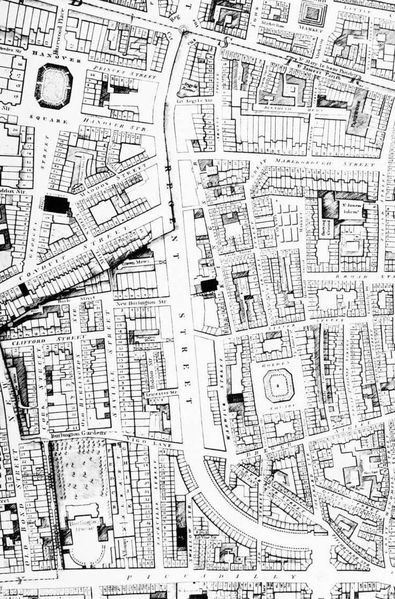
John Nash’s buildings exemplified the neoclassical style of early 19th Century Architecture. His sweeping changes transformed London, from the graceful curve of Regent Street to the majestic terraces and vistas in Regent’s Park, to the clearing of the area which was to become Trafalgar Suare. John Nash’s transformations reflected the Prince Regent’s grand plan for London. J.B. Priestly wrote in The Prince of Pleasure:

Over and over above [the Prince’s] collections and rebuilding of royal houses, there was his grand plan, designed and carried out by John Nash, of demolishing a clutter of little streets and miserable buildings to drive a broad way, as straight as possible, between Carlton House and the newly created Regent’s Park, itself one of the most charming city parks in the world. Some of Nash’s work has gone, notably Regent Street as he left it, but the broad thoroughfares and his delightful terraces are still with us. (The Prince of Pleasure, p 290)

View some of his edifices below:

  1. Regent’s Park
  2. Regent Street
  3. Buckingham Palace
  4. Brighton Palace .

More About John Nash:

View a Powerpoint Presentation here: Modern Architecture: Nash and the Regency

Read Full Post »

One of my favorite blogs on the blogosphere is ::Surroundings:: by interior designer Linda Merrill. Linda, who is a fan of the 1995 version of Pride and Prejudice, has been hard at work finding scrumptious pieces of furniture and objects d’art that would fit perfectly inside Netherfield Park, Longbourn, and Pemberley. Click on the following links to view her interior shots of these fabulous houses and some of the objects you can order today.

Read Full Post »

The Georgian House at #7 Charlotte Square in New Town, Edinburgh, Scotland is a fine example of Georgian architecture. The square was designed by Robert Adam in 1792, but he did not live to see it built. The house itself was designed by Edward Butterworth and built in 1796, strictly following Adam’s plan.

The Georgian House Teach Pack, a 42 page PDF document, is designed to teach children (and others who are interested) about the intimate details of a Georgian house and its occupants. While Jane Austen did not travel to Scotland, this house provides an insight into the every day life of a middle-class family during her era. The teach pack itself is full of interesting details and activities, especially about life below stairs.

The house has been restored and furnished in the manner of the late 18th and early 18th century by the National Trust of Scotland, and is open to the public.


Read Full Post »

In researching information for this blog, I am discovering that public libraries and museums are becoming increasingly creative in featuring their collections online. Because Jane Austen lived during the Regency and Georgian eras, my searches use both tag lines.The New York Public library’s website describes the Regency Style and features related books on its shelves. Click here to read some short, insightful descriptions, such as this quote:

This period saw a continuous search for novelties in design. Chinoiserie and the “Hindu,” or Indian, styles became fashionable, along with nationalistically inspired Gothic or Tudor decorative elements. The Greek chair with sabre legs, elegant sideboards, revolving bookcases, and couches with claw feet were popular.

The Victorian and Albert Museum website goes through great lengths to describe period styles, including Palladianism, Neoclassicism, Chinoiserie, and more. In addition to learning something about the era, the V&A also showcases some of its objects to illustrate their point.
Museum and libraries aren’t the only organizations interested in imparting good information on their sites. This fireplace company, West Country Fires Limited, located in Hampstead U.K., sells Georgian style fireplaces. The company’s website contains this description:

Georgian interiors were as important as exteriors, with a new-found emphasis on home entertaining, and were intended to illustrate a cultural wealth alongside the material wealth. The fireplace was inevitably the focus of the room, and fireplace designs from this period incorporate many Classical elements. In the evolution of fireplace design the fire surround itself was an invention of Renaissance Italy and was in the first instance designed along Classical lines, namely a pair of jambs either side of the hearth with an entablature linking the two.

The site offers a veritable wealth of information about fireplace surrounds! What a great place to get started on the subject. In writing this blog, I find it is simply amazing how many diverse ways there are to uncover information about Jane Austen’s world on the World Wide Web. These resources are in addition to the traditional scholarly articles, books, and journals. I’m sure I won’t have enough time in the day to discover them all.

Read Full Post »

Louis Simonds continues to describe London townhouses in his book, An American in Regency England:
The plan of these houses is very simple, two rooms on each story; one in the front with two or three windows looking on the street, the other on a yard behind, often very small; the stairs generally taken out of the breadth of the backroom. The ground-floor is usually elevated a few feet above the level of the street, and separated from it by an area, a sort of ditch, a few feet wide, generally from three to eight, and six or eight feet deep, inclosed by an iron railing; the windows of the kitchen are in this area. A bridge of stone or brick leads to the door of the house.


The front of these houses is about twenty or twenty-five feet wide; they certainly have rather a paltry appearance – but you cannot pass the threshold without being struck with the look of order and neatness of the interior. Instead of the abominable filth of the common entrance and common stairs of of a French house, here you step from the very street on a neat floorcloth or carpet, the wall painted or papered, a lamp in its glass bell hanging from the ceiling, and every apartment in the same style – all is neat, compact, and independent, or, as it is best expressed here, snug and comfortable – a familiar expression, rather vulgar perhaps, from the thing itself being too common.

To read more about townhouses during this era, click on the following:

English Heritage Townhouses Selection Guide: Domestic Buildings

Here’s an interesting historical detail, as described in The Hidden Dimension by Edward T. Hall:

…rooms had no fixed functions in European houses until the eighteenth century. Members of the family had no privacy as we know it today. There were no spaces that were sacred or specialized. Strangers came and went at will, while beds and tables were set up and taken down according to the moods and appetites of the occupants … In the eighteenth century, the house altered its form. In French, chambre was distinguished from salle. In English, the function of a room was indicated by its name – bedroom, living room, dining room. Rooms were arranged to open into a corridor or hall, like houses into a street. No longer did the occupants pass through one room into another. Relieved of the Grand Central Station atmosphere and protected by new spaces, the family pattern began to stabilize and was was expressed further in the form of the house. p.104

See the illustration of a Georgian terraced house below.

Read Full Post »

« Newer Posts - Older Posts »

