Feeds:
Posts
Comments

Archive for the ‘Architecture’ Category

London Houses in Jane Austen’s Day

Louis Simond was a French emigre who lived in America. He spent over 6 months in London in 1810, describing the customs and manners of the British in a book that is now entitled An American in Regency England.

During his tour of England, Louis met and talked to people from all walks of life. He observed every day and momentous events of that era, and visited the countryside, describing with a keen mind what he saw and ate and who he met.

Here is Louis’ description of a typical London Townhouse:

Each family occupy a whole house, unless very poor. There are advantages and disadvantages attending this custom. Among the first, the being more independent of the noise, the dirt, the contagious disorders, or the dangers of your neighbour’s fires, and having a more complete home. On the other hand, an apartment all on one floor, even of a few rooms only, looks much better, and is more convenient. These narrow houses, three or four stories high – one for eating, one for sleeping, a third for company, a fourth under ground for the kitchen, a fifth perhaps at top for the servants – and the agility, the ease, the quickness with which the individuals of the family run up and down, and perch on the different stories, give the idea of a cage with its sticks and birds.

Typical touches were bow fronts, Palladian windows, symmetry, graceful lines and neoclassical touches — the hallmarks of the Regency town house. This example of grand townhouses is of the Circus in Bath.
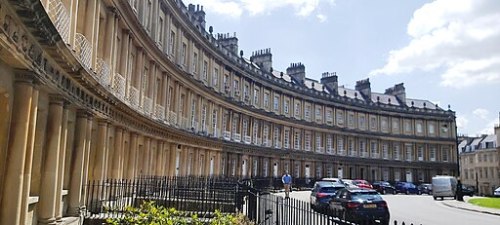
The Circus in Bath. Excellent example of Regency era town houses. Image: Wikipedia. Image taken by Anthony Parkes.

Read Full Post »


In Xanadu did Kubla Khan
A stately pleasure-dome decree :
Where Alph, the sacred river, ran
Through caverns measureless to manDown to a sunless sea.

So twice five miles of fertile ground
With walls and towers were girdled round :
And there were gardens bright with sinuous rills,
Where blossomed many an incense-bearing tree ;
And here were forests ancient as the hills,
Enfolding sunny spots of greenery.

–Samuel Taylor Coleridge


When I visited

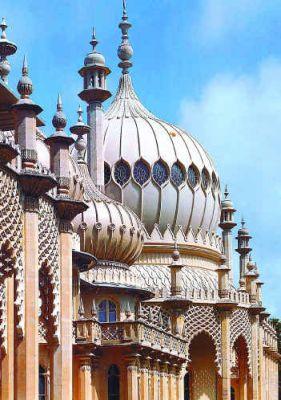
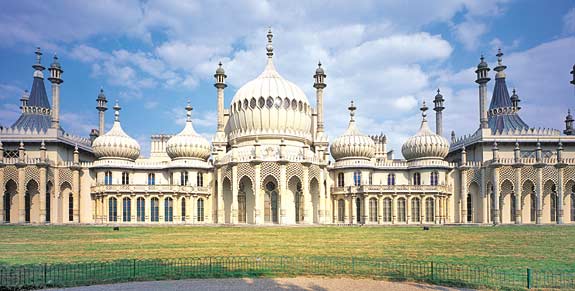
Brighton Pavilion in Brighton, a charming seaside town in Sussex’s South Downs, I found it more beautiful and fantastic than the drawings, paintings, and photos I’d seen. The building, rebuilt between 1815-1822 by John Nash, the Prince Regent’s architect, is starkly white and stands in the center of town. Approaching it on foot, one is astounded by the intricacy of the architectural details, from the exterior domes, spires, and columns, to the interior with its gothic touches, fantasy rooms, and exquisite color combinations and patterns.

The Prince Regent was known for his excesses and expensive tastes, and his architect John Nash succeeded in fulfilling the Prince’s most outrageous wishes. The Gothic Revival was in full swing during the Regency Era, including the love for all things mid-Eastern, Chinoise, and Arabian. This Arabian Nights fantasy in stone has been well documented in picture books and on the web. I will merely point out a few spectacular rooms and some of the details that struck me as being particularly beautiful or unusual.

The kitchen, a cavernous room created to comfortably accommodate the Prince’s idea of an intimate dinner, is depicted on this web page. Click here and scroll down to the kitchen. You can also see a panoramic view of the kitchen on the page if you have a real player. It was not unusual for the Prince to throw a banquet with 36 courses, hence the kitchen was designed to accommodate the scores of cooks and enormous amounts of food stuffs and ingredients required to prepare these foods.

The long gallery is indeed long. The colors are riotous, and one feels as if one is traipsing through a fantasy land.

On the left is a picture of John Nash’s long gallery. On the right is a photograph of the long gallery today.

The banquet room also lingers in my memory, with its long, long banqueting table, the exquisite details in the ceiling, and the fantastic carved dragons peeping out from chandeliers disquised as palms.


Salon & Music Room

Images of Brighton in the 19th Century:
Evening Gathering at Brighton Pavilion in the Yellow Room


Brighton, a seaside resort

Read Full Post »

View the updated version of this post here.

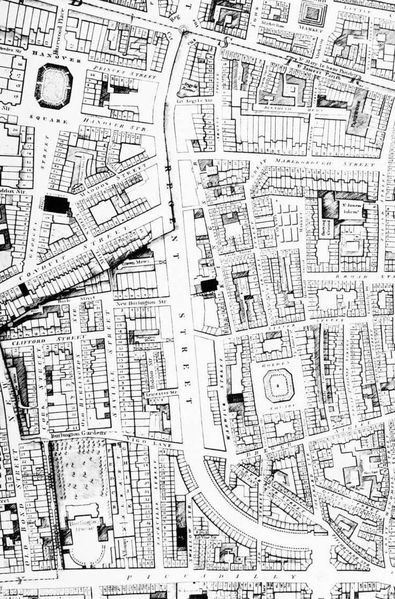
John Nash’s buildings exemplified the neoclassical style of early 19th Century Architecture. His sweeping changes transformed London, from the graceful curve of Regent Street to the majestic terraces and vistas in Regent’s Park.

View some of his edifices below:

1. Regent’s Park
2. Regent Street
3. Buckingham Palace

We will devote an entire section to Brighton Palace later.

Read Full Post »

« Newer Posts