Feeds:
Posts
Comments

Archive for the ‘Book review’ Category

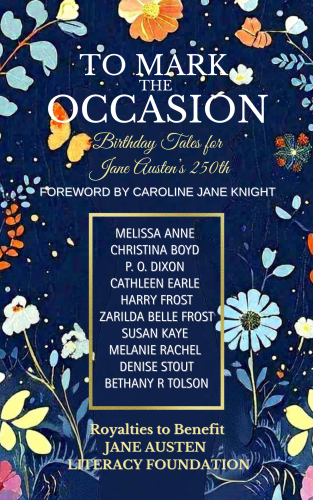
Inquiring Readers: One of our most loyal readers is publicist and author Denise Stout Holcomb. She leaves her comments on almost every post on this blog as far back as I can recall. Denise recently sent us this alert for a new book coming out at the end of this month: Birthday Tales for Jane Austen’s 250th. What a wonderful gift for this important month celebrating Austen’s life. – Vic

Celebrate 250 years of Jane Austen with a thoughtful collection of birthday tales inspired by her unforgettable characters!

In honour of Austen’s milestone jubilee, ten Austenesque authors reimagine the lives—and fêtes—of her most beloved (and occasionally infamous) creations. Join the festivities for Pride and Prejudice favourites such as Mr Darcy, Elizabeth Bennet, Mr Bingley, Charlotte Lucas, Kitty Bennet, and Georgiana Darcy, celebrate Captain Wentworth’s long-awaited occasion after Persuasion, attend the debut of Mansfield Park’s Mary Crawford, while two funerals and a birthday return us to Northanger Abbey.

Each story sparkles with wit, warmth, and a few surprises in the spirit of dear Jane. Brimming with humour, romance, and a keen understanding of the human heart, To Mark the Occasion: Birthday Tales for Jane Austen’s 250th is an enthusiastic tribute to Austen’s enduring genius—and a joyful reminder that every year (and every story) is worth celebrating.

All proceeds from this anthology will be donated to Jane Austen Literacy Foundation.

Foreword by Caroline Jane Knight. Below sit links to Caroline’s connection to her famous aunt Jane.

“Caroline is the fifth great niece of Jane Austen, and is the last of Jane’s nieces to grow up in Chawton House, in the South of England, on the family’s ancestral estates where Jane herself lived, wrote and published her most famous works…

Caroline has unique insight into the life, works and family of a literary icon. The worldwide celebrations of the 200-year anniversary of Pride & Prejudice in 2013 inspired Caroline to establish the Jane Austen Literacy Foundation to harness the passion for Jane Austen and support the practice of literacy across the world, in honour of Jane. ..

Click here to read Caroline’s Story, a Q&A interview with Ms Knight on the Jane Austen Literacy Foundation website. 

Click here to join Caroline’s FB page

Authors: 

Melissa Anne * Christina Boyd * P. O. Dixon * Cathleen Earle * Harry Frost * Susan Kaye * Melanie Rachel * Denise Stout * Bethany R Tolson 

Editor: 

Zarilda Belle Frost

Read Full Post »

Reviewed by Brenda S. Cox

I very much enjoyed Sarah Emsley’s new novel, The Austens. It is written as a series of first-person diary entries and letters, mostly invented, but based on solid research. It shows the relationship between Jane Austen and her younger brother Charles’s wife, Fanny Palmer Austen.

Sarah Emsley gives us deep insights into the lives and struggles of women of Austen’s time. We see contrasts and commonalities between the lives of a young naval wife and mother traveling the world, and an unmarried author living with her family in rural Hampshire.

The Austens, a new novel by Sarah Emsley, tells the story of Jane Austen and her sister-in-law Fanny Palmer Austen in a series of letters and journal entries.

We asked Sarah Emsley, who lives in Canada and has explored the Austen connection to Nova Scotia, to tell us more.

Jane Austen’s World: Sarah, what led you to write this book? Why did you choose Fanny Palmer Austen as the second main character?

Sarah Emsley: The striking contrasts between the lives of Jane Austen and her sister-in-law Fanny Palmer Austen sparked my imagination, leading to The Austens. I wanted to tell a story about the Austen family set partly in North America and to focus on sisterhood and friendship.

While Jane is writing fiction in England, not knowing if any of her novels will ever be published, Fanny is sailing from Bermuda to Nova Scotia and back again, and eventually to England. She is dealing with the challenges of pregnancy and childbirth and caring for her young daughters.

No letters between the two of them survive, and that gap seemed an area worth exploring in fiction. I imagined Jane and Fanny developing a friendship through letters sent across the North Atlantic and then meeting in person the summer before Sense and Sensibility was published.

Also, as I researched The Austens, my own first novel, imagining my way into the story, I found my heroine Fanny asking Jane urgent questions about her books: What was left out? What might happen to her heroines after the happy endings?

From the beginning of my work on The Austens, the voices of both Jane and Fanny were central. I don’t think it could have been a novel about just one heroine or the other.

JAW: What do you admire most about Fanny Austen?

I like and admire Fanny Austen’s courage in doing the best she could to adapt to the challenges and uncertainties of her husband’s naval career. Like Mrs. Croft in Persuasion, she and other naval wives learned that “We none of us expect to be in smooth water all our days.”

JAW: How long did it take you to research and write the book?

Eighteen years! When I began, I had no idea it would take that long. It wasn’t my only project during that period, but it was the main one. I worked on it steadily over all those years. I learned through experience that books need to take the time they take. The writing and publishing process are different every time, for every book and every writer. I sort of knew that before, from writing and publishing nonfiction, but this novel taught me far more about patience and persistence. I cared so much about the Austens, Jane and Fanny and their extended family, that I couldn’t give up on them.

Sarah Emsley spent 18 years working on The Austens, which is set in England, Bermuda, and her native Halifax, Canada.

JAW: There are many books on Jane Austen and her family. What makes yours unique?

My novel has a particularly North American flavour because it’s set on this side of the Atlantic as well as in England, during Jane Austen’s lifetime. I was inspired to begin the book when I learned about the Austen family’s connections with my hometown of Halifax, Nova Scotia at the 2005 Jane Austen Society (UK) conference. The organizer was Patrick Stokes, a direct descendant of Charles Austen and Chairman of the Society. He had asked the archivist at St. Paul’s Church in Halifax to search for the baptismal record for Charles and Fanny’s first daughter, Cassy.

I was a parishioner at St. Paul’s and got married there. I had written a short, illustrated history of the church in 1999, without knowing about the Austen connection. Details of Cassy’s baptism were first published by Sheila Johnson Kindred in Jane Austen and the North Atlantic, a collection of conference papers I edited for the Jane Austen Society in 2006.

When I began my novel in 2007, I did extensive research on the Austen family and their historical period. I had already visited Austen-related sites in England. I began to visit Austen-related places in my own hometown, including Government House in downtown Halifax, featured on the cover of The Austens. Those visits were among the many joys of working on this book.

JAW: What was the hardest part of this book for you to write?

The Harris Bigg-Wither section, near the beginning of The Austens, was the hardest to write. In early drafts, I used a flashback to 1810 to show Jane accepting and rejecting his marriage proposal. I wasn’t satisfied with that approach, and I kept going back to imagine what it might have felt like for her to live through those painful hours. Early in 2019, after almost twelve years of work, I finally wrote a draft of this section I liked. Then I revised it many more times before the book was published.

One of the hardest parts of writing this book was figuring out where to begin the story! Some of the earliest drafts began with Fanny’s perspective in 1809. As I worked, I saw where I needed to expand and deepen the story, going further back in time.

JAW: What was the most fun part of the book to write? 

I loved bringing to life the ball at Government House. Fanny wrote to her sister Esther that this ball was “splendid” (12 June 1810). She also referred to Captain Pechell, one of Charles’s brother officers, as her “very great favorite” (14 August 1810). (You can read these letters in Sheila Johnson Kindred’s biography, Jane Austen’s Transatlantic Sister: The Life and Letters of Fanny Palmer Austen.) It was such fun to research and write this scene.

I pictured Fanny arriving at Government House with her husband on a chilly evening in June, wishing she could linger with him in the garden. But she knows she must follow him into the ballroom and socialize with Admiral and Lady Warren and other guests. Each time I visited Government House, I could see Fanny there, dancing with Captain Pechell, playing cards with Lady Warren, and feeling naïve and excluded from the inner circles of Halifax society when she hears about a scandalous poem.

Emsley chose to write in the voice of Fanny Palmer Austen, wife of Charles Austen. Painting by Robert Field, public domain, via Wikimedia Commons

JAW: Why did you choose to write in the first person as Jane Austen? What source material did you use to echo her voice? How difficult was it to get into the mind of the author?

When I began to work on this book, I wrote in third person—first person didn’t even occur to me. I suppose it was too intimidating to think of writing in the voice of Jane Austen, one of the greatest writers of all time. At the same time, I was trying to write a novel that would look and sound sort of like an Austen novel. Paradoxically, then, I was trying to echo her voice, style, and structure too closely.

Through research and immersion in Jane Austen’s world for many years, I got a good sense of what she might have been thinking and feeling. However, I was at first too scared to say any of it from her point of view. But after about twelve years (!), once I had worked out the shape of the plot, I decided to try writing in the first person. I wanted to see what Jane would sound like, and that transformed the novel. Reading, and rereading, her letters and teenage writings helped me find the voice I wanted.

Jane herself gave me courage, especially through her strong heroines, Fanny Price and Elizabeth Bennet. I needed to stay true to my vision of this story, told from inside the minds and bodies of my two heroines. I found my own voice, and allowed myself the freedom to include letters, newspaper clippings and notices, and other pieces of writing. Once I invented letters from Jane to Fanny and from Fanny to Jane, it felt natural to write longer chapters also in the first person.

Figuring out how to write in both Jane’s voice and Fanny’s voice was part of the long, eighteen-year process of helping the novel find its best possible shape.

Thanks very much, Brenda and Vic, for the opportunity to talk about The Austens!

Brenda: Thank you, Sarah, for your insightful answers.

Gentle readers, I think you will love The Austens, as I did. No matter how well you know Jane Austen, it will give you new perspectives on her novels, her life, and the life of her sister-in-law. You may also enjoy Sarah Emsley’s blog.

You can find the book at:

Jane Austen Books,

Woozles (signed copies, personalized on request, for shipping in the United States and Canada)

Bookmark (signed copies, personalized on request, for shipping within Canada)

Amazon in the UK (available in March, 2026)

ebook from:

Amazon in the US (Kindle only right now, paperback later)

Barnes and Noble

In brief:

The Austens: Jane Austen chooses art and the freedom to write fiction instead of marrying for money and thereby selling her body and soul, while her sister-in-law Fanny chooses to marry for love. Their disagreements about work and family threaten their friendship in a world that is hostile to art and love, and even the idea of a woman making a choice.

Sarah Emsley is the author of Jane Austen’s Philosophy of the Virtues and the editor of Jane Austen and the North Atlantic. She lives in Halifax, Nova Scotia, with her family, and she writes about Austen and other authors she admires at www.sarahemsley.com. The Austens is her first novel.

Happy reading!

Read Full Post »

This week I’d like to introduce you to a new book by Helena Kelly called The Worlds of Jane Austen: The Influences and Inspiration Behind the Novels. This book caught my eye, initially, because of its beautiful cover – yes, I admit it! I do judge a book (first) by its cover. But more than that, I was intrigued by the idea that Jane Austen’s novels reveal deeper influences that we might not realize without careful digging.

Austen lived through many historically significant moments, and though Austen doesn’t discuss war or politics or social issues in detail in her novles, Kelly asserts that Austen’s “sharp, observant fiction reveals just how engaged she was with the issues of her time.”

Kelly’s chapter titles include: “The Rectory,” “The Revolution,” “Army and Navy,” “Give a Girl an Education,” “City,” “Countryside,” “Seaside,” and “Empire and Slavery.” Three additional chapters are titled “Legacies,” “Austenmania,” and “Present Day.” Kelly explores the various facets of each topic in detail, providing key examples from Austen’s novels to show the way each influence plays a part in her writing, which is always my favorite part.

ORDER YOUR COPY HERE

About the Book

The Worlds of Jane Austen invites readers to see one of Britain’s most beloved authors in a completely new light. Far from the quiet world of country houses and tea parties, Austen lived through revolution, war and major social change, and her sharp, observant fiction reveals just how engaged she was with the issues of her time. 

This lively and accessible guide explores the people, politics and places that shaped Austen’s life and work. It features expert insight from bestselling author Helena Kelly alongside over 150 photographs, artworks and illustrations that bring her world vividly to life. 

Whether you are discovering Austen for the first time or returning to her novels with fresh eyes, The Worlds of Jane Austen is the perfect companion for curious readers, literature lovers and admirers of classic storytelling.

About the Author

Helena Kelly holds a doctorate in English Literature from Oxford, where she has also taught from time to time and where she is about to return for a visiting scholarship at the Oxford Centre for Life Writing at Wolfson College.

She is the author of The Life and Lies of Charles Dickens (November 2023), already praised by Kirkus Reviews as ‘a literary bio that deftly untangles truth from untruth’, and of Jane Austen, the Secret Radical (2016), hailed as ‘a sublime piece of literary detective work’ (The Observer) and ‘an interpretive coup that is dazzling and dizzying’ (The New Yorker).

Additional Influences

I enjoyed this book tremendously and learned a great deal. I was familiar with some of it, but there were many new areas of information for me to delve into. I do have a few additional area of inspiration and influence I would be curious to investigate further as well.

In Kelly’s words, “Book could teach you almost anything.” I would have appreciated an additional chapter or section devoted to the books Austen read in the chapter about education for women and Austen’s personal education. After all, we are what we read. Our opinions and convictions are a compilation of our influences, and many of those ideas for Austen came through extensive reading. Austen read widely and deeply, even memorizing great portions of text, secular and religious alike, and her reading interests surely influenced her writing and the ideology behind her novels.

In a similar vein, I would have also enjoyed learning about the influence of religion on her writing. Austen had a brilliant mind and read Fordyce’s Sermons, The Book of Common Prayer, William Cowper, and other religious writers and materials during her lifetime. She was not silent about the role of the clergy in her novels, nor was she ignorant of the issues facing the Church of England during her lifetime. As a clergyman’s daughter, her daily life was intertwined with the Church, and it would be fascinating to read more scholarly information about that particular influence in her life.

However, exploring Austen’s influences could become a lifelong project, so I applaud Kelly’s careful research on the topics she chose and her excellent focus on the texts of Austen’s novels. Seeing the “proof” on the page is always the best part! Seeing Austen’s influences play out on the pages of her novels was splendid. Austen tells us so much, even when she’s not telling us much.

New Releases for Austen’s 250th

This is yet another incredible book in the great line up of books releasing this year for the 250th celebration of Austen’s life and legacy. The bounty of books knows no bounds this year! If you’d like to read a comprehensive live of new releases for this year, I invite you to visit this wonderful blog resource that I recently found in my searches: Regency Explorer: “Jane Austen 250 – a list of new books scheduled for 2025” by Anna M. Thane.

If you’re like me, you’ll find yourself overjoyed and overwhelmed by the vast list of books Thane put together. It must have taken an immense amount of time and dedication. I plan to reference it as I continue to explore the many new Austen books that have released this year (and some that are coming next year).


RACHEL DODGE teaches writing classes, speaks at libraries, teas, and conferences, and writes for Jane Austen’s World blog. She is the bestselling, award-winning author of The Anne of Green Gables DevotionalThe Little Women DevotionalThe Secret Garden Devotional, and Praying with Jane: 31 Days Through the Prayers of Jane Austen. A true kindred spirit at heart, Rachel loves books, bonnets, and ballgowns. Visit her online at www.RachelDodge.com.

Read Full Post »

Interviewed by Brenda S. Cox

“As soon as he can light upon a bishop, he will be ordained. I wonder what curacy he will get!”–Anne Steele, about Edward Ferrars in Sense and Sensibility.

A few days ago, I told you about a fascinating new book on Henry Austen. The author is a retired Church of England bishop, living in Farnham, where Henry Austen served as perpetual curate of the parish church. (A perpetual curate was a curate, substituting for the rector or vicar holding the living of that church. “Perpetual” meant that he could not be fired; he could keep his job for life, just as a rector or vicar did. However, his salary was still only a portion of the tithes that supported the main, absentee clergyman.)

I asked the Right Reverend Dr. Christopher Herbert, who is now a Visiting Professor of Christian Ethics at Surrey University, about his journey in writing this book.

Jane Austen’s Favourite Brother, Henry, was written by an Anglican bishop, Christopher Herbert

Jane Austen’s World: Rev. Herbert, what led you to write Jane Austen’s Favourite Brother, Henry?  How did you get interested in Henry Austen?

Rev. Herbert: In retirement I live in Farnham, Surrey, only a few miles from Chawton. I am the Patron of the Farnham Castle Trust; Farnham Castle was once one of the major homes/palaces of the Bishops of Winchester. At a Trustees’ meeting, discussing how to attract more visitors to the Castle and Farnham, I wondered if there might be some connection with Chawton and Jane Austen. The other Trustees did not know of any, but a friend pointed out an article in the Farnham Herald mentioning a man called Henry Austen christening a baby in the parish church of St Andrew’s. [JAW: This story opens Herbert’s book.]

I followed this up, checking the Parish Registers at the Surrey History Centre, and found many signatures in Henry’s hand—and of course, he was Jane’s brother. I was fascinated. Who was he? How did he become a Perpetual Curate in Farnham? What was his story?

At that point, all that I had were his dates of birth and death, and a few insights from Wikipedia. I had no intention of writing a book about him, but the more I researched his life, the more intriguing Henry became. By the way, my book’s publication in the 250th Anniversary Year was pure chance. I had no idea that was coming up when I raised my initial question!

JAW: How long did it take you to research and write the book?  What were some of the most interesting sources you found?

I took well over two years to research and write the book. That might seem a short period of time. However, in my earlier work as a diocesan bishop, with over 400 churches in my diocese, plus membership of the House of Lords and other national and international responsibilities, I was accustomed to working very rapidly to fulfil all my duties. I also read for [pursued/studied for] an MPhil [Master of Philosophy] and a PhD in Medieval Art History at the University of Leicester whilst I was a bishop, and again, had been able to read and digest and write rapidly. So, I had some of the requisite research skills, and I loved the research process—that joy of discovering new and unexpected jewels.

My most useful primary sources were obtained from the Hampshire County Record Office where I was able to trawl through a great deal of original material, plus similar material such as the Parish Registers of St Andrew’s, Farnham, at the Surrey History Centre.

For secondary sources, I read biographies of Jane Austen by people such as Claire Tomalin, and David Cecil, and accessed the huge online resources of JASNA, etc. I was helped greatly by the staff at Jane Austen’s House, Chawton, and, of course, re-read all of Jane’s novels, plus the utterly invaluable edited version of Jane’s letters by Deirdre Le Faye and invaluable and scholarly papers by people such as yourself [Brenda Cox], John Avery Jones, et al.

Of course, as is often and frustratingly the case, after my book had been published, I came across some more primary material at Winchester College. The researcher’s life, as you know, is littered with ‘if onlys’. [I encouraged him to find a place online to publish his further research.]

Amongst the most interesting material were the Parish Registers of Bentley and Farnham. Those gave me enlightening insights about the lives of Henry and his parishioners.

JAW: What did you learn about Henry that interested you the most?

Apart from my obvious personal affinity with Henry as a clergyman, it was his time as a dealer in Army Commissions, a Banker, and a Tax Collector which I loved researching. I am not an economic historian and so my research in this area was very challenging. I would need to re-train in economic history to begin to fully understand every detail. This was the most difficult part to write, trying to get my head around the economic and financial landscape within which Henry worked.

Beneath all the top-layer elements of his life, I enjoyed delving beneath the wealthy surface and speculating on Henry’s motivations and methods of work. Walking the streets of London and investigating where he lived during this phase of his life was hugely enjoyable.

Following Henry through his banking downfall and his approach to his bishop to discuss the possibility of ordination required a great deal of ‘inner work’ on my part  to comprehend how and why that happened. I have interviewed hundreds of ordinands in my life. It was fascinating trying to get into the mindset of Henry’s bishop, Bishop Brownlow North, who lived in very different times to my own. Like Henry, Bishop North worked with different cultural assumptions than ours. It is such a challenge to try to stretch one’s sympathetic imagination into another era.

By contrast, and bathetically*, it was the fact of Henry having almost 1,000 bottles of wine in his cellars which sticks in my mind!

Henry Austen as a Clergyman later in life. Public domain via wikimedia.

JAW: What was something interesting you learned about Jane Austen herself in writing the book?

Oddly, it was spending time exploring Steventon and realising how isolated the Rectory and the village were in the late 18th and early 19th centuries. I had, of course, been to Jane Austen’s House in Chawton a number of times, but in my mind’s eye I had imagined Steventon as a quintessential English Village: village green, church, a few farmsteads, a pub, and even, perhaps, a game of cricket. That idea was completely shattered when I visited Steventon. The cultural life inside the Rectory must have been a great contrast to the isolated, scattered cottages of the poor inhabitants of the village. 

My understanding of the life of Cassandra Austen (Leigh) [Jane’s mother] grew as I thought of her coping with her own children plus the students boarding with them—all that food, oversight of the washing of bedding and getting it dry, all that hullabaloo inside the house during term-time. When did she have a moment to herself?  I began to wonder, as Jane watched her mother, how much Jane recognised the sheer logistical task her mother undertook to keep the ship happy, afloat and moving in the right direction.

This was the most fun part of the book to write, showing the inside of Steventon Rectory with all the liveliness and learning of Jane, Henry, and their siblings.

And, of course, Jane’s letters are an absolute delight. If only there were more…if only…

JAW: If you were able to meet Henry Austen personally, what do you think you would like about him? What would you want to ask him? What parts of his character might you find difficult or less pleasant?

I would enjoy his sense of humour, his generosity towards, and affection for, Jane, and his affection for Liza [his wife Eliza] and her son, Hastings. Not being a risk taker myself, I would love to hear about his own understanding of the nature of financial risk and entrepreneurship. When did he see the storm clouds brewing? Was ordination always at the back of his mind? Was it a kind of attempt to ‘give back’ to society, having enjoyed and then lost the fruits of worldly success?

I would find his undoubted attraction to the aristocratic level of society difficult, but I fully recognise that it was the 18th/early 19th century way. And when he was Perpetual Curate, I suspect I would have found his lack of awareness of the Farnham Workhouse very difficult. However, in fairness, I must add that it might simply be lack of evidence which leads me to suppose that he was not at his best with the poor and impoverished. So much information has been lost. I could be entirely wrong. 

JAW: Why do you think he was Jane’s favourite Brother?

I will say the idea for the title of the book was not mine, it was my publisher’s, but I am entirely happy with it. Why was Henry Jane’s favourite? He was obviously very close to her and looked to her for help whenever he hit a difficult or tragic patch in his life. They shared the same sense of humour, the same love of the quirks of society, the same interest in humanity. And it was Henry who went out of his way to ensure that her books were published. Besides, who but a favourite brother would actually volunteer to read Proofs!?

JAW: What would you like to tell potential readers about your book?

I hope that if they love Jane Austen, my book will reveal some lesser-known aspects of Regency society which might enhance their understanding of Jane and her novels. In brief, context really matters. But, most importantly of all, if my book leads to people reading or re-reading Jane, my hopes will have been more than fulfilled.

JAW: Thanks very much, Christopher! I loved Jane Austen’s Favourite Brother, Henry, and I think our readers will also.

Jane Austen’s Favourite Brother, Henry, by Christopher Herbert, is now available from the publisher, Pen & Sword, and from Amazon in the US and in the UK in hardcover. The Kindle version will be released September 30, 2025.

You can find out more about Dr. Herbert at https://en.wikipedia.org/wiki/Christopher_Herbert and https://www.chpublishing.co.uk/authors/christopher-herbert Since those lists of accomplishments, he has also been involved in the Royal Hospital for Neurodisability in London and the Lyme Resource Centre, a charity based in Scotland raising awareness of the growing incidence of Lyme disease and co-infections in Scotland and elsewhere in the UK.

*I looked up bathetic. It means “producing an unintentional effect of anticlimax.” Nice word!

Brenda S. Cox is the author of Fashionable Goodness: Christianity in Jane Austen’s England. She also blogs at Faith, Science, Joy, and Jane Austen.
Read Full Post »

Book Review by Brenda S. Cox

“I had a letter from him [Henry], in which he desired to hear from me very soon—His to me was most affectionate and kind, as well as entertaining;—but there is no merit in that, he cannot help being amusing.”—Jane to Cassandra, April 8, 1805

“Henry at White’s! Oh, what a Henry!”—Jane to Cassandra, June 23, 1814 (when Henry attended an exclusive high class gathering celebrating Napoleon’s defeat)

Jane Austen’s Favourite Brother, Henry, by Christopher Herbert, gives an in-depth view of Henry Austen’s life, beliefs, and connections with Jane and her novels.

What a Henry

Henry Austen was apparently a lot of fun, and Jane loved her brother dearly. He was also quite versatile. At various times he was:

  • an Oxford student who produced a periodical called The Loiterer with his brother James,
  • paymaster and adjutant in the Oxford Militia,
  • army agent,
  • banker (of a bank that eventually failed),
  • receiver general of taxes,
  • Jane Austen’s own literary agent,
  • clergyman of several parishes,
  • chaplain of the British Embassy in Berlin, and
  • husband of Eliza de Feuillide and later of Eleanor Jackson (niece of Rev. Papillon of Chawton).

Christopher Herbert, in his fascinating new book, Jane Austen’s Favourite Brother, Henry, explores Henry Austen’s life through all these changes.

Culture and Current Events

I loved that Herbert gives lots of cultural details in going through Henry’s life. For example, in the chapter on Henry’s birth, we learn about childbirth practices at the time. During pregnancy, his mother Cassandra Austen, rather than buying special maternity clothes as we do today, would have widened her stomacher, used aprons to cover gaps in clothing, and loosened side lacings. A “churching” service would celebrate her survival of the very dangerous process of giving birth. Philadelphia Hancock, her sister-in-law, may have been there to help the mother before, during, and after the delivery.

The author speculates on what the children growing up in the the rectory may have read, who taught them to read and write, and where they obtained their books.

Current events and ideas are woven in alongside stories of Henry and Jane growing up. The balloon ascent of 1784 is described by quoting a magazine article of the time. We hear about battles, steam power, improvements and enclosures, and the Wesleyan revival which began at Oxford. We see how the ideas of contemporary writers such as John Locke, focusing on reason in understanding God and society, may have affected Jane Austen’s ideas of church and clergy in Mansfield Park, as well as her prayers.

Henry Austen as a Clergyman later in his life. Public domain via wikimedia.

Work and Money

An in-depth discussion explains Henry’s various jobs and what they involved. We see how his bank throve, launching Henry into upper ranks of society, and then failed. The author obviously did quite extensive research to dig this all up, and it was interesting to learn, for example, what exactly an army agent was. (For me, there was a little too much detail, since I’m not interested in finance; however, other readers may find this the most illuminating part!) It seems Henry had some financial dealings which were at least ill-advised, and possibly questionable.

Henry as Clergyman

After his bank failed, Henry reverted to earlier plans and was ordained as a clergyman. In Henry’s one extant sermon, he attacks pride and prejudices. Herbert says Henry is encouraging his congregation toward giving Catholics political rights, a major issue of that time. (See also “Sermons by Jane Austen’s Family.”) Herbert explores what Henry may have believed, also drawing from statements in Mansfield Park.

He also points out that Henry’s pastoral workload was much greater than that of Mr. Elton or other Austen clergymen. In one year, Henry performed 149 christenings, 34 weddings, and 105 funerals! All for very little income. He also had to deal with a new workhouse and other issues related to the poor of his parishes. Henry’s journey as a clergyman, his income and how he spent it, are further explored, as well as his anti-slavery work.

Jane Austen’s Novels

The author skillfully connects concepts to passages in Austen’s novels.  He also explains Henry’s role in getting her novels published. He concludes that there are still some questions about Henry’s life. But we do know that:

“without Henry’s determined and passionate commitment in getting Jane’s novels published, our lives, and the life of the world, would be so much the poorer.”

Amen!

On Thursday I will post an interview with the author, who is uniquely qualified to write this book. He is a former bishop of the Church of England, now living in Farnham where Henry Austen served as perpetual curate in the parish church. Farnham Palace, where the Right Revd. Dr. Herbert is a patron, was a home of the Bishops of Winchester.

I recommend this book to anyone who wants to learn more about Austen’s family and her world.

Jane Austen’s Favourite Brother, Henry, by Christopher Herbert, is now available from the publisher, Pen & Sword, and from Amazon in the US and in the UK in hardcover. The Kindle version will be released September 30, 2025.

Brenda S. Cox is the author of Fashionable Goodness: Christianity in Jane Austen’s England. She also blogs at Faith, Science, Joy, and Jane Austen.
Read Full Post »

Older Posts »