This Jane Austen blog brings Jane Austen, her novels, and the Regency Period alive through food, dress, social customs, and other 19th C. historical details related to this topic.
As promised, I’m back with a reminder and announcement about Regency Marketplace’s brand-new seasonal Jane Austen Box! I’m delighted to share that the theme of this new box is “Christmas In Highbury”! If you missed my review of the lovely Autumn in Chawton Box I received, you can read about it and see photos HERE.
Christmas in Highbury
This Christmas, be transported to the little hamlet of Highbury in County Surrey. Here we find Emma and her friends and family preparing for a delightful country holiday, and you’re invited! Regency Christmastide for the aristocracy was often celebrated at the families’ country estates, and in Emma, we see her sister Isabella and Knightley’s brother John bring all their children to Hartfield for the occasion, enlivening the quiet household with their fun and noise. Mr. Woodhouse would have them stay forever!
The Perfect Gift
The “Christmas In Highbury” Jane Austen Box will be filled to the brim with a cozy and elegant medley of Emma and Regency-inspired Christmas gifts! A perfect gift box to send or receive this holiday season, it also makes a wonderful hostess gift. December 16th is Jane Austen’s birthday, too, so celebrate in style!
At Christmas every body invites their friends about them, and people think little of even the worst weather.
Jane Austen’s Emma
Place Your Order
The “Christmas In Highbury” Jane Austen Box will be available to reserve from Saturday, October 15th-Tuesday, November 15th, 2022. All boxes will ship out the first week of December! These boxes sell out quickly, so do not delay. Place an order for yourself or as a gift for a friend or relative today.
If you want to take it up a notch, you can subscribe to the Quarterly Jane Austen Box and receive a box every 3 months, or purchase as a One-Time Gift option (non-recurring). Free Shipping in the USA! International Flat Rate Shipping available.
Coupon Code
Many thanks to Regency Marketplace for providing me with a discount code that I can share with all my friends and readers this Christmas ordering season. If you would like to receive a discount, you can use my special COUPON CODE for 10% off the Winter Box! *While Supplies Last.*
I just received my first Jane Austen Box from Regency Marketplace, and the minute I opened it, I knew I had to share it with all of my friends here at Jane Austen’s World. This is a beautiful Jane Austen-themed experience not to be missed–and it comes right to your own front door!
Special thanks to @regency_marketplace for sending me the “Autumn At Chawton Cottage” box this month so I could fully experience it for myself! This delightful box is filled to the brim with cozy Autumn and Jane Austen-themed items! I can’t wait to put on my cute new socks and have a cup of tea!
Box Full of Surprises
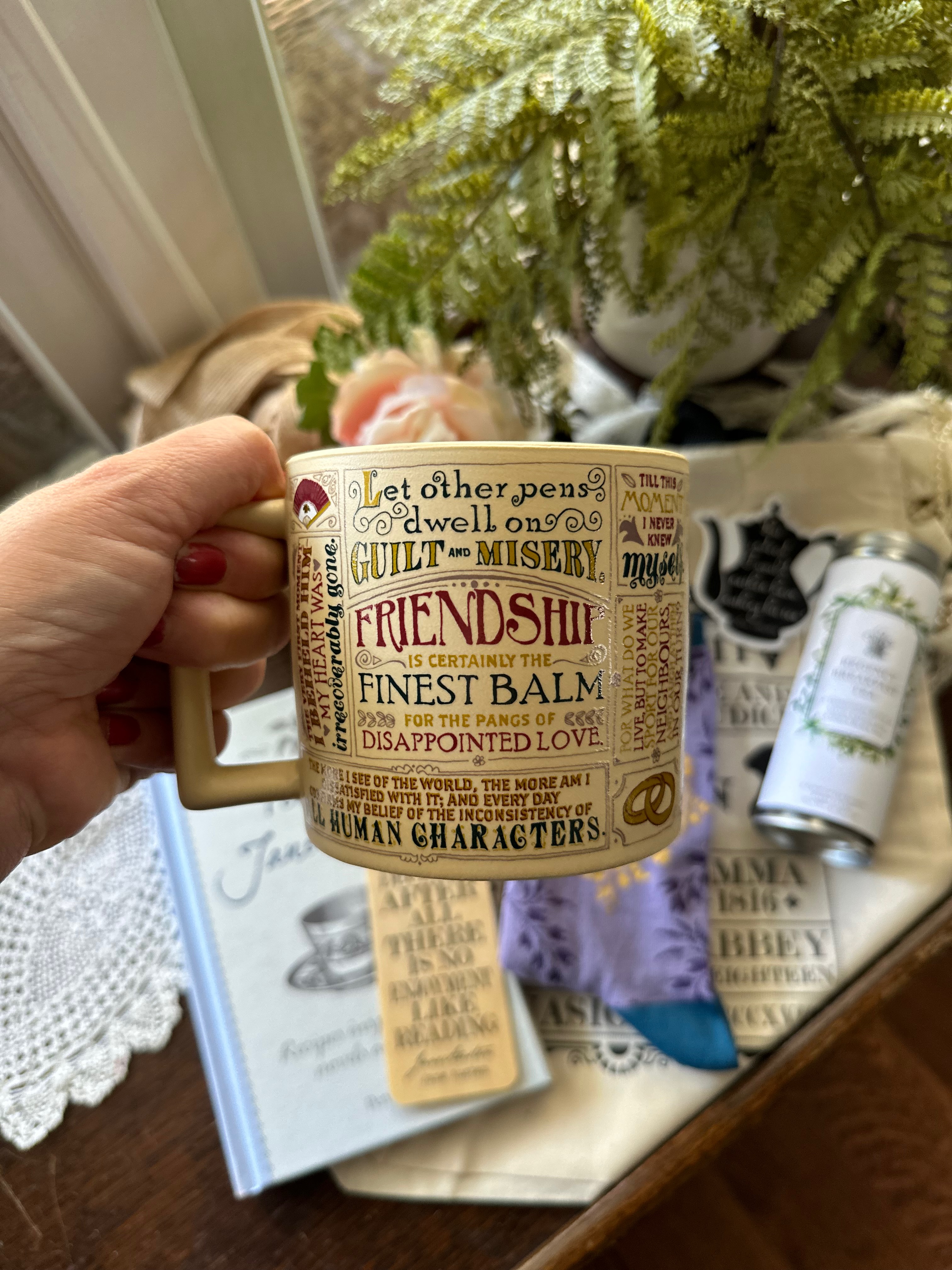
Each Jane Austen Box features a range of products from items of historical interest to lovely items you can incorporate in your everyday life, edibles and fine teas to Jane Austen inspired products. All boxes also include some form of book — expand your library!!
Categories include, but are not limited to:
Fine Teas
Books
Candles
Edibles
Wearables
Items of Historical Interest
Jane Austen Inspired Products
Bath and Body
Home Decor
Writing Accessories
Booklovers Paraphernalia
And More!
Subscription boxes are delightful because there are so many surprises held within each box. Regency Marketplace does a lovely job of keeping the mystery alive. They give hints and a theme for each box, but they never show what specific items are coming in each new box. That makes it even more exciting to open when it comes in the mail!
Unboxing
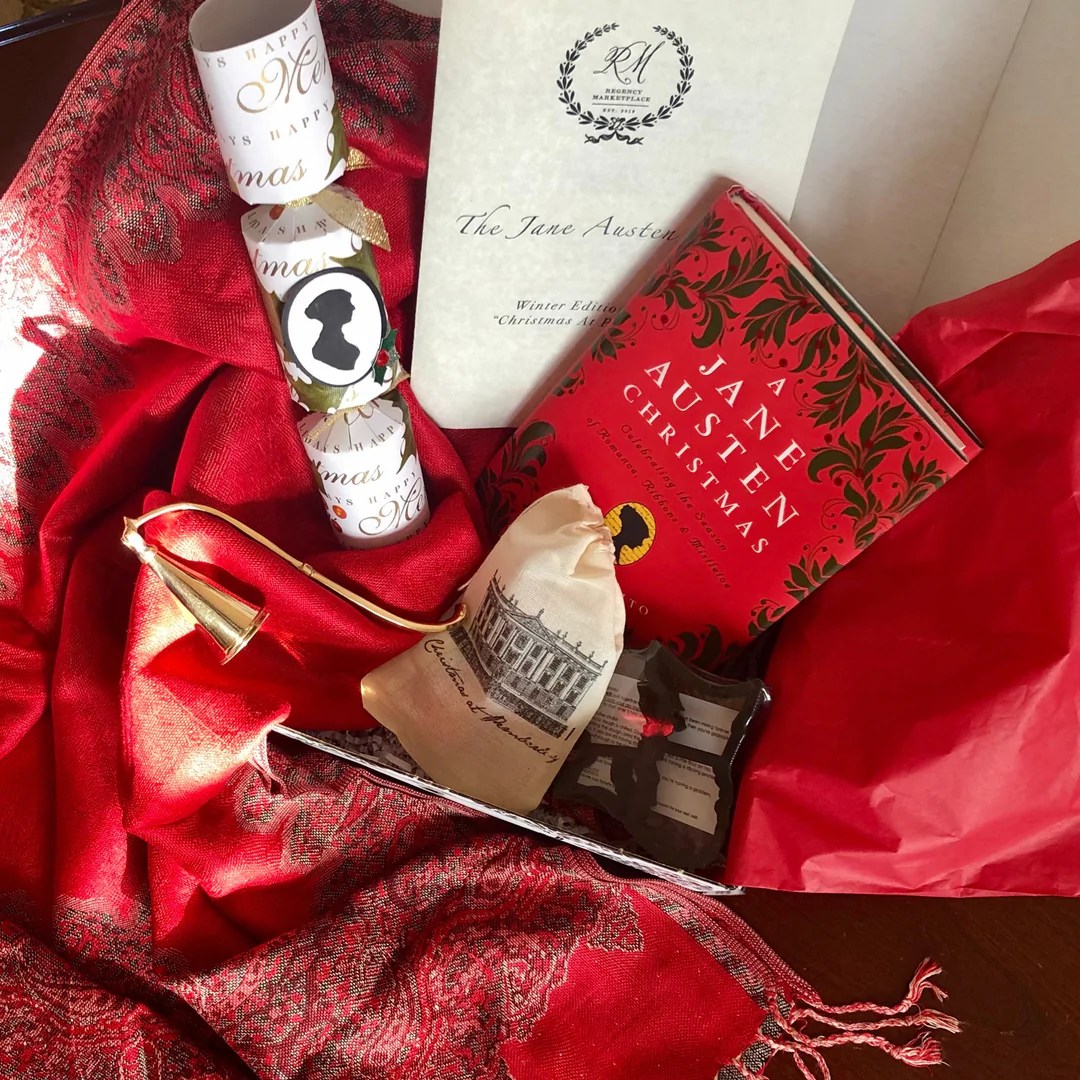
One of the most exciting parts about getting any kind of subscription box is the actual unboxing. When it arrived, I was so impressed with the packaging and the beautiful box. When I opened it and saw the pretty tissue and the sticker, I almost couldn’t bring myself to open it. I snapped a picture because it felt like my birthday and Christmas had arrived all at once.
If you’d like to watch an unboxing video of me opening the box, you can view it HERE. I had a blast (and it was my first time making a video reel like it). Here’s a peek inside:
Stay Tuned
The Winter Jane Austen Box will be available for Pre-Order October 15th – November 15th, and boxes will ship in early December. Regency Marketplace offers free shipping in the US. (International flat rate shipping is also available.) These luxurious boxes sell out quickly, so mark your calendars to reserve one for yourself or for a friend.
Enjoy this box for yourself, or gift one to a friend or family member for the holidays this year! Once the Winter Theme is announced, I will post a reminder to place your orders and a coupon code.
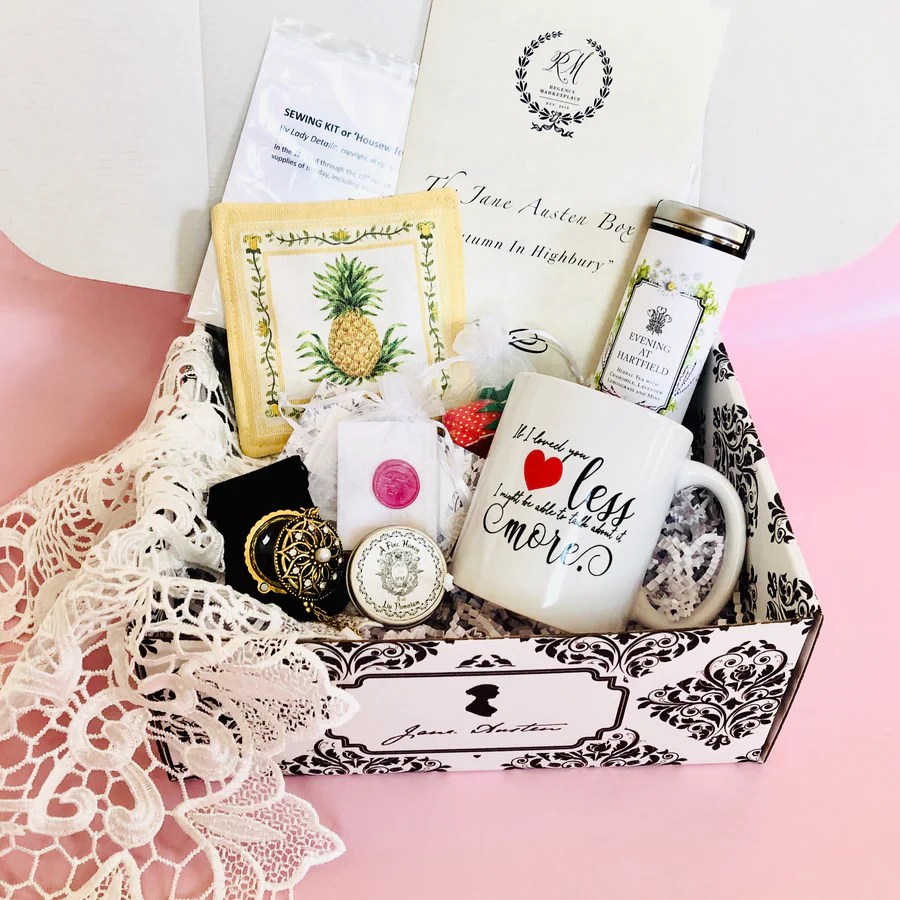
Sample of a previous Jane Austen Box
About Regency Marketplace
Regency Marketplace is run by the lovely Christina Denton. It was envisioned many years ago as a beautiful oasis for all things Regency and Jane Austen: a place where one could escape from the breakneck pace of today’s world, and enter into an era of elegance, charm, and wit.
A lifelong love of Jane Austen and the Regency Era is the guiding influence behind Regency Marketplace. As a family-run company, they work hard to source the best products for their discerning customers and fellow Janeites! They focus on celebrating the grace and beauty of an Era so distinct that it still captivates us two hundred years later.
Is this something you would like to receive as a gift? Would you buy it for yourself or for someone else as a lovely surprise?
“This is quite the season indeed for friendly meetings. At Christmas every body invites their friends about them, and people think little of even the worst weather.”–Mr. Elton, Emma
I hope you are all enjoying the holidays. In Austen’s novels, Christmas is a time for parties and for family and friend to gather, just like today. It was also a day for attending church (see Emma ch. 16 and Mansfield Park ch. 23), after weeks of Advent when prayers focused on the coming of Christ. For more on the prayers and readings that Austen would have prayed and read for Advent and Christmas, see my post Advent with Jane Austen. You can also find many posts at this site (and others) on Christmas customs in Jane Austen’s England.
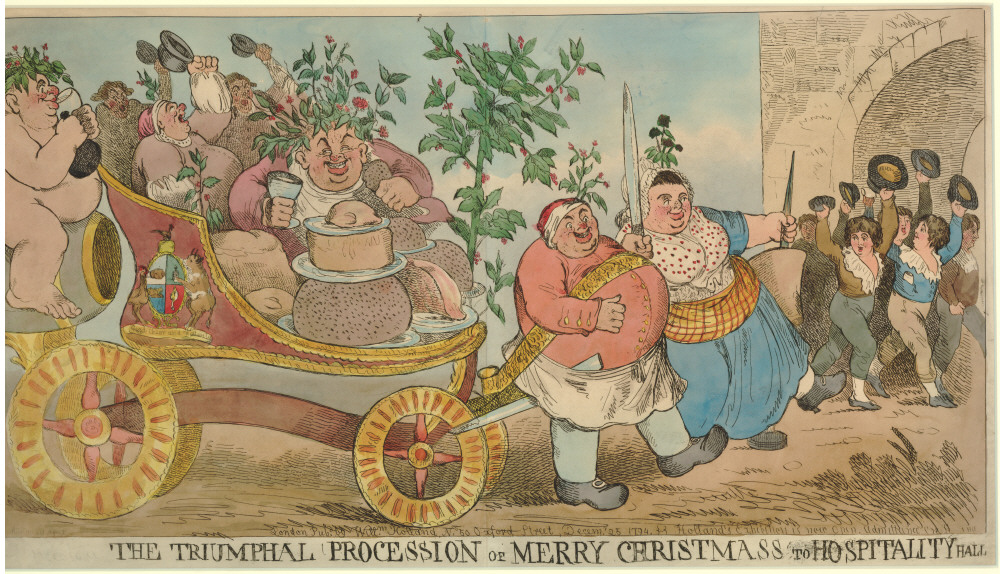
I recently gave a presentation on “Satirical Cartoons and Jane Austen’s Church of England” at JASNA’s Annual General Meeting (you can read it in this month’s Persuasions On-Line, or, if you are a JASNA member, you can watch it in the AGM on Demand). Today I’d like to share a few cartoons about Christmas in Austen’s England. (I didn’t find many; perhaps Christmas was not a popular subject for caricatures.)
In an earlier post about the Clerical Alphabet cartoon, I wrote about Richard Newton, a prolific young artist of the time. Newton drew the above cartoon in 1794, satirizing the general gluttony and drunkenness associated with Christmas. In The Triumphal Procession of Merry Christmas to Hospitality Hall, men on a carriage feast on large pieces of meat while behind them a naked man sits on a barrel, probably of wine or another alcoholic beverage.
Academics at Christmas
Christmas Academicks, Playing a Rubber of Whist, Thomas Rowlandson, 1803. Public domain via the Metropolitan Museum of Art.
University professors have a much more restrained celebration, though still not a devout one. Thomas Rowlandson’s The Christmas Academicks Playing a Rubber of Whist (1803) shows four academics playing cards, while a fifth stands nearby and a servant brings drinks. All are clergymen, probably fellows (professors or tutors) at the University of Oxford or Cambridge, who would be single clergymen. (Jane Austen’s father was a fellow at Oxford until he married.) As in many satirical cartoons of the time, the clergymen are pictured as overweight and self-indulgent. They are gambling and drinking, not in church.
Farmer Giles’s Establishment, Christmas day, 1800, by William Heath, 1830 Courtesy of The Lewis Walpole Library, Yale University
Farmer Giles: Christmas Through the Years
Some years later, in 1830, William Heath drew a series on Christmas as a political satire. It begins with a delightful version of an 1800 country Christmas, such as the Musgroves or Westons might have enjoyed in Austen’s novels.
Farmer Giles was a symbol of the unsophisticated country farmer. Here he feasts with his joyfulfamily at Christmastime. As we see in Austen’s novels, Christmas was a time for parties and feasts. Greenery decorates the fireplaceand the wife is slicing plum pudding. Farmer Giles is apparently prosperous and he becomes more so.
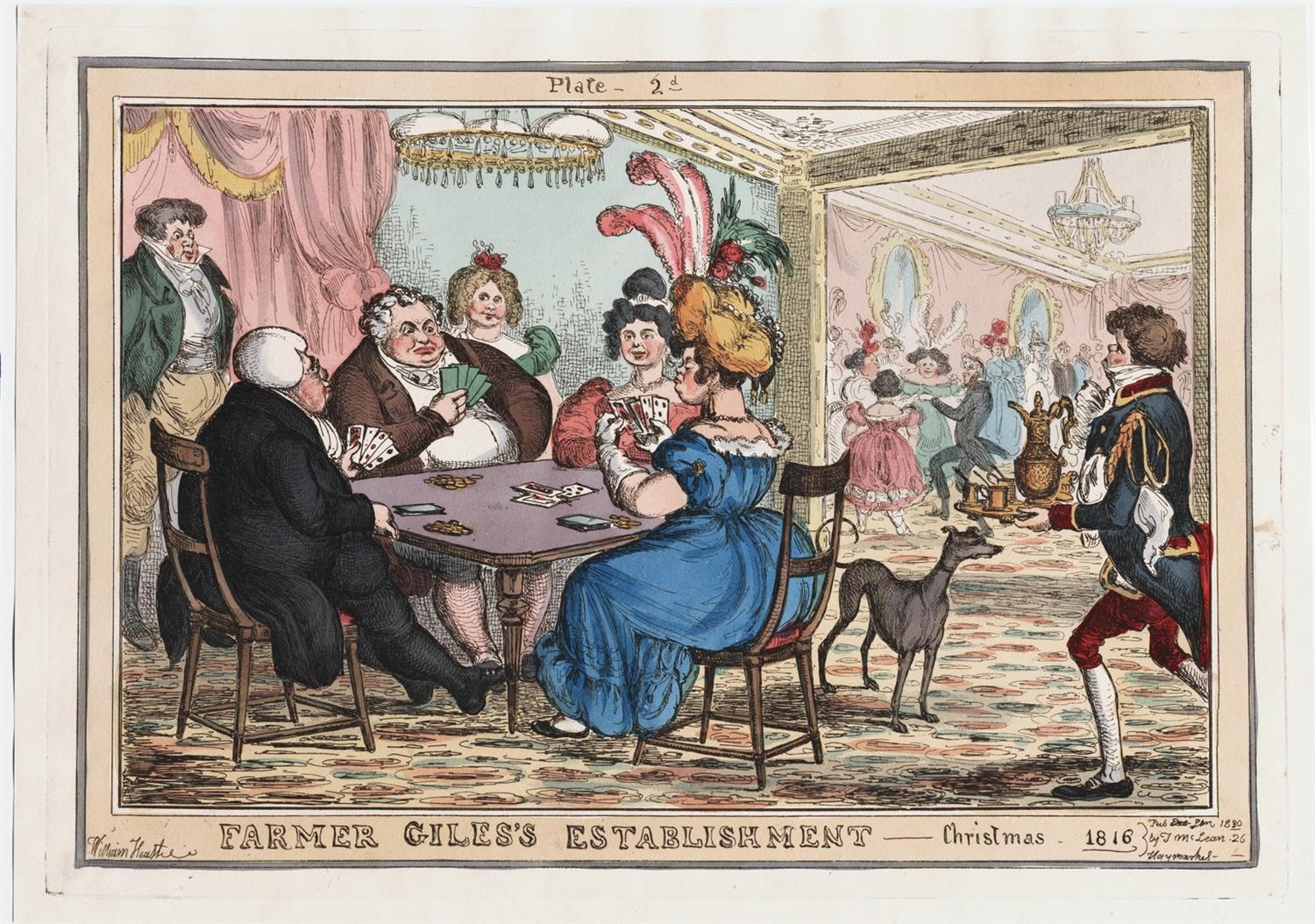
Farmer Giles’s Establishment Christmas 1816 by William Heath, 1830 Courtesy of The Lewis Walpole Library, Yale University
By 1816, the farmer has done well and moved up into fashionable society. This Christmas he and his wife are playing cards (gambling) while guests dance in the ballroom. However, they look much less happy than in the first print. The children are grown now, and looking on. The farmer’s hand appears to be bandaged for the gout, from overeating and excessive drinking.
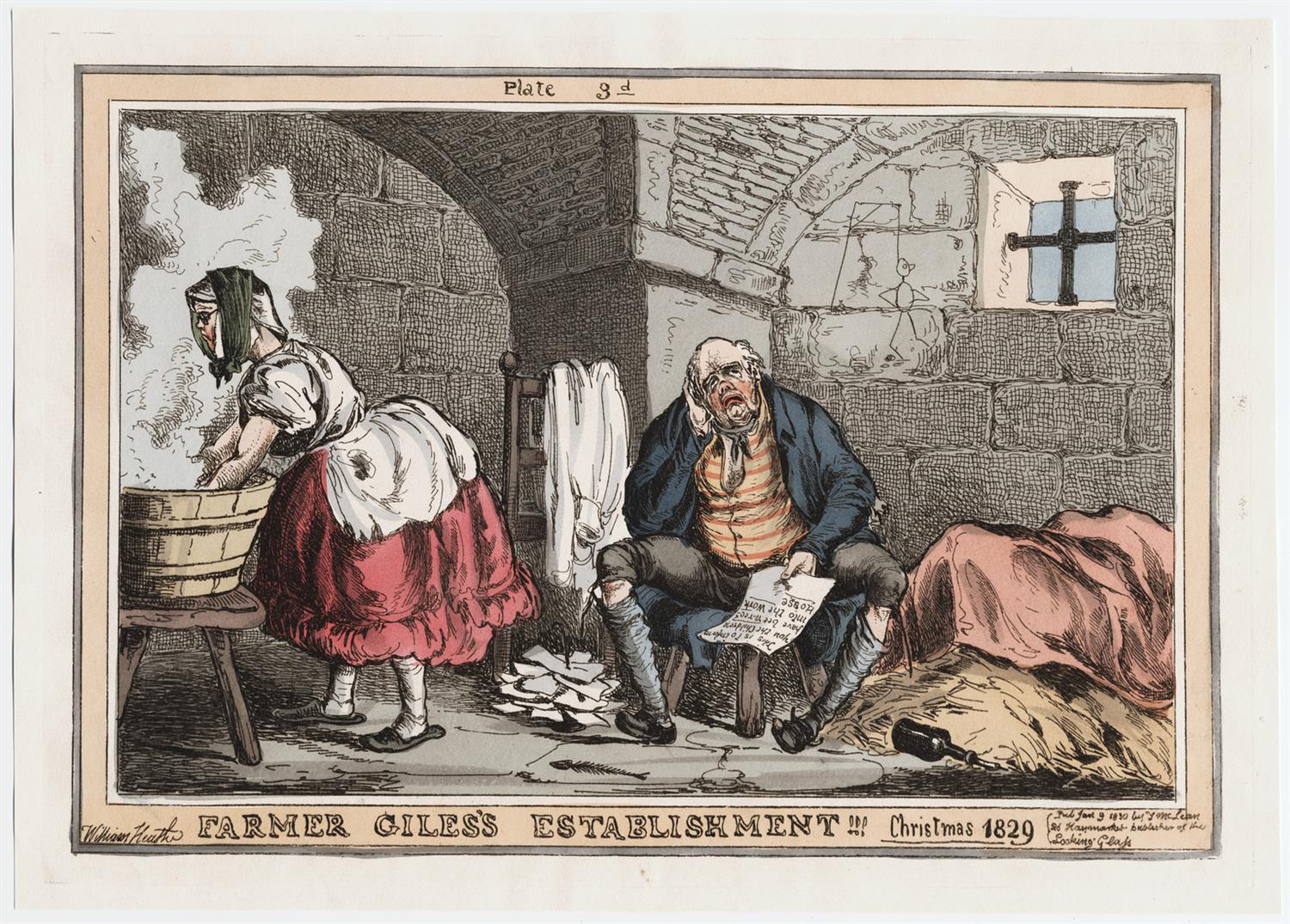
Farmer Giles’s Establishment!!! Christmas 1829 by by William Heath, 1830 Courtesy of The Lewis Walpole Library, Yale University
Their financial prosperity doesn’t last, though. The agricultural economy crashed.
In the third plate, Farmer Giles’ Establishment!!! Christmas 1829, the farmer is in a debtors’ cell. He holds a paper saying his children have been sent to the work house. His wife is doing laundry in a tub.
So this series becomes political satire, criticizing the government for its policies which led to an agricultural depression. A very sad Christmas.
The Merry Musgroves
But let’s return to Austen’s happier times.
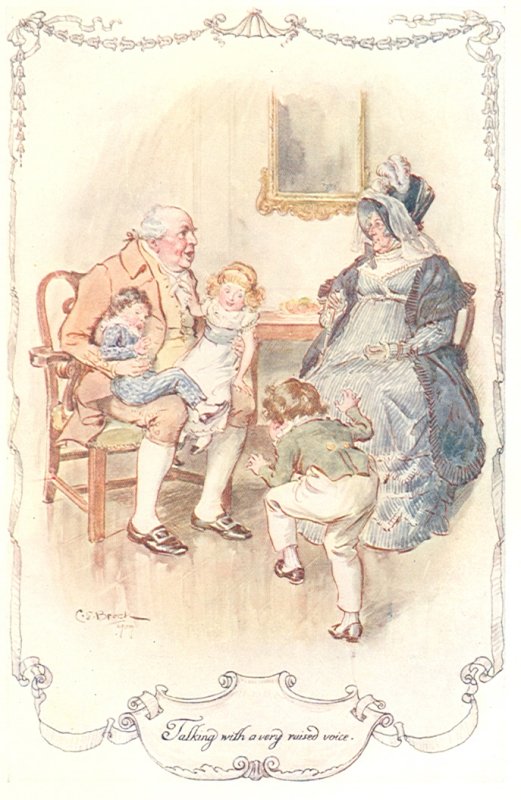
The Musgroves and children at Christmas C.E. Brock, Persuasion, Volume 2, chapter 2
As Austen describes Christmas at the Musgroves, in Persuasion:
On one side was a table, occupied by some chattering girls, cutting up silk and gold paper; and on the other were tressels and trays, bending under the weight of brawn and cold pies, where riotous boys were holding high revel; the whole completed by a roaring Christmas fire, which seemed determined to be heard, in spite of all the noise of the others. . . .
Anne, judging from her own temperament, would have deemed such a domestic hurricane a bad restorative of the nerves, which Louisa’s illness must have so greatly shaken; but Mrs. Musgrove, . . . concluded a short recapitulation of what she had suffered herself, by observing, with a happy glance round the room, that after all she had gone through, nothing was so likely to do her good as a little quiet cheerfulness at home. . .
“I hope I shall remember, in future,” said Lady Russell, as soon as they were reseated in the carriage, “not to call at Uppercross in the Christmas holidays.”
Every body has their taste in noises as well as in other matters . . .
I hope this Christmas is just to your taste! Many blessings to you in the New Year.
Brenda S. Cox writes on Faith, Science, Joy, and Jane Austen. She is currently working on a book entitled Fashionable Goodness: Faith in Jane Austen’s England.
For more on satirical cartoons in Jane Austen’s England, see:
Keeping Within Compass Mike Rendell also shows and discusses many other fascinating cartoons from Austen’s era on this blog, but be aware that many are risque. I am indebted to Mike for posting on the Newton Clerical Alphabet cartoon that got me started looking at cartoons and the clergy.
For more on Christmas in Austen’s England, see:
Party Like the Musgroves, by Rachel Dodge, to have your own party like the Musgroves did in the passage above!
I love the idea of a Regency-style Christmas season, complete with gifts, foods, and traditions that Jane Austen and her heroines might have enjoyed. Though Christmas traditions were different during Jane Austen’s time than they are today, as I share in my article about Regency Christmas Traditions, it’s fun to think of creative ideas that can make for a truly Austen-tatious holiday season.
In Persuasion, Austen paints a Christmas scene. It’s one of my favorite festive scenes, and I love to think of ways to recreate it:
On one side was a table occupied by some chattering girls, cutting up silk and gold paper; and on the other were tressels and trays, bending under the weight of brawn and cold pies, where riotous boys were holding high revel; the whole completed by a roaring Christmas fire, which seemed determined to be heard, in spite of all the noise of the others. […] Charles and Mary also came in, of course, during their visit, and Mr Musgrove made a point of paying his respects to Lady Russell, and sat down close to her for ten minutes, talking with a very raised voice, but from the clamour of the children on his knees, generally in vain. It was a fine family-piece.
Persuasion, Jane Austen
Evergreen Decor:
Create your own holiday decorations the way people did during Jane Austen’s time. Trim your windows and home with holly branches and evergreen trimmings.
On Christmas Eve the children laid out the traditional holly branches on the window ledges…
Finally, charitable gift giving was a large part of the Regency Christmas season. On the day after Christmas, on St. Stephen’s Day (now called Boxing Day), people gave gifts to charities and to those in need.
The gentry gave gifts to the servants who worked in their homes and those hired to help on their land. Read The History of Boxing Day And How To Celebrate It (Lindsay Schlegel – Verity.com) for some modern-day ideas for ways to celebrate Boxing Day.
Now it’s your turn! What do you like to do around the holidays to make your gifts and get-togethers special? Do you have any Jane Austen traditions this time of year? I enjoy attending one of the local Jane Austen Birthday Teas in my area at this time of year. At home, I love to decorate the house with greenery and bake family recipes! -Rachel
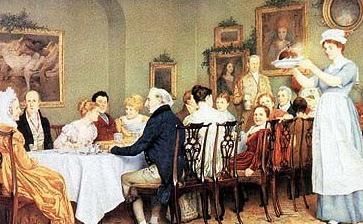
Inquiring readers, Today is one of celebration for those of us who honor Christ’s birth. This is a year of challenge for so many in our communities whose jobs and families have been affected by COVID-19. Inspired by the Georgians in times past, I do what I can in my community and for those in need. Austen describes this community/family/friend caring so well in her novels, a theme that Rachel Dodge covered in a recent post , and Brenda Cox in a post entitled “Thankfulness in Jane Austen’s Novels.”
Charity and the sharing of bounty with the less fortunate was an appropriately pious response to the season.” — Hilary Davidson
One book I purchased this year was written by Hilary Davidson entitled Dress in the Age of Jane Austen: Regency Fashion. Yale Books offers a blog post with information from this book entitled “A Jane Austen Christmas.” Enjoy!
Fashionable Goodness: Christianity in Jane Austen's England is now available! By JAW contributor Brenda S. Cox. See Review. Available from Amazon and Jane Austen Books.
Available through December 31st, 2025. Click on image for details, and share this poster with other teachers and students!
The Obituary of Charlotte Collins by Andrew Capes
Click on image to read the story.
Comments
“My idea of good company…is the company of clever, well-informed people, who have a great deal of conversation.” – Jane Austen, Persuasion
Gentle readers: Please feel free to post your comments and continue the conversation! Due to SPAM, we will no longer accept comments on posts after 30 days of publication. In some instances, links will be removed from comments as well.
Administrators and Contributors
Vic Sanborn, founder of this blog, is supported by a team of talented and knowledgeable writers about Jane Austen and the Regency era. They are:
Tony Grant, who now contributes his photos from London and England
Click on their names to enter their own blogs.
In addition, we thank the many experts and authors who frequently contribute their posts and opinions, and who continue to do so freely or at our request.
Click here to enter the page. Topics include Regency fashion, historic foods, Jane Austen societies, British sites, related topics. Click on image.
May we suggest?
Hello, my name is Vic and I live in Maryland, USA. I have adored Jane Austen almost all of my life. I am a proud lifetime member of the Jane Austen Society of North America. This blog is a personal blog written and edited by me and my team. We do not accept any form of cash advertising, sponsorship, or paid topic insertions. However, we do accept and keep books and CDs to review.
If you would like to share a new site, or point out an error, please email us. (Yes, we are fallible. We'll own up to our mistakes and will make the corrections with a polite smile on our faces.) Write us at
Thank you for visiting this blog. Your comments and suggestions are most welcome.
Project Gutenberg: eBook of Stage-coach and Mail in Days of Yore, Volume 2 (of 2), by Charles G. Harper
STAGE-COACH AND MAIL IN DAYS OF YORE: A PICTURESQUE HISTORY
OF THE COACHING AGE, VOL. II, By CHARLES G. HARPER. 1903. Click on this link.








 nquiring readers, Today is one of celebration for those of us who honor Christ’s birth. This is a year of challenge for so many in our communities whose jobs and families have been affected by COVID-19. Inspired by the Georgians in times past, I do what I can in my community and for those in need. Austen describes this community/family/friend caring so well in her novels, a theme that Rachel Dodge covered







 Jane Austen's World