Feeds:
Posts
Comments

Archive for the ‘Dandy’ Category

The Dandy’s Perambulations

The Dandy’s Perambulations, printed and sold in 1819 by John Marchall in Fleet Street, is posted in full by www.dandyism.net. Below are a few lines from the pamphlet:

[They] ran along together straight,
Until they reached the turnpike gate,
Where a coach had made a stop;
So they both got upon the top,
And after their disastrous falls,
At length in safety reached St. Paul’s.

Find a fairly cynical definition of a dandy on this Cambridge University Press site.

Read Full Post »

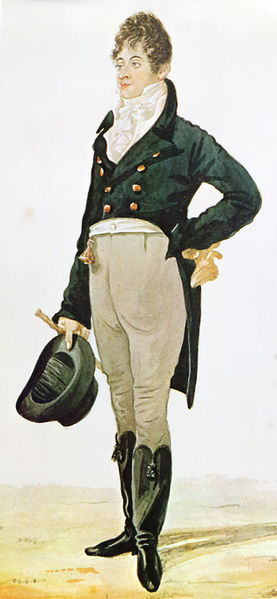
One of my favorite descriptions of the Regency dandy, and one that I contributed to Wikipedia, is the following in which author Venetia Murray quotes an excerpt from An Exquisite’s Dairy, from The Hermit in London, 1819:

Took four hours to dress; and then it rained; ordered the tilbury and my umbrella, and drove to the fives’ court; next to my tailors; put him off after two years tick; no bad fellow that Weston…broke three stay-laces and a buckle, tore the quarter of a pair of shoes, made so thin by O’Shaughnessy, in St. James’s Street, that they were light as brown paper; what a pity they were lined with pink satin, and were quite the go; put on a pair of Hoby’s; over-did it in perfuming my handkerchief, and had to recommence de novo; could not please myself in tying my cravat; lost three quarters of an hour by that, tore two pairs of kid gloves in putting them hastily on; was obliged to go gently to work with the third; lost another quarter of an hour by this; drove off furiously in my chariot but had to return for my splendid snuff-box, as I knew that I should eclipse the circle by it.

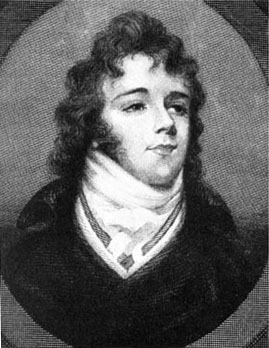
Beau Brummell, image from the British Library

Beau Brummell was the quintessential dandy of the era. Dandies are described in Prinny’s Set on the Georgian Index.

Find a short history of Brummell’s most famous sartorial contribution on the The White Satin Cravat.

Here is another quote about Brummell: “George Bryan “Beau” Brummell, then, must qualify as the most committed dandy of them all. Not only was he an enthusiastic, lifelong slave to his mirrors, he also polished them with champagne. His outrageously flamboyant, nascent rock’n’roll lifestyle, decadent splurging, shameless narcissism and meticulous attention to vanity and wardrobe has set the gold standard for dandies ever since.” (From All Mouths and Trousers)

Click on the following links to learn more about Mr. Brummell:

Beau Brummell: The Dandy

George Brian Brummell: Biography

The Sartorial Dandy

Lesson Two: The Gentleman’s Wardrobe

Upon My Word! Regency Fact and Figures

The Emergence of the Dandy

Dandyism: Andrew Solomon


Also on this blog: Male Bastions: The Clubs of St. James’s

Dandy Clubs for Research

Read Full Post »


Found on the Internet, an abstract of the following article:

The Clubs of St. James’s: places of public patriarchy – exclusivity, domesticity and secrecy, Jane Rendell

The male clubs of St. James’s, specifically the four at the top of St. James’s Street; Boodle’s, Brooks’s, Crockford’s and White’s, were frequented by men of the same class who used their control of space to assert social and political allegiances and rivalries between men. The exclusivity of the first floor gambling room, a place of secrecy and privacy, is contrasted with the ground floor bow window, a site of public display and exclusivity. Male leisure pastimes, such as drinking, sporting, gambling, are explored as social and spatial practices which, by establishing shared codes of consumption, display and exchange, represent public masculinities.”

During the period of his greatest popularity and influence, Beau Brummell (depicted above) held court in the Bow Window at White’s in full view of the public. White’s was founded in 1693 as a Chocolate House. By the end of the 18th Century, the popularity of chocolate houses declined, and many of the exclusive chocolate houses became Gentleman’s Clubs.

Find more information about Gentlemens Clubs in the following:

Read Full Post »

Attire of the Regency Dandy

In The Corinthian, Georgette Heyer describes Sir Richard in her inimitable fashion:

“He was a very notable Corinthian. From his Wind-swept hair (most difficult of all styles to achieve), to the toes of his gleaming Hessians, he might have posed as an advertisement for the Man of Fashion. His fine shoulders set off a coat of superfine cloth to perfection; his cravat, which had excited George’s admiration, had been arranged by the hands of a master; his waistcoat was chosen with a nice eye; his biscuit-coloured pantaloons showed not one crease; and his Hessians with their jaunty gold tassels, had not only been made for him by Hoby, but were polished, George suspected, with a blacking mixed with champagne. A quizzing-glass on a black ribbon hung around his neck; a fob at his waist; and in one hand he carried a Sevres snuff-box. His air proclaimed unutterable boredom, but no tailoring, no amount of studied nonchalance, could conceal the muscle in his thighs, or the strength of his shoulders. Above the starched points of his shirt-collar, a weary, handsome face showed its owner’s disillusionment.”

In High Society: A Social History of the Regency Period, 1788-1830, Venetia Murray writes:

“…admirers of dandyism have taken the view that it is a sociological phenomenon, the result of a society in a state of transition or revolt. Barbey d’Aurevilly, one of the leading French dandies at the end of the nineteenth century, explained: Some have imagined that dandyism is primarily a specialisation in the art of dressing oneself with daring and elegance. It is that, but much else as well. It is a state of mind made up of many shades, a state of mind produced in old and civilised societies where gaiety has become infrequent or where conventions rule at the price of their subject’s boredom…it is the direct result of the endless warfare between respectability and boredom.


In Regency London dandyism was a revolt against a different kind of tradition, an expression of distaste for the extravagance and ostentation of the previous generation, and of sympathy with the new mood of democracy.


Also view:

Gentlemen’s Clothing of the Regency Era

Men’s Fashion from the Jane Austen Centre

Fashionable Gentleman prints

A biography of George Brummel

Menswear from 1790 to 1830

Read Full Post »

« Newer Posts