As spring turns to summer on our month-by-month exploration of Jane Austen’s life, letters, and novels, we turn our attention to May in Jane Austen’s world. If you’re just jumping on the bus, you can find previous articles in this “A Year in Jane Austen’s World” series here: January, February, March, and April.
During last month’s April showers in England, we dreamed of May flowers…and the Hampshire countryside certainly is showing some May flower power. First up, our monthly view of Chawton House Gardens. It certainly is bursting with color!

May in Hampshire
May is the time of year when the sun shines more regularly and everything bursts into bloom. Summer is close at hand, which means the temperatures are starting to warm up a bit, but frequent rain helps keep the gardens cool and watered. Austen had this to say in May 1811 in a letter to Cassandra:
The chickens are all alive and fit for the table, but we save them for something grand. Some of the flower seeds are coming up very well, but your mignonette makes a wretched appearance. Miss Benn has been equally unlucky as to hers. She had seed from four different people, and none of it comes up. Our young piony (sic) at the foot of the fir-tree has just blown and looks very handsome, and the whole of the shrubbery border will soon be very gay with pinks and sweet-williams, in addition to the columbines already in bloom. The syringas, too, are coming out. We are likely to have a great crop of Orleans plums, but not many greengages—on the standard scarcely any, three or four dozen, perhaps, against the wall. (Chawton, Wednesday May 29, 1811)
Here is a glimpse of Jane Austen’s House Museum and its blooms this month.

May in Jane Austen’s Letters
We have several letters from May to peruse. Interestingly, several are written from Bath. In an interesting article entitled “A Brief History of Jane Austen in Bath” on VisitBath.com, we read this about Jane Austen:
While many assume that Jane’s connection with Bath began when she moved to 4 Sydney Place in 1801 after her father’s retirement, the Austen family’s history with the City actually dates back further. Jane’s parents were married at St Swithin’s Church in 1764, and Jane herself visited in 1797 and 1799, lodging with her mother and sister-in-law at 13 Queen Square in 1799 while her brother took the waters for his health. Before moving into Sydney Place, she also stayed with her aunt and uncle, the Leigh-Perrots, at No.1 The Paragon. These short visits had a lasting impact on the young Jane Austen, inspiring her to write Northanger Abbey about Catherine Morland’s first visit to Bath and her “eager delight” at all it offered. (VisitBath.com)
May 17, 1799 (Queen’s Square):
- Jane’s thoughts on the house: “We are exceedingly pleased with the house; the rooms are quite as large as we expected. Mrs. Bromley is a fat woman in mourning, and a little black kitten runs about the staircase. Elizabeth has the apartment within the drawing-room; she wanted my mother to have it, but as there was no bed in the inner one, and the stairs are so much easier of ascent, or my mother so much stronger than in Paragon as not to regard the double flight, it is settled for us to be above, where we have two very nice-sized rooms, with dirty quilts and everything comfortable. I have the outward and larger apartment, as I ought to have; which is quite as large as our bedroom at home, and my mother’s is not materially less. The beds are both as large as any at Steventon, and I have a very nice chest of drawers and a closet full of shelves — so full indeed that there is nothing else in it, and it should therefore be called a cupboard rather than a closet, I suppose.”
- Happy and content, despite a delay with her trunk: “I find no difficulty in closing my eyes. I like our situation very much; it is far more cheerful than Paragon, and the prospect from the drawing-room window, at which I now write, is rather picturesque, as it commands a prospective view of the left side of Brock Street, broken by three Lombardy poplars in the garden of the last house in Queen’s Parade.”

May 1801 (Paragon):
- May 5 (their journey): “I have the pleasure of writing from my own room up two pair of stairs, with everything very comfortable about me. Our journey here was perfectly free from accident or event; we changed horses at the end of every stage, and paid at almost every turn-pike. We had charming weather, hardly any dust, and were exceedingly agreeable, as we did not speak above once in three miles. Between Luggershall and Everley we made our grand meal, and then with admiring astonishment perceived in what a magnificent manner our support had been provided for. We could not with the utmost exertion consume above the twentieth part of the beef. The cucumber will, I believe, be a very acceptable present, as my uncle talks of having inquired the price of one lately, when he was told a shilling.
- Food prices: “I am not without hopes of tempting Mrs. Lloyd to settle in Bath; meat is only 8d. per pound, butter 12d., and cheese 9 1/2 d. You must carefully conceal from her, however, the exorbitant price of fish: a salmon has been sold at 2s. 9d. per pound the whole fish. The Duchess of York’s removal is expected to make that article more reasonable — and till it really appears so, say nothing about salmon.”
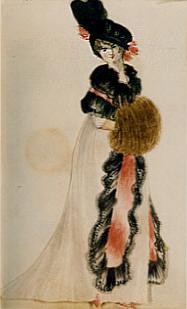
- New bonnets: “My mother has ordered a new bonnet, and so have I; both white strip, trimmed with white ribbon. I find my straw bonnet looking very much like other people’s, and quite as smart. Bonnets of cambric muslin on the plan of Lady Bridges’ are a good deal worn, and some of them are very pretty; but I shall defer one of that sort till your arrival.”

- May 12 (a ball): “In the evening, I hope you honoured my toilette and ball with a thought; I dressed myself as well as I could, and had all my finery much admired at home. By nine o’clock my uncle, aunt, and I entered the rooms, and linked Miss Winstone on to us. Before tea it was rather a dull affair; but then the before tea did not last long, for there was only one dance, danced by four couple. Think of four couple, surrounded by about an hundred people, dancing in the Upper Rooms at Bath. After tea we cheered up; the breaking up of private parties sent some scores more to the ball, and though it was shockingly and inhumanly thin for this place, there were people enough, I suppose, to have made five or six very pretty Basingstoke assemblies.”
- The sale of their belongings: “I thank you for your Sunday’s letter, it is very long and very agreeable. I fancy you know many more particulars of our sale than we do; we have heard the price of nothing but the cows, bacon, hay, hops, tables, and my father’s chest of drawers and study table. Mary is more minute in her account of their own gains than in ours; probably being better informed in them. I will attend to Mrs. Lloyd’s commission and to her abhorrence of musk when I write again.”

- May 21 – the search for apartments continues: “Our views on G. P. Buildings seem all at an end; the observation of the damps still remaining in the offices of an house which has been only vacated a week, with reports of discontented families and putrid fevers, has given the coup de grace. We have now nothing in view. When you arrive, we will at least have the pleasure of examining some of these putrefying houses again; they are so very desirable in size and situation, that there is some satisfaction in spending ten minutes within them.”
- Walking with Mrs. Chamberlayne: “It would have amused you to see our progress. We went up by Sion Hill, and returned across the fields. In climbing a hill Mrs. Chamberlayne is very capital; I could with difficulty keep pace with her, yet would not flinch for the world. On plain ground I was quite her equal. And so we posted away under a fine hot sun, she without any parasol or any shade to her hat, stopping for nothing, and crossing the churchyard at Weston with as much expedition as if we were afraid of being buried alive. After seeing what she is equal to, I cannot help feeling a regard for her. As to agreeableness, she is much like other people.”
- On a small party: “We are to have a tiny party here to-night. I hate tiny parties, they force one into constant exertion. Miss Edwards and her father, Mrs. Busby and her nephew, Mr. Maitland, and Mrs. Lillingstone are to be the whole; and I am prevented from setting my black cap at Mr. Maitland by his having a wife and ten children.”

Jane wrote several other “May letters” from Chawton (1811) and Sloane Street (1813):
May 29, 1811 (Chawton):
- Springtime storms: “Mrs. Terry, Mary, and Robert, with my aunt Harding and her daughter, came from Dummer for a day and a night,—all very agreeable and very much delighted with the new house and with Chawton in general. We sat upstairs, and had thunder and lightning as usual. I never knew such a spring for thunderstorms as it has been. Thank God! we have had no bad ones here. I thought myself in luck to have my uncomfortable feelings shared by the mistress of the house, as that procured blinds and candles. It had been excessively hot the whole day.”
- Improvements: “The chimneys at the Great House are done. Mr. Prowting has opened a gravel-pit, very conveniently for my mother, just at the mouth of the approach to his house; but it looks a little as if he meant to catch all his company. Tolerable gravel.”
May 20, 1813 (Sloane Street):
- Travels: “We left Guildford at twenty minutes before twelve (I hope somebody cares for these minutiæ), and were at Esher in about two hours more. I was very much pleased with the country in general. Between Guildford and Ripley I thought it particularly pretty, also about Painshill; and from a Mr. Spicer’s grounds at Esher, which we walked into before dinner, the views were beautiful. I cannot say what we did not see, but I should think there could not be a wood, or a meadow, or palace, or remarkable spot in England that was not spread out before us on one side or other.”
- Settling in: “I fancy it was about half-past six when we reached this house,—a twelve hours’ business, and the horses did not appear more than reasonably tired. I was very tired too, and glad to get to bed early, but am quite well to-day. I am very snug in the front drawing-room all to myself, and would not say “thank you” for any company but you. The quietness of it does me good.”
May 24, 1813 (Sloane Street):
- On visiting an exhibition and finding the Mrs. Bingley’s (Jane Bennet’s) likeness and looking for Mrs. Darcy’s (Elizabeth Bennet’s) likeness: “…to my great amusement, Henry and I went to the exhibition in Spring Gardens. It is not thought a good collection, but I was very well pleased, particularly (pray tell Fanny) with a small portrait of Mrs. Bingley, excessively like her. I went in hopes of seeing one of her sister, but there was no Mrs. Darcy. Perhaps, however, I may find her in the great exhibition, which we shall go to if we have time. I have no chance of her in the collection of Sir Joshua Reynolds’s paintings, which is now showing in Pall Mall, and which we are also to visit. Mrs. Bingley’s is exactly herself,—size, shaped face, features, and sweetness; there never was a greater likeness. She is dressed in a white gown, with green ornaments, which convinces me of what I had always supposed, that green was a favorite color with her. I dare say Mrs. D. will be in yellow.”
- Later that evening, on searching for Mrs. D (Elizabeth Bennet): “We have been both to the exhibition and Sir J. Reynolds’s, and I am disappointed, for there was nothing like Mrs. D. at either. I can only imagine that Mr. D. prizes any picture of her too much to like it should be exposed to the public eye. I can imagine he would have that sort of feeling,—that mixture of love, pride, and delicacy.”

May in Jane Austen’s Novels
May isn’t mentioned too terribly much in Austen’s novels, but it is a special point of interest and conversation in Emma because of the timing of Frank Churchill’s visit and the timing of the ball:
Emma
- Frank’s visit: “Emma heard that Frank wrote in the highest spirits of this arrangement, and seemed most fully to appreciate the blessing of having two months before him of such near neighbourhood to many dear friends—for the house was taken for May and June. She was told that now he wrote with the greatest confidence of being often with them, almost as often as he could even wish.”
- Mr. Weston’s joy: “Mr. Weston’s own happiness was indisputable. He was quite delighted. It was the very circumstance he could have wished for. Now, it would be really having Frank in their neighbourhood. What were nine miles to a young man?—An hour’s ride. He would be always coming over.“
- A ball: “Mr. Weston’s ball was to be a real thing. A very few to-morrows stood between the young people of Highbury and happiness.”
- May is better for everything: “Mr. Woodhouse was resigned. The time of year lightened the evil to him. May was better for every thing than February.”
- Evening fire in May: “The whole party walked about, and looked, and praised again; and then, having nothing else to do, formed a sort of half-circle round the fire, to observe in their various modes, till other subjects were started, that, though May, a fire in the evening was still very pleasant.“

May Dates of Importance
This brings us now to several important May dates that relate to Jane and her family:
Family News:
May 1801: Austen family leaves Steventon and settles in Bath. Mrs. Austen and Jane travel via Ibthorpe. James Austen and his family take resident at Steventon rectory.
May 1807: Captain Charles Austen marries Fanny Palmer in Bermuda.
Historic Dates:
18 May 1804: Napoleon crowns himself emperor of France.
Writing:
May 1814: Mansfield Park published anonymously, “By the Author of ‘Sense & Sensibility,’ and ‘Pride & Prejudice.’
Sorrows:
24 May 1817: Jane leaves Chawton and moves with Cassandra to Winchester, for medical treatment.
On this day in 1817, Jane Austen left this house for the final time. She went to stay in Winchester, closer to her doctor, where she died two months later, on 18 July. -Jane Austen’s House Museum

Lovely May
I hope you’re enjoying our journey through each month of the year in Jane Austen’s world. It is a joy to look through this lens into Austen’s life and letters. We’ll continue our exploration and find out what happened in June in next month’s installment, June in Jane Austen’s World!
RACHEL DODGE teaches college English classes, gives talks at libraries, teas, and book clubs, and writes for Jane Austen’s World blog. She is the bestselling author of The Little Women Devotional, The Anne of Green Gables Devotional and Praying with Jane: 31 Days Through the Prayers of Jane Austen. Now Available: The Secret Garden Devotional! You can visit Rachel online at www.RachelDodge.com.










 Jane Austen's World