Feeds:
Posts
Comments

Archive for the ‘Fashions’ Category

IMDb has become an indispensable site for those of us who love movies. I especially love the trivia the site features about each film. Take Emma 2009, for example. Costumes that were recycled from other films are listed there. Let’s look at a few:

Johdi May's purple coat

The purple coat Jodhi May (Mrs. Weston) wears on market day in Highbury is the same costume Hattie Morahan (Elinor Dashwood) wears when she arrives at Barton Cottage in “Sense & Sensibility” (2008).

Elinor in purple pelisse

The dark Spencer worn by Louise Dylan (Harriet Smith) to visit the poor is the same costume Lucy Scott wears in “Pride and Prejudice”(1995).

Harriet Smith (Louise Dylan) in dark spencer

The off-white dress with floral embroidery on the bodice worn by Christina Cole (Mrs. Elton) for her big entrance in church is the same costume worn by Cesca Martin in “The Regency House Party” (2004) during her “engagement,” and by Natasha Little (Becky Sharp) at Park Lane in “Vanity Fair” (1998).

Christina Cole as Mrs. Elton, Her Entrance in Church

The gray gown with gold bow print worn by Tamsin Greig (Miss Bates) to Miss Taylor’s wedding is the same costume worn by Anna Massey (Aunt Norris) in “Mansfield Park” (1983), Phyllida Law (Mrs. Bates) in Emma (1996), Lindsay Duncan (Mrs. Price) when Fanny leaves home in Mansfield Park (1999), Janine Duvitski (Mrs. Meagles) in “Little Dorrit” (2008), and Linda Bassett (Mrs. Jennings) in London in “Sense & Sensibility” (2008).

Miss Bates in gray pelisse and Emma in a floral gown

The floral print dress worn by Romola Garai (Emma) to Miss Taylor’s wedding is the same costume worn by Dagmara Dominczyk (Mercedès Iguanada) for Edmond’s homecoming at the beginning of The Count of Monte Cristo (2002).

Johdi May in lilac floral colored wrap dress

The lilac colored floral wrap dress Jodhi May (Anne Taylor/Weston) wears at Hartfield is the same costume worn by Denise Black (Mrs.Brocklebank) in “To the Ends of the Earth” (2005), and Alex Kingston (Mrs.Bennet) in “Lost in Austen” (2008).

Wearing a floral waistcoat at the Cole's party, Jonny Lee Miller as Mr. Knightley

The blue floral waistcoat Jonny Lee Miller (Mr.Knightley) wears at the Coles’ party is the same costume worn by Joseph Beattie (Henry Crawford) in Mansfield Park (2007) (TV).

Henry and Mary Crawford

For more recycled fashion comparisons, go to this link.

Read Full Post »


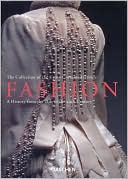
Laurel Ann, my blogging partner at Jane Austen Today, gave me a copy of Fashion: The Collection of the Kyoto Costume Institute a thick, breathtaking book with color photographs of the institute’s extensive western fashion collection.

The Kyoto Costume Institute (KCI), founded in 1978, is the only institution in Japan to study Western fashion. Its collections include primarily Western costume and accessories, dating from the 18th Century to the present. Its website provides information about the KCI, its gallery and exhibition catalogues. The digital archive contains images of 200 objects from the collection, arranged chronologically. The site is available in both English and Japanese parallel versions. – Intute

This book holds a special place on my shelf. Its arrival tells me that Laurel Ann knows me very well! View some of the lovely images contained in the book at this site: Digital archive of the Kyoto Costume Institute

Read Full Post »

Colin Firth wearing a reindeer jumper in Bridget Jones' Diary

The blog, Built on Facts, discusses Pride and Prejudice and Bridget Jones’s Diary in a post entitled: Metafiction and Self-Reference in Bridget Jones’ Diary

..not only is [Bridget Jones’ Diary] a retelling, it’s a retelling that’s very explicit about that fact. But that’s just the start; in fact Bridget meets him at a party wherein Mr. Darcy is standing around being standoffish, precisely as in Pride and Prejudice. And Bridget comments on this, pointing out to herself that if one is going to be named Darcy one shouldn’t be standing around standoffishly at parties.

More Intelligent Life dot Com features a long interview with Colin Firth about his movie, “A Single Man,” and his life and career. Quite insightful.

LOOK UP Firth’s name in a casting director’s address-book, and you’d find it under “a” for Archetypal Englishman. He has played the comedy version (the cuckolded, tongue-tied writer in “Love Actually”), the villainous version (a Blackadderish lord in “Shakespeare in Love”) and the subtle, smarter-than-he-first-appears version—decent Clifton, the young buffer who’s actually a spy, in “The English Patient”. Yet in reality Firth doesn’t have much time for England.

Both his major relationships have been with women from other countries—first the Canadian actress Meg Tilly, with whom he has a son, and now his wife Livia Guggioli, an Italian documentary producer and mother of his two younger children.

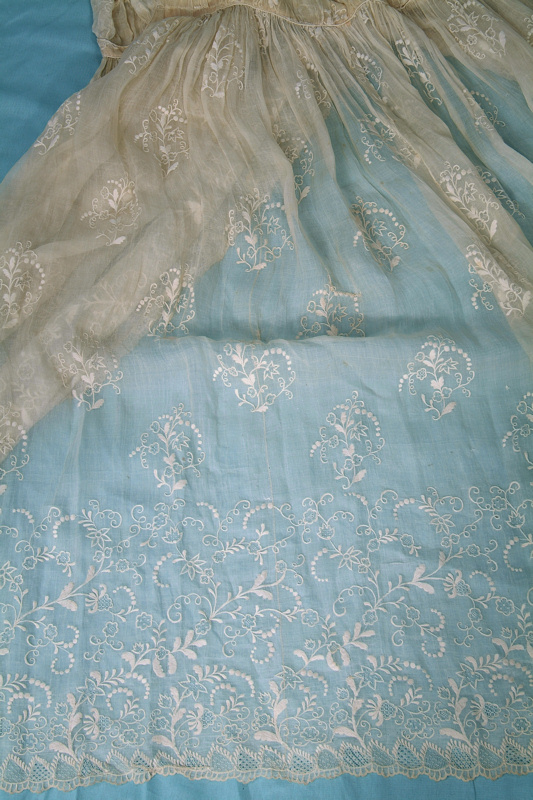
Trousseau features fashion from the 19th century through the early 20th century. This page shows gowns from 1801-1839. Clicking on a dress will lead you to a page; clicking on each image will lead you to an enlarged detail.

Detail of embroidered muslin dress, 1810-1814

Read Full Post »

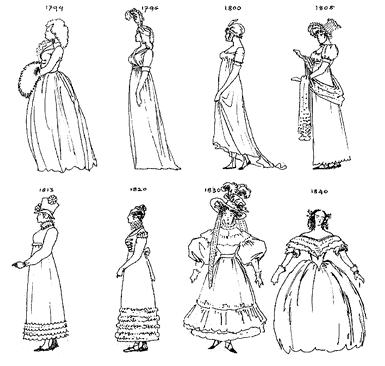
CassandraPretty Cassandra Austen, Jane Austen’s elder sister by two years, lived until the ripe age of 72 . This brief visual guide demonstrates how fashion changed during her lifetime. Wherever possible, I tried to represent Cassandra’s age and the clothes she would have worn during that period. I also used the paired women combination to evoke Cassandra and Jane, even in the years after Jane’s death. The last image shows the changes in the silhouettes of the gowns regarding waists, sleeves, skirts and trains.

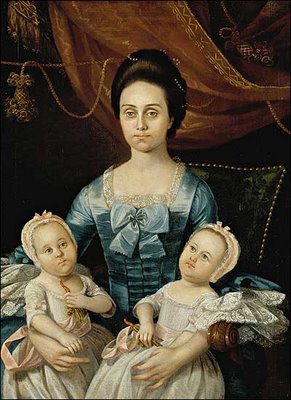
Mrs. Thomas Bolling with children, 1773. One can see the style of clothes baby Cassandra and Mrs. Austen would have worn after her birth.

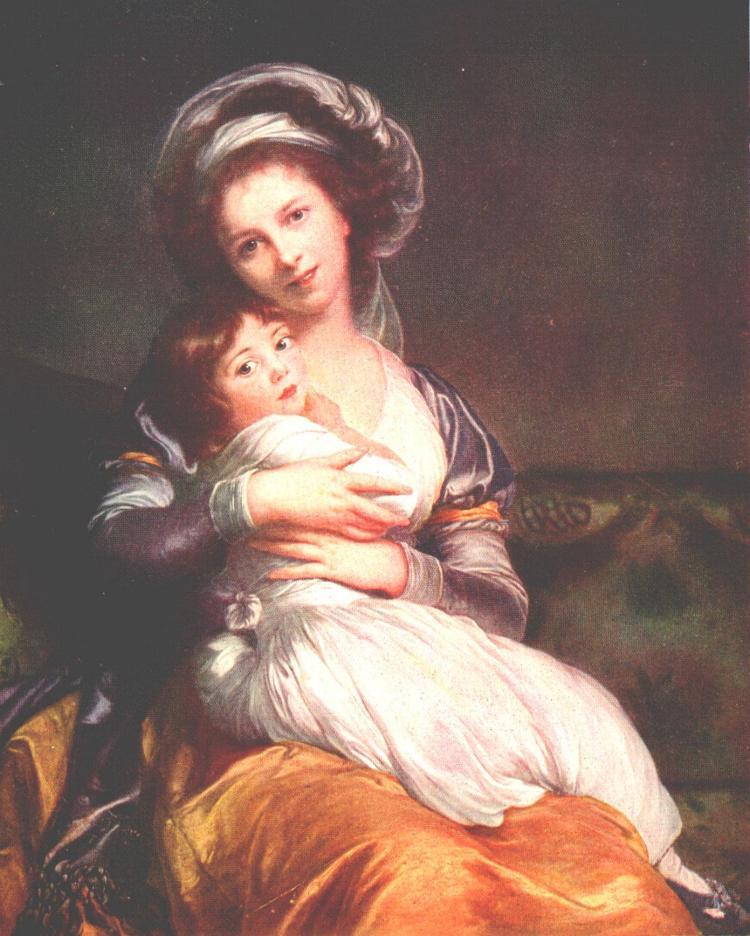
Madame Vigee and child, 1780. Cassandra was seven and Jane had turned five, somewhat older than the child depicted in this painting.

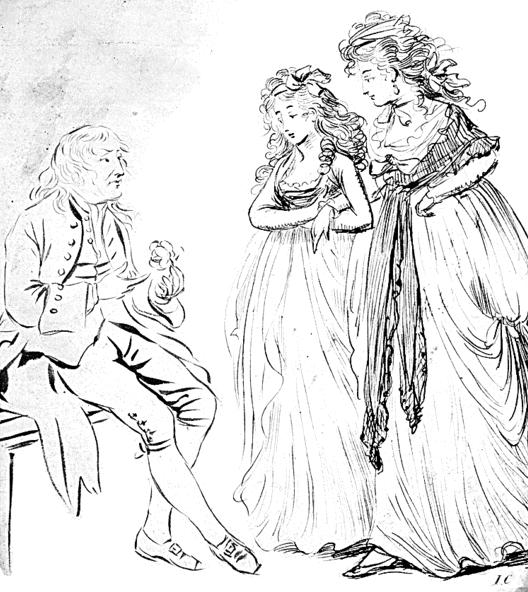
Isaac Cruickshank Sketch 1790. Jane Austen would have been 15 and Cassandra 17 years of age. This image is NOT of the Austen sisters.

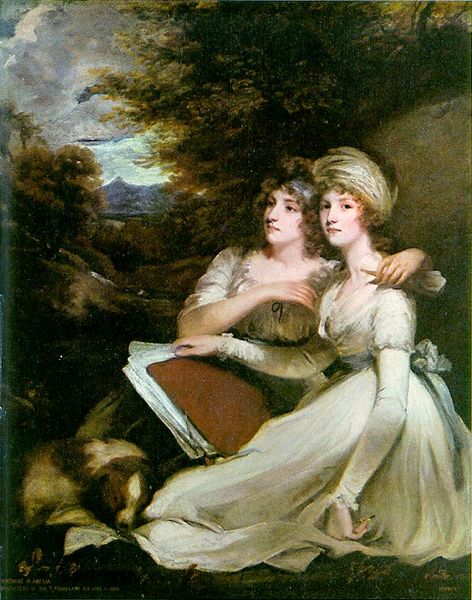
Jane Austen was 20 and Cassandra 22 when Hoppner painted this image of the Frankland sisters in 1795

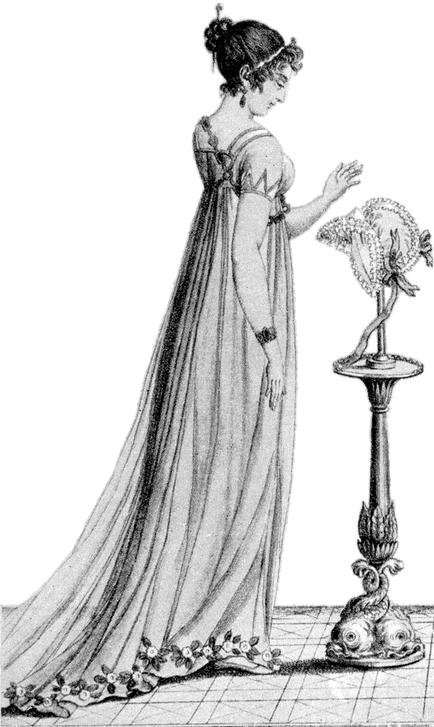
Chemise dress, 1799. Lovely lines, but the trains so popular during these years must have collected dust and dirt.

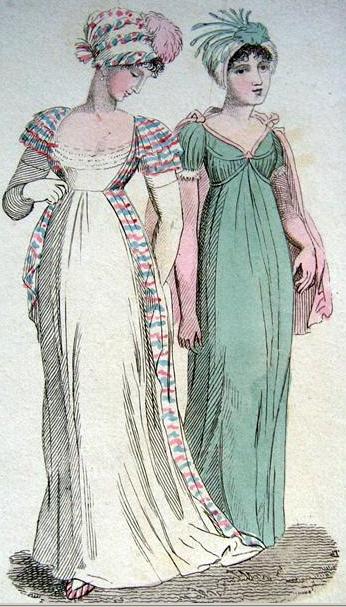
Afternoon dresses, Lady's Monthly Museum, 1802

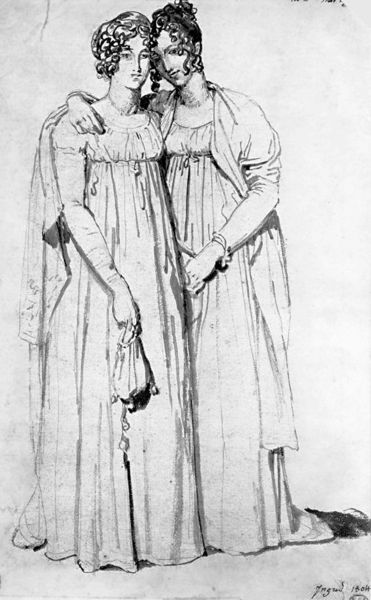
Ingres drew the Harvey sisters in 1804 when Jane was 29 and Cassandra had turned 31

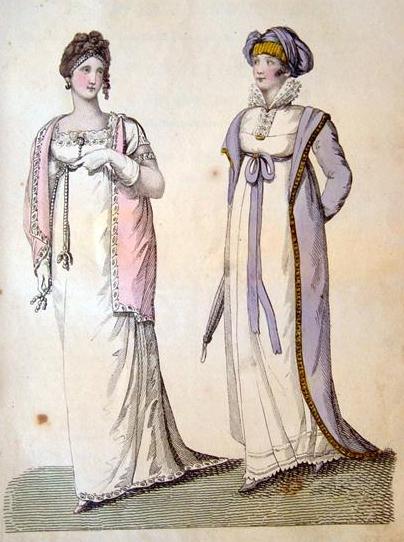
Belle Assemblee, English Costume 1807. Short trains are still fashionable.

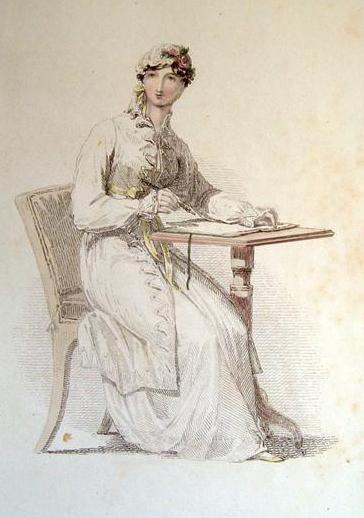
Regency morning dress 1813

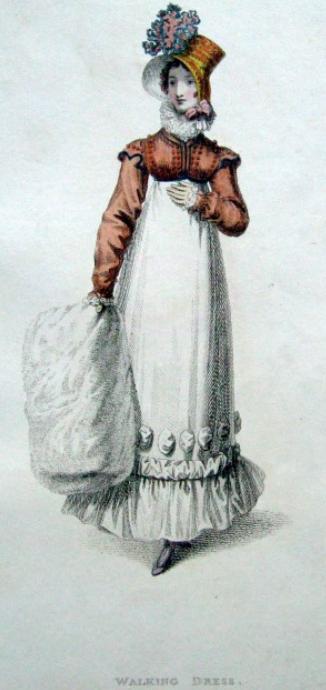
Walking dress 1817, the year Jane Austen died

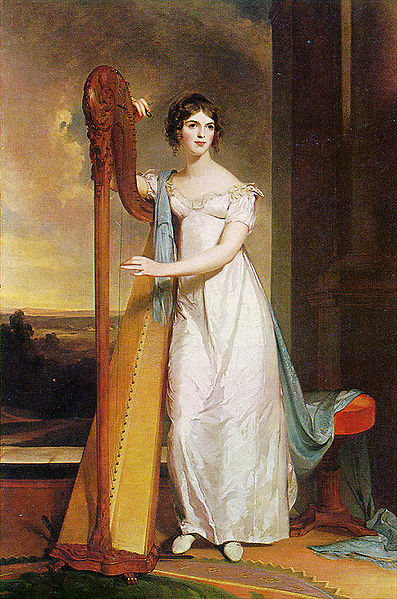
Eliza Ridgely painted by Sully, 1818.

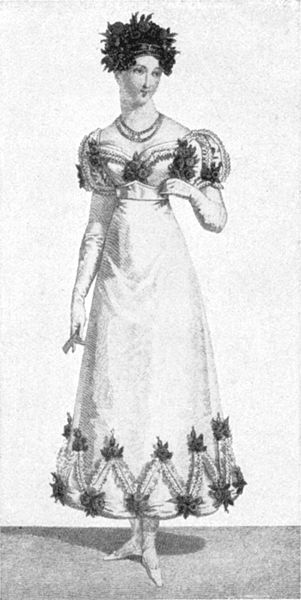
Ball gown, 1820. Notice the shorter dress length and the fancy hem.

Rust brown redingote, 1823

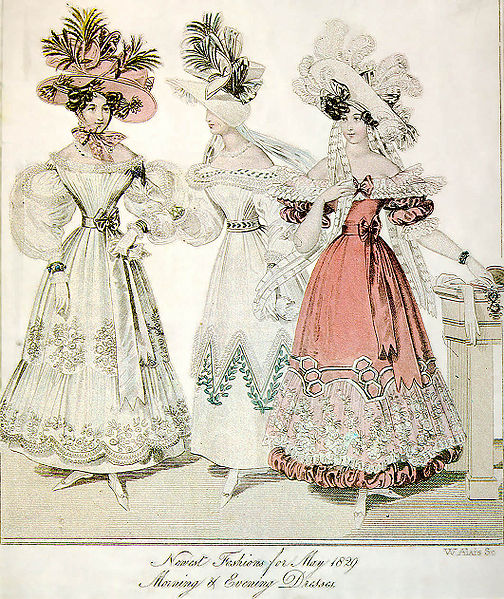
Morning and evening dresses in 1829. Notice how the elaborate hats and hairdos balance the large sleeves. The waistline is situated almost at its natural position and the hemlines reveal slippers and trim ankles.

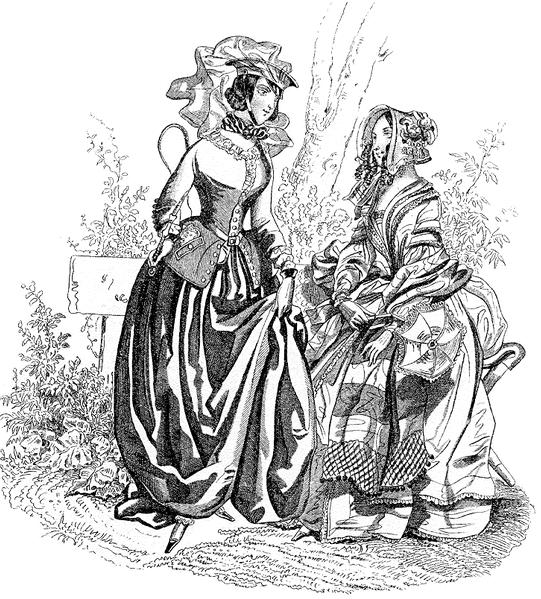
Riding Habit, 1842

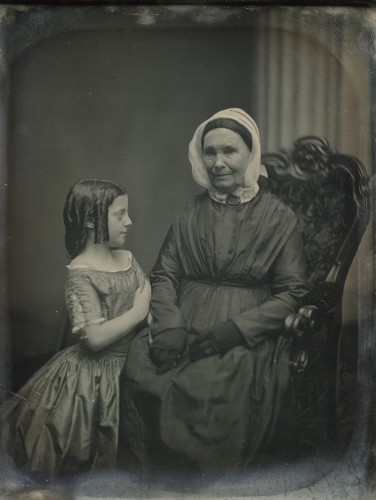
Would Cassandra have resembled this old woman in 1845, the year of her death?

Review of the changes in fashion silhouettes

More on the topic

Read Full Post »

Everything we now use is made [in] imitation of those models lately discovered in Italy. – Observation by an Englishman

diana sackville detail 1777

Diana Sackville, 1777

In the late 18th century, hairstyles for women took a dramatic turn from the pouffed-up and constructed hairdos of the earlier Georgian age to the simple hair styles inspired by the Greeks, Romans, and Egyptians. Curls now framed the face and chignons replaced the complicated, almost architectural concoctions that took hairdressers hours to create. Ancient statues and works of art brought back as spoils of war or as souvenirs from grand tours revealed classical hairstyles. Women began to wear simpler hairdos with long hair pulled back in chignons or simple pony tails, long curls trailing over the shoulder, and short ringlets framing the face. Hair ornaments consisted of flower wreaths, ribbons, jewelry, tiaras, and combs.

greek and roman influences

Hairstyles on statues from antiquity

Lady Caroline Lamb (lower left) sported a saucy short bob, whose influence can be seen from the portrait in the Roman mural at the Metropolitan Museum. Madame Recamier, whose hair is longer, achieves a similar effect with ringlets around her face. Her curly hair, gathered in back, allowed the ringlets to fall. At right, the Marchioness of Queenston achieved a very similar style to Madame Recamier’s, but her bandeau sat further back on her head and the ringlets framing her face were thicker.

Curly styles

Longer hair, while not as prevalent as the up-do’s, usually took the form of a long curl draped over the shoulder. At second to right, Mrs. Henry Baring wore a more casual “do”, with her locks streaming around her neck and shoulders.

long hair

The long curl

Straight, simple hairstyles with few ringlets and ordinary bangs, or a style simply parted in the middle were worn, but were not drawn or painted by artists or depicted in fashion plates as often as the curlier styles.

plain ringlet free

Fashion plates of the time show how these hairstyles looked with bonnets and hair ornaments with a (l – r) walking dress, ball gown, afternoon dress, or morning dress.

fashion plate

The hairstyles that Kate Winslet and Emma Thompson wore in Sense and Sensibility seemed to be particularly true to the period (in my opinion). Some of you may have noticed that I use Kate Winslet’s image of Marianne as my avatar.

hair styles

This image of a Roman statue (a copy of an earlier Greek statue) shows the hairstyle that would become prevalent in the later Regency/early Victorian era (1820’s to 1830’s).

marble head of a woman roman copy of greek statue

1st C. AD Roman bust

“We wore white crepe dresses trimmed with satin ribbon & the bodices & sleeves spotted with white beads. . . Thursday night, Pearl combs, necklaces, earrings, & brooches. . . Tuesday evening we had sprigged muslin. . . gold ornaments & flowers in our heads & Friday we wore yellow gauze dresses over satin, beads in our heads & pearl ornaments” – Fanny Knight Austen

Evening dresses, fronticepiece, The Mirror of Graces,, 1811

Fanny Knight wrote a vivid description of how women dressed and what sort of accessories were popular when she was a young woman. The 1811 fronticepiece to The Mirror of Graces (above) shows how simple and elegant the combination of Neoclassical hair, dress, and accessories looked.  Jewelry styles favored smaller, lighter forms of draped chains and classical motifs, which were reflected in hair ornaments. These days jewelry from the Georgian era is difficult to find, for many of the pieces were refitted or redesigned to reflect motifs of the neoclassical period. (Neoclassical Jewellery ). Ebay Guides can be extremely useful in researching information about this era, such as this one entitled,  Georgian and Regency Combs and Hair Accessories – 1800-1814. (Click here for the PDF document.)
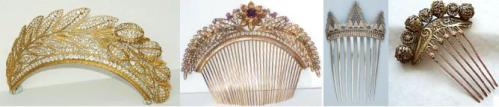
tiaras and combs

Georgian tiara and combs, early 19th c.

In addition to gold and silver hair ornaments, such as tiaras and diadems, young women wore silk ribbons, strands of pearls, feathers and other fancy hair ornaments in their hair, most notably for balls and formal occasions. These hair jewels were a visible sign of a family’s or husband’s wealth. Bonnets, hats, or turbans were also worn on social outings. The second image from the right (above) is of a George III silver comb, 1807.  “Silver combs of this type appear to have been a speciality of Birmingham, where they were produced in a small quantity and in a collectable variety of forms.” (Cinoa)

As the Regency era progressed long hair became increasingly popular and full ringlets began to appear near the side of the face. Hair ornaments for balls included jewellery, bandeaux, turbans and wreaths of grapes and towards the latter end of the Regency era flowers, turbans and ostrich feathers were seen to adorn the hair. (Overseale House)

ornaments

These days we achieve curls and ringlets with a hot curling iron. The use of hot irons in the 19th century was tricky, for hair could easily be singed. Back then, curls were made with pomade, a hair gel, and curling papers. The lost art of the paper curl describes how a person today can make a similar curl using old-fashioned techniques.

Lydia is exposed to an unregency like cut

Perdita Weeks as Lydia Bennet in Lost in Austen

The transition from the structured hairstyles of the mid-18th Century to the Regency period was not achieved without its own set of complications, as this James Gillray cartoon shows. The cartoon was drawn in the earlier Neoclassical period, when round gowns were still worn.

gillray fashion cartoon

A lady putting on her cap, Gillray, 1795

The fashion plate below shows how charming and uncomplicated, yet classic, the combination of the 1802 hairstyles and afternoon dresses are together, whereas the 1811 fronticepiece showed how rich both hair and fabric can be made to look using similar principles of fashion design.

1802 Lady's Monthly Museum afternoon dress june Payne Milliner Old Bond Street

Afternoon Dress 1802 Lady's Monthly Museum

More links on this topic:

Read Full Post »

« Newer Posts - Older Posts »