Feeds:
Posts
Comments

Archive for the ‘Fashions’ Category

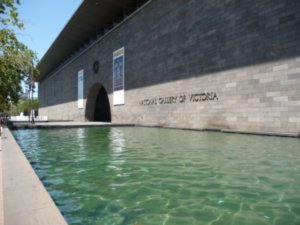
The National Gallery of Victoria

The National Gallery of Victoria

Inquiring Reader: Emma, the author of this post, lives in Melbourne, Australia. After she interviewed me for a class assignment, I asked her if she would give us her impressions of the the fabulous fashion show at the National Gallery of Victoria. Happily, she said yes. Click here to read an article on Jane Austen Today and for more images from the exhibit. I first featured this post on Jane Austen Today and decided to embellish it a little, adding more images of the museum and items in the exhibit. New links have been added, as well as additional comments about the dresses. About 50 costumes were shown in the exhibit. If you click on all the links to view images on other sites, you will see about 20% of the outfits and a few of the Regency items that accompanied them.

Entrance arch to the National Gallery of Victoria

Entrance arch to the National Gallery of Victoria

Entrance to exhibit

Entrance to exhibit

The National Gallery of Victoria has a permanent space for textile exhibits that is often overlooked by visitors. So, you can imagine my surprise when I entered the Persuasion space and found it far from empty. There were young children, middle aged couples, elderly couples and a selection of tourists, all gathered in the rooms openly admiring the clothing and documents behind their glass cases.
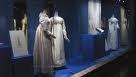
Exhibits with dresses, drawings and artifacts

Exhibits with dresses, drawings and artifacts

The collection was set up beautifully in their cases, decorated to become rooms – painted blue, with pianofortes, writing desks and sitting chairs.

It was interesting listening to the thoughts of those around me, with many observing the “heaviness of the walking dress” and the “gorgeous detailing on that white muslin.” Of course every woman in the room stopped to admire the outfit worn by Colin Firth in the BBC adaptation of Pride and Prejudice, no doubt reliving the lake scene.

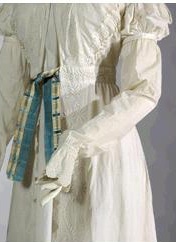
Detail, cotton muslin dress, 1815
Detail, cotton muslin dress, 1815

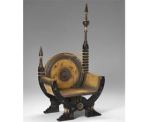
Regency chair "throne"

Regency chair "throne"

With so many pieces to choose from I had no idea how I was going to pick one or two to write about, but finally I have settled on the ball and the walking dress.

Having read many ball scenes in Austen’s works it what inevitable that I would love the ball dress. The dress was an empire line, with a skirt that went outwards into a cone shape, and the sleeves were puffed with lace detailing. It was interesting to read the plaque which revealed just how complicated the ball dress actually was – with there being gauze, embroidery with silk floss, lace, satin, piping and some sort of plants vine used in its construction.

And then there was the walking dress, a dress that I’m not sure I’d like to go for a walk in myself. I’d expected something lighter so I was very surprised by the heavy bronze satin dress in the case. It appeared very restrictive – fitted, long tight sleeves – but was incredibly beautiful and well made.

The bronze walking dress is at right

The bronze walking dress is at right

The exhibit closes at the gallery on November 8, 2009. I encourage anyone that can make it to go. It’s free of charge and definitely a collection not be to missed.

This 1802 round gown is similar to one that Jane Austen would have worn

This 1802 round gown is similar to one that Jane Austen would have worn

Click here for an audio tour of the exhibit. In it you will learn that this exhibit shows the more provincial, country dresses that were designed for walking and outdoor activities. Empire dresses allowed for a greater freedom of movement than in previous eras. The thin cotton, often low-cut gowns also revealed more of a woman’s figure than before, prompting Jane Austen to write about a vicar’s wife that she was “nakedly and expensively dressed.”
pub_Persuasion_P

Pelisse and dress, 1818

Pelisse and dress, 1818

More links to images:

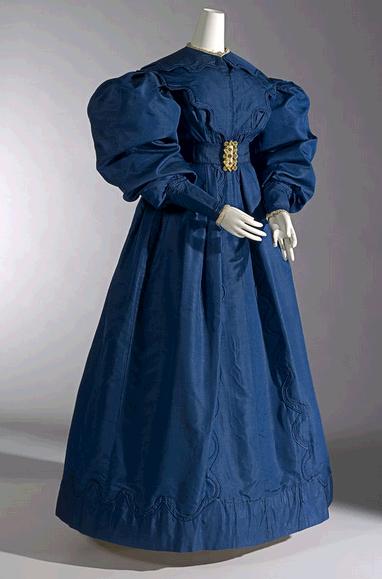
Carriage dress, silk gros de naples, 1830

Carriage dress, silk gros de naples, 1830


Photos NVG

Read Full Post »

Romola speaks as emmaEmily Hill of the Evening Standard isn’t thrilled with this adaptation of Emma:
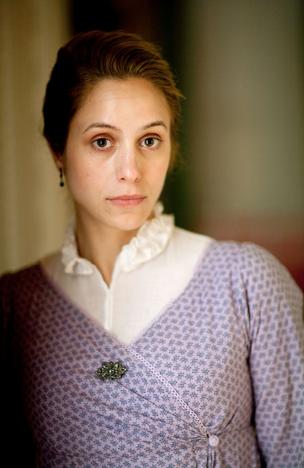
The tension of the series comes not from the characters being marooned in stuffy Regency England, but from the bizarre twenty-first-century dating psychobabble. At some point, whoever created this very pretty 9 pm drama seems to have thrown the actual novel aside and adapted the work with exclusive reference to other Jane Austen adaptations and what they think middle-aged women want to down with their end-of-Sabbath Chardonnay. Even the actors seem to be stuck in synthetic Austen-land.

My review of Emma sits at this link

Having watched 3/4 of the film, tell us what you thought of Emma, Episode Three


My rambling discourse about hair echoes my thinking about this production of Emma, for I can’t decide whether I like it or not. Count me as one of the viewers who is still sitting on the fence. I understand that the producers wanted to modernize and jazz Emma up, so that a new audience can appreciate her story. But many liberties were taken in the process,  such as with Jane Austen’s dialogue and wit, which are practically nonexistent. Let’s examine the hair styles in this film. Ringlets were in vogue at the time Jane Austen wrote the novel. They peeped out of bonnets and mobcaps. Even when hair was pulled back into a chignon, ringlets would be fashioned around the face and in front of the ears.

harriet smith hair
In this image, Harriet Smith’s hair style has ringlets aplenty, but is more reminiscent of the updos worn in 1826-1832, when the ringlets resembled poodle ears. Of course, this hairdo did have a certain cinematic effect, for Harriet is a bit silly and naive and the hairdo suits her personality to a tee. If you recall, Mrs. Bennet (Alison Steadman) in 1995’s Pride and Prejudice was given a similar hair do, and every time she spoke, her ringlets shook, making her seem even sillier.

Ballgown 1826

Ballgown 1826

Fashion plate 1832

Fashion plate 1832

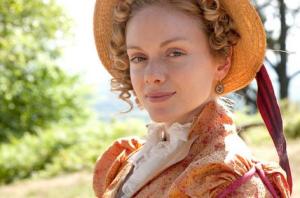
In the next image, Christina Cole (Augusta Elton), below, demonstrates the sort of hair/bonnet combination I have come to associate with the era. Her loose ringlets peep out from under her straw hat most becomingly.
augusta elton Christina Cole
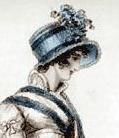
Emma was published in 1815. Let’s compare Augusta’s hair and cap to fashion plate images of the same year. Close enough, don’t you think? Her bonnet is different, but there were many modish styles to choose from and one can’t quibble with a becoming straw cap.
1815 cap and bonnet1815 bonnet

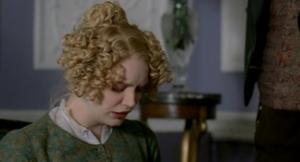
Jodhi May as Mrs. Weston

Jodhi May as Mrs. Weston

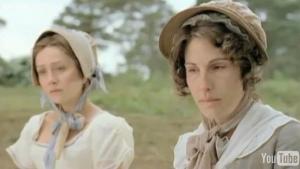
Why was such a plain and unflattering hairstyle chosen for beautiful Jodhi May? Was her hair Quakerish on purpose so that she would not compete in beauty with Emma? At this point she is no longer a governess, but the mistress of her own house and can dress herself accordingly. Even poor Miss Bates (sitting at right below) shows more attempt at “styling”.

Miss Fairfax and Miss Bates at Box Hill

Miss Fairfax and Miss Bates at Box Hill

This plain upswept chignon was adorned with simple curls in front of the ears, which would have helped Jodhi’s hairstyle immensely, making it seem more “authentic.”
chignon ringlets
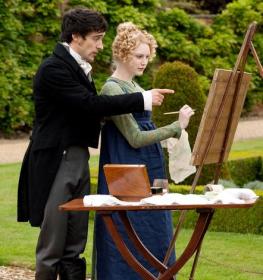
In this image, Blake Ritson wears his hair a la Brutus, a style commonly worn by men in the Regency era. Poor Harriet (Louise Dylan) is stuck with the poodle style for the duration of the film.
blake ritson and louise dylan
In the image below, Blake looks like he’s about to enter Bedlam, which I suppose was his hair stylist’s intention, for Mr. Elton IS a ridiculous character. Still, Blake’s facial ticks should have been enough to clue the viewer in. We didn’t need crazy hair as well.

Did the stylists use 21st century hair gel to accomplish this style?

Did the stylists use 21st century hair gel to accomplish this style?

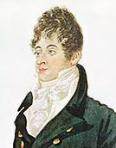
To be fair, men pomaded their hair and created fantastic styles. Witness Beau Brummel in 1805.

BeauBrummellKlein

beau 1805

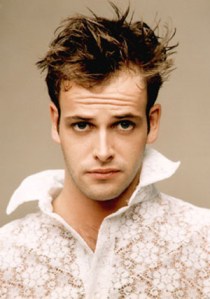
Which begs the question: Why did Jonny Lee Miller fashion his hair a la the 21st century?

Oops, wrong image

Oops, wrong image

I meant to insert this one

I meant to insert this one

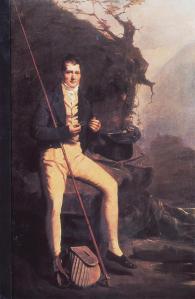
Men wore their hair in many styles, some elaborate, and some quite sleek and modern to our eyes. Jonny’s hairstyle is remarkably close to McMurdo’s below, who, from the neck up would not look too out of place in today’s world.

Lieut Colonel Bryce McMurdo, 1800-1810 by Henry Raeburn

Lieut Colonel Bryce McMurdo, 1800-1810 by Henry Raeburn

Women often wore caps in bed, which they drew over their paper curlers.  Hair was washed only occasionally in those days, and caps prevented pillow cases from being soiled from accumulated oil and dirt.
harriet sick

Ok, we get it. Harriet is SICK. Where is her night cap?

I just had to include the image below. Yes, very young girls at that time wore their hair loose, and, yes, they had to be taught their manners.  (For aren’t we all little savages until our governesses teach us better?) For my finnicky taste, this image shows a woman who is much too modern in hairstyle and facial expression. At the very least, Emma would have been taught to place her hand in front of her mouth when yawning.

yawn Goodness. What would the servants have thought?

I’m still on the fence, waiting to like this film adaptation. It seems that the numbers are tanking and people are not staying with the show (a bad omen for the future of bonnet movies on BBC). Kali at StrangeGirl.com and blog author of Emma Adaptations is still liking this adaptation, although elements are starting to get on her nerves. Please feel free to agree or disagree with anything said in this post. :)

Read Full Post »

Prior to the 19th century, children were dressed as miniature adults…

18th c. Girl With a Kitten, Jean-Baptiste Perronneau

18th c. Girl With a Kitten, Jean-Baptiste Perronneau

Children’s fashion often preceded similar changes in adult clothing. Simple frocks for girls in the closing decades of the 18th century foreshadowed the fashionable high-waisted, neo-classical style that would become popular for women during the first decades of the 19th century.

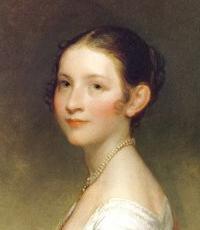
1790 Portrait of a Girl, John Hoppner

1790 Portrait of a Girl, John Hoppner

This pastoral image of a young girl by Thomas Gainsborough is a reminder that poor girls wore “tattered hand me downs or clothes made of coarse woollens and rougher cottons or mixtures like fustian.” (Fashion-Era)

Cottage Girl with Dog and Pitcher, Gainsborough, 1785

Cottage Girl with Dog and Pitcher, Gainsborough, 1785

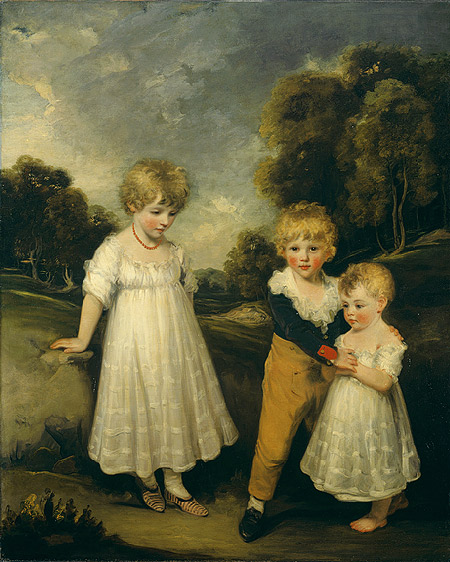
The easy, loose-fitting shifts below made it easy for little girls to play. The little boy’s skeleton suit is described in the post below.

The Sackville Children, John Hoppner 1797

The Sackville Children, John Hoppner 1797

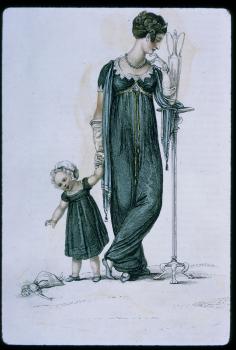
A little girl’s mourning dress in 1809, although black, remained comfortable and unrestrictive. More details about this dress are at this link from Jessamyn’s Regency page.

Mourning dress, Ackermann plate, 1809

Mourning dress, Ackermann plate, 1809

Childrens’ fashion posts on this site:

Read Full Post »

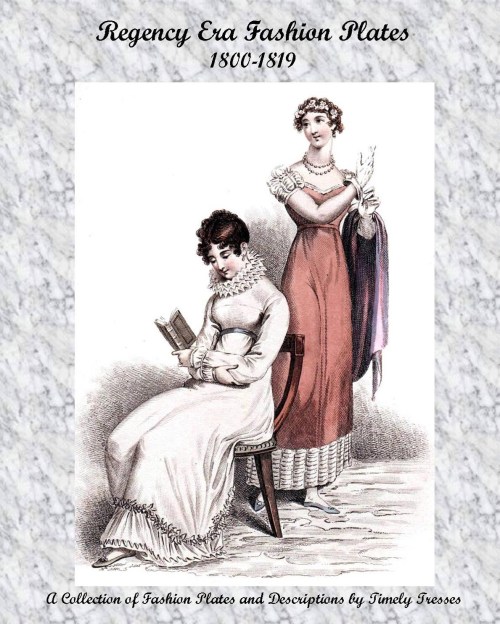
1800-1819 Cover Fashion Plates
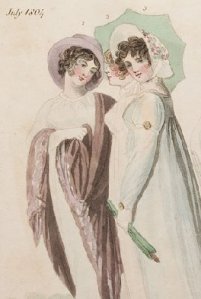
The moment I learned of Regency Era Fashion Plates, 1800-1819: A Collection of Fashion Plates and Descriptions by Timeless Tresses, I ordered it. Available in the U.K. through the Jane Austen Centre and at Amazon.com in the U.S., the book is not inexpensive. (My copy cost $44.) When it arrived I immediately tore open the package and began to peruse the book, which contain pages upon pages of colored fashion plates almost full copier paper size. That’s the good news. Compiled from the personal collections of Timely Tresses, the book is the joint venture of Mandy Foster and Dannielle Perry, two participants in living history who research fashion and create costumes based on the plates of a particular historic era. This is not the team’s first compilation. If you visit their site, you can choose from a variety of fashion plate books. But as I went through the book I was disappointed to find out that, while the fashion plates are arranged in date order, very few come with descriptions, nor are they identified by the season for which the dresses were designed. The plates are so large that in some instances they are blurred, and except for the cover, their colors are washed out.

Detail of a plate in the book, Costume Parisien, 1799

Detail of a plate in the book, Costume Parisien, 1799

For those who are new to Regency fashion, it would have been helpful if these two seasoned collector/historians had shared some pertinent information about their fashion plates, helping the reader to “see” the changes in the silhouettes and styles of the gowns, where the fashion influences came from, and the difference between British fashion of the era and French fashion. Over half the plates are from Le Journal des Dames et des Modes Costumes Parisien or Costumes Parisien.  The Journal des Dames et des Modes was published in Paris from 1797 to 1803 and called Costume Parisien from 1803 to 1839. Until about 1825 the plates were drawn by Horace Vernet, which means that all of the Parisien plates in this book were drawn by him.

Before the Napoleonic wars, there had been a “pan-European” approach to dressing in which the rich and fashionable from countries across Europe largely wore similar fashions influenced by Parisian designs. But because of the war between the two countries, Britain and France took distinctly different approaches to dress design between 1808-1814. During this time period, very little information about fashion trends was shared. French waistlines remained high as British waistlines were lowered. Except for a few Ackermann plates, Regency Era Fashion Plates, 1800-1819, largely ignores British fashion during this 6-year time span, with most of the plates coming from Costumes Parisien. Since the book aims to be a resource for those desiring to make accurate costumes of the era, these differences need to be pointed out. A costumer for a film or play might mistakenly use  a French fashion plate to create a gown for a British character, for example. When British women were finally allowed to visit Paris after the war, they saw a stark difference between their British designed gowns and Parisian high fashion. In no time the French influence took over once more and British waistlines crept up again. After 1820, French designers looked across the Pond for inspiration and English-inspired motifs became all the rage.

The most obvious differences between British and French fashion would have been in the use of lace. Through a decree by Napoleon, French ladies were forbidden to use British fabrics, resulting in the revival of the French Valenciennes lace industry. British dresses began to be heavily influenced by Romantic motifs, such as the Gothic, whose embellishment looked ridiculous and cumbersome to the French.  I had hoped that these trends would have been pointed out clearly in the book and discussed at some length by the authors, but the annotations were sorely lacking, and only the end plates and a very few plates at the beginning describe the details of cloth and trim that the gowns were made of.  Even the simple expedient of sorting the plates according to year AND season would have made the plates easier to understand. (It is hard to tell whether the dresses were to be worn in fall or spring, for example.) Thankfully we can turn to the Ladies Monthly Museum on Cathy Decker’s site for some of the descriptions, but, frankly, this is a lot of work that the book could have saved us. One other point: the book concentrates solely on women’s fashion. Anyone looking for examples of men’s or children’s clothes of the era must look elsewhere.

3 regency fansFor the number of fashion plates, I give the book 3 out of three Regency fans. For overall impact and usefulness, I give it 2 out of three.
More links:

Regency Era Fashion

From Classic to Romantic: Changes in the Silhouette of the Regency Gown

Read Full Post »

The clothing that families have saved over the centuries were usually those items that were special or particularly treasured. This blog – Trouvais – features samples of the most lush 18th and 19th clothing imaginable.  Combined with luxury items of today, the site is a feast for the eyes.

Detail, early 19th c. redingote

Detail, early 19th c. redingote

Meg Andrews is another site worth visiting. Delectible clothing and items from the past are featured. Visiting the site makes you feel as if you have entered a museum.

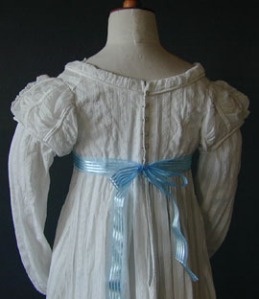
Striped cotton dress, 1810

Striped cotton dress, 1810

David Brass Rare Books may seem like an odd site to feature as a fashion site, but its rare and illustrated colored books show images of people in the past. One can easily concentrate on the Regency period and have plenty to view. One image, which I have shown previously, is from a book entitled The Fashions of London and Paris, 1798-1810.

Close up, Promenade in Kensington Gardens, 1804

Close up, Promenade in Kensington Gardens, 1804

I must also brag a little about my site. I don’t feature commentary about every facet of fashion like Cathy Decker, but I have gathered an extensive list of links . You may click on Social Customs During the Regency Era in the tab above and scroll down to fashions, or view the fashion links to the right in my sidebar, where such gems as Vintage Textiles sit. You can also read my fashion posts at this tagged link: Regency Fashion. Enjoy!

Sold Directoire dress from Vintage Textiles

Sold Directoire dress from Vintage Textiles

Five Old Things showcases three posts of a trip to the Costume Museum in Bath. The three posts are heavy with images, like this one of an 18th century man’s coat, embroidered waistcoat and pants.

Man's suit with embroidered waistcoat

Man's suit with embroidered waistcoat

Read Full Post »

« Newer Posts - Older Posts »