Feeds:
Posts
Comments

Archive for the ‘Fashions’ Category

Once upon a time children wore miniature versions of their parents’ clothing styles. Then, in 1780 or 1790, depending on the source you read, children began to be dressed differently, wearing fashions designed just for them.

Bowden Children, John Hoppner, late 18th c.

Bowden Children, John Hoppner, late 18th c.

Skeleton suit, Kate Greenaway

Skeleton suit, Kate Greenaway

Not that small boys, left to their own devices, would have worn high-waisted, ankle length trousers made of heavy cotton or linen and white cambric shirts with ruffled trim, but these “skeleton suits” as they were called were popular for at least fifty years. The pants had high waists, because they were buttoned onto the long sleeved jacket.

Although these long-sleeved, trousered suits were meant to be comfortable, they had three layers at the waist, not including underwear. Heaven knows how hot the boys must have felt in the summer or during active play! Or how quickly the white ruffed shirts soiled! Completing the outfit were white stocking, flat-soled strap slippers, and a military-style cap. The strapped slippers can best be seen in the 1841 fashion plate image at the bottom of this post.

Boy with cap

Boy with cap

A skeleton suit, one of those straight blue cloth cases in which small boys used to be confined before belts and tunics had come in … An ingenious contrivance for displaying the symmetry of a boy’s figure by fastening him into a very tight jacket, with an ornamental row of buttons over each shoulder and then buttoning his trousers over it so as to give his legs the appearance of being hooked on just under his arm pits. (Charles Dickens, Sketches by Boz, 1838-39.)

webmedia.php

Adding insult to injury, was the underwear that young boys wore under these layered clothes. This sample comes from the Manchester Art Gallery.

Detail of The Hoppner Children, 1791. Formal skeleton suit.

Detail of The Hoppner Children, 1791. Formal skeleton suit.

The smaller the boy, the more elaborately frilled the collar. Colors were generally light, with the most popular being blue or green. Sometimes the suits were made of scarlet or mustard as well. For more formal occasions, a colorful sash might be added and the trousers made of silk or velvet and trimmed with lace. A young man about to go to Eton would wear the larger Eton collar.

Detail of Fluyder Children, Sir Thomas Lawrence. Skeleton suit with sash

Detail of Fluyder Children, Sir Thomas Lawrence. Skeleton suit with sash

Detail, 1841 fashion plate

Detail, 1841 fashion plate

More Links:

Little Anne illustration, Kate Greenaway
Little Anne illustration, Kate Greenaway
Read Full Post »

Inquiring reader, in honor of this week’s tepid heat wave in Richmond, I continue my coverage of all things seaside during the Regency era. To our moderns eyes, Regency fashions by the seashore covered as much of the body as ordinary clothes, and were as complicated as regular fashions. Let’s take a closer look.

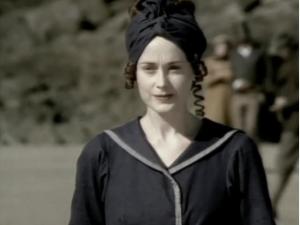
Becky Sharpe (Natasha Little) in bathing costume, Vanity Fair 1998

Becky Sharpe (Natasha Little) in bathing costume, Vanity Fair 1998

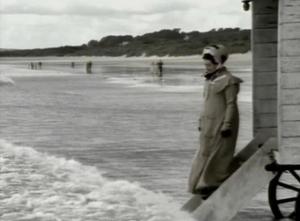
I question this image from 1998’s Vanity Fair, in which Natasha Little as Becky Sharpe looks more like a Victorian seaside gamboller than a proper Regency lady. In addition, she would have changed into this bathing costume inside the bathing machine and gone into the water largely unnoticed. She is shown in full view of both men and women on the beach wearing this outfit, which was clearly meant for swimming.

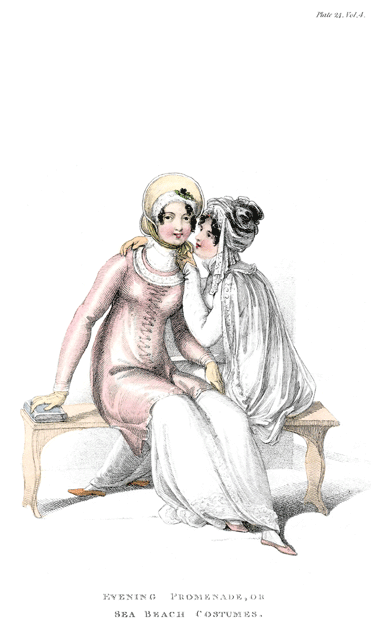
This Belle Assemblee fashion plate depicts a more demure approach to seaside fashion. The muslin gowns are rather plain, meant for the day, but it is only 1810 after all, when dress silhouettes were still classically severe. These dresses could be worn in full view of other vacationers on the beach. One sees the “wrapping” in the style of the turbans and pelisse and cape. A seaside outing was meant to be bracing and restorative, and therefore people would venture to the beach regardless of the weather.
1810_October sea beach costume

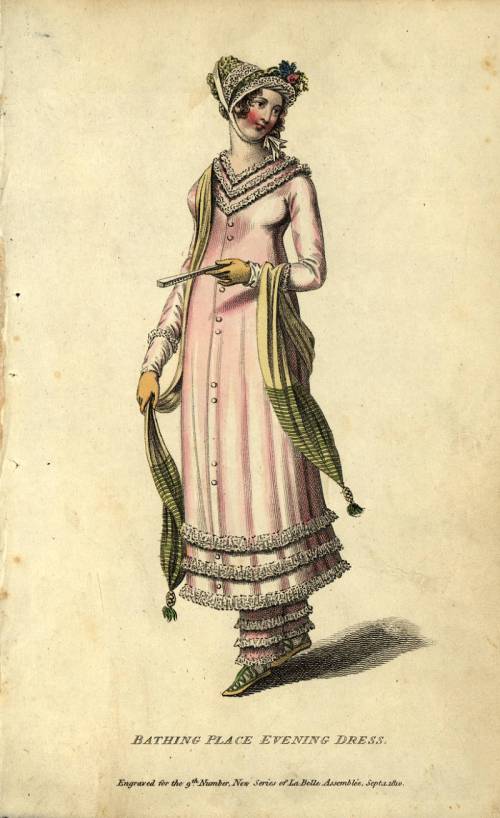
The women are sitting, or else the length of the dress would become obvious. The length of dresses meant to be worn when walking along the shore were cut a little higher, one supposes to accommodate a walk along the beach when sand and waves would wreak havoc with delicate hems. The lady in the illustration is dressed for the evening, perhaps for a fete on a public pier, who knows? Either way, she is dressed to be seen in high style, even if the tiered lacy hems of her bloomers are showing.

Bathing place evening dress, 1810

Bathing place evening dress, 1810

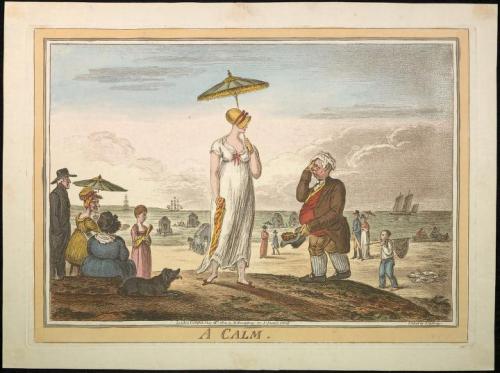
Famed illustrator James Gillray showed seaside fashion in all its glory. From the high tide hem of the lady in the center, to the completely covered up garb of the women sitting on the beach. This lovely illustration from 1810, “The Calm,” shows the seashore on a calm day, with our fashionable miss as exposed as she can decently be – her arms and neck bare, her head covered by a small straw bonnet, and her tiny parasol barely protecting her delicate skin from Sol’s harmful rays.a calm 1810 gilray
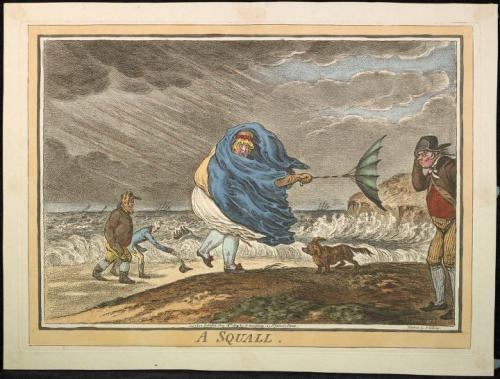
This illustration shows the sea shore on a raw day that many Britons will recognize, with the winds whipping up waves, woolen capes, and muslin skirts. Even covered up, this lady exposes more to prying eyes than was appropriate!

A squall, Gilray 1810

A squall, Gilray 1810

Taking cold dips in the ocean and drinking foul-tasting spa water were two of the health benefits derived from visiting a seaside resort. Inhaling the fresh sea air was another. These fashions again show how thoroughly one covered up before venturing out of doors.

Poetical Sketches of Scarborough, 1813

Poetical Sketches of Scarborough, 1813

Regardless of their location in or out of the water, non-swimmers remained covered up. It is ironic that once in the water, so many men and women would swim completely naked, but there you have it: Seaside, Regency style.

Steps to the sea, Vanity Fair, 1998

Steps to the sea, Vanity Fair, 1998

On a side note, a dog lover like myself will find the Gilray prints and the Scarborough print quite interesting, for dogs are prominently displayed as realistic touches.

Read Full Post »

Wednesday, June 27, 1711, Mr. Addison writes a letter to The Spectator:

Mr. Spectator – Women are armed with fans as men with swords, and sometime do more excution with them. To the end therefore that ladies may be entire mistresses of the weapon which they bear, I have erected an academy for the training up of young women in the exercise of the fan, according to the most fashionable airs and motions that are now practiced at court. The ladies who carry fans under me are drawn up twice a-day in my great hall, where they are instructed in the use of their arms, and exercised by the following words of command: – Handle your fans, Unfurl your fans, Discharge your fans, Flutter your fans – By the right observation of these few plain words of commands, a woman of a tolerable genius, who will apply herself diligently to her exercise for the space of but one half-year, shall be able to give her fan all the graces that can possibly enter into that little modish machine… For the rest of Addison’s letter to The Spectator, please click here.

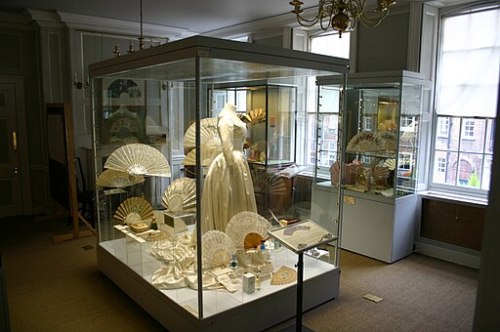
Wikimedia Commons, Image of the Fan Museum, Greenwich, UK

A lady’s fan carried far more symbolism than the mere act of cooling by agitating the air. At first considered a novelty, the fan gained popularity in Europe in the mid-sixteenth century and could be seen in the paintings of fine Elizabethan ladies. The folding fan, which was introduced from the Far East, gradually replaced the fixed fan. Made from vellum or paper, these fashionable and expensive accessories lent themselves well to elaborate painting and decoration. By 1709, fans began to be manufactured in London and a Fan Makers’ Company was established. Commemorative fans that celebrated an historic event were quite popular among the well to do, and their styles echoed the fashion of the day. Neoclassical fans, like the commemorative fan depicted above, lacked color and were generally bare of decoration, reflecting the simple white muslin dresses so popular during the Regency era. When dresses became more ornate and colorful again, fans followed the trend. They were highly prized for their aesthetics, for “in the ordinary fan of the present day Art has not strayed far from Nature.”

Over the centuries, a language of the fan evolved. Legend has it that by the time the Victorian era began fan gestures had been rigidly codified, wherein each movement and snap of the wrist carried a message fraught with meaning, although some experts dispute this. (See comment below made by Pierre Henri Biger, a fan expert.)  Once popular both during the day and evening, fans gradually became restricted only for the evening, increasing in size in the last two decades of the nineteenth century.  Their popularity waned and waxed as the quote below suggests, but until they could be cheaply manufactered in large quantities, they remained the province of only those who could afford them. In the late 19th century to early 1920’s, fans were made in profusion to carry advertisements, and were given away as souvenirs by hotels, restaurants, and businesses.*

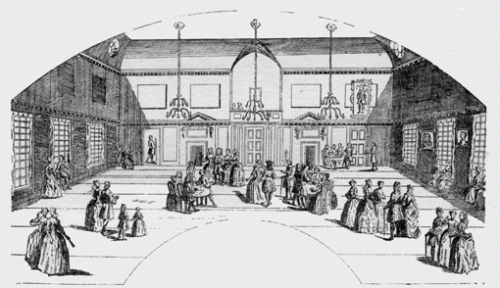
Fan Design, The Lower Rooms, Bath

Fan Design, The Lower Rooms, Bath

For just a century after Addison wrote, the fan figured prominently in polite society, matched, when the sword went out of fashion, against the snuff-box and the clouded cane, and often victorious. The satirists and dramatists wore in turn bitter and pleasant in their references to it. Painters and their sitters paraded it ostentatiously. It is said to have done wonders in diplomacy, and who could wonder at the success of flying sap and masked battery against garrisons defended by an eye-glass, a pinch of snuff, and a malacca. The fan’s apogee was in the days of the minuet de la cour. But since athletic waltzes, polkas, and mazurkas have elbowed out their courtly predecessors, the once ” modish little machine” has retired into obscurity with the “wall-flowers,” or, if at all, is used by the dancers as inartistically as though it were the archetypal ” vanne” or wind engine. Brighter days may, however, dawn, and society which, in its way back to costumes of the Watteau and Pastoral periods, has already reached the stage of short waists and long trains, may over in our time reclaim the little exile from its temporary partial shade. – Nature and Art, by Day & Sons, 1866, p62

More about this fascinating fashion accessory

Read Full Post »

glengarry habit miss mcdonaldThis description in The Grand Sophy by Georgette Heyer makes me wonder if Georgette Heyer was looking at this 1817 Ackermann fashion plate of The Glengary Habit when she wrote the passage:

When Miss Wraxton’s invitation was conveyed to Sophy she professed herself happy to accept it and at once desired Miss Jane Storridge to press out her riding dress. This garment, when she appeared in it on the following afternoon, filled Cecilia with envy but slightly staggered her brother, who could not feel that a habit made of pale blue cloth, with epaulettes and frogs, a la Hussar, and sleeves braided halfway up the arm, would win approval from Miss Wraxton. Blue kid gloves and half-boots, a high-standing collar trimmed with lace, a muslin cravat, narrow lace ruffles at the wrists, and a tall-crowned hat, like a shako, with a peak over the eyes, and a plume of curled ostrich feathers completed this dashing toilette. The tightly fitting habit set off Sophy’s magnificent figure to admiration; and from under the brim of her hat her brown locks curled quite charmingly; but Mr. Rivenhall, appealed to by his sister to subscribe to her conviction that Sophy looked beautiful, merely bowed, and said that he was no judge of such matters.

riding habit 1816
The mannish riding attire in the above image from 1816 is simpler than the first image, lacking the epaulettes, military-style piping and frogs, but it does emulate the masculine style and echoes a military overtone with the Shako hat.  It is interesting to note that until the mid-19th century tailors, not dress-makers, designed female riding habits.

Sean Bean as Richard Sharpe

Sean Bean as Richard Sharpe

The riding hat, or Shako Hat, was adapted from military headdress worn by the Infantry. By 1800, the cocked hat had been replaced by Shakos ornamented with a brass plate bearing the King’s crest. They sported  a tuft fixed in front rising from a black cockade. After each war it had been the habit of the British Army to adopt a head-cover belonging to its allies or the enemy.The cylindrical, flat-topped Shako adopted for the Infantry after the Napoleonic Wars was  in vogue among Britain’s Continental Allies.  Feminine versions of the Shako were often tied with sheer scarves which trailed behind and had feather plumes in front.

Learn more about the topic in these links:

Read Full Post »

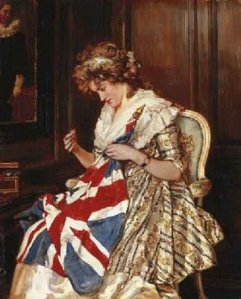
Sewing Victory, Talbot Hughes, 1900

Sewing Victory, Talbot Hughes, 1900

Talbot Hughes was a painter of romanticized genre and historical and landscape scenes who exhibited at the Royal Academy from the age of seventeen (1871) to 1903. For historical accuracy in his paintings he began to collect costumes from the 16th century to the 18th century. The collection was eventually displayed in 1913 at Harrod’s, and the clothes were afterward donated to the Victoria and Albert museum as a gift to the nation.

“The artist…has made the powder and patch era a special study, amassing wardrobes of sacques, flowered brocades, high-heeled mules, and full-bottomed wigs.” He dressed the models for his genre scenes in these clothes, styling hair and accessories to match, mor or less. His painting The Union Jack, for example, shows a ‘comely wench, with elaborately curled locks and a gold and white brocade sacque’. The neoclassical floral stripes of her silk jacket would seem to date from the late 1770’s, whilst her hairstyle and neckerchief are styled to the 1785-90 period. This painting was first shown at the Fine Art Society gallery in London in 1902. – Establishing Dress History, Lou Taylor, 2004,  p. 115.

What to Wear, Talbot Hughes

What to Wear, Talbot Hughes

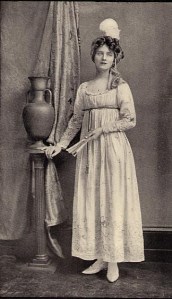
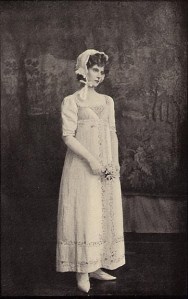
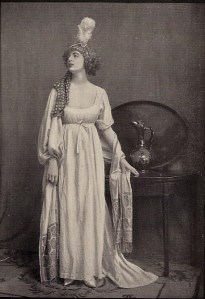
This link leads to a fascinating site that describes the collection and includes turn of the century photographs of the costumes: Old English Costumes Selected from the Collection formed by Mr. Talbot Hughes A SEQUENCE OF FASHIONS THROUGH THE 18TH & 19TH CENTURIES Presented to the. VICTORIA& ALBERT MUSEUM, South Kensington, by HARRODS LTD. London S. W.  Descriptive notes were rewritten from “The Connoisseur,” November:

Empire style dress in embroidered muslin, 1800, Talbot Hughes Collection

Empire style dress in embroidered muslin, 1800, Talbot Hughes Collection

With the French Revolution an entire change of fashion took place, admirably shown by the costumes collected by Mr. Talbot Hughes. The elaborate splendour of the patch-and-powder period gave way to an extreme simplicity of dress in the classical style. The heavy brocaded and stiff flowered skirts were replaced by light gauzes and dainty muslins, which revealed the soft contours of the female form with a delightful and child-like grace. This lasted throughout the Empire period, and, indeed, for many years after Waterloo, until the crinoline came to put out the clinging draperies.

So startling was the change that in 1799 a Russian officer, accustomed at home to estimate the rank of a lady by the warmth of her clothing, offered a woman of fashion a penny in Bond Street, under the impression that, from her scantily clothed appearance, she must be a pauper.

Gold embroidered muslin dress, Talbot Hughes Collection

Gold embroidered muslin dress, Talbot Hughes Collection

There are some delightful specimens of this period in the Talbot Hughes collection – little, clinging frocks that must have fitted the ladies inside as closely as a glove, with low bodices and high waists, and with no room for a petticoat over the silk or cotton slip. Describing the fashion in Old Times, John Ashton writes: “I do not say that our English betters went to the extent of some of their French sisters of having their muslin dresses put on damp, and holding them tight to their figures till they dried, so as to absolutely mould them to their form, but their clothes were of the scantiest. As year succeeded year the fashion developed, if one can call diminution of clothing development.”

Muslin dress, 1810, Talbot Hughes Collection

Muslin dress, 1810, Talbot Hughes Collection

That was again the exaggeration of fashion among smart women of high society; but in the middle classes the period was chiefly noted for a charming simplicity. It was Jane Austen’s period, and, wandering among these costumes with Mr. Talbot Hughes, I was reminded again and again of the dear, delightful Jane.

Here is one of the “coquelicot,” or poppy-coloured sashes, which she so much favoured, and the cambric muslins which one reads of so often in her letters, as when she wrote:

“I shall want two new coloured gowns for the summer, for my pink one will not do more than clear me from Steventon. I shall not trouble you, however, to get more than one of them, and that is to be a plain brown cambric muslin for morning wear; the other, which is to be a very pretty yellow and white cloud, I mean to buy in Bath.”

The latest mode of the 18th century

The latest mode of the 18th century

Here are high-waisted gowns such as Jane Austen’s heroines wore when they “pinned up each other’s things for the dance,” and little white caps which saved Jane herself “a world of torment as to hairdressing,” and a cap of “satin and lace with a little white flower perking out of the left, ear, like Harriet Byron’s feather,” and the cloak, or pelisse, such as Jane wore when she went out for a walk in chilly weather, and the huge muff which is so characteristic, in pictures or the time.

The colours of these silks and cotton prints are delicate and “chaste,” as Jane’s young ladies would have said, but they must be described in the language of the time, which was somewhat fanciful.

Muslin dress, 1795-1805, Talbot Hughes Collection

Muslin dress, 1795-1805, Talbot Hughes Collection

“One lady,” wrote Hannah More, “asked what was the newest colour. The other answered that the most truly fashionable silk was a soupcon de vert, lined with a soupir etouffé, et brodée de l’espérance. Now you must not consult your old-fashioned dictionary for the word espérance, for you will there find that it means nothing but hope, whereas espérance in the new language of the time means rose-buds.”

The middle-class ladies of this time were very cunning in their way of [retrimming] old materials with new adornments, and one is reminded of Jane Austen’s announcement:

“I have determined to trim my lilac sarsenet with lilac satin ribbon, just as my chine crape is. Sixpenny width at bottom, or fourpenny at top. Ribbon trimmings are all the fashion at Bath. With this addition it will be a very useful gown, happy to go anywhere.”

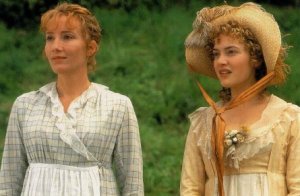
marianne_elinor_waitingThe photographs that accompany this 1913 article are especially interesting. Although the women were dressed as Regency ladies, they definitely have an early 19th century sensibility, made especially so by the hair, make-up, sets, and props. Compare and contrast our modern interpretation of regency fashion with these turn of the 20th century views. Generations from now, our images of that era will seem as dated as these nearly century old photographs.

Read Full Post »

« Newer Posts - Older Posts »