Feeds:
Posts
Comments

Archive for the ‘Fashions’ Category

James Purefoy as Beau Brummell

James Purefoy as Beau Brummell

In 2006 the BBC commissioned four films in celebration of The Century That Made UsBeau Brummell: This Charming Man is the tale of a self-made man whose innovations in male dress influenced men’s fashions for all time. James Purefoy plays the  handsome masculine dandy who dared to think of himself as the prince regent’s social equal. The prince, who was at first amused by Brummell, would watch him shave and dress in the morning. Then one day Brummell overstepped his bounds and insulted the prince. He quickly fell out of favor. Mired in debts he could not pay and with his gambling out of control, Brummell fled to France in 1816. He died in poverty in a mendicant hospital for the insane in 1840.
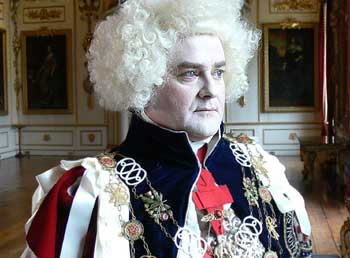
Hugh Bonneville as the Prince Regent before his transformation from fop to dandy

Hugh Bonneville as the Prince Regent before his transformation from fop to dandy

The prince regent after Beau Brummel ltransformed him

The prince regent after Beau Brummell transformed him

The film concentrates on a period in Brummell’s life when he reigned supreme as a fashion arbiter. While I found the story fascinating to watch, I thought the music ugly and distracting and totally unsuited to the 18th century. Beau Brummell: This Charming Man can be rented through netflix or purchased as a DVD. The following YouTube scenes provide a good overview of the film. The first clip is the movie’s trailer.

In the next scene, Beau Brummell describes the dandy style as “No wigs, no powders. We don’t use scent. The dandy uses trousers. The dandy washes. The dandy is clean, the dandy is neat.”

This video clip is the most interesting of all. While Brummell stands in front of his mirror shaving in the nude, the dandy set looks on. In this scene they are awaiting the prince regent’s arrival.

beau_brummell_dvd_cover

Read Full Post »

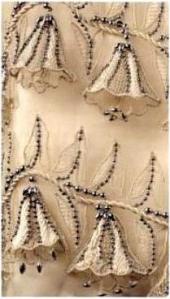
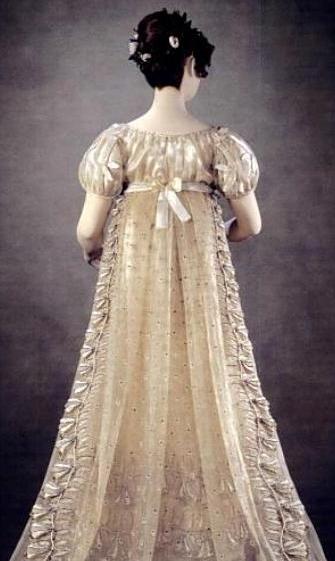
Princess Charlotte's Court Dress, 1814-16, also known as the Bellflower Dress

Princess Charlotte's Court Dress, 1814-16, also known as the Bellflower Dress

embroidered-bellsWhen I saw Princess Charlotte’s bellflower court dress (1814-16) at the Museum of London I remember being transfixed and standing in front of the glass case for a half hour. I could not get over the exquisite details and embroidery of this gossamer thin gown, and wondered at the hours it took to create it, the number of seamstresses that must have toiled over it, and its cost. It was so beautiful that I mistook it for a wedding dress. The train, which showed slight damage where some of the embroidered bells were missing, is similar to the one on Princess Charlotte’s silver net wedding gown. Tradition has it that this court dress was made for Princess Charlotte on her engagement in 1814. The bellflowers were fashioned from silk covered wire and net decorated with silver thread darning and the tiny beads were made from blown glass. (The London Look, p 22)
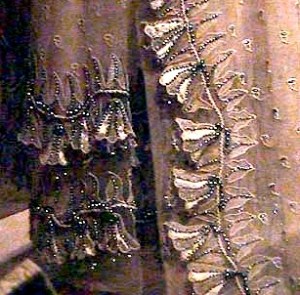
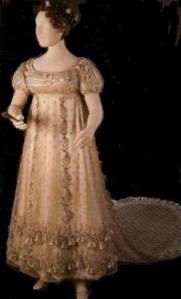
The Museum of London website states that this sumptuous dress, which is “covered with hundreds of tiny three-dimensional bellflowers, exemplifies the technical excellence of London’s dress-makers in this period. The dress needed 600 hours of conservation work and is so fragile it may never be shown in public again.”

Detail of bells and net embroidery

Detail of bells and net embroidery

Short in stature and slightly dumpy, and not known for her fashion sense, Princess Charlotte could easily afford elaborate costumes. Her provisioners included the William King of Pall Mall, a silk mercer, and Mrs. Triaud and Mrs. Bean, London dressmakers who worked on her trousseau. (The London Look, p 22.)

According to a contemporary description, the Princess entered her mother’s drawing room in May 1815 in an exquisitely beautiful dress that (from the description) looked similar to the bellflower dress:

Gold lama and white draperies over a petticoat of rich white satin and gold twisted trimming; train of rich figured white satin, body elegantly trimmed with rich gold and blond lace; head-dress, plume of ostrich feathers, with a beautiful diadem of brilliants; necklace and ear-rings of diamonds. – The London Look, p 24

  • The London Look, Fashion from Street to Catwalk. By Christopher Breward, Edwina Ehrman, Caroline Evans, 2004

princess-charlotte-court-dress3Front of gown, Museum of London

Read Full Post »

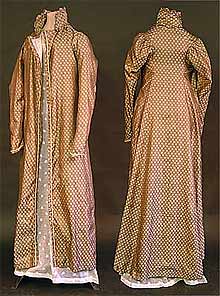
Image of Jane Austen's pelisse coat

Image of Jane Austen's pelisse coat

Isn’t Jane Austen’s pelisse coat pretty? It has an oak pattern on a beige and brown ground. The pelisse was donated to the Hamphire Museum in 1993 and can be viewed in this link. View close ups of the coat here.

According to Fashion-Era: “Both the late 18th century and the early 19th century pelisse were three quarter length coat. Later versions had a shoulder cape or capes. It was often trimmed with fur, ruched silk trimmings or satin along its edges.” Pelisses can be without sleeves or with sleeves and vary in length.

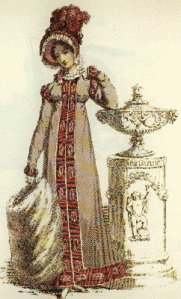
1819 Walking Dress, Ackermann's Repository

1819 Walking Dress, Ackermann's Repository

Lara Corsets and Gowns reproduced a pelisse coat from an 1819 Ackermann fashion plate.  The following is Catherine Decker’s description of this coat: “Walking Dress, featuring Pelisse. This grey pelisse is trimmed with ruby velvet and has a matching ruby velvet bonnet, with ostrich feathers dyed to match. The huge fur muff would stay popular for the next few years, but muffs in the late 1820s were generally of a more reasonable size.”

  • Click here to see the modern reproduction and for ordering information.

Read Full Post »

young-girl-of-spirit-constance-hillIn December 1859, Florence Nightingale wrote this letter of recommendation to Parthenope Verney:
My dear [Parthenope Verney]

It occurred to me after writing yesterday if you are going to set up a needlewoman under the housekeeper, Mary Jenkins, Bathwoman, Dr. W. Johnson’s, Great Malvern, has a niece, living at Oxford, a first-rate needlewoman, eldest girl of a very large family, who wants or wanted a place. If she is at all like my good old friend, her aunt, she would be a very valuable servant. Perhaps her needlework would be almost too good for your place. I believe she is a qualified “young lady’s maid,” though when I heard of her, she had never been “out,” i.e., in service. Perhaps she has a place. I think it answers very well in a large house to have as much as possible done at home, as little as possible “put out.”

This domestic job as needlewoman – mending, embroidering, making clothes – sounds benign compared to the custom of the Regency and Victorian eras to overwork seamstresses. While plying the needle was a common domestic activity (Jane Austen was known to possess a particular talent in this direction), working class seamstresses were appallingly overworked and underpaid, especially during the heyday of the Industrial Revolution. Many women toiled for long hours in poor lighting conditions, with some going blind from their employment. An apprentice seamstress in a milliner’s shop worked under slightly better conditions, but during the Season when demand for new and fashionable dresses was high, these women would also be pressed to work into the wee hours of the night to complete an order.

The above illustration of Jane Austen sewing comes from Jane Austen: Her Homes and Her Friends by Constance Hill. In Chapter XX, Constance makes the following observation about Jane Austen’s skill as a needlewoman:

Her needlework was exquisite. We have seen a muslin scarf embroidered by her in satin-stitch, and have held in our hands a tiny housewife of fairy-like proportions, which Jane worked at the age of sixteen as a gift for a friend. It consists of a narrow strip of flowered silk, embroidered at the back, which measures four inches by one and a quarter, and is furnished with minikin needles and fine thread. At one end there is a tiny pocket, containing a slip of paper upon which are some verses in diminutive handwriting with the date “Jany. 1792.” The little housewife, when rolled up, is tied with narrow ribbon. “Having been never used and carefully preserved, it is as fresh and bright as when it was first made.

For more on this topic, click on my other post The Life of a Seamstress.

Read Full Post »

jane-bennet-housecoat-replicajane-in-house-dressThe blog, Pemberley Couture, features a gallery of costumes made by Anna Kristine. She has made copies of Jane Bennet’s coat from Pride and Prejudice 2005, and the yellow dress Gwynneth Paltrow wore as Emma.

Click here to see the rest of her selections.

Read Full Post »

« Newer Posts - Older Posts »