Feeds:
Posts
Comments

Archive for the ‘Fashions’ Category

wedding-dress-18182Gentle Readers, My niece is getting married and I will be away for a week to attend her wedding. In celebration, I have created this Georgian to Victorian era wedding dress post that consists of a series of quotes gathered on the topic.

The handsome veil of Mechlin lace,
A sister’s love bestows,
It adds new beauties to her face,
Which now with pleasure glows.
Friends brothers sisters cousins meet,
To attend the happy bride,
And Queer’s joy is all complete,
The nuptial knot is tied –
The Dandy’s Wedding, London, 1823, Two Centuries of Costume in America, MDCXX-MDCCCXX By Alice Morse Earle

Hand made lace was extremely expensive and few brides could afford a veil. As the 19th century progressed and machine made laces became more readily available, the bridal veil became more prevalent at weddings.
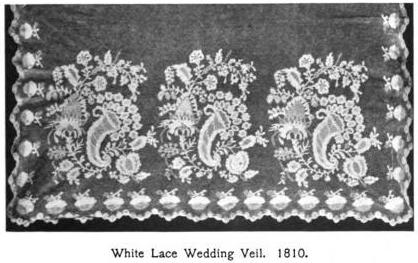
wedding-veil-1810
White was not the prevalent color for wedding dresses during this era. Royal bridal gowns were made of silver tissue and lace, and for a short time regency brides preferred to wear yellow bridal dresses over other colors.

You may be surprised to learn that in the 1800’s, it was common for brides to wear everyday colors such as blue, pink, green, dark brown, burgundy and, yes, even black, rather than white and ivory. It was much more practical for a bride of the average class to wear darker colors for a variety of reasons. One major reason being money. Prudent brides planned ahead – a wedding gown could be worn for many occasions, not just on their “special day.” The wedding gown was a lady’s “best dress” after the ceremony and it was much more practical to have a darker colored dress than a white or ivory dress. Let’s take a minute to imagine the time and effort involved in keeping the hemline of a white gown clean! Dust and dirt and no modern conveniences! Just think about what a white hemline would look like at the end of a day! Laundering was a big consideration, unless, of course, the lady was from a prominate family who had servants available to handle the laundry. – Wedding Gown Traditions
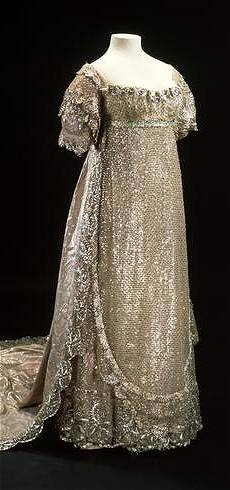
Princess Charlotte's silver net wedding gown, 1815

Princess Charlotte

Description of Princess Charlotte’s Wedding in 1816: The Royal Bride, happy in obtaining him whom her heart had selected, and whom consenting friends approved, wore on her countenance that tranquil and chastened joy which a female so situated could not fail to experience. Her fine fair hair, elegantly yet simply arranged, owed more to its natural beautiful wave than to the art of the friseur; it was crowned with a most superb wreath of brilliants, forming rosebuds with their leaves.

Her dress was silver lama [lamé] on net, over a silver tissue slip, embroidered at the bottom with silver lama in shells and flowers. Body and sleeves to correspond, elegantly trimmed with point Brussels lace. The manteau was of silver tissue lined with white satin, with a border of embroidery to answer that on the dress, and fastened in front with a splendid diamond ornament. Such was the bridal dress … La Belle Assemblee, May 1816

In the 1800’s, gray became a color for wedding gowns for brides of lower classes because the dress became re-used as the bride’s Sunday best. For those who had to wear a dress that would be used for regular occasions after the wedding, many brides would decorate the dress for the special day with temporary decorations.

The “traditional” wedding dress as known today didn’t appear until the 1800’s. By 1800, machine made fabrics and inexpensive muslins made the white dress with a veil the prevailing fashion. By the nineteenth century, a bride wearing her white dress after the wedding was accepted. Re-trimming the dress made it appropriate for many different functions.- Ezine Articles: Wedding Dresses
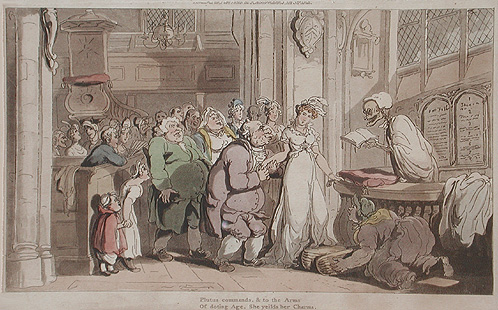
Satiric wedding scene, Thomas Rowlandson

Satiric wedding scene, Thomas Rowlandson

1907 Worth Wedding gown

1907 Worth Wedding gown

The bridal image has not always been white. Wedding dresses were virtually any color in the 1800’s, said Phyllis Magidson, the curator of ”New York Gets Married.”

”It was simply the best dress your family had to offer, meant to be worn at special occasions thereafter,” she said. A very wealthy woman might have her gown made at Maison Worth in Paris, where a dress could cost as much as a middle-class person’s salary for a year, but for most people, Ms. Magidson added, ”wearing something that was specifically and solely intended to be worn for the wedding — the concept that we have of being a fairy princess — is a fairly contemporary perception.”

Queen Victoria’s wedding in 1840 was the 19th-century equivalent of Lady Diana Spencer’s extravaganza in 1982, and Victoria just happened to get married in white because she wanted her gown trimmed with a particularly rich lace. Her wedding-picture engravings were so widely circulated that the public began to associate white with weddings, Ms. Magidson said. – New York Times, Style, 1997

Queen Victoria's White Gown

Queen Victoria

The wedding of Queen Victoria had more of an impact than most and actually started an entirely new trend when she decided not to wear the traditional royal silver bridal gown. Instead Queen Victoria gave the white wedding dress completely new meaning and symbolism when she married her beloved Prince Albert in a simple dress, made of white satin, trimmed with Honiton lace, with Honiton long veil and a wreath of orange blossoms to represent purity. It was then that white became the dominant, traditional choice, symbolizing purity and maidenhood. – Emma’s Wedding Diary
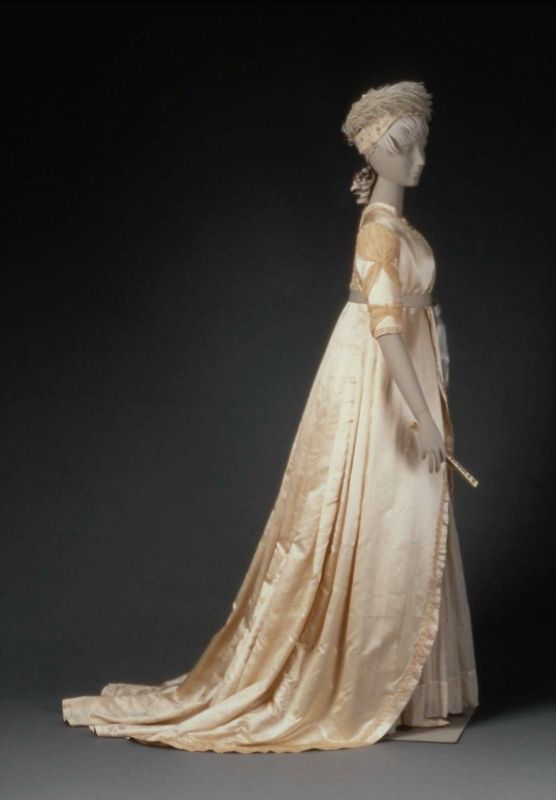
Reproduction wedding dress in two parts, from 1799 model

Reproduction wedding dress in two parts, from 1799 model

Additional Links:

There is an old poem about how the color of your wedding dress will influence your future: “Married in white, you will have chosen all right. Married in grey , you will go far away. Married in black, you will wish yourself back. Married in red, you’ll wish yourself dead. Married in blue, you will always be true. Married in pearl, you’ll live in a whirl. Married in green, ashamed to be seen, Married in yellow, ashamed of the fellow. Married in brown, you’ll live out of town. Married in pink, your spirits will sink.” – History of the White Wedding Dress

Modern Jane Austen inspired chiffon gown wedding dress

Modern Jane Austen inspired chiffon gown wedding dress

Read Full Post »

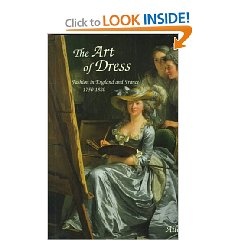
Fashion in England and France, 1750-1820

The Art of Dress: Fashion in England and France, 1750-1820

A free online, 15-week, self-directed class is offered on the Costumer’s Manifesto, a megasite for those who are interested in fashion and costumes. Click here to start the course, which begins with ancient times and takes the student through the mid-twentieth century.  The course is designed and authored by Tara McGinnis, Ph.D., creator of the Costumer’s Manifesto.

Another fabulous find on the CM is Blog.mode, the Metropolitan Museum of Art’s fashion blog that coincided with a special exhibition addressing fashion. The site has unfortunately closed, but one can still access all the posts and comments, such as this post about a comparison of two white dresses, one made in the 1820’s and the other in the 1830’s.

Read Full Post »

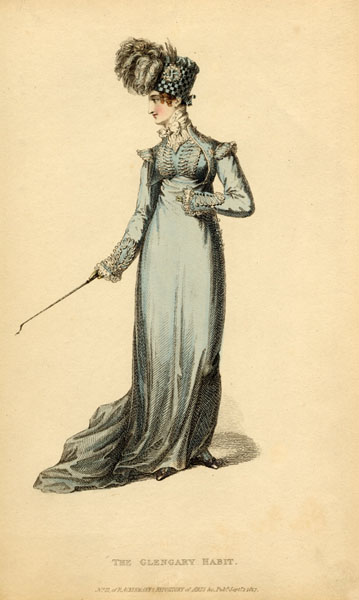
Glengarry riding habit, 1817

Glengarry riding habit, 1817, Ackermann

During the first two decades of the nineteenth century, riding habits echoed the high-waisted empire styles that prevailed and the fashion trends that were currently in vogue. The light blue Glengarry riding habit of 1817 (at right) is typical of the fashion of the day. The military-inspired dress was trimmed with lace, braids (image at bottom of post), and frogs. The hat was made of cork, a sensible light weight material, which was visually overpowered by the plumes of feathers that arched over the wearer’s face. Unlike later riding habits, regency riding costumes came in a variety of colors:

It must be remembered that riding dress fashions had not yet fixed on dark colors. Every tint of bright color was used, even figured materials. . . Cloth was of course the general material, but velvet was also used and even silk.  There seemed to be no limit to the equipments and trimmings of habits. Where undersleeves were worn in full dress, they appear on the habits. If fichus were the mode, fichus were worn on horseback, while artificial flowers decked riding hats, as well as long feathers. Necklaces even appear, and frequently chatelaines with watches and various trinkets. I have seen several old French and English fashion plates in which the rider carried a carefully spread fan. If ruffs were worn in full dress, ruffs appeared on horseback. If embroidery was worn, the habit was embroidered.  Two Centuries of Costume in America, MDCXX-MDCCCXX By Alice Morse Earle

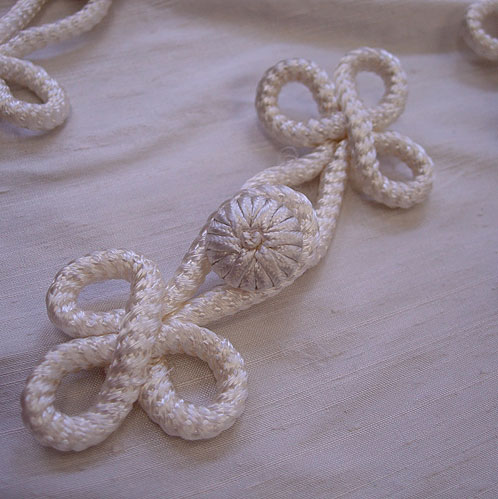
Frog fastening

Frog fastening

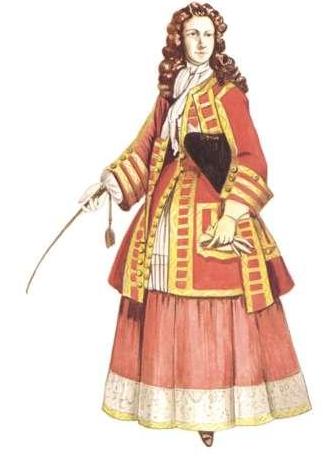
Lady in riding habit, 1720

Lady in riding habit, 1720

Braiding and frog fastenings of the era were heavily influenced by the return of English troops from Egypt. Frogs had been used in the East since ancient times, and added a dashing, even exotic touch.

The masculine influence in riding habits began near the end of the 17th Century when ladies adopted masculine coats and waistcoats for riding and hunting. The tailored tops were paired with feminine petticoats, as in this illustration. Horse riding had always been an important and fashionable sport for the upper classes, but these masculine-inspired riding habits were condemned from the start by critics who argued that the bold outfits belied a woman’s innate modesty. Some women began to wear them in the most unexpected places.

Samuel Pepys wrote famously in his diary on June 11, 1666:

Walking in the galleries at White Hall, I find the Ladies of Honour dressed in their riding garbs, with coats and doublets with deep skirts, just, for all the world, like mine; and buttoned their doublets up to the breast, with periwigs under their hats; so that, only for a long petticoat dragging under their men’s coats, nobody could take them for women in any point whatever; which was an odde sight, and a sight did not please me.

It took a long time for these outfits to become generally accepted. Almost eighty years after Samuel Pepys wrote his remarks, Samuel Richardson reminded women in his Familiar Letters on Important Occasions (1741) that:

as sure as any thing intrepid, free, and in a prudent degree bold, becomes a man: so whatever is soft, tender, and modest, renders your sex amiable. In this one instance we do not prefer our own likeness; and the less you resemble us, the more you are sure to charm: For a masculine woman is a character as little creditable as becoming. (Women of Quality, Ingrid H. Tague, 2002, p 52.)

Not all men of the era became chagrined at the thought of a woman in mannish attire. In 1670, Cardinal Dubois, a Frenchman, wrote in his Mémoires:

Mme de Fontanges – let us follow our young beauty as she goes hunting with her prince. That day she was wearing an expensively embroidered riding habit and a hat covered with the most beautiful plumes procurable. She looked so elegant in this costume none other could have suited her better. Nicole-Cargill-Kipar’s Late 17th Century Clothing History

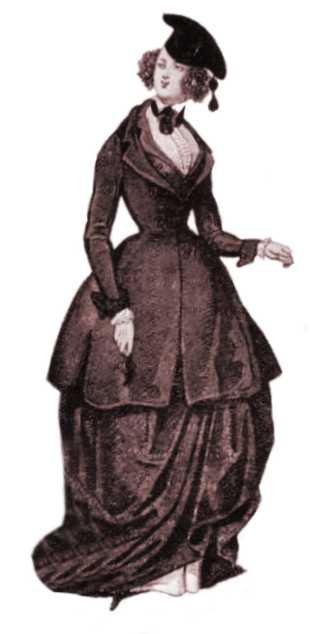
Riding costume, 1841

Riding costume, 1841

Despite their doubtful propriety, ladies continued to wear riding outfits, and as the 18th century progressed these costumes began to be more accepted.  With the changing fashion, the silhouette became more frilly and femininized and began to take on a higher waistline. In fashion plates the riding costume would be accessorized with a riding crop to distinguish the outfit from carriage costumes, which were made with similar sturdy, long-wearing cloth. By the end of the nineteenth century riding costumes had come full circle and taken on a more somber, tailored, and masculine look. Ladies’s riding habits began to be fashioned by men’s tailors as well as dressmakers.  In a New York Times article from June 1901, the author wrote: “the lady on horseback is as much of a man, down to the saddle, as circumstances permit.”

This description of the Glengarry Riding Habit (top image) was written in Ackermann’s Repository, September, 1817. A dressmaker named Miss M’Donald was responsible for its creation.

It is composed of the finest pale blue cloth, and richly ornamented with frogs and braiding to correspond. The front, which is braided on each side, fastens under the body of the habit, which slopes down on each side in a very novel style, and in such a manner as to define the figure to considerable advantage. The epaulettes and jacket are braided to correspond with the front., as is also the bottom of the sleeve, which is braided nearly half-way up the arm. The habit shirt is composed of cambric, with a high standing collar, trimmed with lace. The cravat is of soft muslin, richly worked at the ends and tied in a full bow, and there are narrow lace ruffles at the wrists. The headdress takes the form of the Glengary cap, composed of blue satin, and trimmed with plaited ribbon of various shades of blue, and a superb plume of feathers. Blue kid gloves are worn and half-boots. Sources: Riding Habits, Candice Hern, and Nineteenth-Century Costume and Fashion, Herbert Norris and Oswald Curtis.

Images of Riding Habits in the Regency Era:

History of Riding Habits

More links:

Image of 1841 riding habit from Redingote Fashion History.

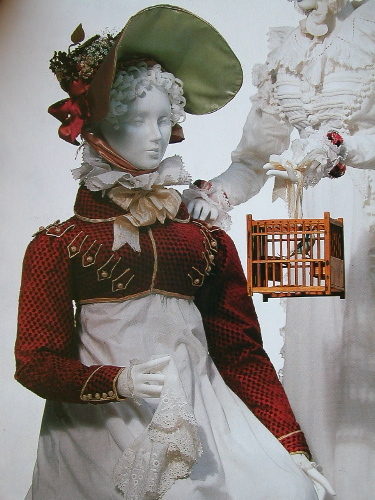
Military influence in the Spencer jacket, with braided piping, 1815

Military influence in the Spencer jacket, with braided piping, 1815. Image: Kyoto Costume Institute.

Read Full Post »

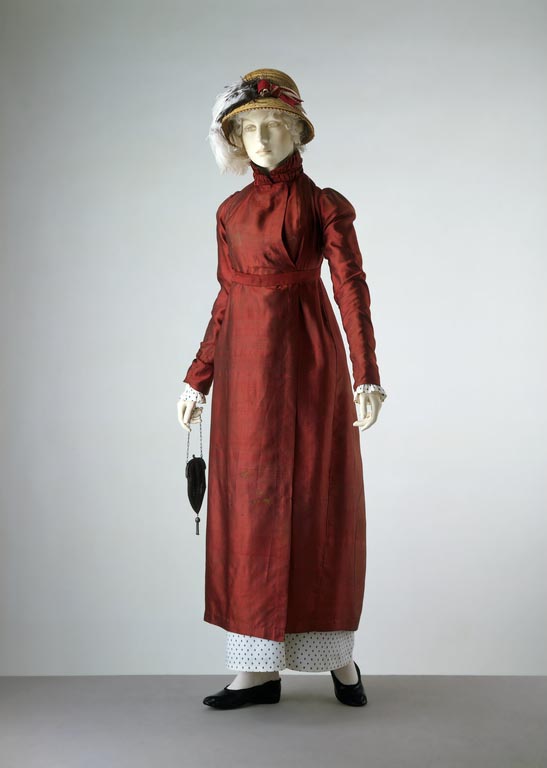
1809 Silk Pelisse, Victoria and Albert Museum

1809 Silk Pelisse, Victoria and Albert Museum

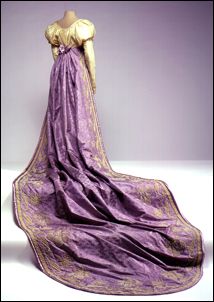
1801 Court Dress with Train, Centraal Museum

1801 Court Dress with Train, Centraal Museum

Nineteenth Century Fashions: A Compendium offers a breathtaking series of thumbnails of 19th Century fashions from museum collections and websites around the world.  The images are not original. In fact, a score of them have already been discussed on this site, such as the images from the Kyoto Costume Institute. Click on the link, then click on the years that interest you. Enjoy!

Read Full Post »

“That fellow Weston,” said Brummell, “is an inimitable fellow — a little defective perhaps in his ‘linings,’ but irreproachable for principle and button-holes. He came to London, Sir, without a shilling; and he counts more realized thousands than our fat friend does ‘frogs’ on his Brandenburg. He is not only rich, but brave; not only brave, but courteous; and not alone courteous, but candid. – Beau Brummel

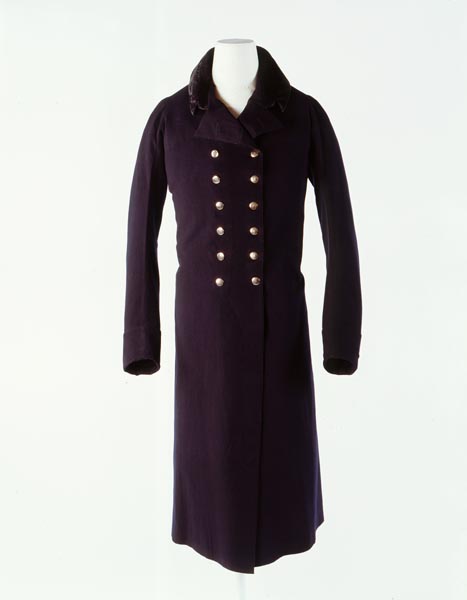
Man's Great Coat by John Weston, 1803-1810

Man

John Weston, Regency London’s most expensive tailor and draper to George, Prince of Wales, was frequently mentioned by Georgette Heyer in her novels. While Ms. Heyer peppered her novels with Weston’s name, I was actually unable to find much about him. This caption from the exhibit a the Museum of London, describes the greatcoat at right: 1803, tailored by John Weston of 38 Old Bond Street.

The prince was passionately interested in clothes and patronised London’s most skilful craftsmen. This slim fitting double-breasted coat, which has a silk velvet collar, is made of high quality British wool facecloth. Charles Jennens, a London button maker, supplied the gilt buttons.

The coat was discovered at Coutts Bank, where the tailor had deposited it for an unknown client, in 1956. A letter accompanying the coat described it as, ‘an exceed[ingly] good blue cloth great coat … made in ev[e]ry respect in the best manner’.

Men of fashion felt a sort of religious awe as they passed over the threshold of Weston, Brummell’s tailor, in Old Bond-street

Read more about London’s tailors at these links:

  • Jean Louis Bazalgette: Fascinating biography of one of the Prince Regent’s earlier, lesser known tailors. (Cached information.)

Read Full Post »

« Newer Posts - Older Posts »