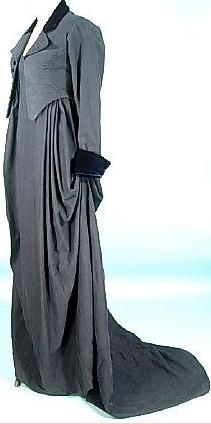
 Antiques and Vintage Dress Gallery features beautiful close up photographs of a riding costume designed for Mansfield Park, 1999. “The jumper gown can be worn buttoned up at the sides as you see, or just unbutton to wear straight. The jacket has violet-blue velvet collar, cuffs and buttons”. Francis O’Connor, who played Fanny Price, did not wear this costume. Click on the link to see 15 images of the gown.
Archive for the ‘Fashions’ Category
Seen Over the Ether: Riding Costume from Mansfield Park
Posted in Fashions, jane austen, Mansfield Park, tagged Jane Austen Movies, regency dress, Regency Fashion on April 18, 2008| 3 Comments »
Emma: A Guest Blogger’s Thoughts on Film Fashion
Posted in Fashions, Film adaptation, tagged Emma, Emma Adaptations, Emma Woodhouse, Jane Austen Adaptations, Kali Pappas, Regency Fashion on March 22, 2008| 1 Comment »
 Jane Austen Today will feature four guest writers in the next four weeks to discuss Emma, Sense and Sensibility, and the last three weeks of The Complete Jane Austen on PBS. The first entry with Kali Pappas is up. Kali wrote about what she knew best: the costumes that were used in Emma 1997, and how these clothes reflected character. The post is titled: Fashionable Emma Woodhouse: Costuming in Austen’s Emma Adapted. Kali created Emma Adaptations, the definitive blog about Emma. If you haven’t visited her blog, you are in for a treat. Along the way, stop over at Jane Austen Today and read her fabulous contribution.
Technorati Tags: Emma 1997, Emma Adaptations, Jane Austen Today
Regency Hairstyle Tutorial
Posted in Fashions, jane austen, tagged Icons, Jane Austen Fan Site, Regency Costumes, Regency Fashion, Regency Hairstyle on March 12, 2008| 5 Comments »
 Aside from the fact that Olde Fashioned: A Girl and Her Graphics contains breathtaking Jane Austen film icons, the site also offers some interesting posts regarding the regency era and Jane Austen novels and film adaptations. Click here to view a step-by-step description of how to recreate this regency hairstyle; and here to view a detailed description of another regency hairstyle at the Jane Austen Centre.
In addition, take a peek at Jenny La Fleur, a costumer. Her site is filled with wonderful projects, including an outfit for coaching days.
Link updated June 2010
Fashion in the Regency Era
Posted in Clothes, Fashions, jane austen, The Spencer Jacket, tagged jane austen blogs, regency dress, Regency Fashion, Regency Outerwear on February 29, 2008| 9 Comments »
Estimating lace and muslin: dress and fashion in Jane Austen and her world, by Jeffrey A. Nigro is a fabulous article about fashion in Jane’s day. This conference paper was published in Persuasions: The Jane Austen Journal in 2001. Some of Mr. Nigro’s observations include:

Convenience was another reason for the increasing simplicity in dress beginning in the 1780s. Dry cleaning was not invented until the middle of the nineteenth century, and did not become commonplace until the twentieth. In Austen’s time, a silk dress that got dirty was essentially ruined. The fabrics that started to become fashionable from the 1780s onward (muslin and other cotton fabrics, linen, lawn) were much easier to care for, which was part of their appeal. Nevertheless, given the absence of modern appliances, the care and maintenance of clothing still meant much work for the servants in upper- and middle-class households.

Outerwear garments included the spencer, a long-sleeved jacket that extended only to the raised waistline. Worn by both men and women, it was named for the 2nd Earl Spencer, who, according to one version of the story, cut off the coattails of his jacket after wagering that he could invent a new fashion. For colder weather, there was the pelisse, a skirt-length overcoat, often lined and trimmed with fur, which originated in Hungary as a part of military dress. Bonnets became fashionable, essentially smaller versions of the straw hats of the 1780s, but now pulled in to frame the face. Bonnets, like shawls, would become staples of feminine dress until at least the middle of the nineteenth century.
 Click here for more links about fashion:
* A Quilted Regency Spencer Jacket
* The Importance of Wearing White, Jane Austen Centre Magazine
* Bonnets, Caps, Turbans, and Hats
Images:
Muslin dress, Vintage Textile (top)
Jane Austen’s Pellisse Coat (middle)
Kyoto Costume Institute, Spencer Jacket (bottom)
Bonnets, Caps, Turbans, and Hats: Fashion Necessities For Regency Ladies
Posted in Fashions, jane austen, Jane Austen's letters, Lady's work, Regency World, Sewing, tagged jane austen blogs, Jane Austen Movies, Jane Austen's World, regency dress, Regency Fashion, Regency Outerwear on February 22, 2008| 11 Comments »
 Illustration from Modes et Manieres Du Jour, 1798 – 1808

I have changed my mind, & changed the trimmings on my Cap this morning, they are now much as you suggested, – I felt as if I should not prosper if I strayed from your directions, & I think it makes me look more like Lady Conyngham now than it did before, which is all that one lives for now. Jane Austen to Cassandra, December 18-19, 1798
 Women during the Regency period wore headdresses outdoors as a matter of course. When a woman married, or if she was a spinster in her late twenties, she would also take to wearing a cap indoors. This image from Wikipedia shows Mme. Seriziat wearing a bergere, or shepherdess-style straw bonnet over a cap, as was the custom back then. When her child was a baby, he might have worn a simple bonnet, as infants still do today.
Aside from sheltering delicate skin from the sun or hair from the elements, or protecting one’s head in drafty rooms, headdresses took on many other functions. They denoted class and economic status, as well as fashion sense and one’s marital state. Hats were also worn as a sign of respect, inside a church, for instance, and this custom remained widely popular until well into the 20th-century.
 Lace caps, mob caps, or draped caps, were made of lace, white linen or delicate muslin, and trimmed with ribbon. They could be ruffled, embroidered, or plain, depending on who wore them and their status. A housekeeper, for example, would wear a more elaborate cap than a scullery maid, whose mob cap was simple by comparison. In Pride and Prejudice 1995, Mrs. Bennet wore such frilly caps with so many ruffles and trimmings that they complimented her image as a silly woman. One can imagine how much fancier her caps were than her maid’s!
Trimming and redecorating old bonnets provided a topic of conversation for women of all ages and social strata. In her novels and letters, Jane Austen frequently mentioned trimming new hats and making over old bonnets as a female activity. According to Penelope Byrde in A Frivolous Distinction, it was quite the fad during the last decade of the 18th century to adorn hats and bonnets with artificial fruits and flowers. As Jane Austen wrote Cassandra in June, 1799 (tongue in cheek we suspect):
Flowers are very much worn, & Fruit is still more the thing – Eliz: has a bunch of Strawberries, & I have seen Grapes, Cherries, Plumbs & Apricots – There are likewise Almonds& raisins, french plums & Tamarinds at the Grocers, but I have never seen any of them in hats.
In addition to professional milliners and modistes, there was quite a large cottage industry for making caps, hats, and turbans from home, which provided a meager salary for women who needed the income. The materials used in making headdresses were as varied as their styles: straw (chip or strip), beaver, velvet, silk, crape, satin, muslin or cloth (Byrde, p 6). Trims included ribbons, the above mentioned artificial fruits and flowers, veils, net, lace, or feathers, and even beads, pins, and brooches.
For a more detailed explanation of the headdresses worn during this era and to view additional illustrations, please click on the following links.
- Ladies Regency Caps, Jane Austen Centre, provides a detailed description of caps.
- Hats and Bonnets, Victoriana: Scroll to the bottom of this page to see illustrations from 1811 and 1812.
- Corsets and Crinolines: Find an image of an original Regency Era bonnet here.
- Fileblogs, Regency Caps, Linore Rose Burkhart: Linore describes the various hat styles in this link, along with materials and trims.
For people interested in ordering their own Regency caps, or in trying their hand at making a bonnet, the following links will lead you to patterns, suppliers, and resources:

- Louise MacDonald Millinery (link suggested by Laurel Ann, see above image). Louise created the caps for Pride & Prejudice 1995, and describes making them for the movie.
- How to Make a Regency Era Bonnet, Jane Austen Centre
- Make your own regency cap: William Booth Draper
Byrde, Penelope, A Frivolous Distinction: Fashion and Needlework in the works of Jane Austen, Bath City Council, 1979.
Four Hundred Years of Fashion, Victoria and Albert Museum, edited by Natalie Rothstein, V&A Publications, 1984.
-
Join 7,126 other subscribers
-
2025 AGM in Baltimore
-

-
Items of Interest
Blog Stats
- 18,547,071 hits
- Follow Jane Austen's World on WordPress.com
-
RECOMMENDED BOOKS AND RESOURCES
-
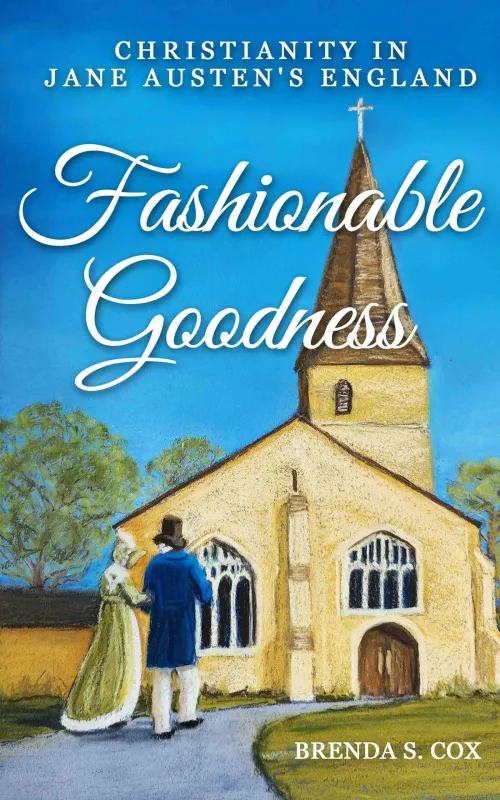
Fashionable Goodness: Christianity in Jane Austen's England is now available! By JAW contributor Brenda S. Cox. See Review. Available from Amazon and Jane Austen Books. 
We also recommend JAW contributor Rachel Dodge's devotionals based on Jane Austen's prayers and classic literature. Reviews:
Praying With Jane: 31 Days Through the Prayers of Jane Austen
The Anne of Green Gables DevotionalThe Little Women Devotional
The Secret Garden Devotional
The Tour of Doctor Syntax. Edited by Ben Wiebracht. Read the review of the book at this link. Click to order the book on Amazon US or Amazon UK or Jane Austen Books FREE Student Membership to JASNA
Available through December 31st, 2025. Click on image for details, and share this poster with other teachers and students!

The Obituary of Charlotte Collins by Andrew Capes

Click on image to read the story.
Comments
“My idea of good company…is the company of clever, well-informed people, who have a great deal of conversation.” – Jane Austen, Persuasion

Gentle readers: Please feel free to post your comments and continue the conversation! Due to SPAM, we will no longer accept comments on posts after 30 days of publication. In some instances, links will be removed from comments as well.
Administrators and Contributors
Pin It!

Top Posts
-
Recent Posts
Links to Jane Austen Blogs
May we suggest?
Hello, my name is Vic and I live in Maryland, USA. I have adored Jane Austen almost all of my life. I am a proud lifetime member of the Jane Austen Society of North America. This blog is a personal blog written and edited by me and my team. We do not accept any form of cash advertising, sponsorship, or paid topic insertions. However, we do accept and keep books and CDs to review.
If you would like to share a new site, or point out an error, please email us. (Yes, we are fallible. We'll own up to our mistakes and will make the corrections with a polite smile on our faces.) Write us at

Thank you for visiting this blog. Your comments and suggestions are most welcome.
Project Gutenberg: eBook of Stage-coach and Mail in Days of Yore, Volume 2 (of 2), by Charles G. Harper
STAGE-COACH AND MAIL IN DAYS OF YORE: A PICTURESQUE HISTORY
OF THE COACHING AGE, VOL. II, By CHARLES G. HARPER. 1903. Click on this link.
Top Posts & Pages
- Regency Fashion: Men's Breeches, Pantaloons, and Trousers
- Men's hair styles at the turn of the 19th century
- Jane Austen’s Regency Women: A Day in the Life, Part 1
- Regency Hygiene: The Bourdaloue
- Highclere Castle Floor Plan: The Real Downton Abbey
- Cheapside, The Gardiners, and Pride and Prejudice
- Pride and Prejudice 1995, China Pattern at Longbourn
- Social Customs During the Regency
- Pictorial History of Regency Hairstyles
- Dressing for the Netherfield Ball in Pride and Prejudice: Regency Fashion
Tour Chawton Cottage on YouTube
-
Disclaimer: Our team makes no profit from this blog. We may receive books (physical or digitized) for review purposes.
-
Copyright Statement: © Jane Austen's World blog, 2009-2024. Unauthorized use and/or duplication of this material without express and written permission from this blog’s author and/or owners is strictly prohibited. Excerpts and links may be used, provided that full and clear credit is given to Jane Austen's World with appropriate and specific direction to the original content.




 Jane Austen's World