Feeds:
Posts
Comments

Archive for the ‘Georgette Heyer’ Category

Inquiring readers: I have no doubt you shall enjoy this post by my good friend, Lady Anne, an expert when it comes to the subject of Georgette Heyer. Lady Anne has read Georgette Heyer’s novels for most of her years upon this earth. Smart, sassy, fabulous, well tressed and well dressed, she has read every GH book backwards and forwards. There is not one tiny detail of Georgette’s novels that escapes Lady Anne’s attention or opinion. As to her review of  These Old Shades- please enjoy.

Set in the Georgian period, about 20 years before the Regency, These Old Shades is considered to be the book that launched Heyer’s career. It features two of Heyer’s most memorable characters: Justin Alastair, the Duke of Avon, and Leonie, whom he rescues from a life of ignomy and comes to love and marry.

The title of the book, These Old Shades, is a subtle allusion to the fact that this book is a far superior reworking of Georgette Heyer’s first book, The Black Moth, a book she wrote for the amusement of her brother who was ill. The characters in The Black Moth are at best two dimensional, but like most of Heyer’s creations, have enough humor and idiosyncrasy to catch our interest. In her case, it was the character of the villain whom she wished to revisit, develop and deepen.

These Old Shades is the first of the Alistair trilogy – she really did like these characters – and is not Regency, nor does it take place primarily in England. Like many of her early books, it falls more accurately into the category of historical romance, and is cast in mid-18th century Paris, with a short idyll at the English county seat of our hero, Justin Alistair, the Duke of Avon. He is known by the soubriquet Satanas, for his cold exactitude and prescient understanding of what his opponent will do next, as well as a certain elasticity in his moral fiber. The Duke has restored his family’s fortune through gambling; he is, as one would expect of one of the first peers of the realm, an arrant snob, careful, although certainly flamboyant, in his dress, and punctilious in manner. The historical background is the court of Louis XV, complete with its intrigues and excesses. It is the perfect backdrop for this story, for which one must be willing to suspend disbelief for pages at a time. It is such fun, and so sparkling in its writing, that one is indeed willing.

We first meet the Duke, dissolute, languid, apparently unaware of his surroundings, when a gamin comes hurtling from a side street and provides Avon with the weapon he has been waiting for to bring about the destruction of the Comte de Saint-Vire, the man who famously insulted Avon beyond courtesy. Avon buys the youngster from his brother, and establishes him as a page dressed in sober black, who attends Avon at parties, assemblies, and the Court at Versailles. The youngster, called Leon, attracts considerable attention, not only for his utter adoration of his master, whom he calls Monseigneur, but also for his startling red hair and dark eyebrows. Such hair and eyebrow combination is evident in the Saint-Vire family. As le tout Paris buzzes, Avon begins laying his plans. Leon is revealed to readers as Leonie, and goes to England in the country to learn how to be a lady. The Duke adopts her and returns to Paris with his ward. His friend Hugh Davenant returns to Paris at the same time and Avon tells him, in a passage that makes clear both the character and performance of this Duke:

“I am becoming something of a patriarch, my dear.”
“Are you? Davenant said, and smiled to himself. “May I compliment
you on your ward?”
“Pray do! You find her to your taste?”
“Infinitely. Paris will be enchanted. She is an original.”
“Something of a rogue,” conceded his Grace.
“Justin, what does Saint-Vire to do with her?”
The thin brows rose.
“I seem to remember, my dear, that your curiosity was one of the
things I deplored in you.”
“I’ve not forgot the tale you told me – in this very room, Justin. Is
Leonie the tool with which you hope to crush Saint-Vire?”
His Grace yawned.
“You fatigue me, Hugh. Do you know, I have ever had a fancy to
play my game — alone.”
Davenant could make nothing of him and gave up the attempt.”

But it is not the plot that carries the reader along; it is the delightful characters. The Duke, the darkest of Heyer’s heroes, has real charm, albeit a little sinister. He is not one you would wish to cross, as we see. Leonie, the heroine, is an effervescent charmer with a ferocious temper and an inherent sense of her own worth that grows through the book. Her character is honest and instinctively noble. She also, like any adorable pet of a large circle, gets away with being outrageous – except when Monseigneur is displeased. The supporting characters have charm and individuality as well. It is no wonder that Heyer comes back to the family twice: once in The Devil’s Cub – to revisit the Duke and his family, with a focus on the Cub, definitely the son of both his parents, and then in what is generally considered her finest novel, in An Infamous Army, where the grandchildren of the second book’s couple play out their roles at Waterloo.

If the story that unfolds is outrageous and unbelievable, the characters develop beautifully, the dialog bubbles delightfully, and we love the rollicking ride.

These Old Shades/Black Moth comparison from Wikipedia

More on the topic:

Read Full Post »

The Conqueror by Georgette Heyer has arrived just in time for the holidays. This historical saga of William, Duke of Normandy, who defeated the Saxons in The Battle of Hastings in 1066, is told vividly, accurately, and with mastery by an author who was able to do her research using the rare resources in the London Library.* The story covers William from his infancy until his victory. Although this book is mostly historical, it wouldn’t be a Georgette Heyer novel without some romance. The proud Matilda, daughter of Count Baldwin of Flanders, balks at her betrothal to the baseborn William, which sets up an interesting tension:

Layout 1

The Lady Matilda rose slowly to her feet, and made a reverence to her father. Speaking in a cool, very audible voice, and with her hands clasped demurely together, she said, picking her words: “My liege and father, I thank you for your care of me. If it be your will that I should wed again be sure that I know my duty towards you, and will show myself obedient to your commands as befits my honour and yours.” She paused. Watching her close, Raoul saw the smile lift the corners of her mouth, and was prepared for the worst. Veiling her eyes she said: “Yet let me beseech you, beau sire, that you will bestow my hand upon one whose birth can match with mine, and not, for the sake of our honour, permit the blood of a daughter of Flanders to mingle with that of one who is basely descended from a race of burghers.” She ended as coolly as she had begun, and making a second reverence went back to her stool and sat down, looking at her hands.

A stricken silence hung heavily over the company. There were startled looks, and men wondered how the Norman envoys would stomach this insult. Montogoméri flushed, and took a step forward. “Rood of God, is this to be our answer?” he demanded.

Raoul intervened, addressing himself to Count Baldwin. “Lord Count, I dare not take such an answer back to my master,” he said gravely. Surveying the Count’s shocked face he came to the conclusion that the discourteous reply had been prepared without his knowledge. Curbing Montogoméri with a frown, he said: “My lord, I await Flander’s reply to my master’s proposals.”

Count Baldwin availed himself of the loophole gratefully. He rose to his feet, and made the best of a bad business. “Messires,” he said, “Flanders is sensible of honour done her, and if she is obliged to bestow our daughter in marriage on the Duke of Normandy, were it not for the repugnance the Lady Matilda feels towards a second marriage.” So he began, and went on at length, smoothing away the insult. The envoys withdrew, one thoughtful, the other smouldering with indignation. What Count Baldwin said to his daughter is not known, but it is certain he sent for Raoul de Harcourt late that evening and was closeted with him alone for a full hour.

As with Simon the Coldheart, Georgette employs a more old-fashioned writing style for this early era in both language and detail. This makes the book harder to read than her regencies, but also more realistic in tone. She also writes the tale through Raoul de Harcourt’s eyes, a fictional character, so that we never quite get into William’s mind or understand his motives.  However, for those who cannot get enough of historical biographies, this newly reissued Georgette Heyer history is a must read! Order the book at Amazon or at Sourcebooks.

Other Georgette Heyer Reviews Sit Below

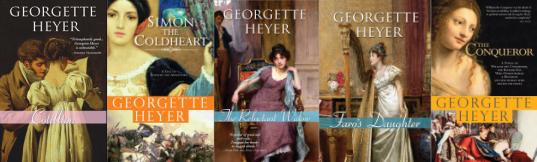
These Georgette Heyer books, available this holiday season, will be reviewed on this blog and Jane Austen’s World through mid-December: Cotillion, Simon the Coldheart, The Reluctant Widow, Faro’s Daughter, and The Conqueror.

Cotillion, Simon the Coldheart, The Reluctant Widow, Faro's Daugher, and The Conqueror

*The Private World of Georgette Heyer, Jane Aiken Hodge, The Bodley Head, Ltd, London, 1984.

Read Full Post »

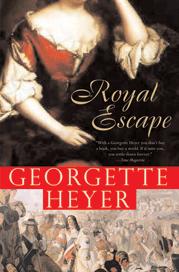
Gentle Readers, Source Books has reissued a number of Georgette Heyer novels, including two historical novels, The Spanish Bride and Royal Escape, which is about Charles II’s escape to Europe after his defeat by Cromwell. Coincidentally, NPR’s Nancy Pearl chose another Heyer historical novel, Infamous Army, as one of her recommended summer reads.

Hillary Major, a friend and colleague who had never read a Georgette Heyer novel, but who is quite knowledgeable about life and historical events of the era, agreed to review Royal Escape for this blog.

Let’s give Georgette Heyer and her publicists props for her subtitles; she certainly tells it like it is: “a novel in which a daredevil king with a price on his head fools his enemies and terrifies his friends.”

Rightly or wrongly, Heyer expects her reader to know her history – that, though defeated by Cromwell’s forces in 1651 and exiled to Europe for most of a decade, Charles II assumed the throne in 1660, when England’s monarchy was restored (by invitation of Parliament). Thus, despite quite a bit of action in Royal Escape, this is not a novel of suspense. Instead, it’s truly a character study. Heyer spends the length of the novel fleshing out her “daredevil king” and exploring the effects his journey through the English countryside have on Charles the man. Charles is without a doubt the book’s most complex character – foolishly brash in the opening pages as he urges the defeated Scots army to greater efforts; nearly despairing as he contemplates capture or a life in exile (while hiding out in a big tree); saucy in his overtures to a tavern mistress; reckless in risking his life (and his companions’) for a spot of lunch; coolly determined in his plan to disguise himself as a servant despite the indignities. On the whole, however, Heyer’s Charles comes across as confident, persistent, charming, unshakeable in the face of danger – in fact, not so surprisingly, an air of majesty hangs about him like a mantle.

What keeps the book interesting are the small details of how a royal intruder affect the life of an everyday Englishman or woman. From the poor householders who, quite against their will, find themselves slaughtering a neighbor’s sheep for the king’s mutton supper to the not-so-secret Catholic noble who finds his home’s hidey-holes a bit overcrowded with priest, pupils, and royalty, Charles disrupts business-as-usual wherever he goes.

The large cast of minor characters are not treated with as much depth as is the person of Charles: by and large, each is exactly what he seems to be: the poor but loyal farmer, the stern and loyal ex-soldier, the loyal servant, the loyalist noblewoman, the staunchly loyal nobleman. (Get the picture?) True, Heyer adds a twist to some of these types: the steadfast fop, for example, is hardly a literary cliché. And Heyer makes it clear that women are an integral part of the king’s escape, dramatizing such quandaries as whether giving the king the best eiderdown will damage his masquerade as a servingman. While her older female characters are generally wise dames indeed, her younger women fall victim to some rather unfortunate typecasting. Jane is the first young lady to assist Charles in his pose as a servant and escort; she is both sensitive and sensible, the romantic heroine who doesn’t (quite) give in to the romance. The next young woman to perform the role, however, is cast as foolish, fearful, and perhaps even a bit of slut – this despite the fact that she faces even more real danger than Jane and that her fears are quite well-founded. Georgette, couldn’t you be a bit kinder to womankind?

In the end, the almost-too-sweet Jane is the character who best sums up the tone of the novel (as she assures her cousin Harry Lassels that she does not intend to give in to Charles’ not-so-subtle advances):

“I shall not regret, Harry. You spoke of our journey as an adventure. Indeed, it is one, and I have thought that since the King is merry we should be so too. We shall never have another adventure like to this, you and I…. He will go his way, and we ours, but this will be a little part of our lives that we shall remember always, like a fairy tale told us in our childhood. You are anxious because the King kissed me, but you need not fear for me. I am not for him, since I am not a princess to whom he may offer marriage, and not a trollop whom he would make mistress. … In my heart, I know him for an easy lover, but no ravisher.”

Between Heyer’s idealized worldview and the informed reader’s confidence of an eventual happy ending, Royal Escape reads a bit like an advertisement for monarchy. This said, it’s certainly an entertaining one. I shall not regret my first Georgette Heyer read; indeed, I rather enjoyed the journey. Who wouldn’t want to abandon her cynicism (and occasionally her good sense) and, like Jane, join Charles and company on a merry adventure?

Links

My other Georgette Heyer Reviews:

Read Full Post »

Miss Annis Wychwood, at twenty-nine, has long been on the shelf, but this bothers her not at all. She is rich and still beautiful and she enjoys living independently in Bath, except for the tiresome female cousin, who her very proper brother insists must live with her.

When Annis offers sanctuary to the very young runaway heiress Miss Lucilla Carleton, no one at all thinks this is a good idea. With the exception of Miss Carleton’s overbearing guardian, Mr. Oliver Carleton, whose reputation as the rudest man in London precedes him. Outrageous as he is, the charming Annis ends up finding him absolutely irresistible. – Sourcebooks blurb

I discovered Georgette Heyer just after I graduated from college. Having run out of new Jane Austen novels to read, I began to search for other regency stories set in similar settings. One day at the library, I stumbled across Charity Girl and Arabella, and my love affair with all things Georgette began.

In those days I was barely older than the youngest of Heyer’s heroines, and could identify closely with The Grand Sophy. I reveled in Georgette’s world filled with bored aristocratic gentlemen who, usually as they traveled by coach or horse to a country inn or walked the streets in London in the middle of the night, stumbled across an innocent and disarming chit who needed rescuing. This plot device was a popular one with the author. Another one of Georgette’s plots was that of the “older” beautiful, rich, and independent spinster (almost on the shelf, but not quite) who is determined to live her life as she likes it and skirt convention when she can. Because she has independent means, she rules her roost and will brook no interference from any man. Invariably, these strong willed women meet their match in an even richer, stronger-willed man, usually a Duke or Earl, but not always as in a Lady of Quality.

I learned about Bath through Georgette Heyer’s eyes, not Jane Austen’s. Oh, Jane mentioned Molland’s on Milsom Street, and her characters take the waters in the Pump Room and attend assembly balls in the Upper and Lower Rooms. But Jane is spare in her descriptions, and could barely be bothered to describe dresses, fripperies, and interiors, or how well a man’s broad shoulders fit into his tailored coat, or that his valet polishes his tasseled Wellington boots with champagne. Georgette revels in these descriptions, and takes them to the extreme. Her characters are rather shallow and predictable, and she uses the same “type” over and over again. However, one doesn’t read a Georgette Heyer novel to learn something new and wondrous about the human character – one reads her stories to learn about Regency manners and mores, and how bored the aristocrats are with their privileged lifestyles, and about carriage rides in Hyde Park, and intrigues in Bath, and elopements to Gretna Green, and for descriptions of satin ball gowns and sprigged muslin day dresses. Georgette’s world is filled with high perch phaetons, and visits to Gentleman Jackson’s salon and Astley’s Amphitheatre, and a night at the opera. When I think of Georgette’s descriptions of matrons, I think of formidable ladies dressed in puce and ostrich feathers, bosoms heaving, and faces pinched with displeasure. Or I think of an older, fluffier, high maintenance woman dressed too young for her age, wearing too many ruffles, always fainting or expostulating about something inconsequential, and driving everyone but our heroine to distraction.

Jane Austen’s novels are meaty and take a long time to digest; Georgette’s frothy, sparkling, and often funny romances are as light and sugary as a meringue, and just as filling, which is to say that one becomes hungry to read more after having just finished the previous book. I have read all of Georgette’s regency romances, but I can barely recall one plot from the other, whereas Jane’s six novels are different and distinct. There is no confusing Persuasion with Pride and Prejudice!


To give Georgette her due, she KNOWS her stuff. Not only was her own “breeding” impeccable, but she married well. She and her husband rented rooms in a grand house in Mayfair, and they knew London inside and out. Georgette visited museums, and filled her notebooks (right) with drawings of costumes, uniforms, carriages, and the like. One of the characteristic that sets Georgette’s books apart from all other romance novels is her use of language and aristocratic cant. She made up many of her phrases, including “A Banbury Tale,” but they sound so authentic that other authors began to copy her, much to her dismay. A frustrated historian, who yearned to be recognized for her serious historical novels, she lived long enough to see her regency romances take off in popularity, and printed in many languages all over the world. Her artist of choice for her hard cover book jackets was Barbosa, (illustration of second book cover) whose talent for portraying the regency world was incomparable.

Georgette and her husband rented space in Albany House in Mayfair, London for 24 years. Turned into bachelor chambers in the early 19th century, its famous renters included Lord Byron and Lord Macaulay.

Georgette is a sweet romance writer, which means that she writes no X-rated sex scenes. In fact, she writes no sex scenes at all. Her characters might kiss and hug, but that is towards the end of the story to seal the deal. Unfortunately, Georgette’s light-hearted books have inspired other, lesser writers, like Barbara Cartland, whose awful repetitive romances about barely post-pubescent heroines with heart-shaped faces and huge liquid eyes are barely digestible. Writers like Cartland have given the entire genre a bad name. As with all genre writers, there are good ones and bad ones. Georgette’s works stand out as among the best. Having said that, her plots about 18-year-old misses catching the interest of 38-year-old dukes attract me the least. When I was young I could barely stomach the age difference, and now that I am longer in the tooth and a tad world weary, I refuse to read them. However, her novels about the older feisty heroine of independent means verbally sparring with her hero still strike my fancy.

Which brings me to the real topic of this post: a review. If you haven’t read a Georgette Heyer book, and you are of a certain age, I would like to recommend that you first read a Lady of Quality, which combines both of Georgette’s two basic plots. The book starts predictably, with our older, stubborn heroine, Miss Annis Wychwood, who has set up her own house in Bath (in a fashionable part of town, of course), returning from a visit with her brother and sister-in-law.  Her chaperone is a meek mannered spinster cousin, who doesn’t dare to cross her rich patroness, which is exactly how Annis had planned it. The hero of the story is Oliver Carleton, the uncle and legal guardian of a silly chit, (Lucilla) who has run away. Annis becomes her protector, which sets up frequent opportunities for Annis and Oliver to verbally spar with one another.

He came forward to shake hands with Miss Wychwood, paying no immediate heed to Lucilla, following her into the parlour. “You can’t think of how relieved I am to see that you haven’t brought your cousin with you,” he said, by way of greeting. “I have been cursing myself these three hours for not having made it plain to her that I was not including her in my invitation to you! I couldn’t have endured an evening spent in the company of such an unconscionable gabble-monger!”

“Oh, but you did!” she told him. “She took you in the greatest dislike, and can’t be blamed for having done so, or for having uttered some pretty sever strictures on your total want of conduct. You must own, if there is any truth in you, that you were shockingly uncivil to her!”

“I can’t tolerate chattering bores,” he said. “If she took me in such dislike, I’m amazed that she permitted you to come here without her chaperonage.”

“She would certainly have stopped me if she could have done it, for she does not think you are a proper person for me to know!”

“Good God! Does she suspect me of trying to seduce you? She may be easy on that head: I never seduce ladies of quality!” He turned from her as he spoke, and put up his glass to cast a critical look over Lucilla. “Well, niece?” he said. “What a troublesome chit you are! But I’m glad to see that your appearance at least is much improved since I last saw you. I thought that you were bidding fair to grow into a Homely Joan, but I was wrong: your are no longer pudding-faced, and you’ve lost your freckles. Accept my felicitations!”

“I was not pudding-faced!”

“Oh, believe me, you were! You hadn’t lost your puppy-fat.”

Her bosom heaved with indignation, but Miss Wychwood intervened, recommending her not to rise to that, or any other fly of her uncle’s casting. She added severely: “And as for you, sir, I beg you will refrain from making any more remarks expressly designed to put Lucilla all on end, and to render me acutely uncomfortable!”

“I wouldn’t do that for the world,” he assured her.

“Then don’t be so rag-mannered!” she retorted.

An experienced reader of romance novels can divine the plot from this short scene, in which Lucilla is induced to speak to her uncle after having run away from him. One thing leads to another, with many plot twists and misunderstandings and heaving of bosoms, until Georgette neatly ties up her various threads, and her hero and heroine live happily ever after. The author was nearly seventy years old when she sent this note to her publisher about the book’s progress:

“I’ve left [Carleton] making himself thoroughly obnoxious to Lord Beckenham in the Pump Room, and must go back to him, and think of a few more poisonously rude things for him to say…I have only to add that Mr. Carleton is not merely the rudest man in London, but has also the reputation of being a Sad Rake, to convince you that he has all the right ingredients of a Heyer-Hero.” (Hodge, p 196*)

SourceBooks is issuing a select number of Georgette Heyer novels in Trade Paper for the first time. Click here to enter the site and see the selections. If you find my description of the book intriguing, then you will not be disappointed reading it. Georgette’s breezy romances are a perfect accompaniment for a summer’s day at the beach or a relaxed afternoon in your lawn chair.

For additional information about Georgette Heyer, click on the links below:

  • *The Private World of Georgette Heyer, Jane Aiken Hodge, The Bodley Head, London, 1984. Quote and illustration of Heyer’s notebook and house are from this book.

Read Full Post »

« Newer Posts