Feeds:
Posts
Comments

Archive for the ‘Georgian Life’ Category

It will, I believe, be everywhere found, that as the clergy are, or are not what they ought to be, so are the rest of the nation.”—Edmund Bertram in Mansfield Park
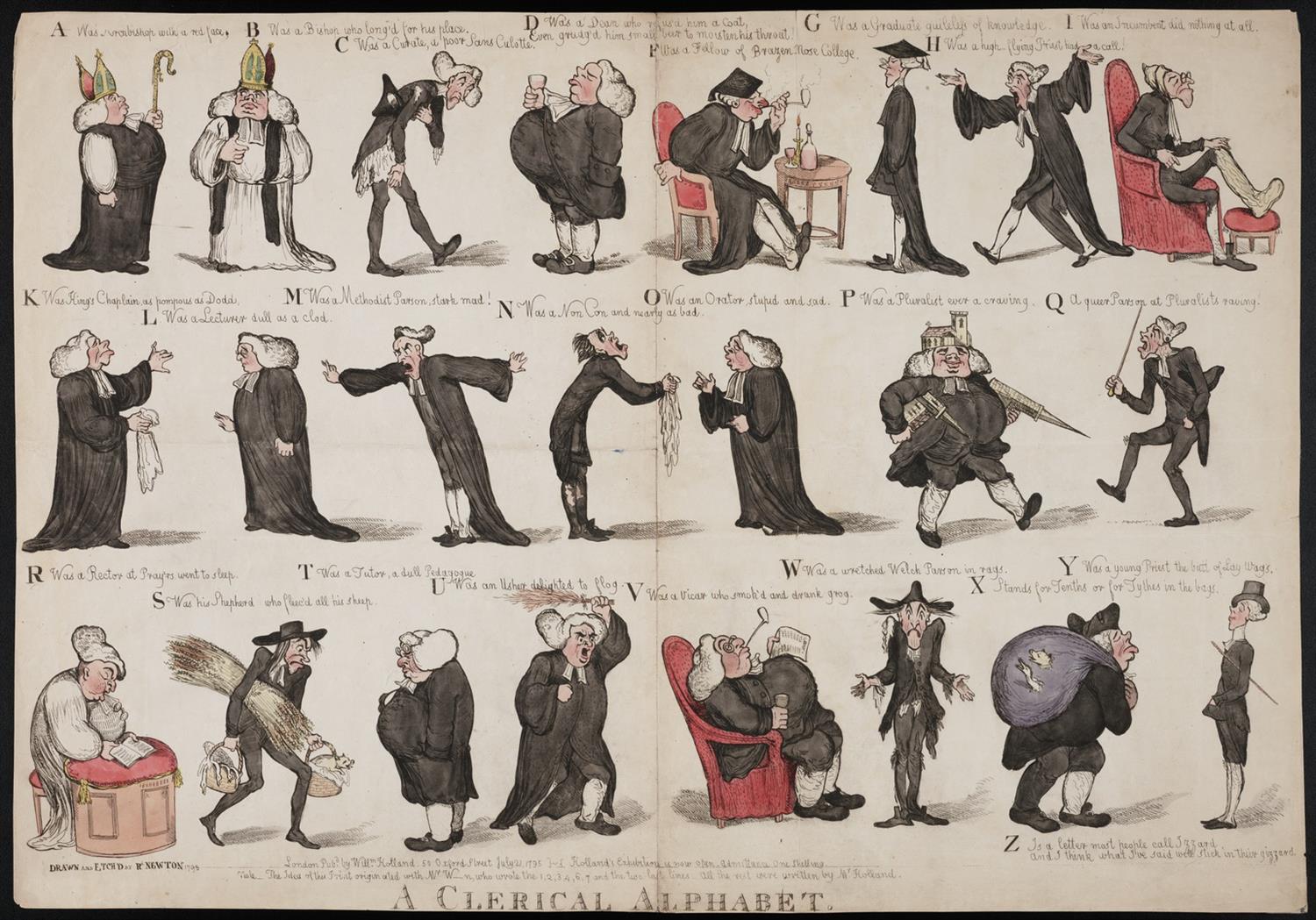
Richard Newton’s “A Clerical Alphabet,” published in 1795. Illustrations by Richard Newton; captions by Newton and publisher William Holland. Courtesy of the Lewis Walpole Library, Yale University.

Richard Newton’s “Clerical Alphabet” satirizes the English clergy of Austen’s time. You may be familiar with cartoonists, or caricaturists, of the eighteenth century like Thomas Rowlandson and James Gillray. Some of Rowlandson’s cartoons are based on Richard Newton’s work. Newton’s popular cartoons mocked the “establishment,” including fashions, politicians, the king, and even the church. Newton lived only 21 years. He died of typhus in 1798, shortly after he drew a satirical series on death!

Jane Austen herself wrote satirically, though much more gently, of the clergy. We laugh with her at foolish Mr. Collins, presumptuous Mr. Elton, and gluttonous Dr. Grant. It seems, though, that they performed their jobs as ministers adequately. In Emma, Miss Nash has copied down all the texts (Bible passages) Mr. Elton preached from since he came to Highbury. In Mansfield Park, Mary Crawford says Dr. Grant’s curate does much of his work. But at least Dr. Grant preaches good sermons, according to both Mary and Fanny Price.

Three of Jane Austen’s heroes, Edmund Bertram, Edward Ferrars, and Henry Tilney are conscientious clergymen. Sense and Sensibility tells us of Edward’s “ready discharge of his duties in every particular,” meaning that he willingly and eagerly did all that a clergyman was supposed to do. Henry Tilney employs a curate to do his duties while he is at Bath and Northanger Abbey. But Henry faithfully attends parish meetings, and I think he would have done his duties well once he was full-time at Woodston.

What were the clergy (church ministers or pastors) really like in Austen’s England? Many were good men, serving God and their communities. Jane’s father and brothers and her cousin Edward Cooper were faithful clergymen.

Mary Crawford of Mansfield Park, though, doesn’t think much of the clergy. “A clergyman is nothing,” she tells Edmund. Edmund and Fanny have much higher ideas of what the clergy can be, and should be.

Edmund says that the clergy “has the charge of all that is of the first importance to mankind, individually or collectively considered, temporally and eternally, . . . the guardianship of religion and morals, and consequently of the manners which result from their influence.” By “manners,” he explains that he means actions based on religious principles. He says the clergy have a huge influence on the people of their area.

Unfortunately, the church system in Austen’s day allowed anyone with a gentleman’s education and the right family and social connections to become a clergyman. Even an immoral man like Wickham could have been a clergyman, if he had not renounced his claim.

Newton’s cartoon shows us some of the major issues in Austen’s Church of England. Some of his clergymen are very fat and some are very thin. The church livings of Austen’s England were unevenly distributed. Some provided a high income, others a low income, and some were moderate. Let’s look in more detail at Newton’s criticisms of the Church of England in Jane Austen’s time, and how they connect to Austen’s novels.
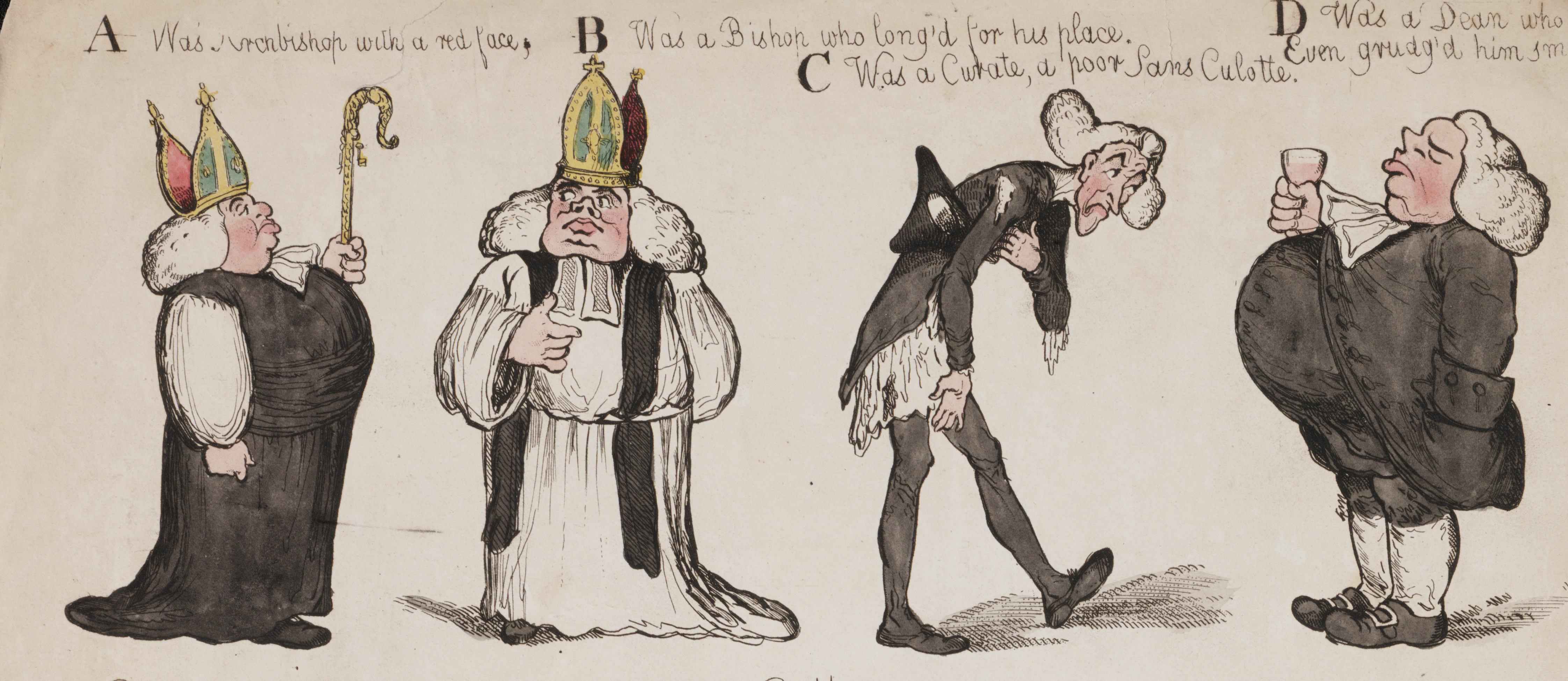
A, B, C, D, and E of Richard Newton’s “Clerical Alphabet,” published in 1795. Courtesy of the Lewis Walpole Library, Yale University.

The “Clerical Alphabet” begins:
A Was Archbishop with a red face,
B Was a Bishop who long’d for his place.
C Was a Curate, a poor Sans Culotte,
D Was a Dean who refus’d him a Coat
Even grudged him small beer to moisten his throat. (No picture for E, just a caption.)

A-B: In the Church of England, the king was the supreme authority of the church, and under him was the archbishop of Canterbury, then the archbishop of York. Each archbishop supervised a number of bishops, and the bishops supervised the more than 11,000 parish priests of England. Bishops and archbishops were wealthy men, with high incomes from the church. They were members of the House of Lords in Parliament. Mr. Collins says he is not worried that the archbishop or Lady Catherine will rebuke him for dancing. In reality, the archbishop would not know of Mr. Collins’s existence! Collins is exalting Lady Catherine by putting her at the same level as the highest church official.
C: Sans Culotte is French for “without pants” (more literally “without knee breeches”; the peasants wore long trousers instead of the knee breeches worn by upper classes). The “Sans Culotte” were the lower class French people who supported the French Revolution. In the English church, curates were the lowest rung of the clergy. Most lived on stipends of only £50 per year or less, barely enough for survival. They either assisted rectors and vicars, or led services in their place. In Persuasion, Mary Musgrove looks down on Charles Hayter as “nothing but a country curate.
D-E: A dean was another wealthy church leader, the head clergyman overseeing a major church. In Mansfield Park, Mrs. Grant says they can move to London if someone commends “Dr. Grant to the deanery [the dean’s office] of Westminster or St. Paul’s.” Dr. Grant does get such a promotion at the end of the book. However, his gluttony kills him. No doubt this is Jane Austen’s own satire of wealthy clergymen!
Small beer was cheap beer with a low alcohol content. The church was not generous to the poor curates.
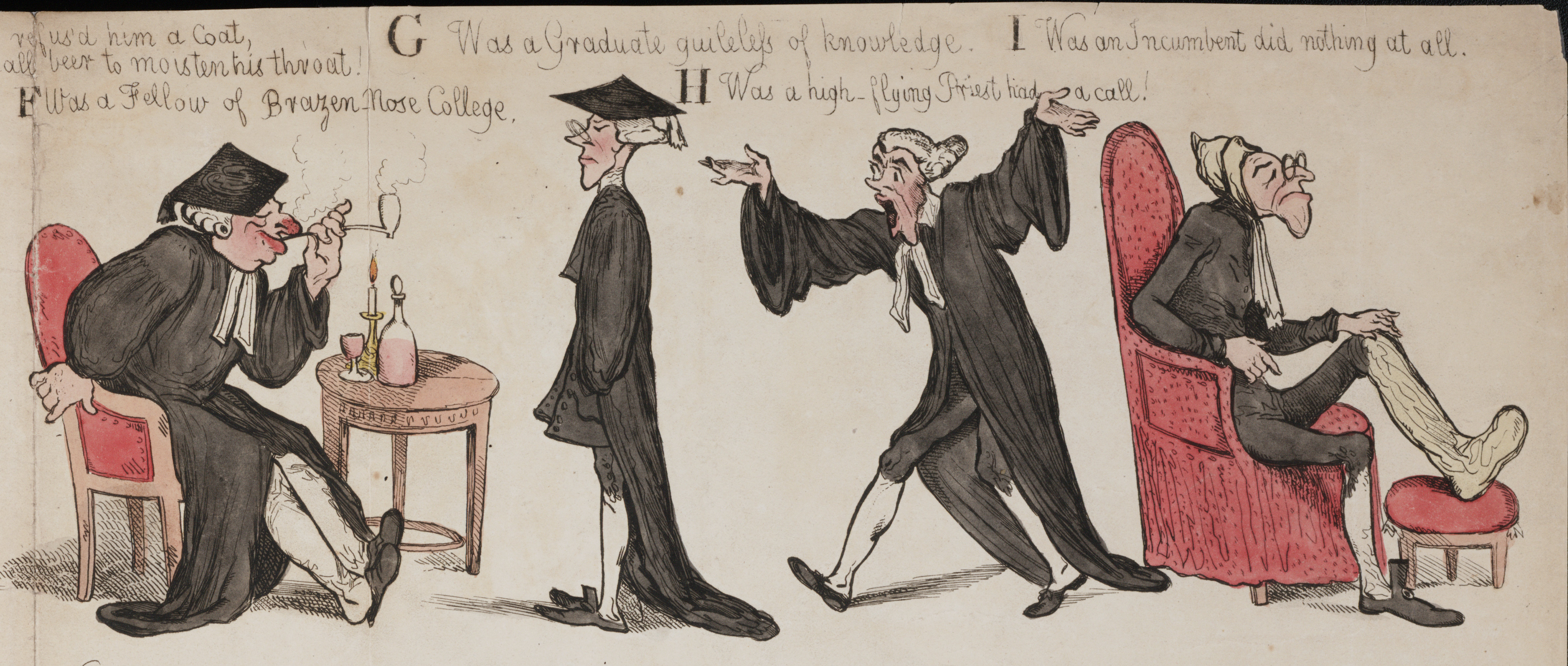
F, G, H, and I of Richard Newton’s “Clerical Alphabet,” published in 1795. Courtesy of the Lewis Walpole Library, Yale University.

F Was a Fellow of Brazen-Nose College
G Was a Graduate guileless of knowledge
H Was a high-flying Priest had a call!
I Was an Incumbent did nothing at all.

F: Brazen-Nose College is a pun on Brasenose College of Oxford University. Fellows were the senior members of a college, usually clergymen. This one enjoys his pipe and his wine.
G: The graduate, without knowledge, is likely a member of the highest social classes. The nobility and others with wealth could graduate from Oxford or Cambridge University simply by being there for a certain amount of time. Students who were not as rich had to write essays in Latin and take exams. Clergymen followed the same course of study as any other gentlemen, plus they had to show up for one course on theology. Edward Ferrars says he was “properly idle” at Oxford.
H: The clergy was considered an occupation at this time, not usually a calling from God.
I: Once a man had a church living (a post as rector or vicar of a parish), he was the incumbent. He held the living until he died. In old age, or if he moved elsewhere, he would hire a curate to perform his duties. Although Dr. Grant gets a post at Westminster and moves to London, he still has the income from the parish of Mansfield Park (he is still the incumbent) until he dies. Then Edmund can take that parish.
(At this time, I and J were considered to be the same letter. So there is no J in this alphabet. That is also why the Jane Austen sampler has an I but no J.)
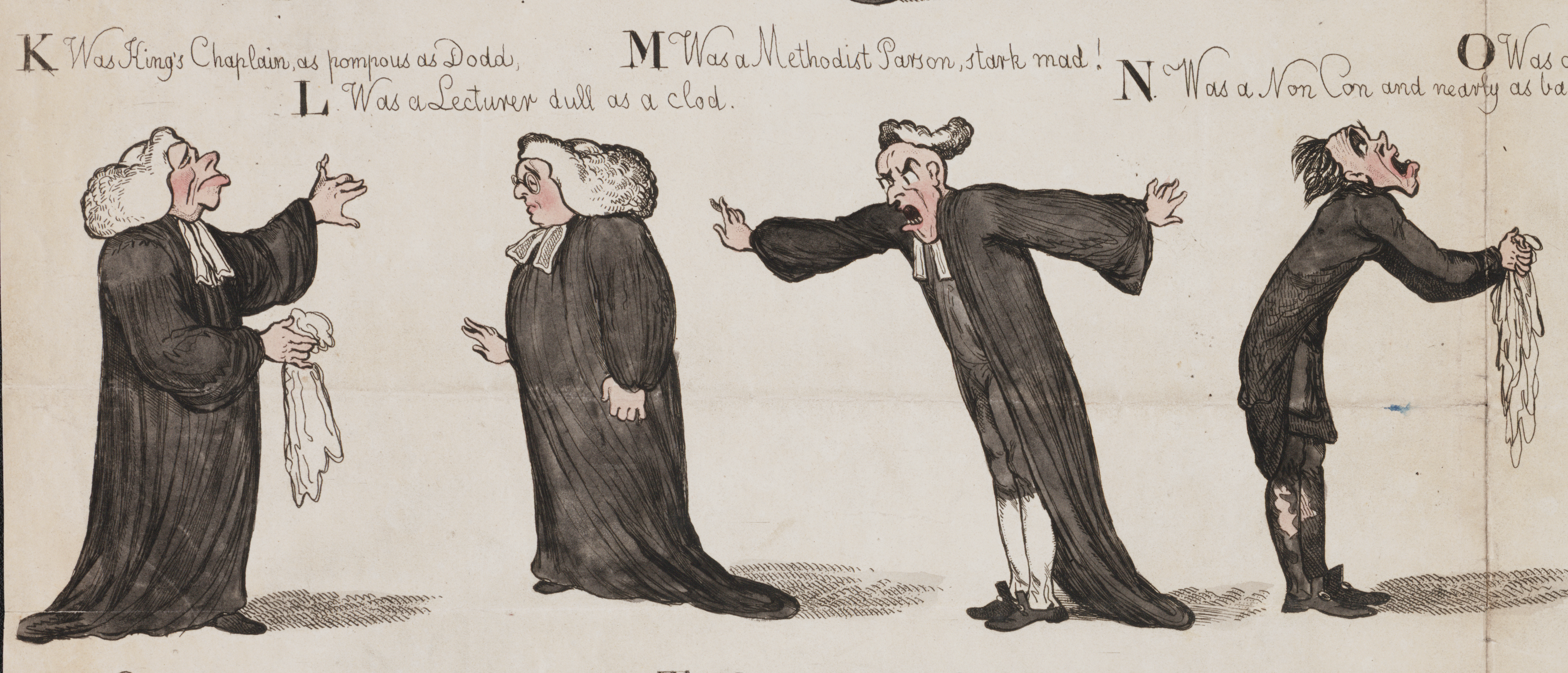
K, L, M, and N of Richard Newton’s “Clerical Alphabet,” published in 1795. Courtesy of the Lewis Walpole Library, Yale University.

K Was King’s Chaplain as pompous as Dodd,
L Was a Lecturer dull as a clod.
M Was a Methodist Parson, stark mad!
N Was a NonCon and nearly as bad.

K: The king’s chaplain was the king’s personal priest for the Chapel Royal. William Dodd (1729-1777) was an extravagant clergyman who became chaplain to the King of England in 1763. To clear his debts, he forged a bond for £4200. He was convicted and hanged in 1777.
L: A lecturer was a preacher chosen and paid by the congregation who gave additional sermons (“lectures”) at a church, usually at afternoon or evening services.
M: The Methodists were part of the Church of England until around this time. They were known for their emotional enthusiasm and their focus on salvation by grace. Some Methodist preachers, including John Wesley, preached to large open-air meetings. According to Wesley’s Journal, listeners sometimes responded with “outcries, convulsions, visions, and trances.” More orthodox Anglicans considered this madness. When Edmund rebukes Mary Crawford, she ridicules him, saying, “when I hear of you next, it may be as a celebrated preacher in some great society of Methodists.” In the late 1700s, the Methodists separated from the Church of England and became Dissenters.
N: A NonCon was a Non-Conformist or Dissenter, a person who did not “conform” to the Church of England (or “dissented” from its statement of faith). These included Catholics, who faced major prejudices in Austen’s England. Baptists, Quakers, Independents, Unitarians, and others all fell into this category. They were usually from the middle and lower classes at this time. They could not get a degree from the universities, and were not supposed to hold public office. Mainstream Anglicans thought Nonconformists were enthusiasts (excessively emotional) like the Methodists.
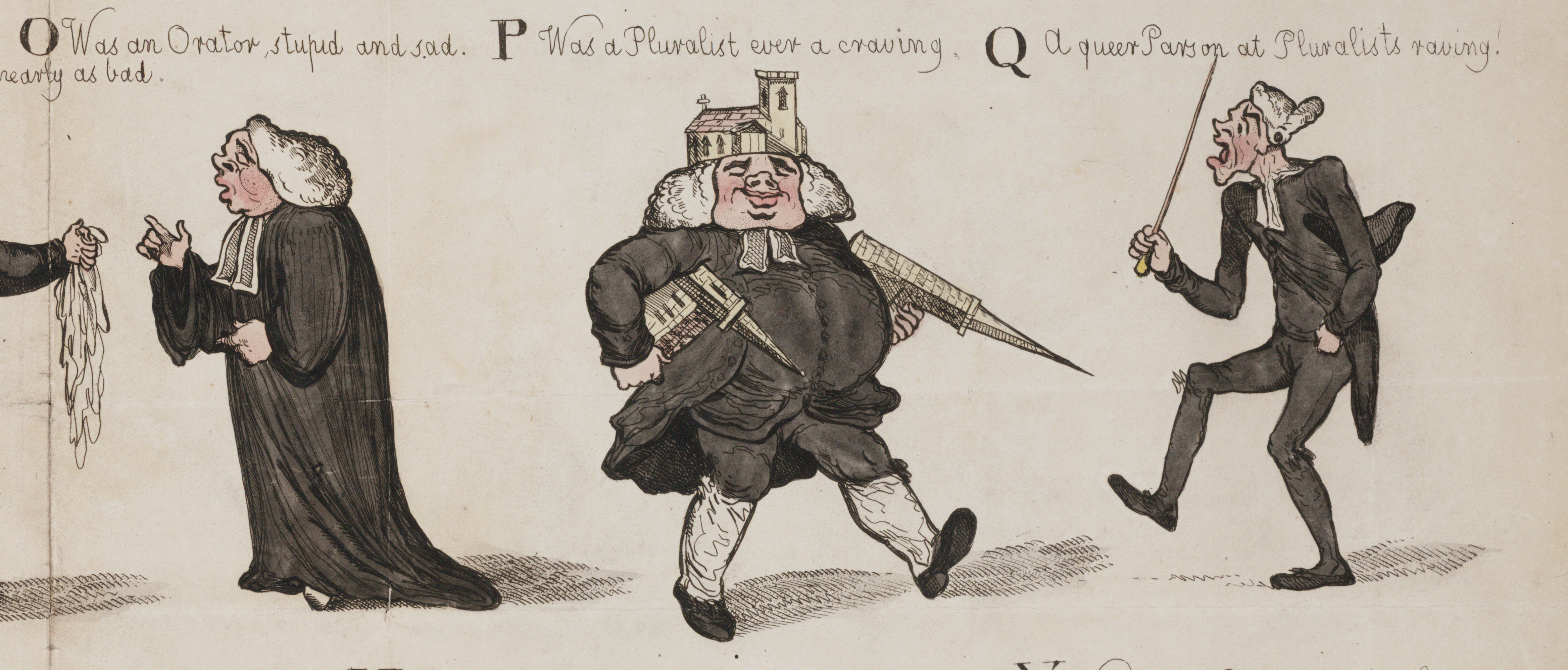
O, P, and Q of Richard Newton’s “Clerical Alphabet,” published in 1795. Courtesy of the Lewis Walpole Library, Yale University.

O Was an Orator, stupid and sad.
P Was a Pluralist ever a-craving
Q A queer Parson at Pluralists raving!

O: An orator, as today, was a public speaker. In Mansfield Park, Edmund and Henry Crawford discuss how to best read the liturgy and preach in Church of England services. They agree that it was often done poorly. Edmund says that things have changed, and now, “It is felt that distinctness and energy may have weight in recommending the most solid truths.” Edmund is concerned with communicating truth. Henry, though, would like to speak well in order to be popular and admired.
P-Q: Pluralists held multiple church livings. They might live in one parish and serve as its minister and pay curates to serve the others, while they took most of the income from those parishes as well. They were not necessarily fat, though. Some livings were quite small and the clergyman needed a second one. Jane Austen’s father held two livings, at Steventon and Deane. They were close enough together that he could lead services at both churches on Sundays, and the income from each was low. Some pluralists, however, were extremely wealthy. In Mansfield Park, Sir Thomas Bertram says a clergyman should reside in his parish to set an example and care for the people of the parish. We don’t know what Edmund did once he had two parishes to care for, at Mansfield Park and Thornton Lacey.
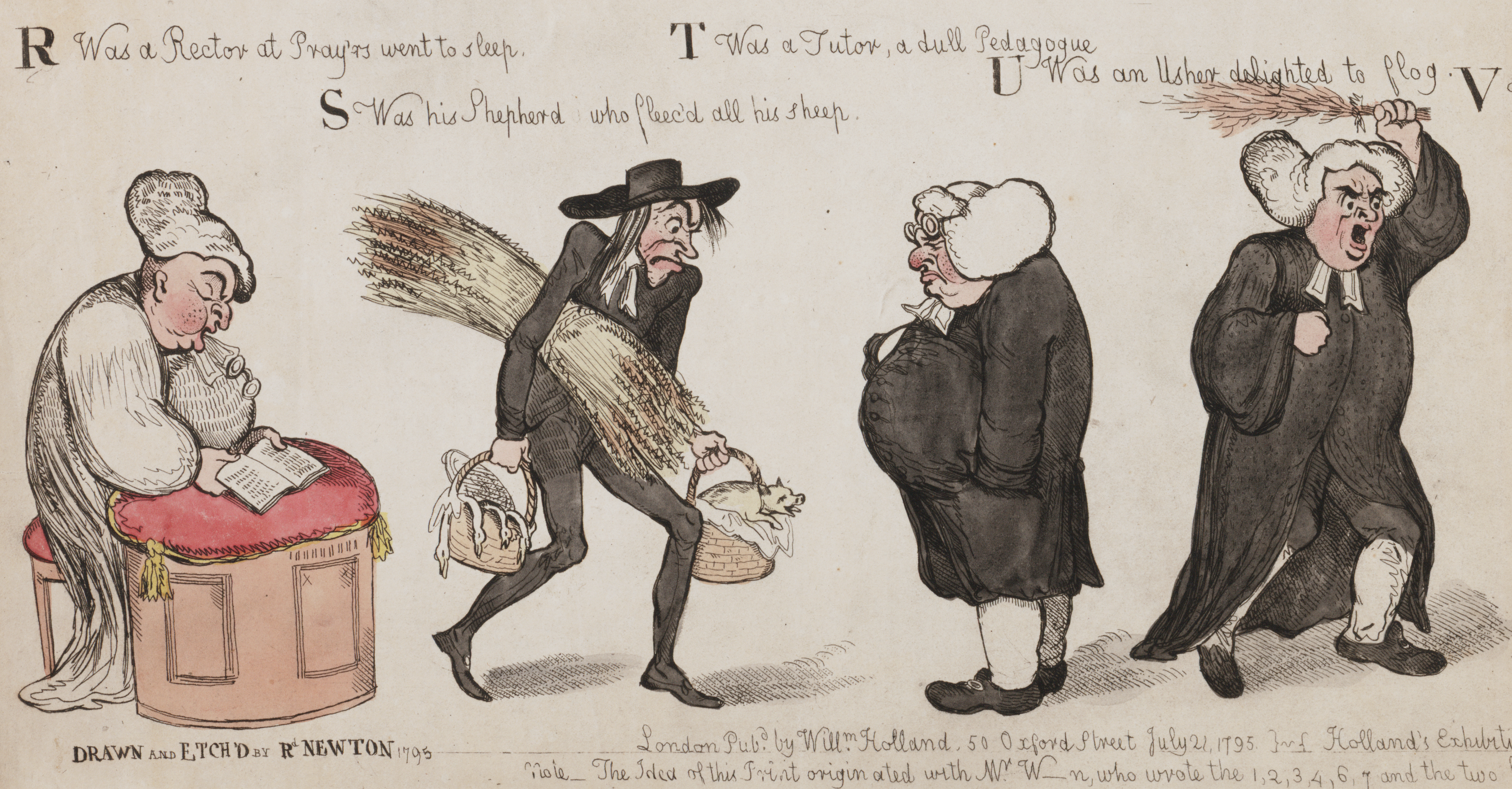
R, S, T, and U of Richard Newton’s “Clerical Alphabet,” published in 1795. Courtesy of the Lewis Walpole Library, Yale University.

R Was a Rector at Pray’rs went to sleep
S Was his Shepherd who fleec’d all his sheep.
T Was a Tutor, a dull Pedagogue
U Was an Usher delighted to flog.

R: Mr. Collins was quite proud of being a rector. The rector received all the tithes from the parish; a vicar like Mr. Elton only received a portion of the tithes.
S: This is a play on words. The clergyman was to be a shepherd, caring for his parishioners, his flock. However, he also had to collect tithes from them: one-tenth of their farm income, including crops, the young of animals, and even eggs from their poultry.
T: At Oxford, each student had a tutor responsible for his education. The tutor gave assignments and lectured. A pedagogue is a teacher, especially a pompous or strict one.
U: An usher was an assistant to a schoolmaster. Schools were often run by clergymen. Flogging, or whipping, was a common punishment.
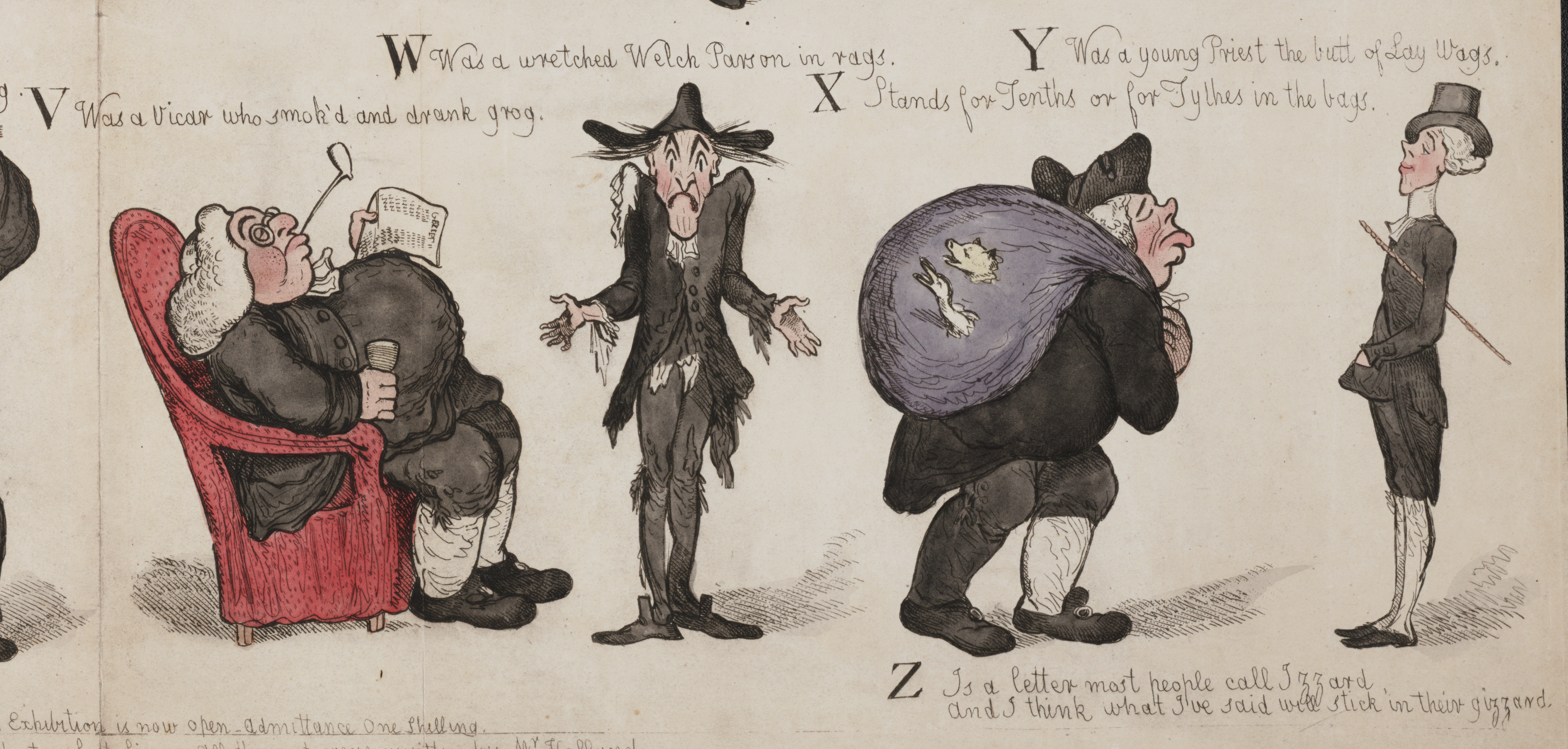
V, W, X, Y, and Z of Richard Newton’s “Clerical Alphabet,” published in 1795. Courtesy of the Lewis Walpole Library, Yale University.

V Was a Vicar who smok’d and drank grog.
W Was a wretched Welch Parson in rags.
X Stands for Tenths or for Tythes in the bags.
Y Was a young Priest the butt of Lay Wags.
Z Is a letter most people call Izzard
And I think what I’ve said will stick in their gizzard. (No picture for Z.)

V: A vicar, like Mr. Elton, was a clergyman who only got about a quarter of the tithes for the parish; someone else, often the squire, received the rest. Drunkenness was a widespread issue in Austen’s England. Grog was an alcoholic drink, usually rum and water. It was usually associated with sailors.

W: The church in Wales was poor compared to the church in England.

X: The clergy’s main income came from tithes, collected from farmers in the parish (see S). People of the parish were legally required to pay tithes to the clergyman, even if they were Dissenters. This sometimes caused friction between clergymen and the people of the parish.

Y: Laymen, who were not clergy, made fun of this priest. Johnson’s Dictionary says a wag is anyone “ludicrously mischievous.” The cartoonist Newton himself was apparently one of these “lay wags” making fun of priests.

Z: Izzard is a dialectal word for z, first recorded about 1726. Newton wasn’t afraid to irritate his readers.

Do any of these clergymen remind you of characters in Austen’s novels? I think Dr. Grant might have become the fat dean if he had lived long enough. Mr. Collins might end up as the dozing rector. And Collins wanted to be a pluralist; he hoped for more livings from Lady Catherine.

This was obviously an exaggerated picture of the church in Austen’s England. Because of such clergymen who abused their positions, though, many people like Mary Crawford thought poorly of the church and the clergy. The cartoon points out some of the issues that later generations would correct.

About the author: Brenda S. Cox blogs on Faith, Science, Joy, and Jane Austen, and is working on a book entitled Fashionable Goodness: Christianity in Jane Austen’s England.

The British Museum www.britishmuseum.org/collection/term/BIOG40122 offers brief information about Newton and a link to Newton’s many caricatures held by the British Museum. For more about Richard Newton and his life and cartoons, see Lambiek.

Read Full Post »

Inquiring readers: The information about this exhibit makes me wish I was in the UK to see it. To view a first edition of Pride and Prejudice would make my mouth water. Enjoy the images and the information. 

Georgian era of light and shade explored at

Worcester City Art Gallery and Museum

  • Artworks, costume and literature tell the conflicting stories of the Georgian era
  • Includes a first edition of Jane Austen’s Pride and Prejudice on loan from a private lender
  • Exhibition brings together artefacts and stories from across Regency Worcester
  • Opens 18 January until 28 March, free entry.

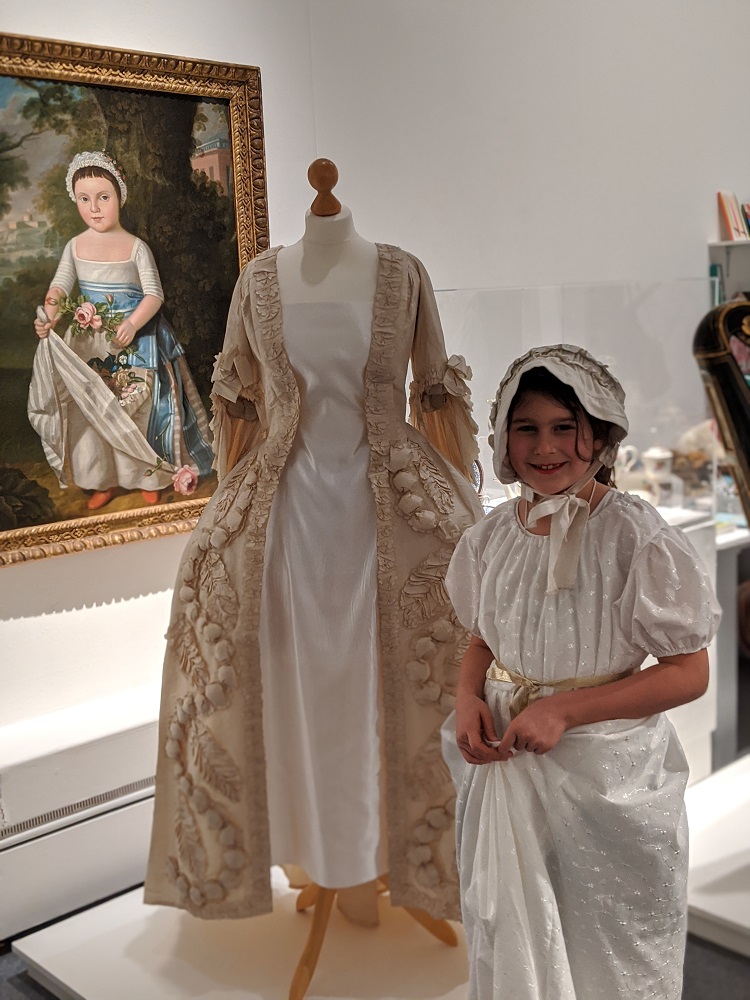
Worcester City Art Gallery & Museum presents a new exhibition exploring the fact and the fiction behind one of the most fascinating and tumultuous periods of British history. Georgians: the Pride and the Prejudice is designed to lead the viewer on a Grand Tour of Regency Worcester, taking in the beautiful landscapes, exquisite interiors and pass-times of the Bennetts and Darcy’s of the city, emerging into the wider world to see at what cost the pursuit of pleasure and elegance. The exhibition opens 18 January until 28 March and entry is free.

The exhibition brings together for the first time a wealth of art and artefacts from the museum’s own collections including works by John Downman, one of the most popular watercolour portraitists of the late 18th century, and the renowned pastelist John Russell, as well as Georgian costume, a rare Erard harp and a stunning Sedan chair, together with a first edition of Pride and Prejudice from a private lender.

The Georgian period captivates an audience like no other. The grandeur of the architecture, the extravagance of the fashion and the intricacies of the social etiquette create a wonderful image of elegance and exuberance which has been celebrated time and time again in literature, television and film. The exhibition begins in Regency Worcester but ends with a glimpse into the fragile reality upon which it was built. Behind the extravagances of the Georgian period was the exploitation of people, in plantations, in the colonies or in the factories and slums.

Exhibition Curator Claire Cheshire said: “This exhibition celebrates Worcester’s landscapes and its trades. In fine houses across the country there would have been Royal Worcester porcelain, gloves, and even Worcester-made bricks. Georgians: the Pride and the Prejudice will be a visual delight for all visitors.”

Georgians: the Pride and the Prejudice is free and runs from 18 January until 28 March, more information can be found here: www.museumsworcestershire.org.uk

For a more in-depth look at the exhibition and to discover some of the stories behind the objects on display join a Curators Tour on 16th March, 11.30 a.m. No booking needed. £3 per person.

Georgians: the Pride and the Prejudice

18 January until 28 March 2020

FREE ENTRY

Exploring the fact and the fiction behind one of the most fascinating and tumultuous periods of British history through artworks, costume and literature.

Image of a Costume from Museum Worcestershire collection: courtesy of the Worcester City Art Gallery & Museum. Permission given, no names.

Costume from Museum Worcestershire collection: courtesy of the Worcester City Art Gallery & Museum. Permission given, no names.

11th February

Bite sized talk – Georgians: the Pride and the Prejudice – the stories behind the objects

1-1.30pm. £3

16th March Curators tour of the exhibition

11.30am. £3

Open Monday – Saturday 10.30am – 4.30pm

Worcester City Art Gallery & Museum

Foregate Street

Worcester WR1 1DT

Tel: 01905 25371

About Museums Worcestershire
Museums Worcestershire is the joint museum service of Worcester City and Worcestershire County Councils. It comprises three fantastic venues–Worcester City Art Gallery & Museum, the Commandery in Worcester and The County Museum at Hartlebury Castle.

The collections and exhibitions at our sites are many and varied, covering centuries of the county’s history right up to the present day. Thousands of objects, including the historic buildings themselves, are brought to life through innovative exhibitions and events throughout the year.

www.museumsworcestershire.org.uk


Read Full Post »

Sanders-JaneAustenforKidsInquiring readers,

In this blog post (to wind up women’s history month), author Nancy Sanders discusses her new book Jane Austen for Kids: Her Life, Writings and World, with 21 activities, which teaches young readers about our favorite novelist through 21 enriching activities that help them gain a better understanding of what day-to-day life in the Georgian era was like. Activities include learning to play whist, designing their own family coat of arms, planting a Georgian-style kitchen garden, hosting a Regency tea, sewing a reticule, and more.

I am pleased to announce that the publisher has agreed to give away two free copies of the book. Please leave a comment to enter the contest and let us know which activity you would introduce to children to learn more about Georgian life! Winners will be drawn via random number generator 7 AM EST USA April 1st. (US readers only, please). You may leave as many comments as you like. NOTICE: Contest is closed as of 10 AM April 1. The winners are: Rona Shirdan and DanelleinKansas

Ms. Sanders sent us information about her new book and her splendid visit to Winchester. Enjoy!

When I signed the contract to write a biography of Jane Austen for young people, it was a thrilling day indeed! The deadline was set when the final manuscript would be due at the editor’s desk, and I dove into my project.


How diverting it was to read and reread Jane’s delightful novels, watch and watch again the amazing variety of movies based on her books, and pour over biographies others had written about our favorite author.


Several months into my deep research, however, I discovered a treasure that changed my course. Shortly after my manuscript was due at the publisher, all England would be celebrating the 200th anniversary of Jane’s legacy to the world.


On July 18, 2017, Winchester Cathedral planned to host private services at Jane’s grave followed in the evening by a Choral Evensong honoring this amazing woman.


Would I be there to witness this once-in-a-lifetime event? Could I be there? I called my editor and got my deadline extended to include this unexpected trip. My husband Jeff and I booked an exclusive tour with JASNA (The Jane Austen Society of North America). Upon my word, we were excited to participate in the gala celebrations and all-things-Jane!

1_P1040161_WINCHESTER_CATHEDRAL[1]

All photos from Winchester Cathedral by author, courtesy of the Winchester Cathedral.

July 18, 2017 dawned sunny and fair. I entered the hushed halls of Winchester Cathedral with Jeff and my tour group whom we had just met the night before. Our capable and enthusiastic group leader was Liz Philosophos Cooper, a Janeite from a family of Janeites who was destined to become the very next President of JASNA!

2_P1030843_nave[1]

All photos from Winchester Cathedral by author, courtesy of the Winchester Cathedral.

We were led through the magnificent nave of the cathedral and stood next to Jane’s grave. Canon Sue Wallace greeted us and shared inspirational words about Jane and how her faith shaped Jane’s thoughts, actions, and writings. Along with the other members of our tour group, Jeff and I placed a rose on Jane’s grave.

3_P1040022_grave_with_3_flowers[1]

All photos from Winchester Cathedral by author, courtesy of the Winchester Cathedral.

It was 200 years ago, this very day, that our beloved Jane passed quietly away. After the graveside service finished, we lingered nearby.

4_P1040007_website_with_bust[1]

All photos from Winchester Cathedral by author, courtesy of the Winchester Cathedral.

There was a beautiful bust of Jane displayed in the nave. I stopped and looked into Jane’s eyes.

5_P1040041_website_signing_memory_book[1]

All photos from Winchester Cathedral by author, courtesy of the Winchester Cathedral.

There was a memory book to sign. The BBC radio interviewed several of us on our way out. The only way I could force myself to leave was knowing that in the evening we would return back to the cathedral for yet another special event once again in honor of Jane.

6_P1040146_college_street[1]

All photos from Winchester Cathedral by author, courtesy of the Winchester Cathedral.

We traced the route the small funeral procession probably took on the day of Jane’s funeral. The short walk led us to College Street where the house still stands that Jane and her sister Cassandra rented during Jane’s last days.

7_P1040139_website_nancy_at_front_door[1]

All photos from Winchester Cathedral by author, courtesy of the Winchester Cathedral.

I stood at the front door of this historic landmark…remembering the letter her sister wrote to inform the family of Jane’s last moments…remembering the description she gave of the small sad funeral procession that departed from this door…

8_P1040106_website_dog_close_up[1]

All photos from Winchester Cathedral by author, courtesy of the Winchester Cathedral.

A dog looked down at me and at our tour group who was visiting this house. What was the dog thinking? What did Jane think as she looked out onto this street during her final days? What did Cassandra think 200 years ago as she chose to stay behind from the funeral and looked out on this street to whisper her final good-byes to the sister she had so dearly loved? I longed to switch places with the dog for just a moment to catch a glimpse of the same view these two sisters shared during those heartbreaking times.

9_P1040124_website_film_crew[1]

All photos from Winchester Cathedral by author, courtesy of the Winchester Cathedral.

A film crew arrived and set up their equipment to begin filming. This was an important day in history. Two hundred years ago this very day, one of English literature’s greatest authors passed quietly away into the halls of eternity. Although practically unknown, Jane Austen was given a stately burial site in the magnificent Winchester Cathedral. Somehow, someone recognized the treasures this self-taught genius and amazing woman had given to England…and the world. They gave her a final resting place where Janeites from around the globe could come show their love and respect…as did I and hundreds of others on this unforgettable day.

Thank you Nancy, for this wonderful description of your visit to Winchester and these excellent photos! Don’t forget to leave your comment, readers, for a chance of winning one of two copies of this book. (U.S. readers are eligible only)

___________

About the author:

Nancy I. SAnders is the author of many books, including Frederick Douglas for Kids, America’s Black Founders, A Kid’s Guide to African American History and Old Testament Days. She lives in Chino, California.

About the book: 

Jane Austen for Kids: Her Life, Writings, and World, with 21 Activities by Nancy I. Sanders. Chicago Review Press, Distributed by IPG Publication Date: February 5, 2019, 144 pages. Two color interior, ages 9 & up. ISBN: 978-1-61373-853-5

Other posts about Winchester on this blog:


Read Full Post »

Inquiring readers,

Today is Valentine’s day, a perfect time to revisit some of Jane Austen’s most romantic and memorable quotes.

I can listen no longer in silence. I must speak to you by such means as are within my reach. You pierce my soul. I am half agony, half hope. Tell me not that I am too late, that such precious feelings are gone forever. I offer myself to you again with a heart even more your own…I have loved none but you.” – Captain Wentworth, Persuasion

The driving force behind this quote was a talented and witty, yet ordinary-looking spinster. The sentiments expressed in her novels were remarkable given that Austen lived in an era when money and status were considered primary reasons for courtship and marriage.

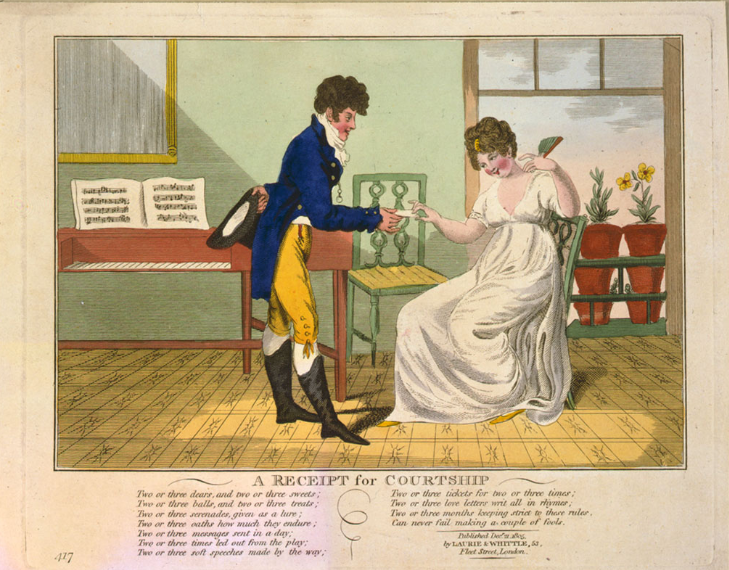
This caricature, created in 1805, poked fun at the era’s courtship conventions, much like Jane Austen did through characters like Mr. Elliot, Mr. Collins, and Henry Crawford, all of whom followed current courtship conventions but misread their heroines exceedingly.

receipt image

Image in the public domain, U.S. Library of Congress

Receipt for Courtship – Text

Two or three dears, and two or three sweets;
Two or three balls, and two or three treats;
Two or three serenades, given as a lure;
Two or three oaths how much they endure;
Two or three messages sent in a day;
Two or three times led out from the play;
Two or three soft speeches made by the way;
Two or three tickets for two or three times;
Two or three love letters writ all in rhymes;
Two or three months keeping strict to those rules,
Can never fail making a couple of fools.

A lady’s imagination is very rapid; it jumps from admiration to love, from love to matrimony in a moment.” – Mr. Darcy’s sarcastic comment to Miss Bingley, Pride and Prejudice

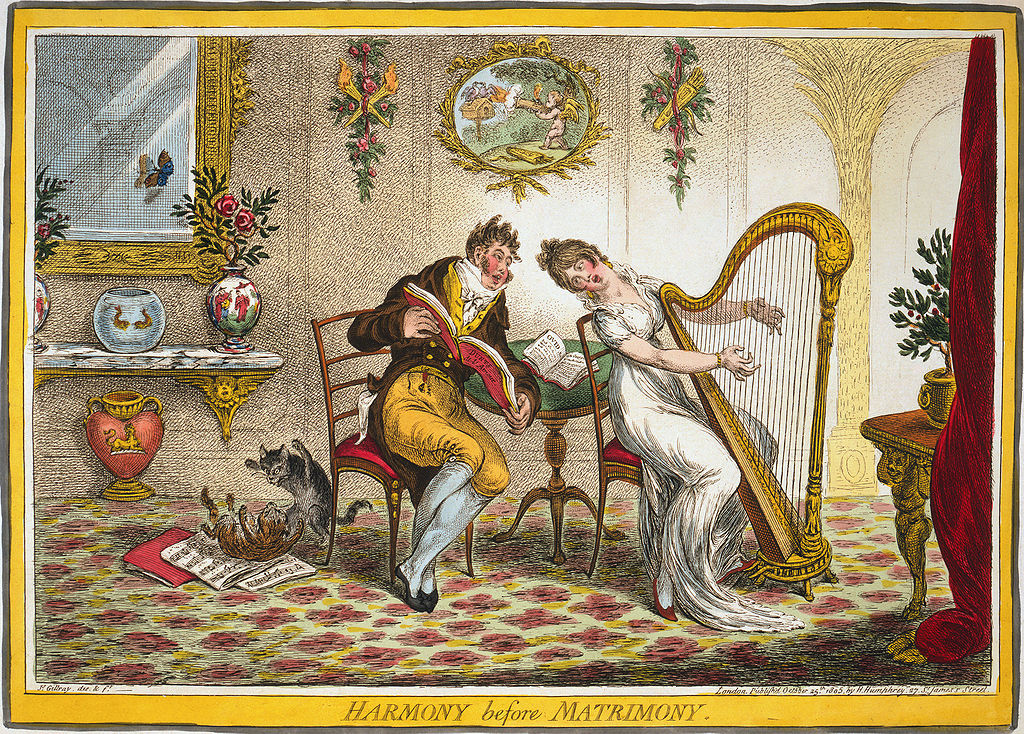
1024px-1805-Gillray-Harmony-before-Matrimony

Image in the public domain, Wikimedia Commons

This 1805 caricature entitled “Harmony before Matrimony” of a courting couple would have the young lady assume that a proposal would soon be in the offing. The artist made sure that the viewer understood this through iconography: the cupid in the oval painting, which also shows two courting doves, the two roses in a vase featuring a Chinese couple, the two fish, the two playful cats, a wall sconce made of cupid’s arrows, the two flaming torches, and the butterfly reflected in the mirror making two. The couple sit on a carpet of roses, the music book, “Duets de L’Amour,” is held by the courting swain, while on the table lies an open copy of Ovid’s “Art of Love.” In this scene, all is harmonious, all is good, but those familiar with the caricatures of the engraver James Gillray know that not “all” is what it seems.
The second companion cartoon “Matrimonial Harmonics” depicts life after marriage: Cupid is dead in the funereal image, two parrots sit in their cage with their backs to each other, a dog barks at a hissing cat, the husband covers his ear as his baby screeches in the maid’s arms, and his wife sings alone at the piano forte. It is a scene of inharmonious conflict, one often described by Jane Austen (Mr. and Mrs. Bennet, John and Frances Dashwood, Charlotte and Mr. Collins, Mr. Wickham and wife Lydia).

If I loved you less, I might be able to talk about it more.” ― George Knightley, Emma

Jane’s Heroes were men of few words as this quote by Mr. Knightley attests. A number of Jane Austen’s heroes were men of few words, but Elinor Dashwood and Fanny Pricem two long-suffering heroines, also had difficulty expressing their emotions.

Thomas_Gisborne_Joseph_Wright_Derby

Image in the public domain, wikimedia commons.

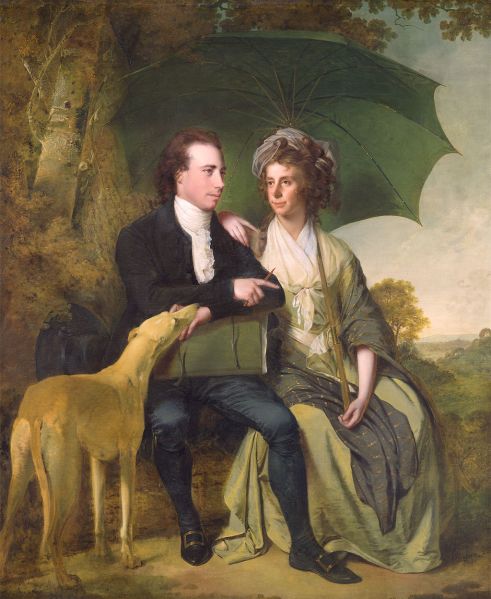
This 1786 painting of The Rev. and Mrs. Thomas Gisborne, of Yoxhall Lodge, Leicestershire by Joseph Wright of Derby depicts a sober couple much in the vein of Elinor Dashwood and Edward Ferrars or Fanny Price and Edmund Bertrum. The year the portait was painted precedes Jane’s era, but the calmness of the scene and the sober mien of a couple who clearly come from the gentry class remind me very much of how I envisioned both couples. Neither seem to be the type to behave in in unseemly manner at an assembly ball.

In Jane’s novels, lovers who behaved badly often expressed good insights tinged with regret.

“Where the heart is really attached, I know very well how little one can be pleased with the attention of any body else. — Isabella, Northanger Abbey

and

Yes, I found myself, by insensible degrees, sincerely fond of her; and the happiest hours of my life were what I spent with her.— Mr. Willoughby, Sense and Sensibility

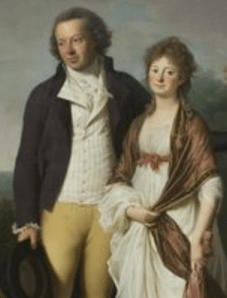
Johan Christian and his wife-Engelke Jens Juel 1797 Statens Museum for Kunst

Thumbnail of Johan and Engelke Christian, 1797, by Jens Juel


Older sensible couples who weathered married life and its vicissitudes and remained happy together play prominent roles in Austen’s plots. One senses that Admiral and Mrs Croft who befriend Anne Ellito in Persuasion must have observed the kind attention that Caption Wentworth paid her when he thought no one was looking.

The sensible older couple in Pride and Prejudice are Mr & Mrs Gardiner. He is silly Mrs. Bennet’s brother and a relation over whom Elizabeth did not need to blush. Their calmness and common sense helped to unite Mr. Darcy and Elizabeth after many missed opportunities.

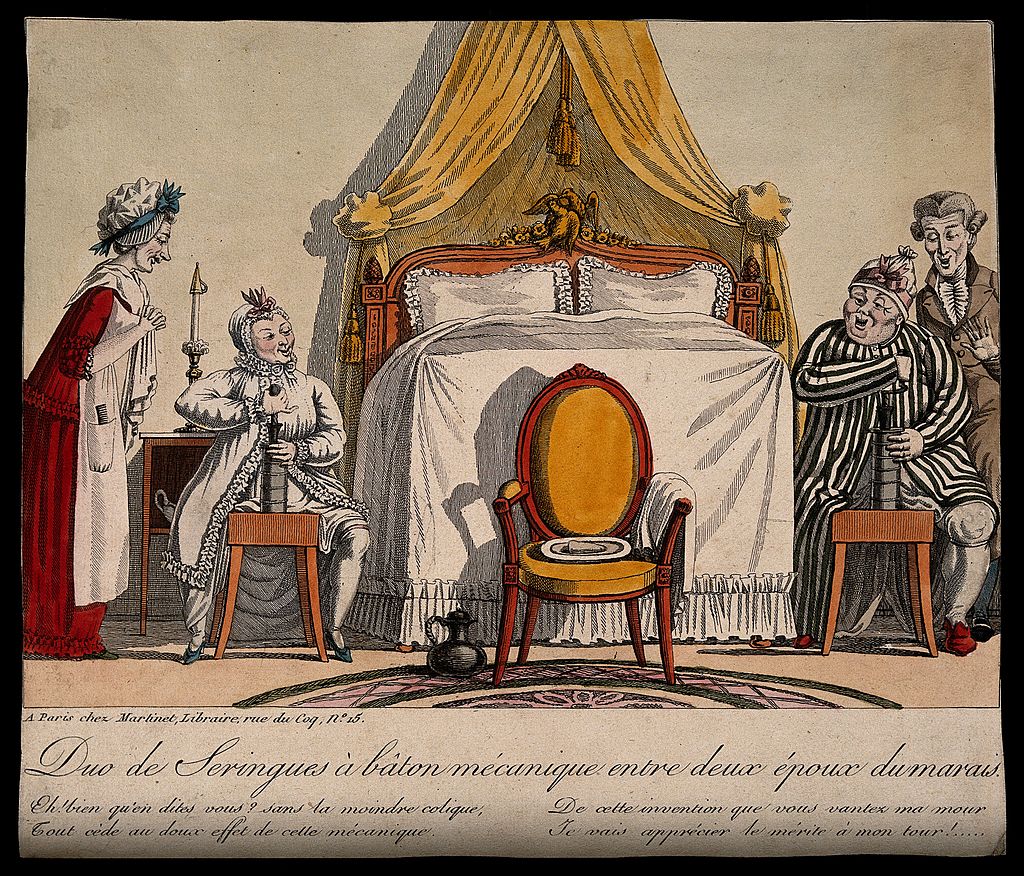
An_old,_rich_couple_enjoy_the_latest_fad_in_baton-powered_en_Wellcome_V0011705

Wellcome Collection image in the public domain by G. di Cari?

Romantic gestures change for many older couples. Over the years they are comfortable with each other. With age, often physical comfort and health have priority over more youthful pursuits. In her novels Jane Austen ignored the prurient, yet she lived in the Georgian age where social and political cartoons or satire were often graphic. Families took care of each other in sickness and health. They bathed their sick and tended to their every need. One wonders what was in Jane’s private letters to Cassandra regarding the more ordinary tasks of life.

The above image shows the sweetness of an older couple enjoying in tandem the latest fad in Baton-powered enemas. They seem happy and content and at ease with each other!

Jane, however, never found such a mate for life.

To you I shall say, as I have often said before, Do not be in a hurry, the right man will come at last.” – Jane Austen’s Letter to Fanny Knight

Following Jane’s advice, Fanny married for keeps. She bore 9 children to Sire Edward Knatchbull a baronet, to whom she was married for 26 years until his death.

Jane’s heroines were astute about pledging their love. Elizabeth Bennet failed to see through Wickham’s falsehoods at first, but common sense prevailed. Anne Elliot was never quite enamored of slimy William Elliot, for her heart belonged to the infinitely superior Caption Wentworth. One of Anne’s more memorable quotes is:

“My idea of good company, Mr. Elliot, is the company of clever, well-informed people, who have a great deal of conversation; that is what I call good company.” – Persuasion

One can only surmise that rather than settle for marriage to just any man, Jane Austen chose good company over a less than perfect union.

Jane’s heroes were equally steadfast and saw through foibles, insecurities, and prejudices of the women they loved, especially when their first impression was. They, like Mr. Darcy, waited patiently for the right moment to reveal their true feelings:

“My real purpose was to see you, and to judge, if I could, whether I might ever hope to make you love me.”— Darcy, Pride and Prejudice

In my opinion, none of Jane’s true heroes and heroines were ridiculous or maudlin. They chose well and understood the meaning of true love.

More on the topic: 


Read Full Post »

Inquiring readers,

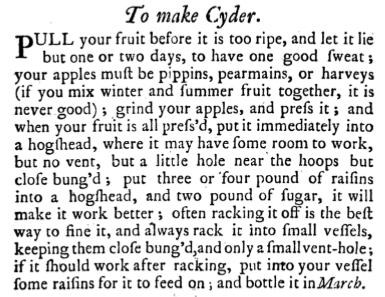
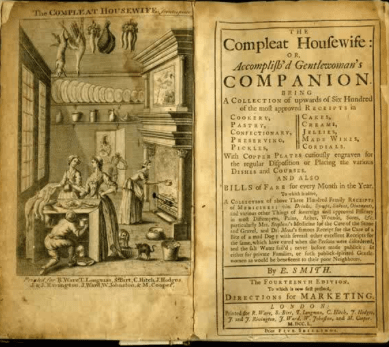
I am sharing this 18th century recipe just in time for the American Thanksgiving. In Georgian England and Colonial America, apples were picked in late fall in preparation for making cyder.  The fermented concoction was then bottled in March. This recipe comes from The Compleat Houfewife: or, Accomplifs’d Gentlewoman’s Companion, written by Eliza Smith and first published in London in 1727. The book was widely disseminated over the next 50 years, including the American colonies.

Recipe from the Compleat Housewife, a cookery book written by Eliza Smith and published in London in 1727.PULL your Fruit before ‘tis too ripe, and let it lie but one or two days to have one good Sweat; your Apples muft be Pippins, Pearlmains, or Harveys, (if you mix Winter and Summer Fruit together ‘tis never good) grind your Aples and prefs it, and when your Fruit is all prefs’d. put it immediately into a Hogfhead where it may have fome room to Work; but no Vent, but a little hole near the Hoops, but clofe bung’d; put 3 or 4 pound of Raifins into a Hogfhead, and two pound of Sugar, it will make it work better; often racking it off is the beft way to fine it, and always rack it into fmall Veffels, keeping them clofe bung’d, and only a fmall Vent-hole; if it fhould work after racking, put into your Veffel feme Raifins for it to feed on, and bottle it in March.

For those who are curious about the cider recipe above, a hogshead equals 110 gallons. By the end of the 17th century, close to to 10,000 hogsheads were exported yearly from Worcestershire alone. (1)

ancient cider making

From Ancient Cider Making at Smithsonian.com

Drinking cider has been around for thousands of years.

…cider spread throughout the Roman Empire and across Europe, becoming popular with people from the Germanic tribes to the Normans, whose conquest of England in the 9th century brought apple orchards and the very word “cider” into the English language.”  Read more @ Smithsonian.com

While ale and beer were more popular drinks, cider held its own. One of the apples mentioned in Eliza Smith’s cyder recipe is a pippin.  The word pippin denotes an apple tree grown from a seedling and that was not a grafted. Apples in the 17th and 18th century were not the sweet and beautifully shaped varieties we are accustomed to in our day. Pippins were lopsided, lumpy little fruits that were hard and tasted tart when picked early, but slowly ripened into a rich flavor. Other popular cyder apples were Pearmains,  the oldest known apple of English origin, and Doctor Harvey apples, which originated in Norfolk, England in 1629.

The endangered newton pippin apple.

Lumpy little pippins. Click here to learn more about the Newton Pippin apples in this photo. They are (link) now endangered in the U.S. 

In the 16th and 17th centuries , apple orchards were planted in Kent, Herefordshire, Gloucestershire, and Worcestershire. Most of the apples, which were transported via canals throughout England to an ever expanding market, were used to make cider. This was how cider-making became a big business.

Image of the fronticepiece and title of the Compleat Housewie or Accomplished Gentlewoman's Companion

I recall reading one historian’s opinion that, because of the dangers of unsafe water, before the age of enlightenment and before tea, hot chocolate, and coffee became popular and more affordable, (the boiled water essential in their preparation was safe), the populace was generally soused morning, noon, and night from drinking alcoholic beverages such as wine, ale, gin, cider, and other fermented beverages. Some folks obviously drank more than others (the vivid characters in Tom Jones come to mind), but drinking alcoholic beverages was so common, that pregnant women were administered these drinks to dull the pain of labor.

In 2009, Sarah Meachan, a history professor at Virginia Commonwealth University, published a book entitled Every Home a Distillery: Alcohol, Gender, and Technology in the Colonial Chesapeake. In it, she wrote:

In parishes, villages, and small towns throughout England, women continued to make small-scale cider and ale until the eighteenth century.”Quote in this link from Google books

The men and women who colonized the Chesapeake region (Virginia and Maryland) followed patterns similar to their British counterparts. Women made alcohol in the Colonies from the late 17th to late 18th centuries. Men owned the taverns, which made sense since women were not allowed to own property, except in the instance of a rich widow. And, so, cyder making , which was once a woman’s task, both in Great Britain and the colonies, was eventually overtaken by men as the distribution of cyder to male-owned taverns increased in both size, scope, and profitability.

Hard cider is once more gaining popularity in boutique craft breweries that are sprouting up in every place I frequent along the East Coast of the U.S.

In ending this post, I raise my glass of cyder to you, dear readers. May you and yours have a most blessed day with family and friends (and may you remember every bit of it!)


Sources:

The Ancient Origins of Apple Cider: The classic fall drink has boozy origins going back thousands of years, Smithsonian Magazine, December 8, 2016, Smithsonian.com

Pippin image: The Heirloom Orchadist,

Additional reading:

Save England’s Real Apples, Karen Homer, The Guardian, downloaded 3/21/2018. URL: https://www.theguardian.com/commentisfree/2011/mar/14/apple-britain-gala-traditional

‘Age of Indulgence: Beer and Wine in the Era of Jane Austen,’ Ancient Art Podcast, July 12, 2015


Read Full Post »

« Newer Posts - Older Posts »