Feeds:
Posts
Comments

Archive for the ‘Georgian London’ Category

Inquiring readers: I have no doubt you shall enjoy this review of Georgette Heyer’s The Masqueraders by my good friend, Lady Anne, an expert when it comes to the subject of this author. Lady Anne has read Georgette Heyer’s novels for most of her years upon this earth. Smart, sassy, fabulous, well tressed and well dressed, she has read every GH book backwards and forwards. There is not one tiny detail of Georgette’s novels that escapes Lady Anne’s attention or opinion. As to her review of The Masqueraders– please enjoy. For first-time readers: Spoiler alert.

Such a daring escape…

Their infamous adventurer father has taught Prudence Tremaine and her brother Robin to be masters of disguise. Ending up on the wrong side of the Jacobite rebellion, brother and sister flee to London, Prudence pretending to be a dashing young buck, and Robin a lovely young lady…
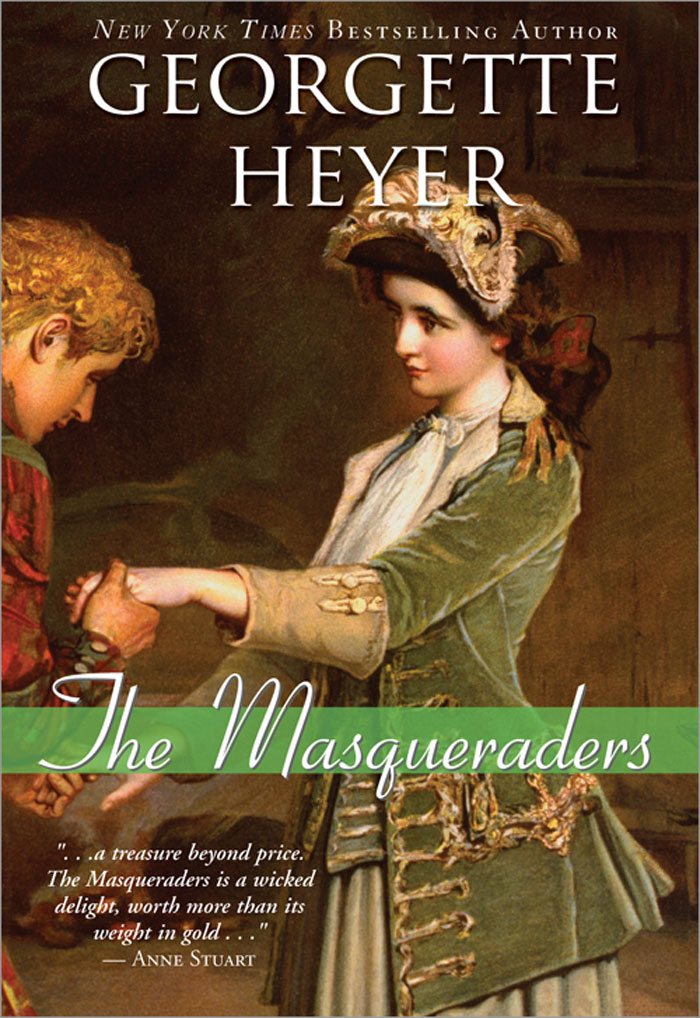
Although we know her as the queen of the Regency Romance, in fact, many of Georgette Heyer’s books take place a half-century or so earlier in Georgian times, with its gorgeous clothes, stylized social occasions, and convoluted intrigues. The Masqueraders could be set in no other time; it requires both the artifice and the intrigue to work.

We first meet the brother and sister, Robin and Prudence, in their elaborately contrived costumes; Robin disguised as the elegant and enchanting Kate Merriot, and Prudence, appearing as Kate’s equally elegant, if somewhat more retiring, brother Peter. They are on their way to London, to settle with a family friend and await the arrival of their father. The reason for the disguise is simple: Robin and his father backed the Stuarts in the 1745 uprising, and there is a price on each of their heads. But the reason they are indulging in this amazing masquerade of switched genders is due to their father, who has led them a precarious and wildly improper upbringing through most of the major cities of Europe. The old gentleman, as their not entirely dutiful children refer to him, married their mother, a farmer’s daughter, against his family’s wishes and left England without a backwards glance. But there is more mystery here, and the return to England in this fantastical make-believe plays into it.

In the opening chapter, the brother and sister meet an enchanting young lady who had wished for some excitement in her life ,but turned to the wrong person. Kate and Peter rescue her, and shortly after that delightful bit of playacting and sabotage, Sir Anthony Fanshawe, a close friend of Miss Letitia’s father, appears. Letitia becomes great friends with the lovely Kate, who in his real person is on his way to falling in love with the young lady. Sir Anthony also takes a shine to the attractive young man, who is so surprisingly worldly and well traveled, if slightly too smooth of cheek. We watch these circuitous wooings with delight; the young lady is all unaware, but what of Sir Anthony? He is a large man in his mid-30s, said by many to be sleepy, if not altogether dull, and slow to quarrel. But, large as he is, there is more to Tony Fanshawe than meets the eye. For several chapters, we wonder as Heyer walks a careful line; Sir Anthony is clearly interested in the young man, but before we start feeling any discomfort or seeing homoerotic overtones, we become aware that Fanshawe is not so sleepy, and he has ascertained the truth, not only behind Prudence’s masquerade, but also Robin’s, and perhaps as well, the mystery of the old gentleman. He asks if they had thought of what could have happened to Prudence had her identity been discovered by someone not in love with her. Such an occurrence had not been anticipated, and they wonder what had given her away:

“I should find it hard to tell you…some little things and the affection for her I discovered with myself. I wondered when I saw her tip wine down her arm at my card party, I confess.

My lord frowned, “Do you mean my daughter was clumsy?”

“By no means, sir. But I was watching her closer than she knew.”

As the two romances work towards their happy conclusion, the larger story of the old gentleman, who he is really, and the place that he and his children will take in England plays out brilliantly. As is always the case in a Heyer historical novel, the times and the place are carefully laid out. The political fallout, the harsh measures taken against the Jacobites, and the dangers of living in London at that time all play their part in the plot, adding some weight, if not gravitas, to this fine caper. And too, there is great opportunity to enjoy several of Heyer’s delightful young gentlemen and their conversations among themselves. In fact, the stylized society that was so much of the mid-18th Century is what makes this plot work. Only in the elegant velvets and laces, the swordsticks and elaborate hairdos, long full petticoats, boots and full-skirted coats with fine gilt lacings could the brother and sister pull off their amazing disguises and the incredibly intricate plot unwind.

“I contrive,” said the old gentleman, and indeed he does. So too does his creator, in this charming tale of adventurers. The Masqueraders is a delightful romp from beginning to end, with one of the most romantic interludes, a ride in the moonlight, ever penned by this delightful and dependable author.

Other Georgette Heyer Book Reviews on this Site:

Gentle readers: Until Amazon.com stops strong arming publishers like McMillan about the pricing of their ebooks, I will not link to their site for book orders. Rather, I will link straight to the publisher’s site until the bullying tactics are resolved.

Read Full Post »

Inquiring readers: I have no doubt you shall enjoy this post by my good friend, Lady Anne, an expert when it comes to the subject of Georgette Heyer. Lady Anne has read Georgette Heyer’s novels for most of her years upon this earth. Smart, sassy, fabulous, well tressed and well dressed, she has read every GH book backwards and forwards. There is not one tiny detail of Georgette’s novels that escapes Lady Anne’s attention or opinion. As to her review of  These Old Shades- please enjoy.

Set in the Georgian period, about 20 years before the Regency, These Old Shades is considered to be the book that launched Heyer’s career. It features two of Heyer’s most memorable characters: Justin Alastair, the Duke of Avon, and Leonie, whom he rescues from a life of ignomy and comes to love and marry.

The title of the book, These Old Shades, is a subtle allusion to the fact that this book is a far superior reworking of Georgette Heyer’s first book, The Black Moth, a book she wrote for the amusement of her brother who was ill. The characters in The Black Moth are at best two dimensional, but like most of Heyer’s creations, have enough humor and idiosyncrasy to catch our interest. In her case, it was the character of the villain whom she wished to revisit, develop and deepen.

These Old Shades is the first of the Alistair trilogy – she really did like these characters – and is not Regency, nor does it take place primarily in England. Like many of her early books, it falls more accurately into the category of historical romance, and is cast in mid-18th century Paris, with a short idyll at the English county seat of our hero, Justin Alistair, the Duke of Avon. He is known by the soubriquet Satanas, for his cold exactitude and prescient understanding of what his opponent will do next, as well as a certain elasticity in his moral fiber. The Duke has restored his family’s fortune through gambling; he is, as one would expect of one of the first peers of the realm, an arrant snob, careful, although certainly flamboyant, in his dress, and punctilious in manner. The historical background is the court of Louis XV, complete with its intrigues and excesses. It is the perfect backdrop for this story, for which one must be willing to suspend disbelief for pages at a time. It is such fun, and so sparkling in its writing, that one is indeed willing.

We first meet the Duke, dissolute, languid, apparently unaware of his surroundings, when a gamin comes hurtling from a side street and provides Avon with the weapon he has been waiting for to bring about the destruction of the Comte de Saint-Vire, the man who famously insulted Avon beyond courtesy. Avon buys the youngster from his brother, and establishes him as a page dressed in sober black, who attends Avon at parties, assemblies, and the Court at Versailles. The youngster, called Leon, attracts considerable attention, not only for his utter adoration of his master, whom he calls Monseigneur, but also for his startling red hair and dark eyebrows. Such hair and eyebrow combination is evident in the Saint-Vire family. As le tout Paris buzzes, Avon begins laying his plans. Leon is revealed to readers as Leonie, and goes to England in the country to learn how to be a lady. The Duke adopts her and returns to Paris with his ward. His friend Hugh Davenant returns to Paris at the same time and Avon tells him, in a passage that makes clear both the character and performance of this Duke:

“I am becoming something of a patriarch, my dear.”
“Are you? Davenant said, and smiled to himself. “May I compliment
you on your ward?”
“Pray do! You find her to your taste?”
“Infinitely. Paris will be enchanted. She is an original.”
“Something of a rogue,” conceded his Grace.
“Justin, what does Saint-Vire to do with her?”
The thin brows rose.
“I seem to remember, my dear, that your curiosity was one of the
things I deplored in you.”
“I’ve not forgot the tale you told me – in this very room, Justin. Is
Leonie the tool with which you hope to crush Saint-Vire?”
His Grace yawned.
“You fatigue me, Hugh. Do you know, I have ever had a fancy to
play my game — alone.”
Davenant could make nothing of him and gave up the attempt.”

But it is not the plot that carries the reader along; it is the delightful characters. The Duke, the darkest of Heyer’s heroes, has real charm, albeit a little sinister. He is not one you would wish to cross, as we see. Leonie, the heroine, is an effervescent charmer with a ferocious temper and an inherent sense of her own worth that grows through the book. Her character is honest and instinctively noble. She also, like any adorable pet of a large circle, gets away with being outrageous – except when Monseigneur is displeased. The supporting characters have charm and individuality as well. It is no wonder that Heyer comes back to the family twice: once in The Devil’s Cub – to revisit the Duke and his family, with a focus on the Cub, definitely the son of both his parents, and then in what is generally considered her finest novel, in An Infamous Army, where the grandchildren of the second book’s couple play out their roles at Waterloo.

If the story that unfolds is outrageous and unbelievable, the characters develop beautifully, the dialog bubbles delightfully, and we love the rollicking ride.

These Old Shades/Black Moth comparison from Wikipedia

More on the topic:

Read Full Post »

T’is the season to purchase books for a Christmas gift or to curl up with a novel in front of a fire as the cold weather settles in. Without hesitation, I would urge the casual reader to read a Jane Austen novel they have not yet read. Her works are as equally satisfying to read in print as to listen to as a podcast, CD, or tape.  

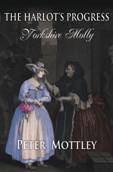
In addition to Jane’s outstanding novels,  I’d like to suggest several new books this week for your consideration. The first is The Harlot’s Progress: Yorkshire Molly, by Peter Mottley. This is the first in a trilogy and a fictional actualization of Hogarth’s series of etchings called “The Harlot’s Progress”. Each story follows one of three 18th Century harlots who have all been seduced into a life of prostitution at The Bell, a Wood Lane brothel in the City of London run by the notorious bawd, mother Wickham. Underlying each story is the tale of a young woman’s struggle against overwhelming misfortune.

The Harlot’s Progress: Yorkshire Molly by Peter Mottley
This excellent book is for the history buff whose image of years past is NOT colored by sweet nostalgia. Tough, gritty, more realistic than the Hogarth prints on which the story is based, Peter Mottley portrays a harsh, predatory world in which a maid from the country steps down from a wagon on Wood Street to meet her fiance, and is swiftly seduced and turned into a harlot. Sweet 17-year old Molly Huckerby, her head filled with fancies about her new life as a dressmaker in London, can think of nothing but meeting her cousin Tom, who has prepared a room in his lodgings for her visit. But it is Mother Wickham, looking down from an upper window of The Bell, a seedy Ale-house, who intercepts her and introduces her to Colonel Charnell. He plies the young maid with bread, and brandy, and honey. And more bread, more brandy and honey…until she wakes up choking with despair, too ashamed to weep, and realizing with a start that “Instead of saving herself for Cousin Tom, she’d allowed herself to be taken to market by Mother Wickham. And she’d been bought.”  And so Miz Molly’s career as a Cheapside Whore had begun.

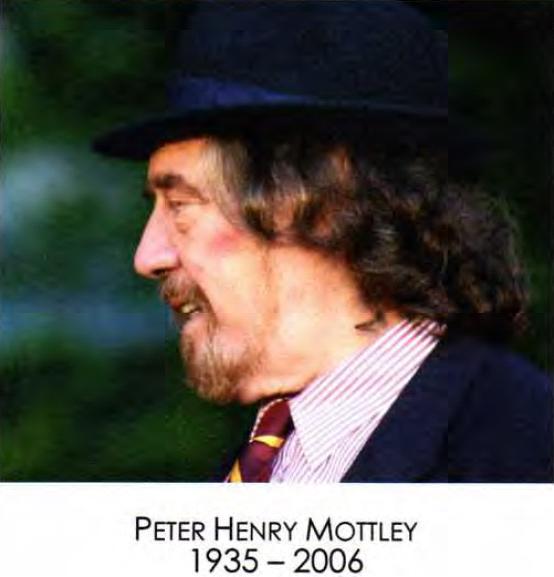
Author and playwright Peter Mottley died in 2006, before this book was published. He was an actor, writer, and director and an active member of the Oxford Theatre Guild. One of his radio plays had been performed on radio by Bob Hoskins. Once gets a sense of his colorful personality in this obituary: “Peter Mottley (1935-2006), for many years a cheery presence at Pangbourne pub gatherings, died on 16 July; he was 71. Martin Hoare writes: ‘He had been a novelist, playwright, actor, producer and philosopher as well as having a career in advertising. His contribution to sf was the comic novel The Sex Bar (1972), about an aphrodisiac and contraceptive chocolate bar. His best known play was After Agincourt (BBC Radio 3, 1988).’ Goodbye, Peter, and thanks for all the birthday parties.”

Mr. Mottley’s sense of stage and scene are apparent in his writing:

The York Wagon. A canvas-covered bone-shaker full of hopefuls who had travelled two hundred miled to The great City, two hundred miles to escape the cattle and sheep of Yorkshire, two hundred miles to fall prey to the wolves of Wood Street. Out of the rat-holes crept the cutpurses, the bawds, the pimps, the harlots, all the Cheapside predators who might earn a shilling or steal a florin or gull a fledgling or find a fresh piece of meat to peddle.

To get a stronger flavor of the book, watch the excerpt below of the author’s daughter, Josselyn, reading a portion of his book. She performs it marvelously well, capturing the grittiness of the writing. Unfortunately, the book is only available in the UK at present. Many of us who have had the privilege to read it will keep you apprised of its U.S. publication date when it arrives.

I give this book my highest rating and strongest recommendation. Again, it is not for the faint of heart. For those with a keen interest in reading about London in the early 18th century, this book is a must have.

More on the topic:

Read Full Post »

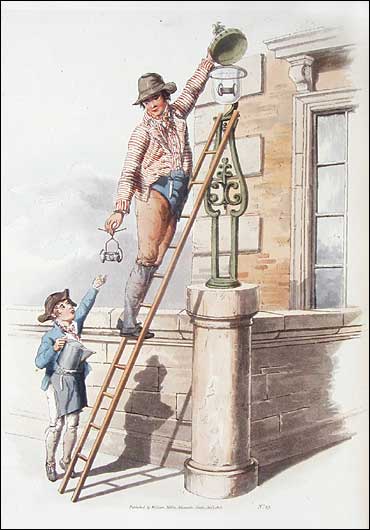
Lamplighter, Pyne, 1808

Lamplighter, Pyne, 1808

In Oxford Road alone there are more lamps than in all the city of Paris. Even the great roads, for seven or eight miles round, are crowded with them, which makes the effect exceedingly grand. – Archenholtz, 1780s

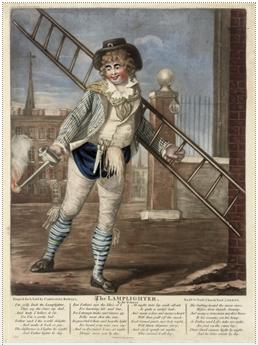
The Lamplighter, 1790's

The Lamplighter, 1790's

Urban development in London grew at a rapid rate during the 18th century, especially in London’s West End, where the great squares were laid out. The population of London surpassed one million in 1815 and an increasing number of bridges were built between 1750 and 1819, boosting development south of the river. In 1750, a system of street lighting with oil lamps was introduced, changing the nature of city life. The lights were supplied with reflectors, a big improvement. Previous to 1736, the lights were lit until midnight, but after that year they stayed on until sunrise, making the streets safer. As the quote suggests, foreign visitors were impressed, for at that time no other city could boast of so much lighting. Before 1750, people who traveled at night hired link boys to light their way. Their torches emitted poor lighting, however, and the streets were dangerous and dark outside their small circles of light.

With the new system of lights, walking the streets at night became relatively safe. The new lights contributed to London’s nightlife and the sense that life in the City was unnatural and not subject to traditional constraints.* The pleasure gardens of London, such as Ranelagh and Vauxhall, offered illuminated entertainment, and fashionable people could travel to theatres, assembly rooms, and each others’ houses, which extended social interaction. Shops lighted window displays and stayed open later,  profiting from the extended hours. The benefit of  better lighting worked both ways, for:

The shop-keepers of London are of infinite service to the rest of the inhabitants by their liberal use of the Patent Lamp, to shew their commodities during the long evenings of winter. Anecdotes of the Manners and Customs of London During the Eighteenth Century, James Peller Malcolm, 1810,  P 383,

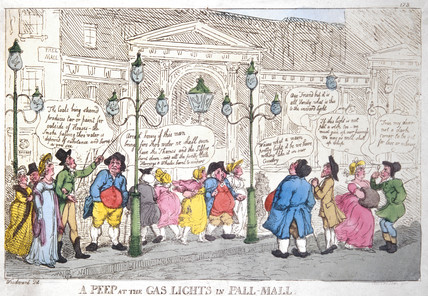
The first gas lights were introduced in Pall Mall on January 28th, 1807. Samuel Clegg had by then set up the London and Westminser Gas Lighting and Coke Company. On December 31, 1813, the Westminster Bridge was also lit by gas, and by 1823, 40,000 lamps covered 215 miles of London’s streets. Today, one can still see the gas lights in Green Park and the exterior of Buckingham Palace.

A peep at the gas lights in Pall Mall, Rowlandson

A peep at the gas lights in Pall Mall, Rowlandson

More on the topic:

Read Full Post »

Georgian town houses in Bath

Georgian town houses in Bath

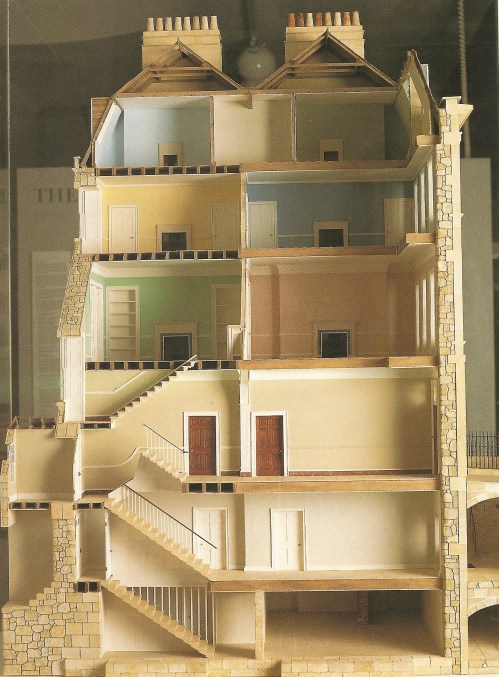
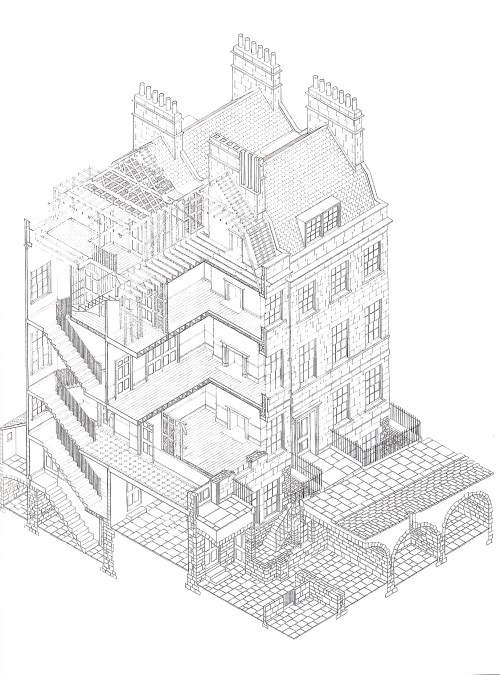
Cutaway of a Bath town house

Cutaway of a Bath town house

When we think of Regency architecture we think of the beautiful Georgian architecture so popular in Bath and Brighton. While there were subtle variations in design and detail, the basic plan for First Rate houses was similar to Fourth Rate houses*.

Bath Regency town house

Bath Regency town house

  1. The basement, or subterraneans section: All except the poorest houses had basements. They were occupied by the kitchens and other servant offices. The housekeeper and cook might be given rooms in this area away from the maids who slept in the attic.
  2. Ground floor: The drawing room was placed near the front door so that it was easily accessible. Drawing rooms were a place to greet visitors and where the women of the house could retreat. The humbler parlor was generally a private room where the family could retire. Furnishings in the drawing room were generally more feminine than those in the adjacent dining room. Double doors would lead to the dining room, which was more austere and masculine in nature. After dinner the men would remain there to enjoy conversation over port and cigars, while the women retreated to the drawing room. The closer the dining room was located to the kitchens, the warmer the food remained when it arrived at the table.
  3. The first floor: Featured a large room for entertaining on a grand scale, such as dancing, card playing, or other fashionable pastimes. This floor might also hold the principal bedrooms, which were generally placed in front of the house. The bedrooms would be decorated lavishly and in the latest style.
  4. The second floor: Featured bedrooms for children, or perhaps a lodger or guests.  Little expense went into decorating the nursery in comparison to the lower bedrooms. As the levels rose, the complexity of room decorations were simplified since fewer visitors bothered to climb the stairs to the upper levels. In general furnishings, mouldings, and decorations were modest on these floors.
  5. The attic: Reserved for the servants, whose beds were often like murphy beds and let down from the wall.  These rooms were cheaply painted and furnished.
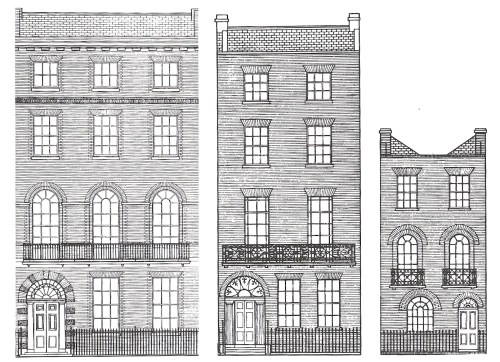
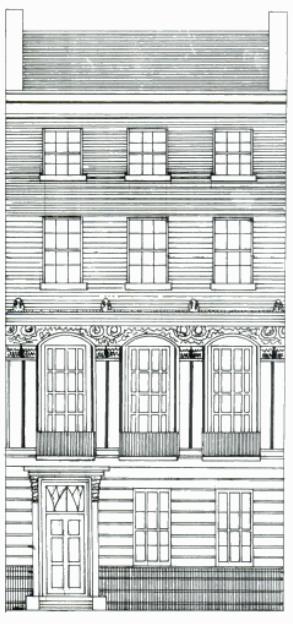
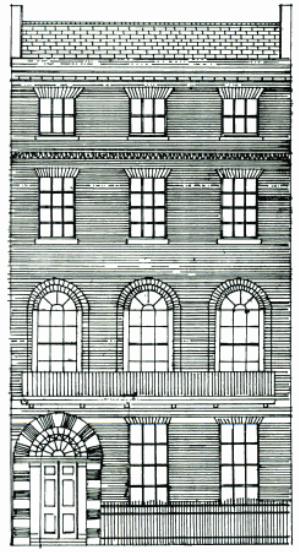
Georgian houses: first rate, second rate, and fourth rate

Georgian houses: first rate, second rate, and fourth rate

Throughout the 17th century, London houses had been susceptible to big fires that swept through narrow, twisting lanes in the city’s center and houses made of timber. A series of Rebuilding Acts specifying building construction followed the Great Fire of 1666 that destroyed over 14,000 houses. A rise in population generated demand for housing, encouraging land owner to develop large tracts of land. The Building Act of 1774 prescribed how houses were to be built. The act specified the use of stone or brick and determined the width of the street, the size of the houses, floor to ceiling heights, and the layout of the houses. It also defined the four types of houses that could be built in London. Each of these types were standardized and followed strict building guidelines:

First Rate House: Worth over £850 per year in ground rent and occupied over 900 square feet of space. These houses faced streets and lanes.

First rate house

First rate house

Second Rate Houses: Worth between £350 and £850 in ground rent and occupied 500-900 square feet of floor space. They faced streets, lanes of note, and the RiverThames.

Second rate house

Second rate house

Third Rate Houses: A smaller house worth around £150-£300 and occupied 350-500 square feet. They faced principal streets.

Fourth Rate House: Worth less than £150 per year in ground rent and occupied less then 350 square feet. These houses stood in their own ground.

About ground rent:
Land owners improved their land by laying out roads and services.  They then charged rent on this land. Housing developers (landlords) would build spec houses on the improved land and generate an income from leaseholders by collecting rent. Sometimes the land owner and the house landlord were the same person. These people were usually owners of great estates, which were better managed and the most sought after. Original leases were for as little as 33 years, but by the end of the Georgian era the length of time for many leases was increased to 99 years.

Curiously, the people who paid rent on large houses belonged to the nobility or gentry or prosperous merchants. While they did not own the houses they lived in, they received enormous incomes from their properties and businesses.

Read Full Post »

« Newer Posts - Older Posts »