Feeds:
Posts
Comments

Archive for the ‘jane austen’ Category

Mr Darcy, Vampyre coverInquiring reader,

Great news! I have come across some letters by Elizabeth Bennet about  Mr. Darcy, Vampyre, written by Amanda Grange
, which is coming out this month. These letters, well, critiques, really, were penned long ago and describe events that seem to have transpired in a parallel universe. I was particularly struck by how freely Elizabeth shared her thoughts with her sister Jane about her adventures with an other-worldly Mr. Darcy. I will be publishing all of Elizabeth’s critiques over the next few days. Contained herein, then, is critique, part one of Mr. Darcy, Vampyre. For those to whom this matters, spoiler alert!

My dearest Jane,

I have unaccountably awoken in the 21st century and I am writing to you out of habit, though I surmise that you must be long gone, or also living in that grey netherworld of the undead fictional character into which I have landed. I’ve just discovered that Mr. Darcy and I are the hero and heroine of a spate of books that, frankly, my dear sister, make me blush from shame. Apart from their topics (imagine us as zombie fighters and being married to vampyres), I am depicted as behaving in a manner that is so unlike myself that I fear my blood shall boil from the rise in my temper.

A recent book, which has turned my Mr. Darcy into a vampyre, has me seething in particular, for, my dear Jane, you know better than anyone that I am no namby pamby missish nebbish. In this book, the author has Mr. Darcy shunning my bed. The REAL Elizabeth Darcy née Bennet, had Mr. Darcy been guilty of such a heinous offence, would not have accepted the situation without hunting him down the corridors of their cruise ship (which is what honeymoon vessels seem to be these days) and demanding an explanation of why he was unresolved in his husbandly DUTY of BEGETTING an heir immediately. Instead, this Ms Grange has me strangely accepting the situation as if I were a zombie, which I am assuredly NOT, for has not Mr. Grahame-Smith given me the warrior skills to chop off their heads?

What particularly burns me, to use 21st century parlance, is that I take pride in my conversational ability. Sparks fly when Mr. Darcy and I converse. Even when such a mundane subject as tea comes up, double entendres abound. One may be assured that Mr. Darcy and I can easily devote hours of our lives sparring verbally and taking pleasure from these seemingly uneventful encounters. But Ms Grange has us speaking in dead and flat voices, as if we were not Mr. Darcy and Elizabeth from the brilliant mind of Jane Austen, but another couple conjured up by some other author who happened to have given us similar names.

My dear Jane, I can assure you that there is only ONE Mr. Darcy and his Elizabeth. And so, I do protest strongly. Let Miss Grange choose another couple to write about. Miss Jane Austen was the first to use us and she should be the last! Oh, I am exhausted. My blood has almost reached boiling point, and I must find a cooling bath for, unfortunately, more than one reason.

Signed,

Your wedded but unbedded sister, Lizzie.

P.S. Are you experiencing a rabid bat infestation? One almost flew through my window, but I slammed it shut before it could enter. I shudder to think what might have happened had it landed on my neck. (Now why on earth did I think that?) I shall write more about this situation tomorrow, for there is so much I must share with you about my new life that my thoughts cannot be contained within a mere few sheets of vellum.

Read Full Post »

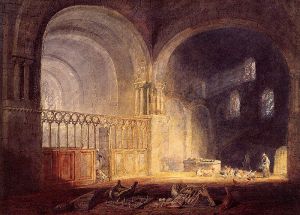
Interior of Lindisfarne Priory, 1797, Thomas Girtin

Interior of Lindisfarne Priory, 1797, Thomas Girtin

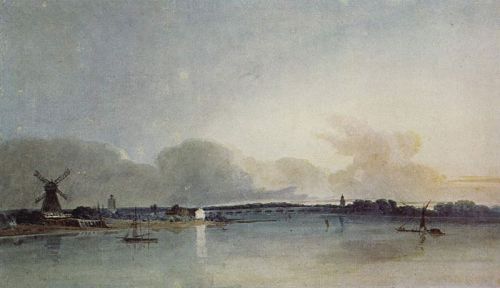
Young Thomas Girtin’s painter friend was the famous artist J.M.W. Turner. As teenagers both men had been employed to color prints with watercolor paints. While Turner lived to be over seventy-five years of age, Girtin died of consumption at 27. Turner would recall in his later years: “Had Tom Girtin lived I should have starved.” No small praise.  During his short life, Girtin gained a major reputation as a watercolor artist and played an important role in establishing English Romantic watercolor paintings as an art form. As one biographer noted, “While Girtin lived, Turner followed.”  One can only imagine how fascinated young and romantically minded Catherine Morland would have been had she seen Girtin’s painting of the priory ruins.

Watercolor landscape, Thomas Girtin, 1800

Watercolor landscape, Thomas Girtin, 1800

Three years before his death, Girtin had acquired important patrons who collected his works. Thankfully the young artist had been prolific and his influence was not soon forgotten. In 1842, while sketching high in the Swiss Alps, a mature Turner, reminded of a unique effect of light in darkness, penciled a brief note in the margin of his drawing: “Girtin’s White House.”

Transept of Ewenny Priory, Glamorganshire, JMW Turner, 1797

Transept of Ewenny Priory, Glamorganshire, JMW Turner, 1797

Read about Thomas Girtin in these links:

Read Full Post »

No needlework, either of ancient or modern times, (says Mr. Lambert,) has ever surpassed the productions of Miss Linwood. So early as 1785, these pictures had acquired such celebrity as to attract the attention of the Royal Family, to whom they were shewn at Windsor Castle. Book of Days

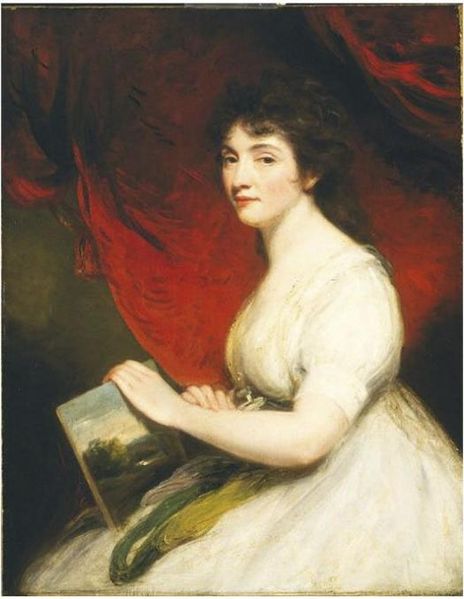
Mary Linwood by Hoppner, 1800

Mary Linwood by Hoppner, 1800. Image @Victoria & Albert Museum

Mary Linwood, Partridges after the painting by Moses Haughton, 1798

Mary Linwood, Partridges after the painting by Moses Haughton, 1798

Mary Linwood was an artist who used needlework as her material.  Born in Birmingham in 1755, Mary made her first embroidered picture when she was thirteen years old. She was mistress of a private boarding school, which her mother started, but her lasting claim to fame lay in her needlework art. For nearly seventy-five years Mary imitated popular paintings in worsted embroidery. An enterprising woman, she opened an exhibition in the Hanover Square Rooms in 1798,  which afterward traveled to Leicester Square, Edinburgh and Dublin. Four years before her death in 1845,  her works were still exhibited in London.  She embroidered her last piece when seventy-eight, although she lived to be 90 and worked as a school mistress until a year before her death.  In 1844, during her annual visit to her Exhibition in London, she caught the flu and died.

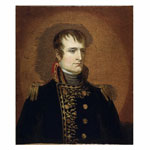
Mary worked with stitches of different lengths on a fabric made especially for her in Leicester. She had coarse linen tammy cloth prepared for her as well. Her long and short stitches looked like brush strokes, with silk for highlights, and many amateurs copiesd her on a smaller scale. A good example of her work is the almost 2 ft square portrait of Napoleon in the South Kensington Museum.

Needlework image of Napoleon

Needlework image of Napoleon

Portrait of Napoleon Bonaparte embroidered with coloured worsteds in small short and long stitches By Miss Mary Linwood In gilt frame glazed English Late 18th or early 19 th centy H 2 ft 7 in W 2 ft 2 in Bequeathed by the late Miss Ellen Markland 1438 1874 This is a remarkable specimen of embroidery involving great labour to imitate a painting – A Descriptive Catalogue of the collections of tapestry and embroidery in the South Kensington Museum, Alan Cole, 1888, p.369

Miss Linwood’s worked pictures, exhibited in Leicester square, were for many years reckoned among the sights of London, and although their pretensions to artistic merit are regarded contemptuously by the present generation, they were in one sense undoubtedly wonderful productions. The exhibition contained copies after such masters as Carlo Dolci, Guido, Ruysdael, Opie, Morland, Gainsborough, Reynolds; a list that proves how great was the scope Miss Linwood’s ambition, and how catholic  her taste. The whole collection was dispersed at Christie’s room after Miss Linwood’s death in 1845, when the pieces knocked down for sums far below those at which they had been valued a few years previously…Miss Linwood’s pictures, worked with untwisted soft crewel specially dyed in graduated shades on a ground of twilled linen, are really meritorious, nevertheless one cannot regret that their day, equally with that of the Berlin wool Landseers, is overpast and that we have at last learnt the limitations as well as the possibilities of the embroiderer’s delightful craft. – The Collector

Exhibition, Book of Days

Exhibition, Image @Book of Days

Although Mary Linwood’s needlework exhibits were popular during her lifetime, not everyone was enamored with her work. In 1919, Emily Leigh Lowes wrote these rather hateful statements about Mary in her book, Chats on Old Needlework (Embroidery),

The originator and moving spirit of this bad period was Miss Linwood, who conceived the idea of copying oil paintings in woolwork. She died in 1845. Would that she had never been born! When we think of the many years which English women have spent over those wickedly hideous Berlin-wool pictures, working their bad drawing and vilely crude colours into those awful canvases, and imagining that they were earning undying fame as notable women for all the succeeding ages, death was too good for Miss Linwood. The usual boiling oil would have been a fitter end! Miss Linwood made a great furore at the time of her invention, and held an exhibition in the rooms now occupied by Messrs. Puttick & Simpson, Leicester Square. Can we not imagine the shade of the great Sir Joshua Reynolds, whose home and studio these rooms had been, revisiting the glimpses of the moon, and while wandering up and down that famous old staircase forsaking his home for ever after one horrified glance at Miss Linwood’s invention?

Not only Miss Linwood, but Mrs. Delany and Miss Knowles made themselves famous for Berlin-wool pictures. The kindest thing to say is that the specimens which are supposed to have been worked by their own hands are considerably better than those of the half-dozen generations of their followers. During the middle and succeeding twenty years of the nineteenth century the notable housewife of every class amused herself, at the expense of her mind, by working cross-stitch pictures with crudely coloured wools (royal blue and rose-pink, magenta, emerald-green, and deep crimson were supposed to represent the actual colours of Nature), on very coarse canvas.

More on the topic:

Read Full Post »

Wednesday, June 27, 1711, Mr. Addison writes a letter to The Spectator:

Mr. Spectator – Women are armed with fans as men with swords, and sometime do more excution with them. To the end therefore that ladies may be entire mistresses of the weapon which they bear, I have erected an academy for the training up of young women in the exercise of the fan, according to the most fashionable airs and motions that are now practiced at court. The ladies who carry fans under me are drawn up twice a-day in my great hall, where they are instructed in the use of their arms, and exercised by the following words of command: – Handle your fans, Unfurl your fans, Discharge your fans, Flutter your fans – By the right observation of these few plain words of commands, a woman of a tolerable genius, who will apply herself diligently to her exercise for the space of but one half-year, shall be able to give her fan all the graces that can possibly enter into that little modish machine… For the rest of Addison’s letter to The Spectator, please click here.

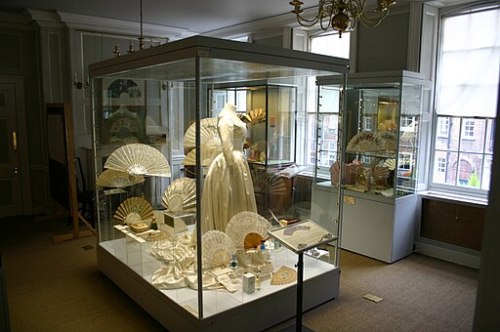
Wikimedia Commons, Image of the Fan Museum, Greenwich, UK

A lady’s fan carried far more symbolism than the mere act of cooling by agitating the air. At first considered a novelty, the fan gained popularity in Europe in the mid-sixteenth century and could be seen in the paintings of fine Elizabethan ladies. The folding fan, which was introduced from the Far East, gradually replaced the fixed fan. Made from vellum or paper, these fashionable and expensive accessories lent themselves well to elaborate painting and decoration. By 1709, fans began to be manufactured in London and a Fan Makers’ Company was established. Commemorative fans that celebrated an historic event were quite popular among the well to do, and their styles echoed the fashion of the day. Neoclassical fans, like the commemorative fan depicted above, lacked color and were generally bare of decoration, reflecting the simple white muslin dresses so popular during the Regency era. When dresses became more ornate and colorful again, fans followed the trend. They were highly prized for their aesthetics, for “in the ordinary fan of the present day Art has not strayed far from Nature.”

Over the centuries, a language of the fan evolved. Legend has it that by the time the Victorian era began fan gestures had been rigidly codified, wherein each movement and snap of the wrist carried a message fraught with meaning, although some experts dispute this. (See comment below made by Pierre Henri Biger, a fan expert.)  Once popular both during the day and evening, fans gradually became restricted only for the evening, increasing in size in the last two decades of the nineteenth century.  Their popularity waned and waxed as the quote below suggests, but until they could be cheaply manufactered in large quantities, they remained the province of only those who could afford them. In the late 19th century to early 1920’s, fans were made in profusion to carry advertisements, and were given away as souvenirs by hotels, restaurants, and businesses.*

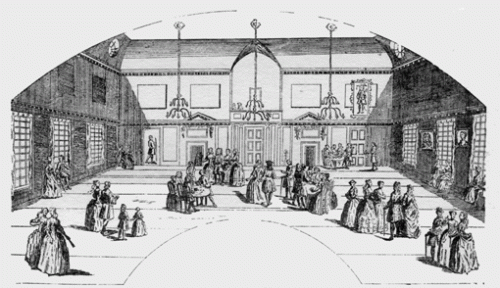
Fan Design, The Lower Rooms, Bath

Fan Design, The Lower Rooms, Bath

For just a century after Addison wrote, the fan figured prominently in polite society, matched, when the sword went out of fashion, against the snuff-box and the clouded cane, and often victorious. The satirists and dramatists wore in turn bitter and pleasant in their references to it. Painters and their sitters paraded it ostentatiously. It is said to have done wonders in diplomacy, and who could wonder at the success of flying sap and masked battery against garrisons defended by an eye-glass, a pinch of snuff, and a malacca. The fan’s apogee was in the days of the minuet de la cour. But since athletic waltzes, polkas, and mazurkas have elbowed out their courtly predecessors, the once ” modish little machine” has retired into obscurity with the “wall-flowers,” or, if at all, is used by the dancers as inartistically as though it were the archetypal ” vanne” or wind engine. Brighter days may, however, dawn, and society which, in its way back to costumes of the Watteau and Pastoral periods, has already reached the stage of short waists and long trains, may over in our time reclaim the little exile from its temporary partial shade. – Nature and Art, by Day & Sons, 1866, p62

More about this fascinating fashion accessory

Read Full Post »

roman road, 1909 H. Thomson
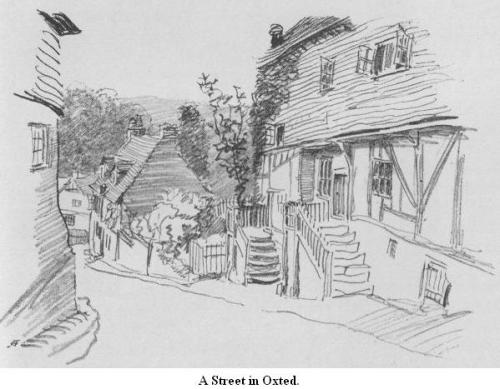
Highways and Byways of Surrey, 1909, an e-book on Project Gutenburg, features drawings by Hugh Thomson. Mr. Thomson is best known to Jane Austen fans for his drawings for Jane Austen’s novels. These idealized images of England, drawn almost 100 years after the Regency period, could still represent village and country life as Jane and her characters knew it.
A Street in Oxted 1909
More about Hugh Thomson on this blog:

Read Full Post »

« Newer Posts - Older Posts »