Feeds:
Posts
Comments

Archive for the ‘jane austen’ Category

Inquiring readers,

Today is Valentine’s day, a perfect time to revisit some of Jane Austen’s most romantic and memorable quotes.

I can listen no longer in silence. I must speak to you by such means as are within my reach. You pierce my soul. I am half agony, half hope. Tell me not that I am too late, that such precious feelings are gone forever. I offer myself to you again with a heart even more your own…I have loved none but you.” – Captain Wentworth, Persuasion

The driving force behind this quote was a talented and witty, yet ordinary-looking spinster. The sentiments expressed in her novels were remarkable given that Austen lived in an era when money and status were considered primary reasons for courtship and marriage.

This caricature, created in 1805, poked fun at the era’s courtship conventions, much like Jane Austen did through characters like Mr. Elliot, Mr. Collins, and Henry Crawford, all of whom followed current courtship conventions but misread their heroines exceedingly.
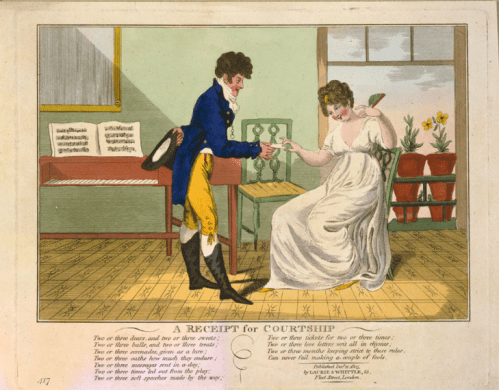
receipt image

Image in the public domain, U.S. Library of Congress

Receipt for Courtship – Text

Two or three dears, and two or three sweets;
Two or three balls, and two or three treats;
Two or three serenades, given as a lure;
Two or three oaths how much they endure;
Two or three messages sent in a day;
Two or three times led out from the play;
Two or three soft speeches made by the way;
Two or three tickets for two or three times;
Two or three love letters writ all in rhymes;
Two or three months keeping strict to those rules,
Can never fail making a couple of fools.

A lady’s imagination is very rapid; it jumps from admiration to love, from love to matrimony in a moment.” – Mr. Darcy’s sarcastic comment to Miss Bingley, Pride and Prejudice
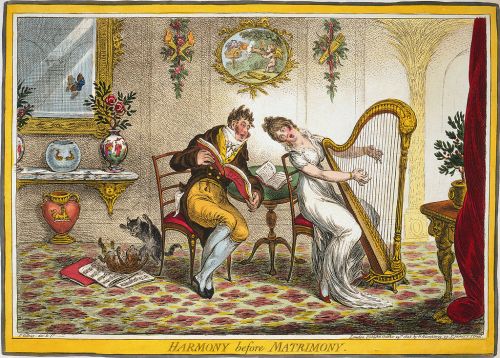
1024px-1805-Gillray-Harmony-before-Matrimony

Image in the public domain, Wikimedia Commons

This 1805 caricature entitled “Harmony before Matrimony” of a courting couple would have the young lady assume that a proposal would soon be in the offing. The artist made sure that the viewer understood this through iconography: the cupid in the oval painting, which also shows two courting doves, the two roses in a vase featuring a Chinese couple, the two fish, the two playful cats, a wall sconce made of cupid’s arrows, the two flaming torches, and the butterfly reflected in the mirror making two. The couple sit on a carpet of roses, the music book, “Duets de L’Amour,” is held by the courting swain, while on the table lies an open copy of Ovid’s “Art of Love.” In this scene, all is harmonious, all is good, but those familiar with the caricatures of the engraver James Gillray know that not “all” is what it seems.
The second companion cartoon “Matrimonial Harmonics” depicts life after marriage: Cupid is dead in the funereal image, two parrots sit in their cage with their backs to each other, a dog barks at a hissing cat, the husband covers his ear as his baby screeches in the maid’s arms, and his wife sings alone at the piano forte. It is a scene of inharmonious conflict, one often described by Jane Austen (Mr. and Mrs. Bennet, John and Frances Dashwood, Charlotte and Mr. Collins, Mr. Wickham and wife Lydia).

If I loved you less, I might be able to talk about it more.” ― George Knightley, Emma

Jane’s Heroes were men of few words as this quote by Mr. Knightley attests. A number of Jane Austen’s heroes were men of few words, but Elinor Dashwood and Fanny Pricem two long-suffering heroines, also had difficulty expressing their emotions.
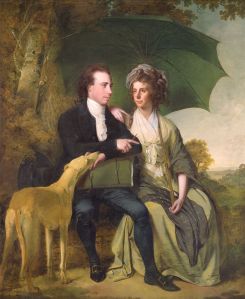
Thomas_Gisborne_Joseph_Wright_Derby

Image in the public domain, wikimedia commons.

This 1786 painting of The Rev. and Mrs. Thomas Gisborne, of Yoxhall Lodge, Leicestershire by Joseph Wright of Derby depicts a sober couple much in the vein of Elinor Dashwood and Edward Ferrars or Fanny Price and Edmund Bertrum. The year the portait was painted precedes Jane’s era, but the calmness of the scene and the sober mien of a couple who clearly come from the gentry class remind me very much of how I envisioned both couples. Neither seem to be the type to behave in in unseemly manner at an assembly ball.

In Jane’s novels, lovers who behaved badly often expressed good insights tinged with regret.

“Where the heart is really attached, I know very well how little one can be pleased with the attention of any body else. — Isabella, Northanger Abbey

and

Yes, I found myself, by insensible degrees, sincerely fond of her; and the happiest hours of my life were what I spent with her.— Mr. Willoughby, Sense and Sensibility
Johan Christian and his wife-Engelke Jens Juel 1797 Statens Museum for Kunst

Thumbnail of Johan and Engelke Christian, 1797, by Jens Juel


Older sensible couples who weathered married life and its vicissitudes and remained happy together play prominent roles in Austen’s plots. One senses that Admiral and Mrs Croft who befriend Anne Ellito in Persuasion must have observed the kind attention that Caption Wentworth paid her when he thought no one was looking.

The sensible older couple in Pride and Prejudice are Mr & Mrs Gardiner. He is silly Mrs. Bennet’s brother and a relation over whom Elizabeth did not need to blush. Their calmness and common sense helped to unite Mr. Darcy and Elizabeth after many missed opportunities.
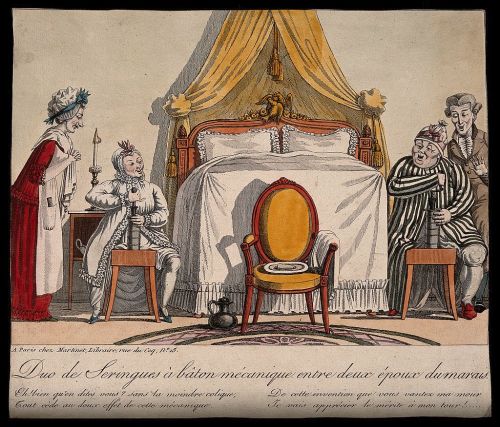
An_old,_rich_couple_enjoy_the_latest_fad_in_baton-powered_en_Wellcome_V0011705

Wellcome Collection image in the public domain by G. di Cari?

Romantic gestures change for many older couples. Over the years they are comfortable with each other. With age, often physical comfort and health have priority over more youthful pursuits. In her novels Jane Austen ignored the prurient, yet she lived in the Georgian age where social and political cartoons or satire were often graphic. Families took care of each other in sickness and health. They bathed their sick and tended to their every need. One wonders what was in Jane’s private letters to Cassandra regarding the more ordinary tasks of life.

The above image shows the sweetness of an older couple enjoying in tandem the latest fad in Baton-powered enemas. They seem happy and content and at ease with each other!

Jane, however, never found such a mate for life.

To you I shall say, as I have often said before, Do not be in a hurry, the right man will come at last.” – Jane Austen’s Letter to Fanny Knight

Following Jane’s advice, Fanny married for keeps. She bore 9 children to Sire Edward Knatchbull a baronet, to whom she was married for 26 years until his death.

Jane’s heroines were astute about pledging their love. Elizabeth Bennet failed to see through Wickham’s falsehoods at first, but common sense prevailed. Anne Elliot was never quite enamored of slimy William Elliot, for her heart belonged to the infinitely superior Caption Wentworth. One of Anne’s more memorable quotes is:

“My idea of good company, Mr. Elliot, is the company of clever, well-informed people, who have a great deal of conversation; that is what I call good company.” – Persuasion

One can only surmise that rather than settle for marriage to just any man, Jane Austen chose good company over a less than perfect union.

Jane’s heroes were equally steadfast and saw through foibles, insecurities, and prejudices of the women they loved, especially when their first impression was. They, like Mr. Darcy, waited patiently for the right moment to reveal their true feelings:

“My real purpose was to see you, and to judge, if I could, whether I might ever hope to make you love me.”— Darcy, Pride and Prejudice

In my opinion, none of Jane’s true heroes and heroines were ridiculous or maudlin. They chose well and understood the meaning of true love.

More on the topic: 


Read Full Post »

Since I moved near my family four months ago, my sister-in-law has read three Jane Austen novels – Pride and Prejudice, Sense and Sensibility, and Persuasion. She took a longer time warming up to Persuasion, but came around in the end, enjoying the experience.

As a Jane Austen devotee, I associate the seaside resort of Lyme Regis with Persuasion.  Imagine my delight to find that the book Lyme Regis: A Retrospect had been digitized by the Internet Archive. I digitally “flipped” through the book and was delighted to view a number of illustrations of Lyme Regis in the era of Austen.

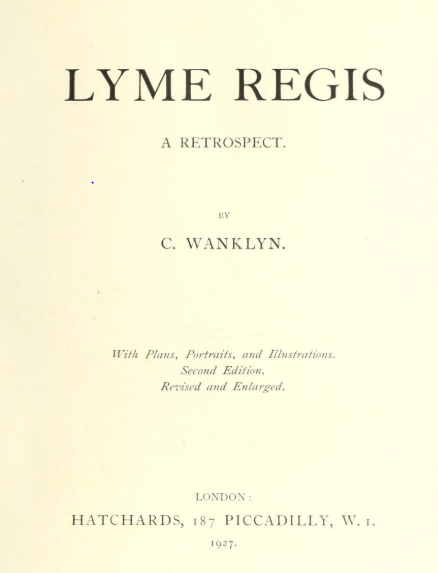
Title page of Lyme Regis: A Retrospect by C. Wanklyn, London, Hatchards, 187 Piccadilly, W.1. 1927

Click here to enter the Internet Archive’s digitized book of Lyme Regis: A Retrospect.

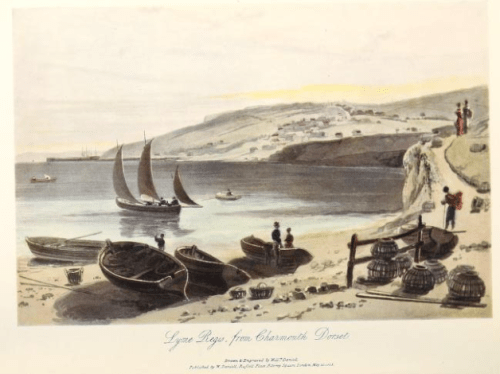
Fronticepiece image

The fronticepiece of the aquatint of Lyme Regis by William Daniell, R.A. This aquatint first appeared in Daniell’s well-known Voyage round Great Britain, published in 1814. The Charmouth end of the lane, which once ran along the edge of the cliffs for the whole distance between Lyme and Charmouth is here shown.

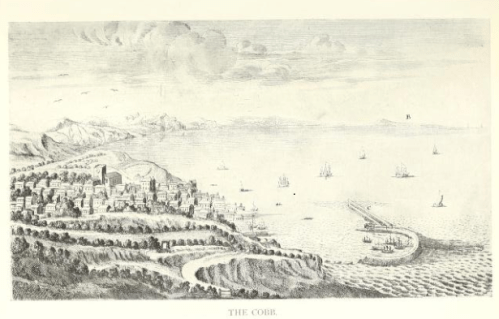
4-cobb-image

This picture of the Cobb…is taken from the 1724 edition of Stukeley’s Itinerarium Curiosum. The original plate is subscribed ‘Lyme, 21 Aug. 1723.’

Excerpt from the book (it is copy right free!):

The Cobb shared in the changes that were taking place at Lyme after 1750. In 1756 the causeway from the western arm of the Cobb, which joins it to the land, was made. As a result of this construction, and the action of sea and tide, a huge bank of sand and shingle began to form in the angle between the new causeway and the mainland. For te first time in its history, Lyme was recovering some land from the sea…At what date exactly the houses were build is not certain, but they are on the drawing of the sea-front which is dated 1796, and they consequently were there when Jane Austen came to Lyme in 1804. In fact the one in which she placed the Harville family was build on this reclaimed land. Close to the warehouses on the Cobb had once been the ‘King’s Pipe,’ the place, that is to say, where spoilt contraband tobacco seized from smugglers by revenue officials was burnt. The palmy days of smuggling were during the period of high duties forced on us by the French Revolutionary Wars. Cargoes of contraband to the Dorset coast were generally run from the Channel Islands or the Northern Coast of France. If the George Inn still maintained its stables, its pack-horses may frequently have been employed at this time to carry smuggled goods inland. The smugglers were good employers and paid well.” – pp. 123-124

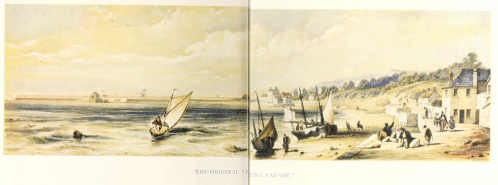
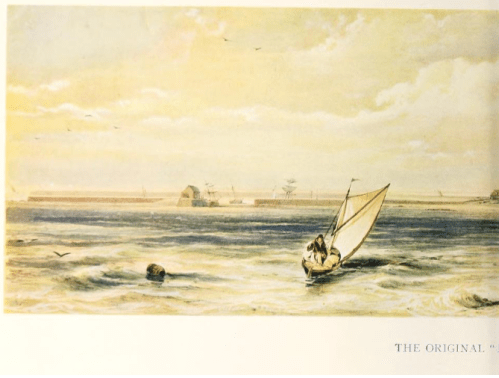
8-The Original

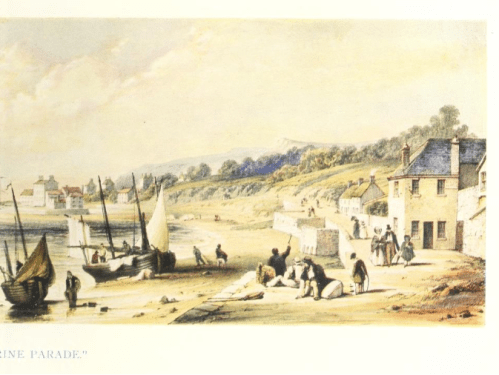
This Cruikshank-Marryat series shows the end of the Walk at Lyme Regis, so far as it went in 1819, i.e., to what is now No. 8 Marine Parade. – p.121.

The original marine parade1Detail left side

The original marine parade2

Detail right side

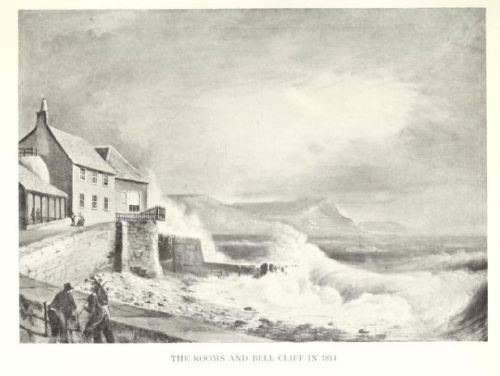
9-The Rooms and...

The front of the Cliff House property…has suffered from continual falls…and the cottage where  Jane Austen lodged (no longer standing alone) shows a greater variation from the perpendicular every year. – p. 122


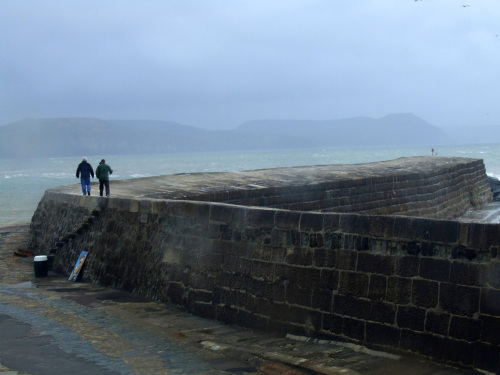
cobb-at-lyme-regis-tony-grant

Image of the Cobb in rough weather, copyright Tony Grant.  Shipwrecks were not uncommon on Dorset’s shores. One can see the slanted top of the stone Cobb.

3-

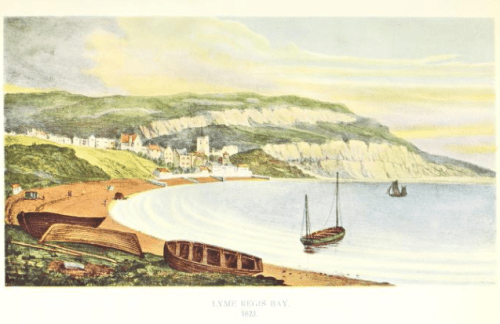
This view of the Bay of Lyme Regis is taken from the 1823 edition of Roberts’ History of Lyme Regis, Dorset.-p. 4.

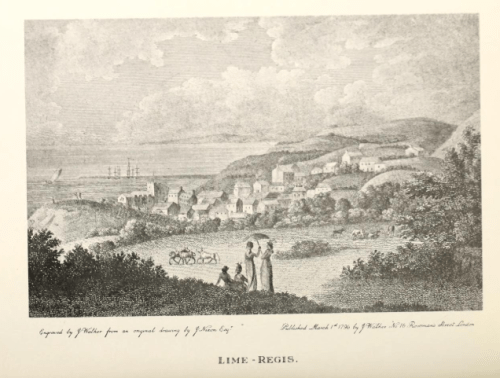
p135

This view of Lyme Regis is dated 1796. It was drawn by ‘J.Nixon, Esq.’ and engraved by John Walker…It was also utilized by W.G. Maton in his Guide to All the Watering and Sea-Side Bathing Places, a work which had a great vogue and was first published in 1803. Nixon was a clever amateur artist who exhibited at the Royal Academy. – p. 135.

Jane Austen makes Mary Musgrove, in Persuasion, bathe at Lyme in November. This is not a mistake; it is rather evidence that Miss Austen was a realist. The year was 1814, and in the autumn of 1814, Princess Charlotte of Wales was staying at Weymouth. Now The Western Flying Post for October, November, and December records that the Princess was bathing on some days of all three months until severe storms from and after December 12th brought the season to an end. Now what Princess Charlotte could do at Weymouth, the aristocratic Mary Musgrove both could and would do at Lme off the beach near Bay Cottage. (p. 140)

And so, in the course of the eighteenth century, Lyme Regis completely changed its character. From being a busy industrial and trading town it became a place of resort for visitors in search of health, amusement, and change. All early writers of Lyme as a seaside place insist on its superior ‘gentility’–a word once redounding in qualities to which all should aspire, but now greatly debased in meaning. ‘The residents are mostly persons of genteel, not large, fortune,’ says one. ‘At lyme,’ says another, ‘there arises no necessity for making any inconvenient sacrifices to the support of style or to the extravagance of outward show.’ -p.141.”


Read Full Post »

Inquiring readers,

Praying with Jane: 31 Days through the Prayers of Jane Austen, Rachel Dodge, and a bookmark with the quote

Praying With Jane: 31 Days Through the Prayers of Jane Austen, Rachel Dodge, Bethany House, 2018

A “Praying With Jane” blog tour will begin October 31st on this blog. I am privileged to showcase Rachel Dodge’s deeply felt first book, which centers around three prayers Jane Austen wrote that have miraculously survived, given the destruction of so much of her original papers.

A whole family assembling regularly for the purpose of prayer is fine!” – Jane Austen, Mansfield Park

Many readers of this blog have come to know Rachel in the past year and a half through her blog post contributions, her exquisite writing style, and her extensive knowledge of Jane Austen’s life. This book is a labor of love for Rachel. Divided into 31 days, readers are guided for one month to a daily examination of sections of the three prayers until, at the end of the book, they have thoroughly studied Jane’s prayers.

My sister-in-law, Carol, who read Pride and Prejudice years ago and knows little of Jane Austen’s novels and characters, other than the movies she’s seen, has read the book for me.

I was skeptical about the book at first, because I know so little about Jane Austen, but I found Rachel’s choice of scriptures to be inspiring,”

Rachel includes two scriptures per day. An example of one is included in the samples of the first day of prayer below:

I have loved you with an everlasting love; I have drawn youth unfailing kindness.” – Jeremiah 31:3 NIV

This slideshow requires JavaScript.

As mentioned, the blog tour begins here October 31st! Other blogs on the tour (in random order) are:

Diary of an Eccentric | So Little Time…| Laura’s Reviews | Calico Critic | Jane Austen in Vermont| My Love for Jane Austen | A Bookish Way of Life | Burton Reviews | My Jane Austen Book Club | Delighted Reader Book Reviews | Laughing With Lizzie | Becoming |(and, of course,) Jane Austen’s World

Please join us as we examine this lovely addition to the canon of works by Jane Austen’s ardent admirers!

Information about Praying With Jane is available at

Rachel  Dodge’s posts on this blog

Follow Rachel Dodge at www.racheldodge.com


Read Full Post »

Inquiring readers,

Many of you have noticed my absence for a long time. If it weren’t for the efforts of Rachel Dodge and Tony Grant, this blog would have remained silent for most of the previous twelve months. Thank you, both, dear friends, for your contributions.

Two years ago I realized my heart and soul were no longer in my work and that it was time to retire.  Since then, I have been in the process of getting my house ready for sale, selling it, and packing my belongings to move to north Baltimore to be near family. Luckily or unluckily, I sold my house the moment my realtor planted the “coming soon” sign on my lawn. This meant that I had to move two months earlier than anticipated, since the new owners were anxious to move into my beloved abode.

My new place, however, was not ready. Currently, all my possessions, save for summer clothes and necessities, are in storage, and so I am living in limbo as a guest with friends until the end of August.

Starting September 1, I will be traveling between Richmond and Baltimore for four months, waiting for my new place to be approved by a house inspector and working remotely at a distance (with frequent travels via I-95 to attend bi-monthly meetings down south). January 1st is the date of my retirement. Ah, the modern life!

As I anticipate my schedule this fall and early winter, my thoughts often turn to Jane Austen. She had immense pleasure of living the first 25 years of her life in Steventon, a small village in Hampshire.

Outside there were fields where Mr Austen farmed and his wife grew potatoes (at that time quite an innovation), formal gardens with a turf walk, sundial, strawberry beds, and a grassy bank down which the young Jane, possibly enjoyed rolling as a child, like Catherine Morland in Northanger Abbey. – http://www3.hants.gov.uk/austen/deane-parsonage/steventon-village.htm, Hantsweb, Hampshire County Council

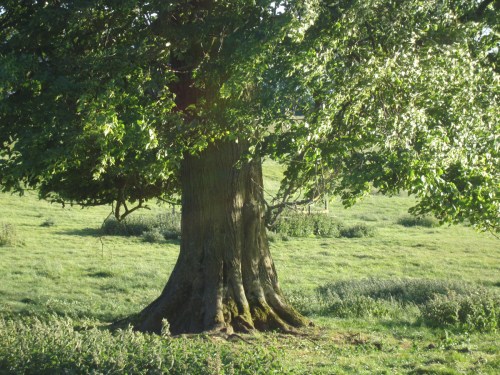
The old rectory site where the parsonage once stood. A well (inside the enclosure in back of the tree) is the only visible remnant of that house. Image @Tony Grant

The old rectory site where the parsonage once stood. A well (inside the enclosure in back of the tree) is the only visible remnant of that house. Image @Tony Grant

The Austens also ran a boarding school for young men out of the parsonage house to augment the reverend’s yearly income of £230. His extensive library of 300 – 500 volumes was amazingly large for that era, since books were frightfully expensive. Rev. Austen encouraged Jane and her sister, Cassandra, to read from his library, an unusual encouragement for females in that time.

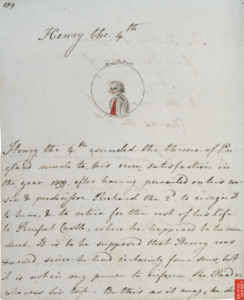
Image of a page of the History of England by Jane Austen and illustrated by Cassandra Austen of Henry the 4th, the British Library

Image of a page of the History of England by Jane Austen and illustrated by Cassandra Austen of Henry the 4th, The British Library

Jane enjoyed an extremely close relationship with her older sister, Cassandra, and they supported each other in their respective strengths and talents. Jane’s talent, as well as Cassandra’s, were nurtured by their doting family, as evidenced by the History of England, written by Jane and illustrated by Cassandra, and the plays and stories of juvenilia a young and playful Jane wrote for family gatherings.

At the age of 25, after enjoying a bucolic childhood that any woman of her era would have envied, Jane’s parents announced the Reverend’s decision to retire and leave Steventon. It was said that, upon hearing the news, Jane fainted. I can only imagine what went through her mind as she imagined the life she adored evaporating as she saw her family’s possessions reduced to the amount that one or several moving carts could hold.

(See slideshow of 18thcentury carts and wagons in Williamsburg of sample carts. I tend to think the blue covered wagon would be similar to one or two vehicles the Austen family would have contracted to move their belongings: http://www.history.org/foundation/journal/spring09/carts_slideshow/)

These days I empathize with the painful decisions the Austen family must have made regarding their possessions. After paring my own book collection down from around 4,000 volumes to 600 and getting rid of or giving away 90% of my furniture, and after living almost 30 years near a beautiful river and leaving my favorite house, ever, I can imagine Jane’s despair as beloved friends and family and favorite walking paths and shops were left behind for a city she didn’t particularly love (or so Claire Tomalin surmised). As the moving wagon and carriage that carried the Austen family and their possessions turned the corner away from the parsonage, Jane must have been overcome with nostalgia, sadness, and a bit of fear all at once.

And so for the next five years Jane began a restless, peripatetic lifestyle, one that influenced her inability to write any meaningful work for a long time. (Houses in Bath Where Jane Austen Lived, KleurijkJaneAusten, May 28, 2011)

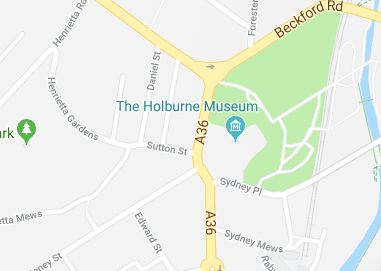
The Austen family’s first house in Bath was located at number 4 Sydney Place.

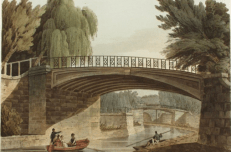
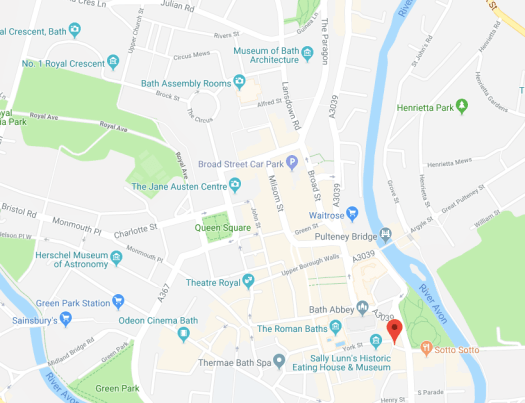
“No. 4 Sydney Place was a good, well-proportioned, newly build terraced house. It was well placed outside the crowded centre of Bath, but within easy walking distance over Pulteney Bridge.” – Claire Tomalin, Jane Austen: A Life

Canal and walks, Sydney Gardens 19th C.This address, opposite Sydney Gardens, allowed Jane easy access to the walking paths along its beautiful grounds, a sop to her country heart. (See image on the right.)

Map of Sydney Gardens and Sydney Place, Bath

Sydney Gardens and Sydney Place

Map of Bath

Main city of Bath, across the Pulteney Bridge from Sydney Place

“Whether you go to see, or to be seen, At Sydney Gardens you’ll be pleased, I ween, Whatever your taste, for prospects or good cheer, Cascades or rural walks, you’ll find them here…”
– Anon, 27 August 1795, poem in local newspaper
–“The History of Sydney Gardens” by Catherine Pitt, The Bath Magazine

Life in the city of Bath was vastly different from life in the country. In Steventon, Mrs Austen oversaw an extensive garden, and used fresh milk from a milk cow and fresh eggs from her chickens to create simple but good food from scratch. She worked alongside her servants in the kitchen and kitchen garden to provide wholesome meals for her family and young boarders, as well as clean clothes and a tidy house. She was a creative poet and a few of her recipes in verse still survive.

If the vicar you treat,
You must give him to eat,
A pudding to hit his affection;
And to make his repast,
By the canon of taste,
Be the present receipt your direction.

First take two pounds of Bread,
Be the crumb only weigh’d,
For the crust the good house-wife refuses;
The proportion you’ll guess,
May be made more or less,
To the size that each family chuses…

(Find the rest of this delightful recipe on this blog at https://janeaustensworld.wordpress.com/2011/04/23/a-receipt-for-a-pudding-by-mrs-austen/)

Imagine the shock this country family felt at having to walk to the green grocer daily, acquire milk from cows kept in city stalls and that was often cut with water, all in an age before refrigeration.


“When proud pied April, dress’d in all his trim,
Has put a spirit of youth in everything.”

yet for the rest of the year the coarse grass is carted to their stalls, or they devour what the breweries and distilleries cannot extract from the grain harvest. Long before “the unfolding star wakes up the shepherd” are the London cows milked; and the great wholesale vendors of the commodity, who have it consigned to them daily from more distant parts to the various railway stations in the metropolis, bear it in carts to every part of the town, and distribute it to the hundreds of shopkeepers and itinerants, who are anxiously waiting to receive it for re-distribution amongst their own customers. It is evident that a perishable commodity which everyone requires at a given hour, must be so distributed.

” –  — from A History of the Cries of London, Ancient and Modern, by Charles Hindley, Project Gutenberg, p 141

This situation for “not so” fresh milk, meat, and vegetables was as similar for the citizens of London as for a small city, like Bath. The Austen’s maid of all work and Austen women purchased “fresh” food on a daily basis, food that was both expensive and often past its “due date.” (Drinking Milk in Regency London, Jane Austen’s World, 2008)

Obtaining decent food supplies in Bath must have been costly for a family living on a parson’s pension. The incessant street cries of the baker, the milkmaid, and other food sellers, even across the Pulteney Bridge in a quieter section of town, must have cut into Jane’s peaceful hours. No wonder her creative juices stalled after her father’s death, as the family moved from place to place (after his pension to his family had been cut off), and before she and her mother and sister found refuge in Chawton Cottage. (Where Jane Lived, Gotta Keep Movin’ blog.)

I confess I possess not a smidgeon of Jane Austen’s writing genius, but the disruption in my life, starting with the years of my father’s slow dying and his death in 2014, and my sweet dog’s sudden fatal illness in 2016, blocked my creative input, both at work and at home.

To be near family, I am moving from a small city with many friends to the suburb of a much larger city., where I know few people. In the process, I am leaving my favorite, unique foodie haunts, small local theater productions, historic city neighborhoods, a short and easy ride to work, and white water rafting downtown on the James River to live in a land of manicured lawns, malls, congested traffic, and national restaurant chains.

Riverside Drive, Richmond, VA

My river walk along the James

Until I regain my footing in early 2019, I don’t anticipate devoting myself to this blog full-time just yet. Thank you, readers, for your understanding. Thank you, Rachel and Tony, for your support.

Vic

Sources:


Read Full Post »

Inquiring readers, Rachel Dodge has once again submitted a superb article. This time she describes the fathers in Jane Austen’s novels. This Sunday marks Father’s Day in the U.S. I lost my own father four years ago. This article once again proves that my father, in every way, was superior to those described by Jane, making me realize how lucky I am and how smart my mother was to choose him.


In life, Jane Austen enjoyed a close relationship with her father. After his death, Austen wrote these words to her brother Francis: “His tenderness as a father, who can do justice to?” (Austen-Leigh 18). In the same letter, she refers to him as “an excellent Father” and writes of “the sweet, benevolent smile which always distinguished him” (144).

But what of the fathers in Austen’s novels? While some of them show exemplary characteristics, others leave much to be desired.

In Persuasion, Sir Walter Elliot is described as “a conceited, silly father” (5) and a “foolish, spendthrift baronet, who had not had principle or sense enough to maintain himself in the situation in which Providence had placed him” (248). He is more interested in his reflection in the mirror than in fathering his three daughters.

In Northanger Abbey, General Tilney runs a tight ship and dislikes delays. Walks cannot be put off, because he is “hurried for time” and mealtimes must be punctual: In one scene, he is “impatient when his eldest son is late” and expresses “displeasure . . . at his laziness” when he finally comes down to breakfast (154). In another scene, General Tilney is described as “pacing the drawing-room, his watch in his hand, and having, on the very instant of their entering, pulled the bell with violence, ordered ‘Dinner to be on table directly!’” (165).

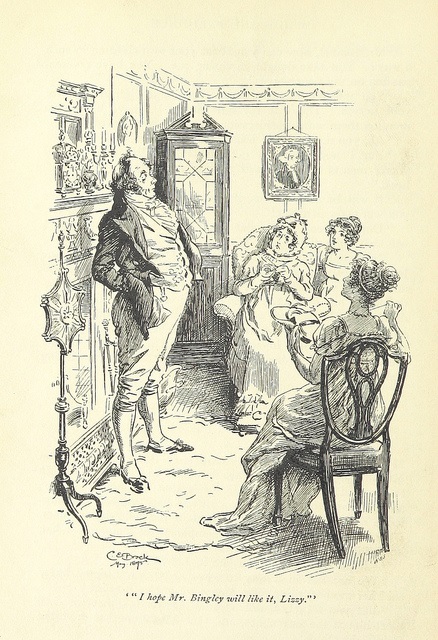
Royalty free image of Mr. Bennet by illustrator Hugh Thomson

1985 edition of Pride and Prejudice, illustrated by Hugh Thomson and published by Macmillan & Co.

In the Bennet household, Mr. Bennet prefers the quiet of his library to the daily activities of family life: “In his library he had been always sure of leisure and tranquillity; and though prepared, as he told Elizabeth, to meet with folly and conceit in every other room of the house, he was used to be free from them there” (71).

In Emma, though Mr. Woodhouse is good-natured and “everywhere beloved” (7), he is most comfortable at home. He’s described on one hand “as a most affectionate, indulgent father” (5), but we also learn that while Emma “dearly loved her father . . . he was no companion for her. He could not meet her in conversation, rational or playful” (7). Austen further explains the intricacies of Mr. Woodhouse here: “He had not much intercourse with any families beyond that circle; his horror of late hours, and large dinner-parties, made him unfit for any acquaintance but such as would visit him on his own terms” (20).

In Mansfield Park, Sir Thomas Bertram is a “truly anxious father,” but he is not “outwardly affectionate” to his children (19). Austen tells us that the “reserve of his manner represse[s] all the flow of [his children’s] spirits before him” (19). Later in the novel, Sir Thomas sees “how ill he had judged” in raising his daughters and that he had “increased the evil by teaching them to repress their spirits in his presence” (463). He feels his “grievous mismanagement” and realizes that his daughters “had been instructed theoretically in their religion, but never required to bring it into daily practice” (463). In his case, Sir Thomas reflects upon, softens, and corrects his own manner.

QUIZ: Which Father is Which?

Finally, the fathers and father figures in Jane Austen’s novels have plenty of interesting advice for their children and fascinating perspectives on the world around them. Test yourself to see if you can guess which father is represented in the following quotes (answer key below):

  1. On One’s Complexion: “I should recommend Gowland, the constant use of Gowland, during the spring months. [She] has been using it at my recommendation, and you see what it has done for her. You see how it has carried away her freckles.”
  2. On Matters of Love: “Next to being married, a girl likes to be crossed a little in love now and then. It is something to think of, and it gives her a sort of distinction among her companions.”
  3. On Being Out of Doors: “It is never safe to sit out of doors, my dear.”
  4. On Early Marriages: “I am an advocate for early marriages, where there are means in proportion, and would have every young man, with a sufficient income, settle as soon after four-and-twenty as he can.”
  5. On the Dangers of Reading: As he had been “found on the occasion . . . with some large books before him, [they] were sure all could not be right, and talked, with grave faces, of his studying himself to death.”
  6. On the Subject of Daughters: “They have none of them much to recommend them,” replied he; “they are all silly and ignorant like other girls; but [she] has something more of quickness than her sisters.”
  7. On a Father’s Role in Parenting: “[He] was a sportsman, [she] a mother. He hunted and shot, and she humoured her children; and these were their only resources. [She] had the advantage of being able to spoil her children all the year round, while [his] independent employments were in existence only half the time.”
  8. On the Care of Ladies in Crowds and Street Crossings: “Come, girls; come . . . come . . . take care of yourselves; keep a sharp lookout!”
  9. On Being Agreeable: “[He], though so charming a man, seemed always a check upon his children’s spirits, and scarcely anything was said but by himself; the observation of which, with his discontent at whatever the inn afforded, and his angry impatience at the waiters, made [her] grow every moment more in awe of him, and appeared to lengthen the two hours into four.”
  10. On Girls Receiving Letters from Lovers: “Whether the torments of absence were softened by a clandestine correspondence, let us not inquire. [Her parents] never did—they had been too kind to exact any promise; and whenever [their daughter] received a letter, as, at that time, happened pretty often, they always looked another way.”

As you reflect on Austen’s literary fathers, may these examples increase your appreciation of the fathers, grandfathers, uncles, and mentors for whom you are most thankful today.

Answer Key: 1) Sir Walter Elliot, Persuasion, 146. 2) Mr. Bennet, Pride and Prejudice, 137-8. 3) Mr. Woodhouse, Emma, 48. 4) Sir Thomas Bertram, Mansfield Park, 317. 5) Mr. Musgrove, Persuasion, 82. 6) Mr. Bennet, Pride and Prejudice, 5. 7) Sir John Middleton, Sense and Sensibility, 32. 8) Mr. Price, Mansfield Park, 403. 9) General Tilney, Northanger Abbey, 156. 10) Mr. and Mrs. Morland, Northanger Abbey, 250.

About the Author

Rachel Dodge is a Christian author, college English instructor, and Jane Austen speaker. A true Janeite at heart, she loves books, bonnets, and ball gowns. For more of Rachel’s literary ramblings, you can follow her at http://www.racheldodge.com or on Facebook or Instagram (https://www.instagram.com/kindredspiritbooks/).

Works Cited:

Austen, Jane, and R. W. Chapman. The Oxford Illustrated Jane Austen. Oxford UP, 1988.

Austen-Leigh, William and Richard Arthur Austen-Leigh. Jane Austen: Her Life and Letters, A Family Record. New York: Barnes & Noble, 2006.


Read Full Post »

« Newer Posts - Older Posts »