Feeds:
Posts
Comments

Archive for the ‘Jane Austen’s language’ Category

By Brenda S. Cox

“Lovely & too charming Fair one, notwithstanding your forbidding Squint, your greazy tresses & your swelling Back, which are more frightfull than imagination can paint or pen describe, I cannot refrain from expressing my raptures, at the engaging Qualities of your Mind, which so amply atone for the Horror with which your first appearance must ever inspire the unwary visitor.

“Your sentiments so nobly expressed on the different excellencies of Indian & English Muslins, & the judicious preference you give the former, have excited in me an admiration of which I can alone give an adequate idea, by assuring you it is nearly equal to what I feel for myself.”–“Frederic & Elfrida,” chapter 2, Jane Austen’s Juvenilia

A few days ago I began telling you about a linguistics conference focused on Jane Austen’s delightful efforts as a teenage writer. Besides the main talks, we got to explore many aspects of Austen’s brilliant use of language.
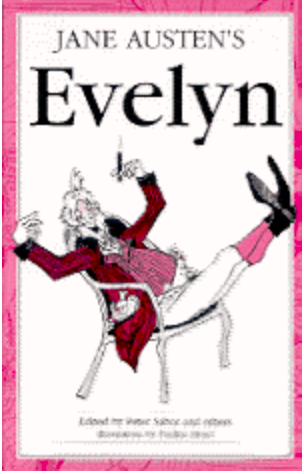
“Evelyn” is one of Jane Austen’s hilarious teenage stories, from her Juvenilia.

Jane Austen’s Grammar, Punctuation, and Education

Several talks reported on analyses of certain types of words, such as intensifiers (very, extremely, etc.), which are often used ironically in the Juvenilia. Phrases indicating prohibition, obligation, or permission are used more often by women than by men in Austen’s early works. One talk examined the language used in sister relationships, comparing Elizabeth and Jane Bennet’s conversations with Anne Elliot and Mary Musgrove’s discussions.

Two talks focused on education at the time. These traced Austen’s own experiences with two brief bouts in boarding school to the comments in her novels criticizing such schools. Austen repeatedly challenged the current systems of women’s education. For example, in Emma, Austen wrote:

“Mrs. Goddard was the mistress of a School-not of a seminary, or an establishment, or any thing which professed, in long sentences of refined nonsense, to combine liberal acquirements with elegant morality upon new principles and new systems—and where young ladies for enormous pay might be screwed out of health and into vanity-but a real, honest, old-fashioned Boarding-school, where a reasonable quantity of accomplishments were sold at a reasonable price, and where girls might be sent to be out of the way and scramble themselves into a little education, without any danger of coming back prodigies. Mrs. Goddard’s school was in high repute—and very deservedly.”–Emma
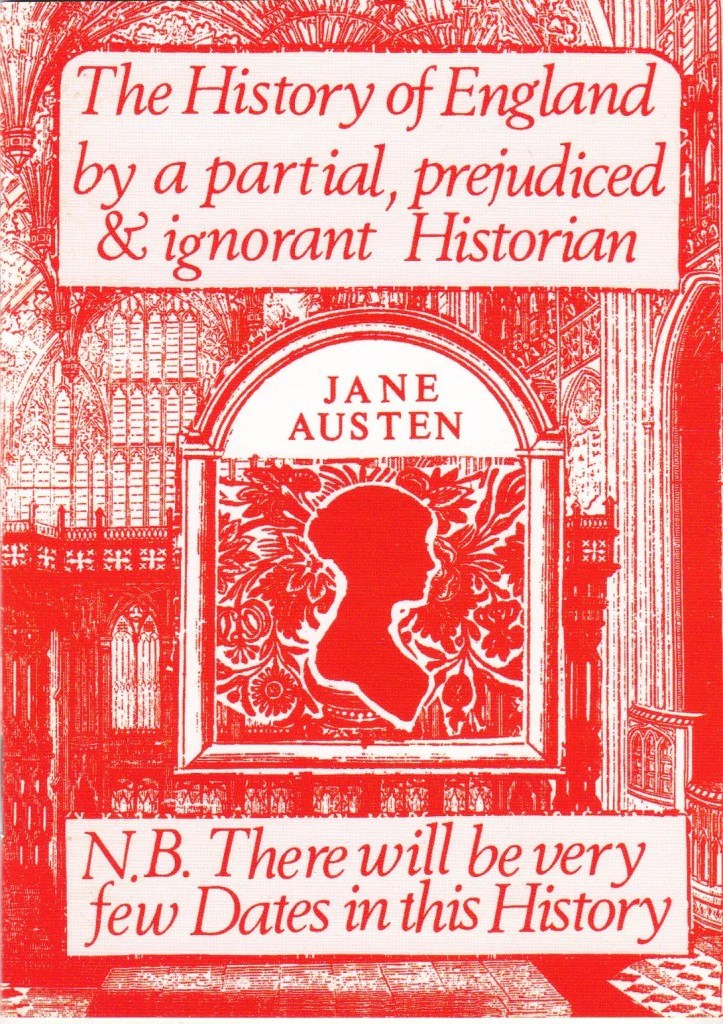
Jane Austen’s The History of England shows her awareness of the bias of all historians. One talk compared it with the serious Oliver Goldsmith textbook she parodies. Goldsmith moralizes, while Austen entertains.

Parentheses

I had never noticed how Austen used parentheses (also called round brackets) as stage directions. Victorina González-Díaz showed us that Austen used parentheses for body movement (smiling), attributions (said I), or both (said he with a saucy smile). Early on, Austen used parentheses in the Juvenilia mostly for speech attributions and combined forms. As accepted conventions changed, she moved to using them mostly for body movements in her mature novels. Specific characters, like Mrs. Elton, get parenthetical expressions to help characterize them. In Volume 2 of Emma, for example, Mrs. Elton says:

“The thing is determined, that is (laughing affectedly) as far as I can presume to determine anything without the concurrence of my lord and master.”–Mrs. Elton

Jane Austen’s Self-Editing

Another talk I appreciated was Breckyn Wood’s on “Jane Austen the Editor.” The original manuscripts of the Juvenilia show many editing changes that Austen made to her own work (Jane Austen: Teenage Writings, edited by Kathryn Sutherland, lists these edits). Wood showed how Austen’s editing process as she worked on her early writings helped her develop the style she used later in her novels.

Wood first pointed out, as van Ostade confirmed, that spelling and punctuation were not at all standardized in Austen’s time. The “errors” Austen made were similar to the spelling and punctuation of other great authors of her time, including Wordsworth and Sir Walter Scott. (Did you know that we have six original examples of Shakespeare’s signature, and he spells his own name differently in each one??)

Love and Freindship uses a spelling acceptable at that time.

So when Austen wrote Love and Freindship, she wasn’t making a childish mistake. She was using an accepted alternate spelling.

Austen’s self-edits were made for various reasons. In one story, Austen changed “She began to fear” to “She began to tremble.” This is a modern writing convention, where we prefer to “show” rather than “tell”—she is showing the character’s fear, rather than telling us the character was afraid.

In another place Austen added alliteration (using the same initial sounds), changing “rouge” to “patches” in “Frederic & Elfrida,” resulting in:

“Charlotte . . . walked to Mrs. Fitzroy’s to take leave of the amiable Rebecca, whom she found surrounded by Patches, Powder, Pomatum, & Paint, with which she was vainly endeavouring to remedy the natural plainness of her face.”
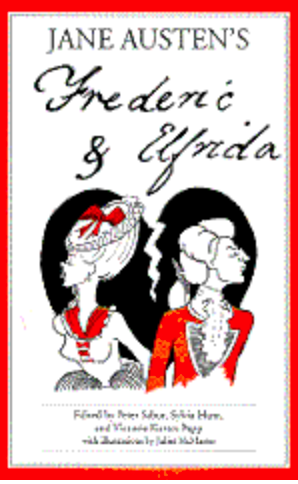
“Frederic & Elfrida” shows Austen editing her own work to make it more fun.

In other cases, Austen increased the silliness of these spoofs. For example, she originally had a young man sending a large Newfoundland dog home to his family every year, but changed that to every month, to make it even more ridiculous.

Austen was careful in her choice of words and phrases throughout the Juvenilia, developing the wonderful style we see in the mature novels.

Language Change

My own talk was on language change in Jane Austen’s religious vocabulary. I focused on words that have changed meaning since Austen’s time, so that we may misunderstand them as readers today. Some, like rector, vicar, and curate, have changed because the Church of England’s structure has changed. Obvious religious words, like atone in the quote that opens this post, are used ironically. Others, like exert, duty, and principle, once had strongly religious meanings, but their emphasis has changed because of cultural changes. The Juvenilia uses these words mostly as satire, showing characters who had made sensibility into their own religion. My talk is posted on my blog.

Who knew that the science of linguistics could add so much to our understanding of Jane Austen’s work and world?

If you want to read or re-read the Juvenilia for yourself, you might try Jane Austen: Teenage Writings, edited by Kathryn Sutherland.  Or, you might go for some of the lovely illustrated volumes from Juvenilia Press. I’ve used some of those covers to illustrate this post. I have even bought some of those delightful storybooks for my grandchildren. They are available from Juvenilia Press in Australia or from Jane Austen Books in the US. 

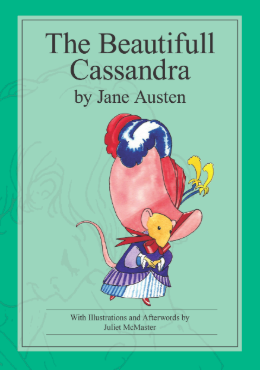
“Cassandra smiled & whispered to herself ‘This is a day well spent.’”—”The Beautifull Cassandra,” Jane Austen’s Juvenilia

If you’ve read the Juvenilia, which story is your favorite, and why?

Online articles on Jane Austen’s use of language

(Note that for jstor, you can get an individual membership free and read many articles each month.)

The Language of Jane Austen’s Teenage Writings: Part 1

For abstracts of the conference talks, see “Linguistic Approaches to Jane Austen’s Childhood.

This list is included in the Social Customs tab above, under Language and Linguistics.

Brenda S. Cox is the author of Fashionable Goodness: Christianity in Jane Austen’s England. She also blogs at Faith, Science, Joy, and Jane Austen.
Read Full Post »

“It was too pathetic for the feelings of Sophia and myself—We fainted alternately on a sofa.”–Love and Freindship, Letter the 8th, Jane Austen’s Juvenilia.

Frederic & Elfrida, one of Jane Austen’s hilarious juvenile stories, published by Juvenilia Press

Since I have a background in linguistics, I was intrigued when I was invited to present at a conference in Spain on “Linguistic Approaches to Jane Austen’s Childhood.”*

This conference, which took place in early May, focused on the language of Austen’s early letters and her Juvenilia, the stories she wrote in her teens for her own family and friends’ enjoyment. She wrote them up in three volumes, as if for publication, though they were not published until long after her death. Why is the language of these works important, or even interesting?

Austen’s Language

A fascinating article on “Jane Austen’s Subtly Subversive Linguistics,” by linguist Chi Luu,  claims that the best thing about reading Austen is her language. “Austen’s subtly subversive ironic language allows readers to receive her work in a layered way—romance, comedy, mystery.” We lose much of this linguistic brilliance in the movies, which tend to magnify the romance and ignore the intricacies of Austen’s language.

Luu says, “As [Austen’s] writing matured, her comedy became less overt and more nuanced.” We can enjoy the overt comedy of Austen’s Juvenilia, ranging from “The Beautifull Cassandra” whose “father was of noble Birth, being the near relation of the Dutchess of —-’s Butler,” to “Love and Freindship,” whose moral is “Run mad as often as you chuse; but do not faint.”

“The Beautifull Cassandra”  is one of Austen’s teenage stories. In twelve chapters of one to four sentences each, Cassandra has outrageous adventures.

Jane Austen Practicing

The conference started at noon in Spain, which was 6 AM for me in Georgia, USA, where I was participating online. Kathryn Sutherland opened with, “Jane Austen Practising: What Her Teenage Writings Can Teach Us.” Sutherland edited editions of the Juvenilia which reproduce the pages in Austen’s own handwriting with transcriptions. 

Sutherland gave a lively introduction to the Juvenilia, which she considers among the best comic writings in English. These stories are parodies of the novels and pulp fiction Austen enjoyed, as well as her schoolbooks on history and geography. Unlike in Austen’s mature novels, girls in the Juvenilia reject all advice on ladylike behavior. We see them overeating, drinking, stealing, accepting two offers of marriage, even involved in murder, sexual misdemeanors, and violence. The girls in the stories are tough, while the men are weak.

Austen experimented with exotic names for places, like “Crankhumdunberry” and “Pammydiddle,” and people, like “Jezalinda” and “Elfrida.” Sutherland called these kinds of names “multisyllabic confections.” She also said Austen was experimenting with what ingredients a novel needs. For example, does it need a hero? In “Jack & Alice,” Jack is only briefly mentioned as a drunk who died and made his sister rich:

“It may now be proper to return to the Hero of this Novel, the brother of Alice, of whom I beleive I have scarcely ever had occasion to speak; which may perhaps be partly oweing to his unfortunate propensity to Liquor, which so compleatly deprived him of the use of those faculties Nature had endowed him with, that he never did anything worth mentioning. His Death happened a short time after Lucy’s departure & was the natural Consequence of this pernicious practice. By his decease, his sister became the sole inheritress of a very large fortune”—”Jack and Alice,” chapter 7, Jane Austen’s Juvenilia [Variations in spelling and capitalization were common at this time.]

Are motivations and believable settings necessary? Austen’s Juvenilia characters act crazily and randomly. Are the boundaries set by society reasonable? These characters ignore them.

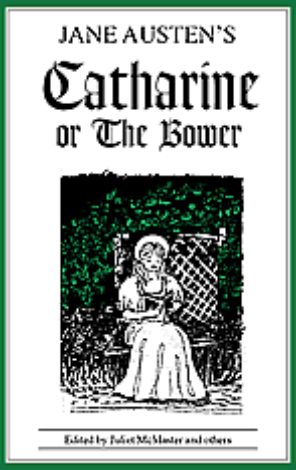
Catharine, or The Bower, shows Austen almost ready for her mature novels.

The last work of the third and final volume of the Juvenilia is Catherine, or The Bower. This is the longest work, and is realistic rather than comic. It includes political commentary and harsh criticism of restrictions on women. Catharine sets the stage for Austen’s later novels, which are set in her real world, with characters who need to live within social realities.

Spelling as Evidence

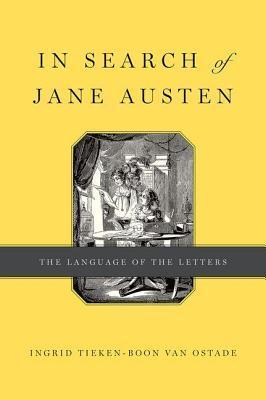
On the second day, Ingrid Tieken-Boon van Ostade gave the plenary talk, “Spelling as Evidence: from Jane Austen’s Juvenilia to The Watsons.” Van Ostade is the author of In Search of Jane Austen: The Language of the Letters, an in-depth analysis of the spelling, vocabulary, and grammar Austen used in her letters.

In Search of Jane Austen: The Language of the Letters explores Austen through her spelling, vocabulary, and grammar.

In this talk, van Ostade suggested dates for parts of Austen’s manuscripts based on different versions of Austen’s handwriting, different shades of ink, and different accepted spellings. She puts The Watsons at 1805-6 (family tradition suggests 1804), and “The Three Sisters” as an addition to the Juvenilia after 1804.

In “The Three Sisters,” a young lady agrees to marry a horrible man in order to spite her sisters. She haggles with him over what kind of coach they will get: she wants a blue one with silver spots.

One participant was working on a compilation of some letters of the period. Van Ostade encouraged such editors to include original spellings, capitalization, and punctuation, rather than “correcting” them. Such details contribute to our historical knowledge of the development and use of language in each time period. I would not have thought of that!

Spelling was not taught as a school subject in Austen’s time, though instructional texts were beginning to become available by the 1790s. Van Ostade says that throughout Jane Austen’s life, Austen was a “careful and consistent speller.” So the “mistakes” we see in her Juvenilia, such as “freindship” for what we would now spell “friendship,” were variations used at that time.

In a few days we’ll continue with more delights of Austen’s language.

“We are the sons as you already know, of the two youngest Daughters which Lord St Clair had by Laurina an italian opera girl. Our mothers could neither of them exactly ascertain who were our Father, though it is generally beleived that Philander, is the son of one Philip Jones a Bricklayer and that my Father was one Gregory Staves a Staymaker of Edinburgh. This is however of little consequence for as our Mothers were certainly never married to either of them it reflects no Dishonour on our Blood, which is of a most ancient and unpolluted kind.”–Love and Freindship, Letter the 15th, Jane Austen’s Juvenilia

What is a phrase from Jane Austen that you love?

To read more about Jane Austen’s brilliant use of language, check out the Social Customs tab above, and scroll down to Language and Linguistics.

*The conference was organized by Nuria Calvo Cortés at the Complutense University of Madrid.

Part 2: The Language of Jane Austen’s Teenage Writings

Brenda S. Cox is the author of Fashionable Goodness: Christianity in Jane Austen’s England. She also blogs at Faith, Science, Joy, and Jane Austen.
Read Full Post »

Much has been said about proper greetings, curtsies, nods, and bows in Jane Austen’s novels, but familiar greetings that occur between close friends and family members are just as fascinating. In fact, a close inspection of the novels reveals more kissing, embracing, and hand-holding than one might first imagine.

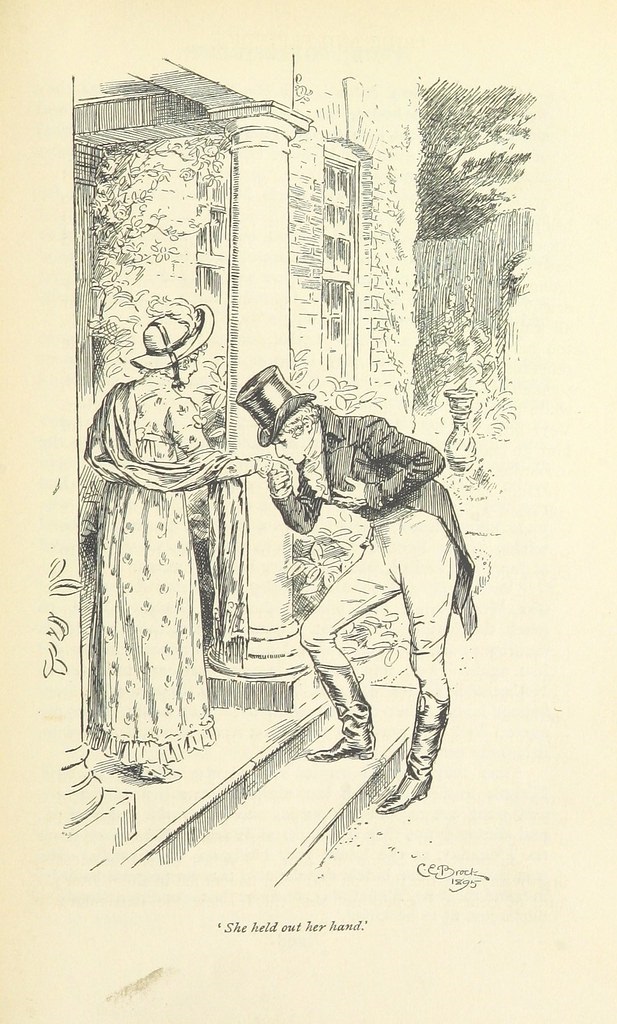
Elizabeth and Mr. Wickham." Pride and Prejudice illustration by C.E. Brock (1895), British Library.

Elizabeth and Mr. Wickham.” Pride and Prejudice illustration by C.E. Brock (1895), British Library.

Austen’s own family is described as affectionate by many of her biographers; her letters reveal the same. In her novels, the degree of physical touch and affection (or the lack thereof) shown by her characters and families can provide us with interesting insights.

Pride and Prejudice

In Pride and Prejudice, Austen uses physical touch to offer clues about her characters in several instances. For example, when saying goodbye to Jane and Elizabeth, Miss Bingley embraces Jane and shakes hands with Elizabeth. With these gestures, she communicates her feelings toward Jane and Elizabeth; the narrator aids our further understanding:

“On Sunday, after morning service, the separation, so agreeable to almost all, took place. Miss Bingley’s civility to Elizabeth increased at last very rapidly, as well as her affection for Jane; and when they parted, after assuring the latter of the pleasure it would always give her to see her either at Longbourn or Netherfield, and embracing her most tenderly, she even shook hands with the former. Elizabeth took leave of the whole party in the liveliest of spirits.” (Chapter 12)

Later, when Elizabeth leaves Hunsford, Miss de Bourgh makes an effort at friendliness in her parting: “When they parted, Lady Catherine, with great condescension, wished them a good journey, and invited them to come to Hunsford again next year; and Miss de Bourgh exerted herself so far as to curtsey and hold out her hand to both” (Chapter 37).

After Lydia’s marriage, Mr. Wickham and Elizabeth’s greeting speaks volumes about what she knows and what he suspects she knows: “She held out her hand; he kissed it with affectionate gallantry, though he hardly knew how to look, and they entered the house” (Chapter 52).

These strained greetings and leave-takings stand in stark contrast to the warm affection shown in the Bennet family. For example, Elizabeth greets her little cousins with a kiss when she returns to Longbourn. Even though she’s in a hurry, her greeting provides a glimpse into their normal family interactions:

“The little Gardiners, attracted by the sight of a chaise, were standing on the steps of the house as they entered the paddock; and, when the carriage drove up to the door, the joyful surprise that lighted up their faces, and displayed itself over their whole bodies, in a variety of capers and frisks, was the first pleasing earnest of their welcome. Elizabeth jumped out; and, after giving each of them a hasty kiss, hurried into the vestibule, where Jane, who came running down from her mother’s apartment, immediately met her.” (Chapter 47)

This scene also reveals that the Gardiner children have a wonderful relationship with their parents and cousin. They’re so full of joy that they’re unable to hold still. Even their movements show their enthusiasm.

Furthermore, Austen uses physical touch to illustrate special fondness between the other Bennet family members. When Elizabeth speaks to Mr. Bennet about her family’s reputation, Mr. Bennet reaches for her hand, in a moment of seriousness, and comforts her:

“Mr. Bennet saw that her whole heart was in the subject, and affectionately taking her hand said in reply: ‘Do not make yourself uneasy, my love. Wherever you and Jane are known you must be respected and valued; and you will not appear to less advantage for having a couple of—or I may say, three—very silly sisters’” (Chapter 41).

Elizabeth and Jane embrace when they are in great trial: “Elizabeth, as she affectionately embraced her, whilst tears filled the eyes of both, lost not a moment in asking whether anything had been heard of the fugitives” (Chapter 47). And again, when they are extremely happy: “Jane could have no reserves from Elizabeth, where confidence would give pleasure; and instantly embracing her, acknowledged, with the liveliest emotion, that she was the happiest creature in the world” (Chapter 55).

When Mr. Bingley and Elizabeth first meet as future brother and sister, there is genuine affection and joy on both sides:

“He then shut the door, and, coming up to her, claimed the good wishes and affection of a sister. Elizabeth honestly and heartily expressed her delight in the prospect of their relationship. They shook hands with great cordiality; and then, till her sister came down, she had to listen to all he had to say of his own happiness, and of Jane’s perfections…” (Chapter 55)

Finally, Jane kisses Mr. Bennet when he gives his permission for her to marry Mr. Bingley: “[H]e turned to his daughter, and said: ‘Jane, I congratulate you. You will be a very happy woman.’ Jane went to him instantly, kissed him, and thanked him for his goodness” (Chapter 55). It’s easy to see how much it pleases Mr. Bennet to see his daughter happy and how much it pleases Jane to make her father happy.

We find examples of kissing and embracing in each of Austen’s novels. Some of her novels have multiple instances and others have very few, depending on the families in question and how they tend to interact with one another. Austen uses these interactions to create a warmer or cooler atmosphere in each family and relationship.

These are just a few scenes from Pride and Prejudice. I’m sure you can think of others. What do these examples say to you about the characters in Pride and Prejudice?

________

Rachel Dodge is a regular contributor to Jane Austen’s World blog and Jane Austen’s Regency World magazine. She is a college English professor and the author of Praying with Jane: 31 Days Through the Prayers of Jane Austen. You can find her online at www.RachelDodge.com, on Instagram https://www.instagram.com/kindredspiritbooks/, or on Facebook https://www.facebook.com/racheldodgebooks/.


Read Full Post »

Austen Prose investigates a phrase or word in Jane Austen’s novels, and examines them closely. Click here for the latest phrase: Abhor. Thank you Austen-tatious for cluing me in.

Check out other Jane Austen word smiths at:

Read Full Post »