Feeds:
Posts
Comments

Archive for the ‘Jane Austen’s World’ Category

Detail of the North Side of Portman Square

Detail of the North Side of Portman Square

Inquiring readers: For two weeks, Laurel Ann, my blogging partner at Jane Austen Today, has been blogging about Lady Susan at her own blog, Austenprose. Lady Susan was published posthumously in 1871, almost 80 years after Jane Austen wrote this short epistolary novel. When one reads the book, one is struck by the number of letters Lady Susan writes to an address on Upper Seymour Street. This is where her friend Mrs. Johnson (Alicia) lives. It was Alicia who famously wrote at the end of the book:

I would ask you to Edward Street, but that once [Mr. Johnson] forced from me a kind of promise never to invite you to my house; nothing but my being in the utmost distress for money should have extorted it from me. I can get you, however, a nice drawing-room apartment in Upper Seymour Street, and we may be always together there or here; for I consider my promise to Mr. Johnson as comprehending only (at least in his absence) your not sleeping in the house. – Mrs. Johnson (Alicia) to Lady Susan, ca. 1805

The houses along Upper Seymour Street in Westminster, which is situated near the Marble Arch (then known as Tyburn) near Hyde Park Corner, are tall, narrow, and four stories high. Edward Lear, the Victorian writer of charming limericks, lived in a house that has been converted to a hotel (Image below). I stayed on the 3rd floor a decade ago and can attest that the stairs are steep!
edlearfront_small

Living at this location off Oxford Street was considered a moderately respectable to fairly good address during the Regency era.  Upper Seymour Street is close to Hyde Park, and within easy walking distance to Mayfair and St. James’s, where the upper crust lived and visited each other when they stayed in London. Upper Seymour Street is actually situated in Marelybone, just around the corner from Portman Square and one block over from Upper Berkeley Street, an area that Jane Austen and her sister, Cassandra, knew well:

Upper Seymour Street and Portman Square

Upper Seymour Street and Portman Square

The Countess de Feuillide looked out from her windows in Upper Berkeley Street towards Portman Square, waiting for her cousin Cassandra to arrive. It still pleased the Countess to be know by her former title rather than as plain ‘Mrs Austen’, and she was always gratified by tradespeople and others who thought to humour her vanity in this matter. – Jane Austen: A Life, David Nokes, 1998, Google Books
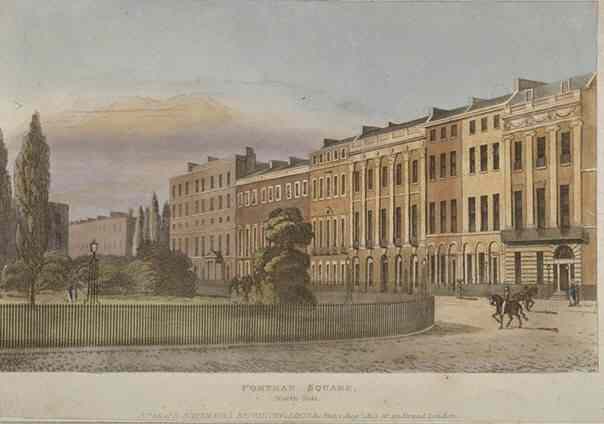
North side, Portman Square, 1812

The nouveau riche, whose ambition was to enter Society, moved as close to the “action” as they could. In 1772, Lady Home, a 67-year-old widow,  made plans to move to Portman Square. This area of London was just beginning to be developed, and, as the image at right attests, the houses (Rated 1 and 2) were big and spacious.  Lady Home had been twice widowed and had become rich from the money she inherited from her father and first husband, Sir Nicholas Lawes, Governor of Jamaica. Her second husband, the 8th Earl of Home, was a dissipated spendthrift. Their marriage in 1742 was one of convenience, for while she got the title, he most definitely married her for her money. In 1744 the earl deserted Lady Home just months before she was to give birth to their child, who, sadly, did not survive. The earl died in 1761, leaving Lady Home a widow once again and free to act as she pleased.
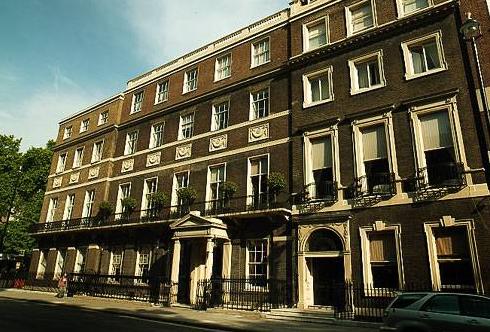
Home House Today

Home House Today

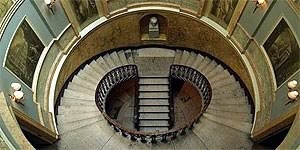
Very little is known about Lady Home’s life until she began to build her grand house in Portman Square. In the early 18th century, Henry William Portman had developed 200 acres of meadow passed down from a Tudor ancestor and turned them into Portman Square. In 1755 he began issuing the first housing leases. Lady Home took a 90 year lease from William Baker in June 1772, on which she was permitted to build a brick house. By 1774, builder Richard Norris was close to completing the house, which had been designed by the architect James Wyatt. His claim to fame was The Pantheon which had opened in 1772 when Mr. Wyatt was just 26 years old.  In 1775, Lady Home fired Wyatt and hired his archrival Robert Adam to complete the interior. One of the most unforgettable features of Adam’s design was the breathtaking  neoclassical stairway under a glass dome.
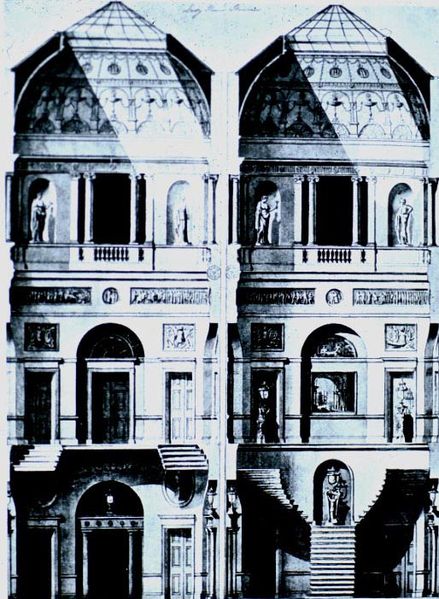
Stair case
Stair case

Stair case, view down

Stair case, view down

Staircase

Staircase

Skylight above staircase

Skylight above staircase

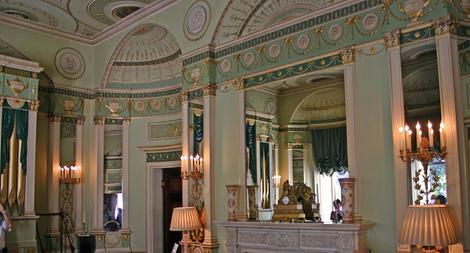
Adam details, Music room

Adam details, Music room

William Beckford, who came from another wealthy plantation-owning family, and who also lived in [Portman] square, described her as: ‘.. the Countess of Home, known among all Irish chairmen and riff-raff of the metropolis by the name, style and title of Queen of Hell…’ He went on to describe her extravagant and eccentric behaviour. She entertained other wealthy Caribbean plantation owners and was related to many of them. She also had royal connections. – BBC History, The business of enslavement

In reading about Lady Home, I was struck by her ambition and audacity, and began to compare her to Lady Susan. Publicly deserted but her husband, Lady Home chose to remain in London and entertain in high style. She successfully made a life for herself on the fringes of society, but, despite her wealth, she was never quite accepted among the haut ton. She lived and entertained in the house from 1776 to 1784, the year that she died.
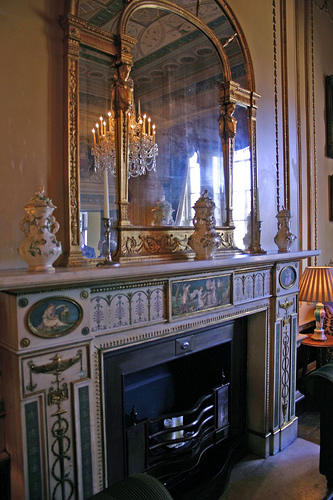
Adam fireplace

Adam fireplace

In an interesting aside, Robert Adam and James Stuart were also the architects of Montagu House, which was built for Mrs. Elizabeth Montague in the northwest corner of Portman Square. The house, known as the ‘Montpelier of England’, became famous for its meetings with the literary world. The Blue-Stocking Club, named for the informal blue stockings that many in the group wore, invited intellectuals to discourse on a variety topics.
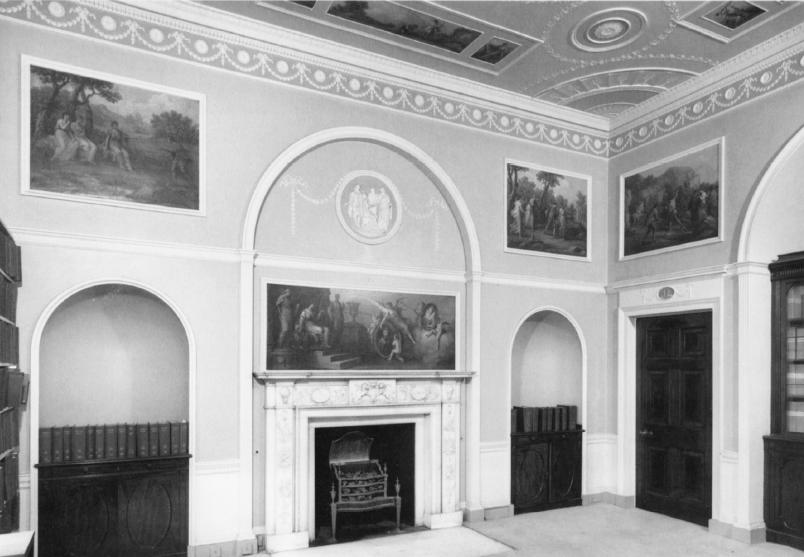
Library

Library

Lady Home’s Etruscan bedroom reflected the current interest in antiquities. The house almost did not survive. From 1989 to 1996, the house was listed on the 100 most endangered sites, and extensive renovations did not begin until 1998. Today the house is part of a private men’s club.
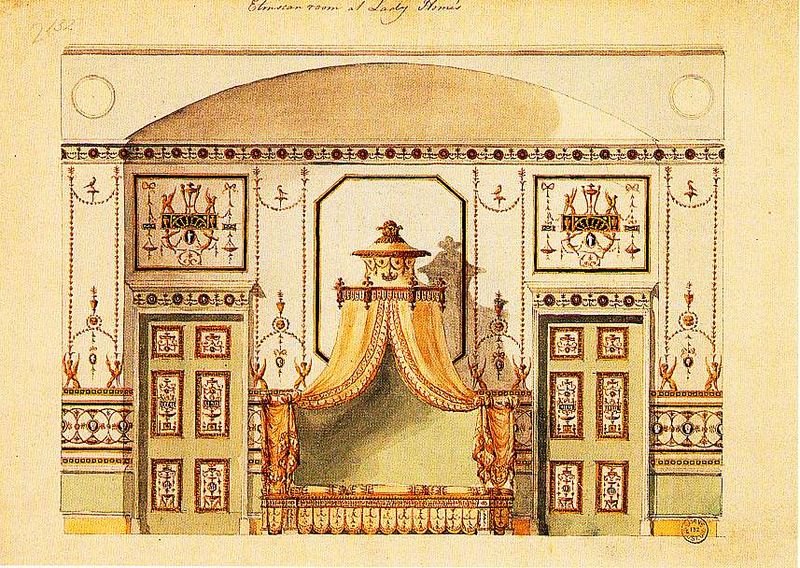
Etruscan room, Home house

Etruscan room (bedroom), Home house

Two portraits by Gainsborough hung in her house, depicting the duke and duchess of Cumberland. The duke was the brother of George III and the duchess related to Lady Home through her first husband. It has been suggested that Lady Home’s motive for building such a large and elegant house when she was a widow who had no children was to entertain the Cumberlands. – BBC History, The business of enslavement

Read Full Post »

Murder at LongbournGentle Reader, Tracy Kiely’s first book, Murder at Longbourn, is set to be released tomorrow, September 1st. I had the pleasure of interviewing Tracy, who was kind enough to provide these fascinating insights in response to my questions. Her murder mystery is a rollicking fun read in the style of a modern Agatha Christie with Austenesque overtones. I think that Tracy summarizes her book best on her website:

If you are a fan of Jane Austen’s Pride and Prejudice, and love classic English mysteries, then you just might enjoy Murder at Longbourn. Set in a picturesque Cape Cod B&B on New Year’s Eve, the story follows Elizabeth Parker, a young woman on the mend from a bad breakup. Instead of a peaceful retreat, she finds herself in the middle of a murder investigation and in the company of the nemesis of her youth, Peter McGowan – a man she suspects has matured in chronological years only. As she investigates her fellow guests, some bearing more than a striking resemblance to characters in Pride and Prejudice, Elizabeth fights to keep her inner poise while she hunts down a killer who keeps killing.

1) Hi Tracy, thank you for agreeing to chat with me. I can’t tell you how much I am enjoying reading your book. Murder at Longbourn, while echoing Jane Austen (and I suspect the cottage industry that has grown up around it) is refreshingly not an Austen sequel, but an original story with Austenesque overtones. How did you conceive of the plot? Can you share with the reader one of your “inside” Jane Austen references? I simply laughed out loud as I encountered them.

The plot for Murder at Longbourn, is something of a mishmash of my favorite forms of entertainment. I grew up reading Agatha Christie, Jane Austen, and watching Alfred Hitchcock movies (I am something of an Anglophile, much to the consternation of my Irish Catholic family). I love the twisty, deviously clever plots of Christie, the sublime wit of Austen, and the “average man caught in extraordinary circumstances” themes of Hitchcock. When I began to think of writing my own mystery, I realized it would have to have those elements. Then one day I was watching the news and – I kid you not – there was a story about a woman who killed her husband at a B&B after they attended a Host-A-Murder Dinner. I was off to the races! However, while there are many references to Pride and Prejudice throughout the book, I didn’t want it to be a retelling of Austen’s classic. Instead, it’s a gentle wink at the reader who is familiar with Pride and Prejudice, but one doesn’t necessarily need to be a fan to “get” the book. That said, I had such fun weaving in the Austenesque aspects. I think my favorites are Henry Anderson’s pride in securing a rare first edition of Fordyce’s Sermons for his client and the ill-mannered white Persian cat, aptly named Lady Catherine.

2) This is your debut novel in print. Due to the maturity of your writing style, I suspect this is not your very first attempt at writing. How long have you been writing? How many first attempts lie upon dusty shelves? And has your work been published in other forms before, such as a magazine?

I have wanted to be a mystery writer since I was a kid. I did briefly entertain a dream of being a cartoonist for The New Yorker but even the early cave dwellers would have rejected my sketches. Several years ago, I wrote a mystery titled An Ostentation of Peacocks. It never really went anywhere (a fact I refuse to attribute to its title) and I put it aside. But it was a bit like taking a SAT prep class; you get an idea of what you’re in for. When I felt ready to write again, I decided to start fresh. However, I was able to use some of the research I did for Ostentation in Murder on the Bride’s Side (the second in the series).

3) The book is funny at times. It is so nice to read an Austenesque novel that echoes Jane Austen’s wit. When did you become a Jane Austen fan, and would you describe yourself as an acerbic wit in real life?

I became a fan of Jane Austen in high school when I first picked up Pride and Prejudice and one of the many aspects of it that I loved was the wit. I would categorize my humor as “acerbicous tardious” which, I believe, is the Latin for thinking of zingers ten minutes too late. I think the French have a term for it too, but I prefer the Latin because it is a dead language and no one can make fun of my pronunciation. However, the beauty of writing is that my characters don’t need to respond in real time.

4) I did you a disservice by calling your book Austenesque, for it is a stand alone novel that even non-Jane Austen fans will like. What are your plans for a second novel? Will it be another mystery?

If calling my book Austenesque is a disservice, then hit me again, dear sir! Luckily, St. Martin’s signed me for the first two in the series. The second, Murder on the Bride’s Side, is due out September 2010 and continues Elizabeth’s sleuthing adventures. My goal for each book is to parallel a different work of Austen’s. The first, obviously, was Pride and Prejudice. The second weaves in elements of Sense and Sensibility. Should the gods smile on me, I will be asked for the third, which is tentatively titled Spirit of Murder and parallels Northanger Abbey. In it certain events occur while Elizabeth is staying in a historic house on Nantucket, which lead her to wonder if her imagination is getting the best of her due to a recent re-reading of The Mysteries of Udolpho or if there is a more sinister explanation.

5) Tell us a little about yourself and your family. How do you fit writing into your schedule when you are raising three children who, I presume, are young?

My husband and I have three kids aged 13, 9 and 6. Throw in a puppy, an uppity cat, and a few fish and there’s precious little time for sanity, let alone a set writing schedule. So I do it when I can: while the kids are brushing their teeth, while the dog is chasing the cat through the dining room, while my youngest is painting his room with crayon. For me, writing is something I can’t not do. Jasper Fforde put it best when he said “Writers write because they can’t stop. They scribble notes in books, write poetry, jot down good snippets of dialogue and generally exist in their own little world.”

Thank you for your wonderful insights, Tracy. I wish you the best of luck as your book hits the stores. You can read my review at this link.  Readers may order copies here,  and enter Tracy’s website at this link.

Tracy KielyAbout the Author: Tracy Kiely graduated from Trinity College in 1990 with a degree in English. This accomplishment, however, merely seemed to prompt most job interviewers to ask “how fast can you type?” Her standard answer of “not so fast” usually put an end to futher questions.
She was eventually hired by the American Urological Association (AUA), who were kind enough to overlook the whole typing thing, mainly because they knew just what kind of stuff she’d be typing. Beggars can’t be choosers, you know. After several years, Tracy left the AUA taking with her a trove of anecdotal stories that would eventually result in her banishment from polite society.

Read Full Post »

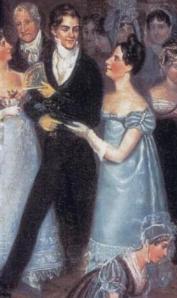
rolinda sharples men ballRolinda Sharples’s 1817 painting of the Cloak-Room, Clifton Assembly Rooms is a familiar one to most Jane Austen fans. This image graces many book covers and has been used for depicting life in the Regency era. Looking closely, one sees that the assembled party seem to be enjoying the occasion as they wait and chat. A lady’s maid is helping a woman exchange her shoes, a man holds a lady’s fan, and the ladies are wearing an assortment of pale dresses, and colorful headwear and shawls. John Harvey, author of Men in Black, 1996, a book about the predeliction men have had over the centuries for wearing black, noted on p. 37 that Rolinda’s painting illustrates the direction that fashion was taking in the 19th century:

The white-haired man to the left is dressed in the older style, with light-coloured knee-breeches and lighter stockings. The stooping man to the right is a transitional type, wearing black knee-breeches, black stockings.

Cloak Room, Clifton Assembly Room, 1817, Rolinda Sharples

Cloak Room, Clifton Assembly Room, 1817, Rolinda Sharples

The man to centre-left is dressed as Brummel dressed, in skin-tight black trousers.

The above style and the two previous styles would have been familiar to  Jane Austen, for she died the same year that this painting was made.
Rolinda Sharples Clifton detail of brummel type

Rolinda Sharples Clifton detail

It is the man to the right of him, in looser black trousers, who is dresed as the century was in future to dress. The men at Mr. Rochester’s party [in Jane Eyre] would all be in his style.

These links do not describe formal menswear, per se, but the are descriptive of men’s clothes of the era:

Read Full Post »

Jane's Window View, copyright Keith Mallet

Jane's Window View, copyright Keith Mallet

Gentle Reader, Keith Mallett wrote to me to say that he visited his homeland of England for the first time in 35 years after moving to Australia. One of his fondest memories of the trip is of a visit to Chawton. When he was a teenager living in England he used to almost drive past the house on the way to and from boarding school each term, but “I have to admit Jane Austen was not high on my teenage reading list.”

We can sympathize, Keith. Not many teenage boys relate to Jane. Not many men do, either, so it is my pleasure to share your insights with my blog’s readers. I also thank you for giving me permission to publish your photograph. How apropos that is was raining that day, for I have often imagined Jane finding excuses to stay inside and write.  Keith wrote in his journal about Jane:

It can be taken for granted that I am a fan of Jane Austen’s writing – I find the acute social commentary woven into the fabric of the romances and intrigues of those Regency days quite fascinating, and wonder how much the novels reflect Jane’s own personality and desires. She would have been a fascinating person to meet. But sadly I was too late by 191 years. I could only tread the bare floorboards of the house, peer into the rooms that contained her life all those years ago and take a few photographs. But she was suddenly present as I looked out from the window of the bedroom she shared with her sister, Cassandra. She must have looked out through the rain-spattered panes many a time, perhaps pondering on the chances of walking on that day, or absently plotting the life of one of her creations. They were dedicated walkers, and I suspect even the dirty weather of my day there would not have deterred that walking. The bedroom window looks out over the back yard to the out-buildings: where the day-to-day domestic tasks would have been done: the baking, the washing, and drawing cool water from the depths of the well.

More About Chawton House (where Jane’s brother Edward lived) and Chawton Cottage (where Jane lived with her mother and sister):

Read Full Post »

Once upon a time children wore miniature versions of their parents’ clothing styles. Then, in 1780 or 1790, depending on the source you read, children began to be dressed differently, wearing fashions designed just for them.

Bowden Children, John Hoppner, late 18th c.

Bowden Children, John Hoppner, late 18th c.

Skeleton suit, Kate Greenaway

Skeleton suit, Kate Greenaway

Not that small boys, left to their own devices, would have worn high-waisted, ankle length trousers made of heavy cotton or linen and white cambric shirts with ruffled trim, but these “skeleton suits” as they were called were popular for at least fifty years. The pants had high waists, because they were buttoned onto the long sleeved jacket.

Although these long-sleeved, trousered suits were meant to be comfortable, they had three layers at the waist, not including underwear. Heaven knows how hot the boys must have felt in the summer or during active play! Or how quickly the white ruffed shirts soiled! Completing the outfit were white stocking, flat-soled strap slippers, and a military-style cap. The strapped slippers can best be seen in the 1841 fashion plate image at the bottom of this post.

Boy with cap

Boy with cap

A skeleton suit, one of those straight blue cloth cases in which small boys used to be confined before belts and tunics had come in … An ingenious contrivance for displaying the symmetry of a boy’s figure by fastening him into a very tight jacket, with an ornamental row of buttons over each shoulder and then buttoning his trousers over it so as to give his legs the appearance of being hooked on just under his arm pits. (Charles Dickens, Sketches by Boz, 1838-39.)

webmedia.php

Adding insult to injury, was the underwear that young boys wore under these layered clothes. This sample comes from the Manchester Art Gallery.

Detail of The Hoppner Children, 1791. Formal skeleton suit.

Detail of The Hoppner Children, 1791. Formal skeleton suit.

The smaller the boy, the more elaborately frilled the collar. Colors were generally light, with the most popular being blue or green. Sometimes the suits were made of scarlet or mustard as well. For more formal occasions, a colorful sash might be added and the trousers made of silk or velvet and trimmed with lace. A young man about to go to Eton would wear the larger Eton collar.

Detail of Fluyder Children, Sir Thomas Lawrence. Skeleton suit with sash

Detail of Fluyder Children, Sir Thomas Lawrence. Skeleton suit with sash

Detail, 1841 fashion plate

Detail, 1841 fashion plate

More Links:

Little Anne illustration, Kate Greenaway

Little Anne illustration, Kate Greenaway

Read Full Post »

« Newer Posts - Older Posts »