Feeds:
Posts
Comments

Archive for the ‘Jane Austen’s World’ Category

Read Full Post »

jane-austen-7-males2

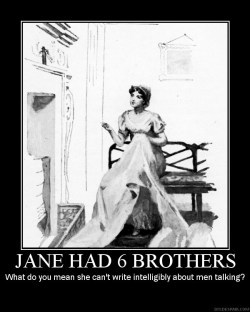
At Steventon Rectory, Jane lived in a house with five brothers (the 6th lived elsewhere), a father, and his male student boarders. As an author she chose not to write scenes showing men talking. In my opinion, this doesn’t necessarily mean she knew little about the way men spoke or thought. Unless the rectory was well carpeted and insulated, she must have overheard any number of conversations between her brothers, or her father and other males. Yet there is a perception that Jane did not know enough about  men talking in private to write about the topic. Ian MacKean observes: “The men may well have discussed politics, but not with the women, and Jane Austen never writes scenes with only men present, for the simple reason that she could never have witnessed such a scene herself.” While Mr. MacKean might be correct in his first observation, how can he know that Jane could NEVER have witnessed two men talking politics? Jane lived in a household where reading and conversation were encouraged, and where the family gathered together to entertain each other and read to each other. MacKean’s conclusion, which is echoed by others from multiple sources, makes little sense to me. I am not a scholar, but I cannot imagine that Jane was never alone in a room with two or more men, and that they always limited their conversation while this lively, talented, and opinionated woman was present. Steventon Rectory was crowded, and I imagine at times it was impossible for Jane to find a private spot with so many people (translate males) in the house.

In this passage in Emma, Jane writes the rarest of scenes: that of two brothers talking about their land holdings. They are the Knightleys to be more specific. This manly dialogue is an unusual occurrence in Jane’s novels, so enjoy.

The brothers talked of their own concerns and pursuits, but principally of those of the elder, whose temper was by much the most communicative, and who was always the greater talker. As a magistrate, he had generally some point of law to consult John about, or, at least, some curious anecdote to give; and as a farmer, as keeping in hand the home-farm at Donwell, he had to tell what every field was to bear next year, and to give all such local information as could not fail of being interesting to a brother whose home it had equally been the longest part of his life, and whose attachments were strong. The plan of a drain, the change of a fence, the felling of a tree, and the destination of every acre for wheat, turnips, or spring corn, was entered into with as much equality of interest by John, as his cooler manners rendered possible; and if his willing brother ever left him any thing to inquire about, his inquiries even approached a tone of eagerness.

Read Full Post »

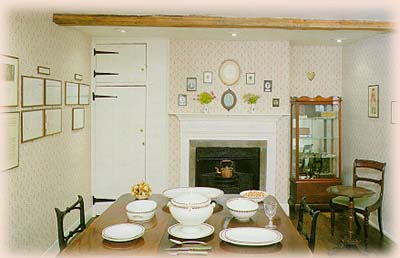
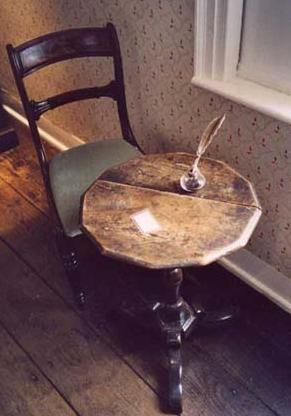
Jane Austen’s novels centered around topics she knew best: hearth, home, neighborhood, and family. The following excerpts offer glimpses of the houses that Jane Austen described in her novels. Accompanying photos illustrate the interior of Chawton, a home in which Jane’s talents as a writer thrived. In Jane Austen’s Idea of a Home , S. M. ABDUL KHALEQUE discusses the difference between Jane’s ideal of a warm and loving home and the architectural characteristics of an impressive ancestral house:

Chawton House Dining Parlor

Chawton House Dining Parlor

In Mansfield Park, Austen makes it clear that physical facilities become useless if moral values are not properly cultivated. Although the houses like Rosings, Sotherton Court, and Northanger Abbey are spacious and magnificent, these are not worthy of consideration as homes. In contrast, the small-sized house of the Harvilles in Persuasion is a home because it exemplifies orderliness as well as other virtues, and the members of the family are always full of life and spirit in their house. Similarly, the Crofts turn their rented house—Kellynch Hall—into a home, a feat that Sir Walter, the owner of the estate, failed to perform; hence, his departure for Bath. What Jane Austen suggests is that physical facilities will be charming only when there is a correspondence between outward beauty and the inner life. Pemberley unites these qualities, and that precisely is the reason why it is a home, whereas some of the great houses are not.

This excerpt from Sense and Sensibility, Chapter 5, demonstrates that the John Dashwoods consider furniture to be symbols of possessions and wealth, not items to be cherished in their home:

Jane's Bedroom at Chawton

Jane's Bedroom

Mr. John Dashwood told his mother again and again how exceedingly sorry he was that she had taken a house at such a distance from Norland as to prevent his being of any service to her in removing her furniture. He really felt conscientiously vexed on the occasion; for the very exertion to which he had limited the performance of his promise to his father was by this arrangement rendered impracticable.– The furniture was all sent around by water. It chiefly consisted of household linen, plate, china, and books, with a handsome pianoforte of Marianne’s. Mrs. John Dashwood saw the packages depart with a sigh: she could not help feeling it hard that as Mrs. Dashwood’s income would be so trifling in comparison with their own, she should have any handsome article of furniture.

Contrast the above description with Lizzy Bennet’s first visit to Pemberley. As she wanders through the stately rooms of Mr. Darcy’s house, Elizabeth is struck as much by the mansion’s magnificence as by its attraction as a home:

The rooms were lofty and handsome, and their furniture suitable to the fortune of its proprietor; but Elizabeth saw, with admiration of his taste, that it was neither gaudy nor uselessly fine; with less of splendour, and more real elegance, than the furniture of Rosings. “And of this place,” thought she, “I might have been mistress! With these rooms I might now have been familiarly acquainted! Instead of viewing them as a stranger, I might have rejoiced in them as my own, and welcomed to them as visitors my uncle and aunt.”

Jane's writing desk at Chawton.

Jane's writing desk.

Expectations loomed large for poor Catherine Morland when she received an invitation to visit Northanger Abbey. She hoped to finally get to see, feel, and experience a romantic and mouldering house like those described in her Gothic novels! Imagine her let-down when she accompanied General Tilney on a tour of the Abbey and realized he had modernized its grand yet comfortable rooms:

They set forward; and, with a grandeur of air, a dignified step, which caught the eye, but could not shake the doubts of the well-read Catherine, he led the way across the hall, through the common drawing-room and one useless antechamber, into a room magnificent both in size and furniture–the real drawing-room, used only with company of consequence. It was very noble–very grand–very charming!–was all that Catherine had to say, for her indiscriminating eye scarcely discerned the colour of the satin; and all minuteness of praise, all praise that had much meaning, was supplied by the general: the costliness or elegance of any room’s fitting-up could be nothing to her; she cared for no furniture of a more modern date than the fifteenth century. When the general had satisfied his own curiosity, in a close examination of every well-known ornament, they proceeded into the library, an apartment, in its way, of equal magnificence, exhibiting a collection of books, on which an humble man might have looked with pride.

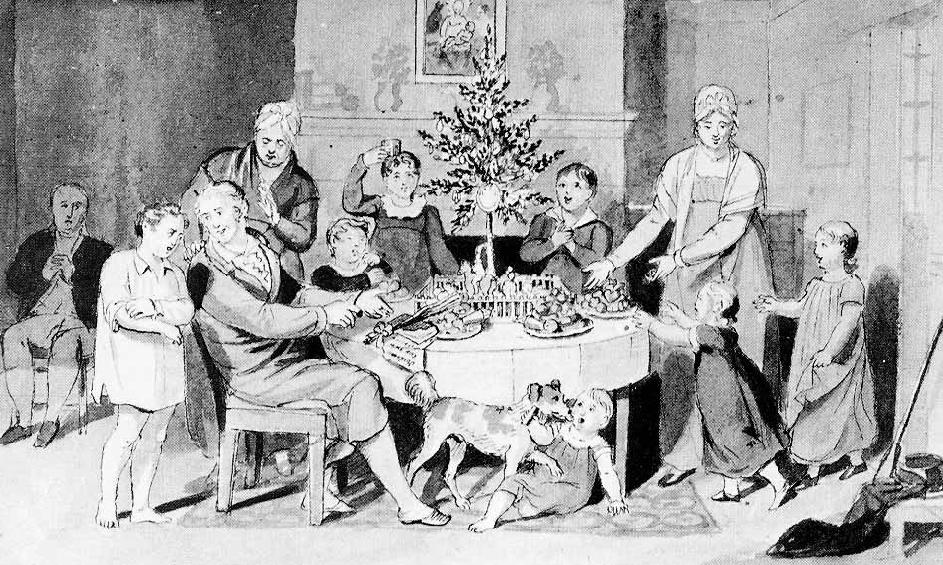
Contrast Catherine’s disappointment with this cozy Christmas scene in Persuasion with two of the Harville children visiting Uppercross as Louisa recovers from her fall in Lyme Regis.

Republic of Pemberley

Christmas Celebration. Image: Republic of Pemberley

Immediately surrounding Mrs. Musgrove were the little Harvilles, whom she was sedulously guarding from the tyranny of the two children from the Cottage, expressly arrived to amuse them. On one side was a table occupied by some chattering girls, cutting up silk and gold paper; and on the other were tressels and trays, bending under the weight of brawn and cold pies, where riotous boys were holding high revel; the whole completed by a roaring Christmas fire, which seemed determined to be heard, in spite of all the noise of the others. Charles and Mary also came in, of course, during their visit, and Mr. Musgrove made a point of paying his respects to Lady Russell, and sat down close to her for ten minutes, talking with a very raised voice, but from the clamour of the children on his knees, generally in vain. It was a fine family-piece.

To read more about this topic, click on these additional Links:

Read Full Post »

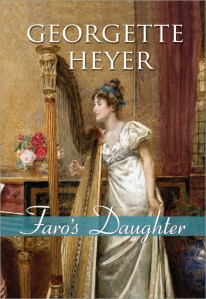
faros-daughterInquiring reader: Faro’s Daughter is reviewed by Lady Anne, my good friend and one of Georgette Heyer’s biggest fans.

Max Ravenscar is one of Georgette Heyer’s favorite hero types: he is 35 years old, single, and the head of his family for many years. He is a powerful athlete and superb horseman. He is harsh featured, strong-willed, and suffers no one to cross his will. And, oh yes, even more importantly, he is extraordinarily, amazingly wealthy. Deborah Grantham is also a favorite type: well-born and gently raised, but her family has suffered reverses, and she is forced to make her way. Her father was a military man, but more importantly to our story, a gamester. Her aunt, with whom she resides since her father’s death, is a widow forced to make ends meet by running a private gaming club. She was successful on a small scale, but is in no way equipped to run a profitable business, and inevitably, has fallen into debt.

Max’s nephew Adrian has fallen hard for Deb Grantham, and his mother, Max’s aunt, one of the women who depend on Max to keep their worlds untroubled, implores him to extricate the young man from this potential pitfall. Deb Grantham, a lovely 25 year old Juno-esque blonde, has a strong will and temper, along with a finely tuned moral code and sense of her own worth. At their first meeting, Ravenscar is surprised by her, but also beats her badly at piquet. The following day, he offers her money to turn his nephew loose. Deb has been playing with Adrian to keep another suitor, one who wishes to make her his mistress, at bay. Incensed at Max’s blunt offer, she plays a role that suits what he thinks she is, rather than showing her very real anger. Predictably, they show each other their worst sides, misconstrue actions, get into and out of scrapes, forestall any serious problems, and inevitably, end up in each other’s arms.

Other characters include the raffish sidekick, her father’s friend and confidante who is devoted to Deb, a spoiled younger brother, who is appalled at the slide into not-quite-respectable territory his aunt and sister have begun, an enchanting younger step-sister who gives her older brother something to think about, and a very young and foolish ingénue who is not so foolish as to allow herself to be married to a far older man of worse than dubious reputation. It is a great mix and a lot of fun.

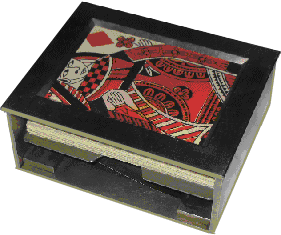
Faro Dealing Box

Faro Dealing Box

Along the way, Heyer, who knows her periods well, reveals some of the cracks in the world of upper class Eighteenth Century England. The wellborn do not work; their money is inherited. If the families waste their fortunes, the choices for their children are harsh. Improvident parents marry children off to the highest bidder they can find, no matter how unsavory the reputation. Few opportunities present themselves for those girls who do not marry: companion or governess for the not so lucky. Deb Grantham shows this when she responds to Ravenscar’s comment that she is accomplished. “No,” she says, “drawing, singing or playing an instrument are accomplishments.” She means of course, suitable for a young lady. She was not fortunate to acquire those skills, but instead has learned card games like faro and piquet. She does not expect to marry because of her slightly tarnished reputation. Max is cynical in part because he has been the head of his family since far-too-young an age. Not only has he had too heavy a burden caring for his various family members, but ambitions mamas trying to marry off their daughters have disgusted him with their headlong pursuit of his name and his fortune. Naturally strong-willed, no one has crossed him in a long time. Deb’s expert fencing with him, whether playing cards or pitting her will against his, comes as a not entirely welcome surprise. They are equally matched; he may have doubts about her eligibility to marry into his family, but her behavior actually is more honorable than his. When he plays for high stakes against Lord Ormkirk, his lordship is drunk. The race, for breathtakingly high stakes, is against a man who he knows has inferior driving skills. It’s all right; both his competitors are bad men, but Deb, for all that she is plays in her aunt’s gaming establishment, would not take unfair advantage. She cannot afford to.
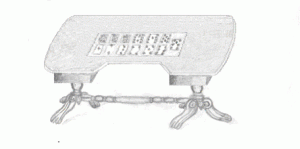
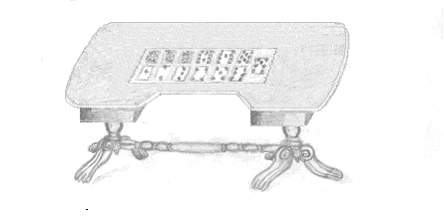
Faro Betting Board

Faro Betting Board

But, being a rollicking romance, all ends well, and Deb can stop playing faro, Max will pay her aunt’s debts, and everyone ends up happy. Including Georgette Heyer’s loyal readers.

About Lady Anne, the reviewer: A confirmed Janeite and co-founder of Janeites on the James (our Jane Austen group), an expert on all things Georgette Heyer and the Regency Era, a lady well read and well bred, Lady Anne is known for her discerning eye for both literature and her breath-taking garments made by a select mantua maker. Cloth’d and coifed, Lady Anne knows few equals, and when she enters a room she is a commanding presence. She is also Ms. Place’s special friend and confidante.

To read more about gambling during this era, please read the post that sits below this one or click here.

Our Other Georgette Heyer Reviews Sit Here:

These Georgette Heyer books, available this holiday season, will be reviewed on this blog and Jane Austen Today.

Cotillion, Simon the Coldheart, The Reluctant Widow, Faro's Daugher, and The Conqueror

Cotillion, Simon the Coldheart, The Reluctant Widow, Faro


Read Full Post »

For centuries, gambling was viewed as a vice typical of the upper classes, but during the Regency this way of passing the time became an even more accepted practice. Card games were played at private parties and at public assemblies, where both sexes indulged in these activities. While the games were often harmless and played for fun, high stakes betting could lead to vice, shocking losses, and crippling addiction. Men gambled and lost vast sums in the men’s clubs in St. James’s, often losing their inheritance. Politicians seeking to deter such an exchange of lands, which undermined the stability of property, held a double standard towards those whom they deemed worthy of winning such wealth:

Regency card party

Regency card party

If a landowner chose to ‘make a sport’ of his property and to lose it, say, at the game of hazard, to another son of broad acres, that was his prerogative. But if, on the other hand, he was foolish enough to throw away what he had inherited to low-born adventurers or, worse, to Jewish moneylenders, the loss was invariably considered serious. The nation’s rulers judged it a threat to their own kind when an estate or any significant portion of one passed into the ‘wrong hands’. The Regency Underworld, Donald A. Lowe, p. 128, ISBN 0-7509-2121-8

Cruikshank, Interior of Modern Hell

Cruikshank, Interior of Modern Hell

One gets the sense that Jane Austen and her social set played cards for amusement and to wile away a pleasant hour or two with friends and family. For some ladies, gambling for profit was an acceptable way of supplementing a fixed income:

Well-off women with no other income sometimes allowed their houses to be turned into gambling houses. The two best known at the end of the eighteenth century, Lady Archer and Lady Buckingamshire, were only the most prominent of a circle of “faro” ladies who owned banks in private homes.- Roll the Bones: The History of Gambling, David G. Schwartz, p. 162, ISBN 1-592-40208-9

Although the two ladies claimed that their aristocratic birth gave them license to run gambling operations, they were subject to ridicule. Lady Buckinghamshire slept with a cache of weapons to protect her bank, and Lady Archer was known for wearing too much makeup. Faro began to decline in popularity, and by the early 19th century, young ladies in boarding school were learning whist and casino. Young gentlemen continued to play hazard, baccarat, and whist in men’s gaming clubs, also known as Hells.

ladygodinaprint

The politician Charles Fox, able to play for long periods without sleep, lost his fortune at the gaming tables. Horace Walpole described one of Fox’s marathon gambling sessions:

He had sat up playing Hazard at Almack’s from Tuesday evening, 4th February [1778], till five in the afternoon of Wednesday 5th. An hour before he had recovered £12,000 that he had lost, and by dinner, which was at five o’clock, he had ended losing £11,000. On Thursday he spoke, went to dinner at past eleven at night; from thence to White’s, where he drank till seven the next morning; thence to Almack’s, where he won £6,000; and between three and four in the afternoon he set out for Newmarket. His brother Stephen lost £11,000 two nights after, and Charles £10,000 more on the 13th; so that in three nights the two brothers, the eldest not twenty-five, lost £32,000. – Lowe, p 129.

Fox’s father, Lord Holland, paid off his son’s debt to the princely tune of £140,000. (In today’s terms this sum would be astronomical – depending on the inflation converter you used, you would multiply the sum by 97 to get at the value of 1780 money today.) The Prince of Wales, in rebellion against his frugal father, modeled his own conduct after that of Fox. Known for his extravagant lifestyle, Prinny set the pace for hedonistic living as Regent and King.

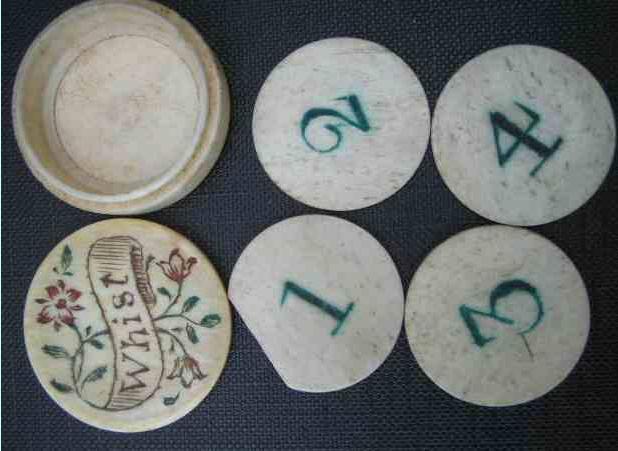
whist-markersWhist Markers

More links on gambling and games in the Regency Era:

Read Full Post »

« Newer Posts - Older Posts »