Feeds:
Posts
Comments

Archive for the ‘Jane Austen’s World’ Category

I own quite a few copies of each of Jane Austen’s novels. Many are annotated, some are old editions or designed for children. Others are illustrated with different artists, many of whom are well known. Most recently I purchased Sense and Sensibility (hardcover), and Pride and Prejudice and Emma (kindle.) All three are illustrated by one of my favorite wildlife artists, Marjolein Bastin, who is known worldwide for her delicate watercolors and gorgeous depictions of flowers, birds, and animals from the field. Click on images below to view some of the beautiful illustrations up close.

photo of Marjolijn Bastin

Illustrator Marjolein Bastin

While Ms Bastin’s painting subjects do not at first seem aligned with Austen’s stories, they are as romantically gorgeous as the author’s prose. They are, in fact, perfect gifts for introducing family members and friends to your favorite author. Considering Austen’s upbringing in Steventon and the countryside and her final years in Chawton Cottage, these images in  Ms Bastin’s portfolio are suited to evoking the countryside in soft, beautiful strokes.

Certainly purchasing a hardback is the best choice, for such a book is tactile, allowing us to finger the pages, and flip back and forth to reread a passage. Hardback books last a long time and remain in good condition much longer than a paperback. In Sense and Sensibility’s edition, gifts of inserts appeared at random throughout the chapters – note the postcard in figure four above!

Online books also have their good features, however. They are portable. I can read them on several devices any time and any place where I have connectivity. My iPad and smart phone allow me to read at night without light, and to change the font size to suit my eyes. While one can find particular passages, the tactile joy of reading a book is gone. When purchasing these books, one does not own them. You are only renting them.

Plus, digital volumes are hidden inside a tablet or computer, while my hardbacks are given logical designations inside my bookcases. I can feast my eyes on them at will and run my fingertips lovingly along their spines. Below are the covers and inserts from my digital books.

More information about illustrated books & illustrators:

About Marjolein Bastin:

Marjolein’s work is enjoyed the world over. In addition to her partnership with Hallmark, she provides ongoing contributions to Libelle, as well as a variety of product partners in Europe and North America. She and her husband Gaston divide their time between country homes in Holland, Switzerland and in Missouri, near Hallmark’s headquarters, as well a tropical retreat in the Cayman Islands. Each setting provides a unique glimpse of what nature has to offer throughout the world.

My personal story: My mother (Moeder) filled a Bastin Dutch birthday calendar of her friends and relatives. This is how I got to know the artist. (My first cousin’s name is Marjolijn.) See the calendar front page below in Dutch.

Read Full Post »

By Brenda S. Cox

Church livings play an important part in most of Jane Austen’s novels.

For example:

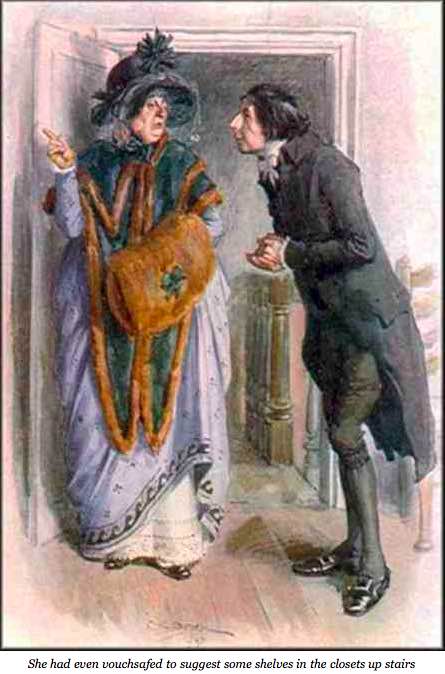
A fortunate chance had recommended him [Mr. Collins] to Lady Catherine de Bourgh when the living of Hunsford was vacant; and the respect which he felt for her high rank, and his veneration for her as his patroness, mingling with a very good opinion of himself, of his authority as a clergyman, and his right as a rector, made him altogether a mixture of pride and obsequiousness, self-importance and humility.—Pride and Prejudice chapter 15

Mr. Collins “venerates” his patron Lady Catherine, who gave him a living as a rector. (C.E. Brock)

A church living was a permanent job as rector or vicar of a parish, and the income, house, and farmland that went along with that.

In a country parish, most of the income came from tithes. People in the parish were legally required to pay the clergyman 10% of their income, which was usually from farming. It might be paid in crops, animals, and eggs, or in cash. During Austen’s time the system was changing over to cash, but many still paid in produce.

The clergyman also sometimes got income from glebe, the farmland that was part of the living. (Austen usually calls this land “meadow.”) And he might get a few pounds a year from the fees people paid for weddings, funerals, etc.

Some parishes in England traditionally had (and still have) a rector. Others traditionally had (and still have) a vicar. Mr. Collins was a rector, like most of Austen’s clergymen. Edward Ferrars is also offered a position as a rector:

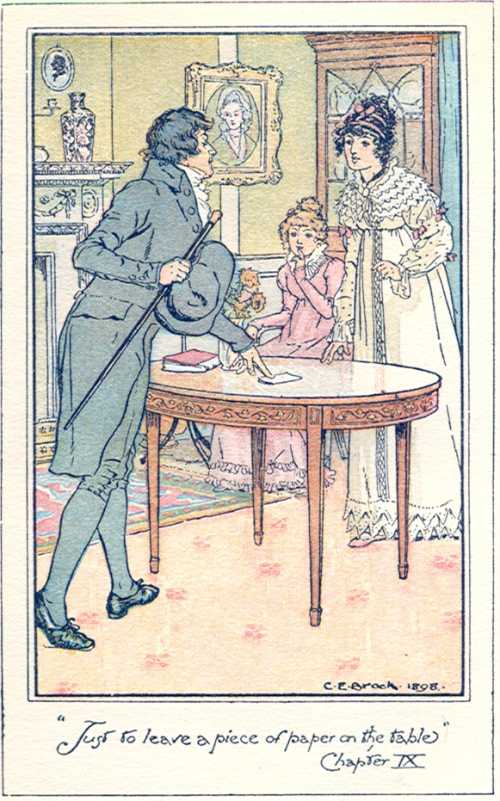
“It is a rectory, but a small one”—Col. Brandon on the church living he is offering Edward Ferrars, Sense and Sensibility chapter 39

Colonel Brandon with Elinor; he gave a living to Edward Ferrars as a parish rector. (C.E. Brock)

The word rectory could mean either a job as a rector, or the rector’s home (also called a parsonage) that was provided with the living. Here it means his position. The word rector, by the way, is related to the words right and rectify. The rector was supposed to lead his parish in the right direction, and he had certain rights, which Mr. Collins is proud of.

Mr. Elton, though, is not a rector. He’s a vicar.

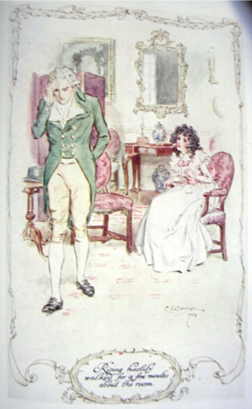
“He [Mr. Elton] had a comfortable home for her [Harriet], and Emma imagined a very sufficient income; for though the vicarage of Highbury was not large, he was known to have some independent property”—Emma chapter 4

Emma does not recognize Mr. Elton’s need for money, thinking he will marry Harriet. (C. E. Brock)

The word vicarage, like the word rectory, could refer to his position or his home; here it means his position. Vicar is related to vicarious, it means standing in the place of someone else.

A rector or a vicar had the same duties. They led church services, preached, officiated at ceremonies like baptisms, met with the vestry to deal with parish issues, helped the poor, and so forth. However, they did not receive the same level of pay.

There were two kinds of tithes. Parishes had their own agreements and definitions about what was included in each. But most commonly:

Greater tithes included everything that came from the ground, like wheat, oats, and barley.

Lesser tithes were usually fruit, eggs, and the young of animals.

If a clergyman was the rector of a parish, he got all the tithes.

If a clergyman was the vicar of a parish, he only got the lesser tithes, usually about a quarter of the total tithes. Someone else, probably the patron, was actually the rector and took the greater tithes.

Farmers brought their tithes of grain and animals to the parish clergyman. From A Clerical Alphabet, Richard Newton, Courtesy of The Lewis Walpole Library, Yale University

So, I think Austen is very intentional when she makes Mr. Elton a vicar. Emma knows that he doesn’t make a lot of money as vicar (“the vicarage . . . was not large”). Austen also gives us another clue:

“Mrs. Bates, the widow of a former vicar of Highbury, was a very old lady . . . She lived with her single daughter in a very small way . . . her [daughter’s] middle of life was devoted to the care of a failing mother, and the endeavour to make a small income go as far as possible.” —Emma chapter 3

Mrs. and Miss Bates, the widow and daughter of the former vicar of Highbury, live in poverty. (C.E. Brock)

Mrs. Bates’s husband, the former vicar, had not made enough money to leave much for his wife and daughter. So the income of this parish, at least for the vicar, is certainly low.

Emma, as usual, is clueless. She doesn’t realize that Mr. Elton, a vicar, is going to need to marry for money (though her readers would have known). So, the fun begins!

The third major type of clergyman was a curate. You can read more about curates in my post Nothing But a Country Curate

Brenda S. Cox blogs on Faith, Science, Joy, and Jane Austen at brendascox.wordpress.com . She is working on a book entitled Fashionable Goodness: Christianity in Jane Austen’s England.

Read Full Post »

In 2021, on the heels of Bridgerton’s success, Netflix announced a new adaptation of Persuasion starring Dakota Johnson as 27-year-old Anne Elliot and Cosmo Jarvis as Captain Wentworth. Henry Golding, given the choice to play either the captain or William Elliot, interestingly chose the latter. Also on board are Richard E. Grant and Suki Waterhouse as, I suppose, Sir Walter Elliot and Elizabeth Elliot, for their roles have not been announced. The other cast members are described at IMBD Persuasion 2022.

Persuasion pulbicity-Netflixfilm

Let these exquisite photos of Dakota Johnson, Cosmo Jarvis (t), and Henry Golding (b) tide you over until PERSUASION, a most excitable new film adaptation of Jane Austen’s novel arrives on Netflix in 2022.- NetflixFilm twitter @NetflixFilm

Netflix is betting on a sure thing. In addition to Bridgerton, now in its second season, the powers that be at Netflix must also have noticed Emma 2020’s draw. Before theaters closed during the pandemic, this film drew huge audiences in its opening weeks and enjoyed a steady stream of online viewers during lock down.

Jane Austen’s final novel was published posthumously in 1818, and by many it is considered her finest. This new adaptation is described as a “modern, witty approach.” We’ll see how well this approach matches Austen’s nuanced novel. Carrie Cracknell, a theater director, directs this film. Like Autumn de Wilde (Emma. 2020), she is a first-time film director. The script was written by Ron Bass (Rain Man) and Alice Victoria Winslow (Hot Spot). 

Filming began in 2021, and a release date is anticipated this year. The film is now in post production. I’m curious to see how this Persuasion stacks up against two previous adaptations, one in 1995 starring Amanda Root, and in 2007 starring Sally Hawkins. Stay tuned for more news as it comes.

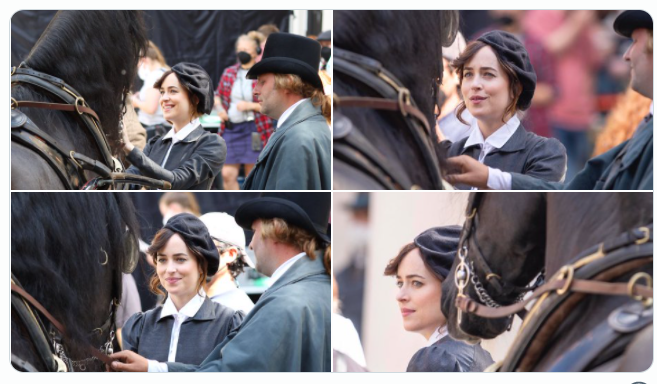
Behind the scenes photos-PhotoWorld Twitter

Behind the scenes photos from Twitter, Period Drama World @WorldPeriod

Review of Persuasion by Tony Grant of the theater production, 2022

“PERSUASION (an adaptation of Jane Austen’s novel by Jeff James and James Yeatman) at The Rose Theatre Kingston upon Thames.”

Marilyn and I went to see Persuasion performed at The Rose on Tuesday 8th March. It may be strange but  for somebody who professes to know a little bit about Jane Austen it is a long time since I had actually read the novel. I have delved deep into Austen’s novels over the years for quotes and to reference her possible thoughts  and ideas about life and love,  but I have failed to read the whole of the novels since I first read them all  years ago.  I have lost sight. I think of what Jane actually wrote. So I read Persuasion again and it wowed me. It is a novel that explores the shifting of society  in the early 19th century when much was changing, not just relationships, but class and the industrial world was taking off. It seems apposite that at the moment when the world order is actually changing that The Rose Theatre chose Persuasion to dramatize. 

I know that novels, good novels, that is, as you read them again over time and  as your own experience of life develops,  reveal  different levels of understanding. So what did I get from reading Austen’s Persuasion this time round before seeing the performance?  The word ,persuasion, is used at times during the novel, but not often. The actual consequences of being persuaded however are felt throughout and drive the novel itself. Anne Elliot was persuaded by not just her father to refuse a  marriage proposal to somebody she really loved  but Lady Russell, the family friend and Anne’s particular friend, was always the deciding factor in the process of persuading  Anne in her youth. Ann seems to have been persuaded into a lot of things in her early life up to the moment of the novel’s action including turning down that offer of marriage from Captain Wentworth eight years previously.   Ann is  annoyingly hyper neurotic. Is that because she has always been pressured by others? Does she feel  she has no control over her life?  

Things happen to Anne. She doesn’t make things happen for herself. She analyses every situation, almost every word and look to an intense degree. She  always comes out worst. In this novel and in the play she eventually learns to decide for herself. So a major theme has to be how we use people’s advice and how much we should be persuaded when making life decisions for ourselves.

Persuasion-program-Image@TonyGrant

Persuasion program. Image taken by Tony Grant. See more of his images in the link at the bottom of this post.

A novel written in the early 19th century  translated into  a play set in the 21st century, surely, it can’t be done. They are two worlds so far apart. How can they possibly come together and meet? There are the wise among us that say Austen is universal in her treatment of relationships. This is true when you drill down to what happens in a  relationship  but all those 18th century rules get in the way to a  translation across centuries, surely? Class status, wealth,  attitudes to money and  the patriarchy  and what seems to us blatant misogyny but wasn’t understood as such in the 18th century, how does it all get transferred to the 21st century? When I read Persuasion again finishing the day before we saw the stage adaptation, I couldn’t see any way that it was possible to achieve that transfer from the 18th century to the 21st century.

To finish the review, continue to read how this production achieved its 21st century point of view and how the comedy was resolved on London Calling, Tony’s blog. Note: Tony Grant is a frequent contributor to this blog. His site covers all things England, past and present.

Read Full Post »

When the world is topsy-turvy and my heart is heavy, many of us find comfort in the beauty of Austen’s novels, in the richness of the movie adaptations, and even in the thought of the lovely Hampshire countryside, secluded and beautiful, tucked away and secure.

The world inside Austen’s novels never changes. The familiar scenes and characters are always there and waiting. Elizabeth and Darcy never fail to spar and flirt in the drawing room in Pride and Prejudice. Mr. Woodhouse continues to eat his porridge and worry comfortably over the weather in Emma. And at the end of Persuasion, Captain Wentworth always sits down to write his letter to Anne Elliot.

Perhaps that’s why many of us (and why so many others throughout history) have found solace and comfort within the pages of Austen’s novels, especially during times of turmoil. And why her novels have been reprinted and translated and enjoyed around the world by so many people for over 200 years.

Familiar Faces

I find similar comfort in the film adaptations. When I sit down to watch a Jane Austen movie (or even have one playing in the background as I do chores), I love knowing just what to expect. I can’t wait to hear the music I love, listen to the accents and voices of characters and actors I adore, and watch the ever-amusing (and always touching) storylines unfold.

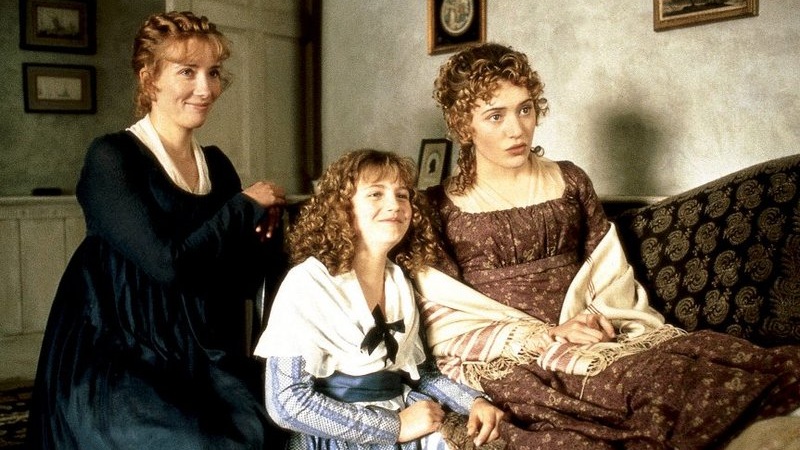
Sense and Sensibility, 1995.
Pride and Prejudice, 1995.
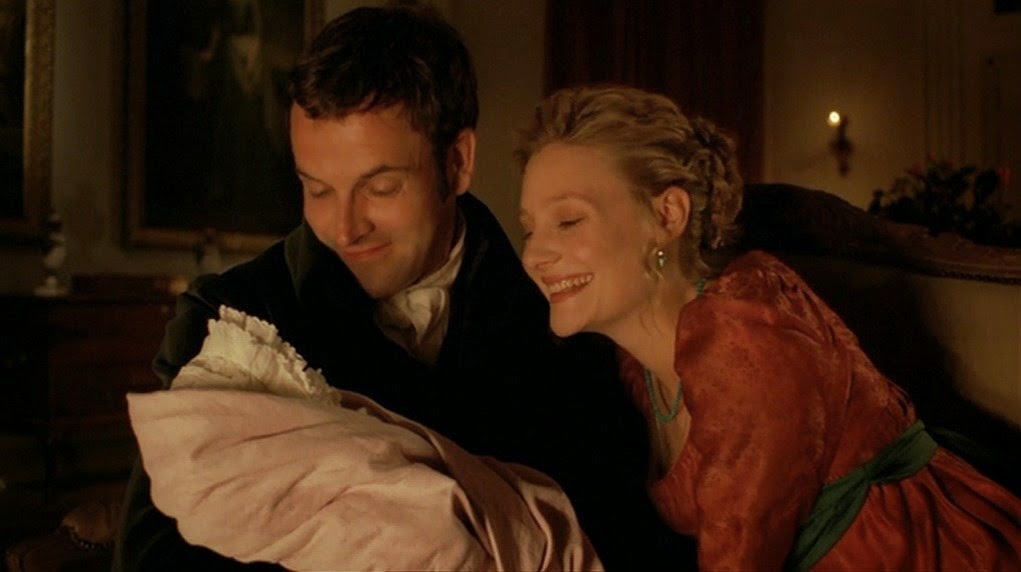
Emma, 2009.

The comfort and familiarity of Austen movies keeps us coming back for more, year after year. There are always new adaptations to enjoy and critique (because there’s nothing better than debating this Emma over that Emma with Austen friends).

Familiar Sights

And then there’s the comfort of Jane Austen’s actual world. Although I know Hampshire is a real place with its own fair share of regular, everyday life activities and stormy days, both figurative and literal (such as when Storm Eunice brought down many trees on the Chawton estate and in Mingledown Woods just last month), the England described in Austen’s novels never fades.

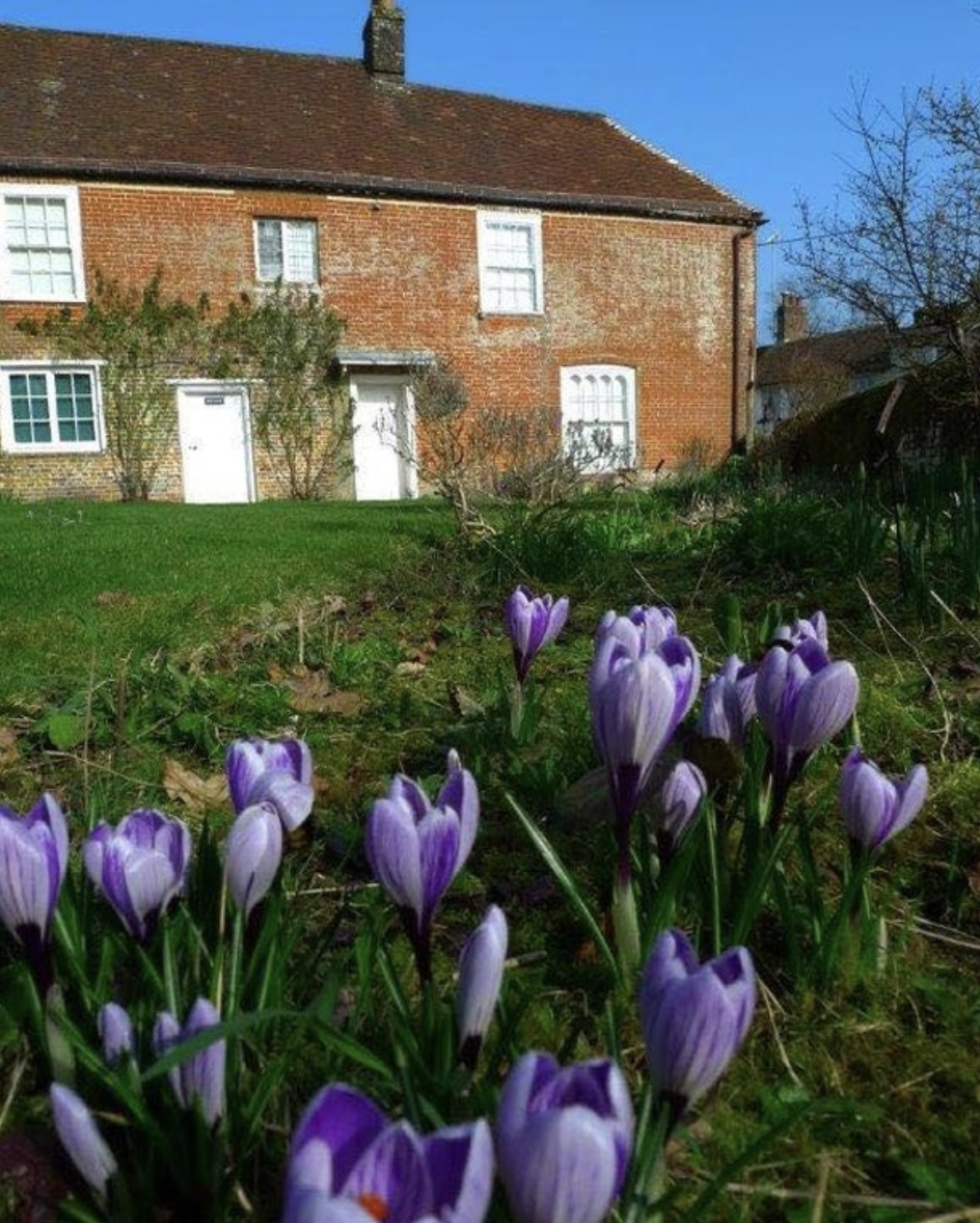
Jane Austen’s House Museum, 2022.

I think the charm of the setting in her books is another reason so many of us as lifelong students and fans of Austen love to learn about her life, her family, and the places where she lived and wrote. During the height of the pandemic, we all did what we could to support the historic sites in England and watched for updates whenever possible. We dreamed of the day when we might get to visit those precious sites again or for the first time. Many of us even took virtual tours so we could “be” there.

Benches Along the Way

That’s probably why I was so overjoyed when I saw the good news a few weeks ago that the bench my local JASNA regional group sponsored had been installed in the Chawton House Gardens. In fact, the entire bench project fundraising is now complete! (I know many of you have contributed in various ways to the care and keeping of the historic sites as well.) Here is a snippet of the announcement:

“This month, we are pleased to announce that thanks to the wonderful support of the North American Friends of Chawton House (NAFCH), we have received the final 17 benches donated through the ‘Share a Bench with Jane’ scheme, just in time for our Spring Flowers season.

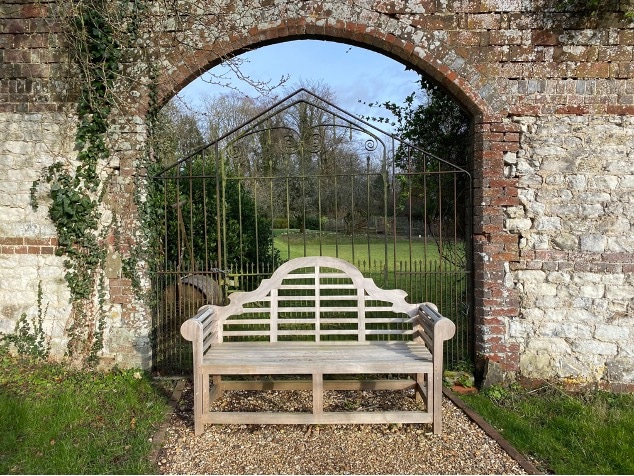
Photo: Chawton House. Bench, 2022.
Location 22: at the head of the Pride and Prejudice Rose Walk.

If you’d like to see all of the bench locations, you can find them HERE.

As I read through the announcement and looked through the photos, I was comforted. I thought about how peaceful it would be to sit on a bench and enjoy the garden around me. I even thought about how I should install a bench in my own small garden area.

And then I came to this lovely quote that was included in the announcement from Chawton House:

Although the recent storms have caused significant damage to parts of the estate, these latest additions mean that visitors to Chawton House will still be able to rest among the spectacular displays of snowdrops and daffodils as we move into a warmer season.”

Isn’t that an encouraging thought? I made me think. Though storms come in this life, there are benches along the way where we can rest. When the journey is long, it’s important to stop and sit. And though some winter seasons are particularly difficult, spring always comes and bright new flowers always bloom.

Signs of Spring

I’ll leave you with that lovely thought and a few photos of the “snowdrops and daffodils” mentioned above. I hope that each of you is finding comfort in the glimpses of beauty around you, in friends and family, in faith and home, in lending a helping hand to others when you can, and in the enjoyment of Jane Austen.

Photo: Chawton House. Snowdrops, 2022.
Photo: Chawton House. Daffodils, 2022.
Photo: Chawton House. Daffodils and Snowdrops, 2022.

Your turn: What is it about Jane Austen’s novels and life that brings you comfort? Why do you think people continue to turn to her work in life’s difficult seasons?


RACHEL DODGE teaches college English classes, gives talks at libraries, teas, and book clubs, and writes for Jane Austen’s World blog and Jane Austen’s Regency World magazine. She is the bestselling author of The Anne of Green Gables Devotional: A Chapter-By-Chapter Companion for Kindred Spirits and Praying with Jane: 31 Days Through the Prayers of Jane Austen. Her newest book The Little Women Devotional just released and is available now! You can visit Rachel online at www.RachelDodge.com.

Read Full Post »

Introduction

Inquiring readers: This is the first of a post on the subject of the upward mobility for two upper servant positions. Part One examines the duties of the lady’s maid, and her motivation for continuing in a position that was hard and demanding, and that required her to be loyal and subservient to her mistresses’ whims and wishes from early morning to late at night, and at times past her usual long hours.

Through her visits to grand houses, such as Godmersham Park, Jane Austen became familiar with the lives of ladies maids and housekeepers. These two positions belonged to the class of upper female servants, but even with their “status” and the deference they received from the lower servants their service required long work hours and extensive knowledge of and years of training in their respective duties and situations. Their hours were determined by the requirements of the lady of the house and her social schedule  (although, in the instance of the housekeeper, the master of the house might also have a great say, especially if he was unmarried, like Mr. Darcy or Mr. Knightley.)
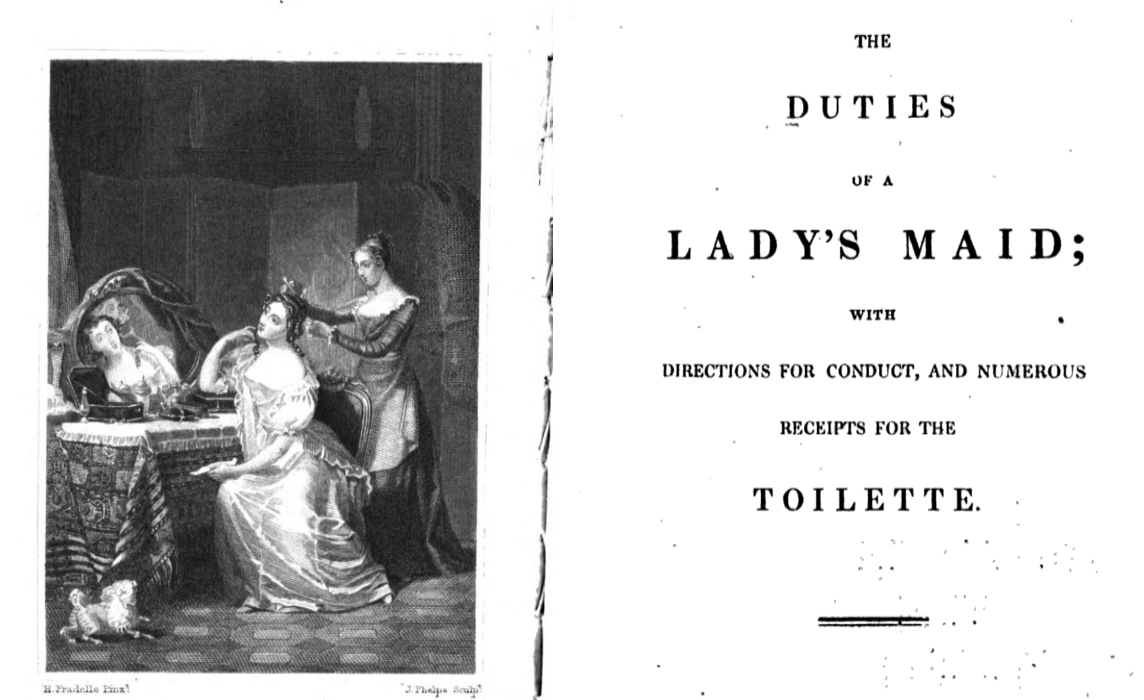
Fronticepiece2

Fronticepiece, The Duties of a Lady’s Maid, 1825, public domain. Image 1

The Lady’s Maid

According to The Woman’s Domain, the position of the lady’s maid was one of the best in the female hierarchy of servants. Most of her day was spent above stairs working in her lady’s dressing room. She frequently accompanied her lady on travels and visits, a privilege not accorded to many. In public, she was expected to dress fashionably in clothes that were tasteful but not as fine as her mistress’s. Better yet, she was chosen by her mistress and employed directly by her.

The Complete Servant (1825) mentions that the “business of the lady’s maid is extremely simple, and but little varied.” The book’s authors describe the lady’s maid’s duties:

  • She is generally to be near the person of her lady ; 
  • and to be properly qualified for her situation, her education should be superior to that of the ordinary class of females, particularly in needle work, and the useful and ornamental branches of female acquirements.
  • To be peculiarly neat and clean in her person and dress is better than to be tawdry or attractive, as intrinsic merit is a much greater recommendation than extrinsic appearance. 
  • In her temper she should be cheerful and submissive, studying her lady’s disposition.
  • It will be her business to dress, re-dress , and undress her lady; and, in this, she should learn to be perfectly au fait and expeditious, ever studying, so far as it depends on herself, to manifest good taste, by suiting the ornaments and decoration of her dress to the complexion, habits, age , and general appearance of her person . (p237)

The image below lists the skills that a lady’s maid is expected to possess. 
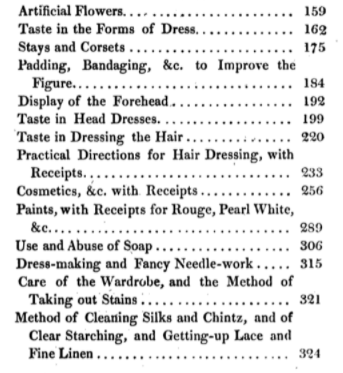
contents2

Duties of a Lady’s Maid, 1825, Public Domain. Image 2

A lady’s maid had no set work hours. Her attention was devoted to her mistress’s comforts and whims. This left her with little time to devote to her family or to visit them. Her schedule was erratic and changed  at the last minute to accommodate unexpected house guests and family trips or travels. She was also expected to attend to her mistress after a  late night return from a ball or visit. During the day she accompanied her mistress while shopping or walking. In this capacity, and while traveling by her mistress’s side, she was expected to behave and dress appropriately, but never to wear clothes more fashionable  than her employer. 

The following image lists the behavior a mistress expects from her lady’s maid, which are described in detail in The Duties of a Lady’s Maid.
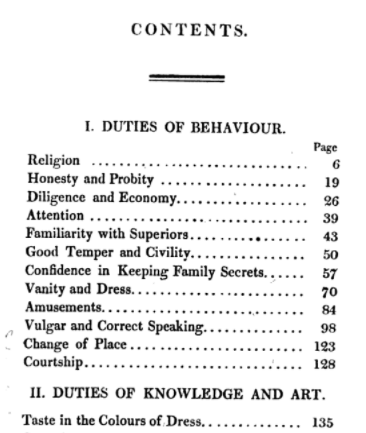
Contents 1

Duties of Behavior of a Lady’s Maid, 1825. Image 3.

In between caring for her mistress, she was expected to mend her clothes, remove spots, iron, and make poultices, lotions, and cosmetics. She was also a hairdresser, dresser, cosmetician, cleaner, supervisor of lesser servants, seamstress, and companion all rolled into one. In other words, she had no free time except for the few days and hours a month allotted to her. 

The Day of a Lady’s Maid

The Complete Servant lists the lady’s maid’s exhaustive duties:

Morning

  • Her first business, in the morning , will be to see that the housemaid has made the fire , and properly prepared her lady’s dressing room: -she then calls her mistress, informs her of the hour, and having laid out all her clothes, and carried her hot water, to wash, she retires to her breakfast with the housekeeper and other principal servants.
  • When her lady’s bell rings, she attends her in her dressing  room – combs her hair for the morning, and waits on her till dressed; after which, she folds and puts away her night clothes , cleans her combs and brushes  and adjusts her toilet table.

Noon/Afternoon

  • About one o’clock the family generally take their lunch, and the servants their dinner.– After this, she is again summoned to attend her lady’s toilet whilst dressing to go abroad.
  • It is her business to see that the house maid, or chambermaid, empties the slops, keeps up the fires , both in this and the bedroom, ( if wanted ) and keeps the rooms in perfect order .

Evening

  • Previous to her mistress ‘ retiring for the night , she will have looked out her night clothes, and aired them well; and she will not only now, but at all times when she goes to dress, carry up hot water, for washing, etc. and when she is gone to bed, she will carefully examine all her clothes, and do all that is necessary to be done to them , before she folds them away. If her lady be elderly, infirm, or unwell, she will sometimes be required to bring her work, and sit with her, to adminis ter her medicines , and sometimes to read to her. 
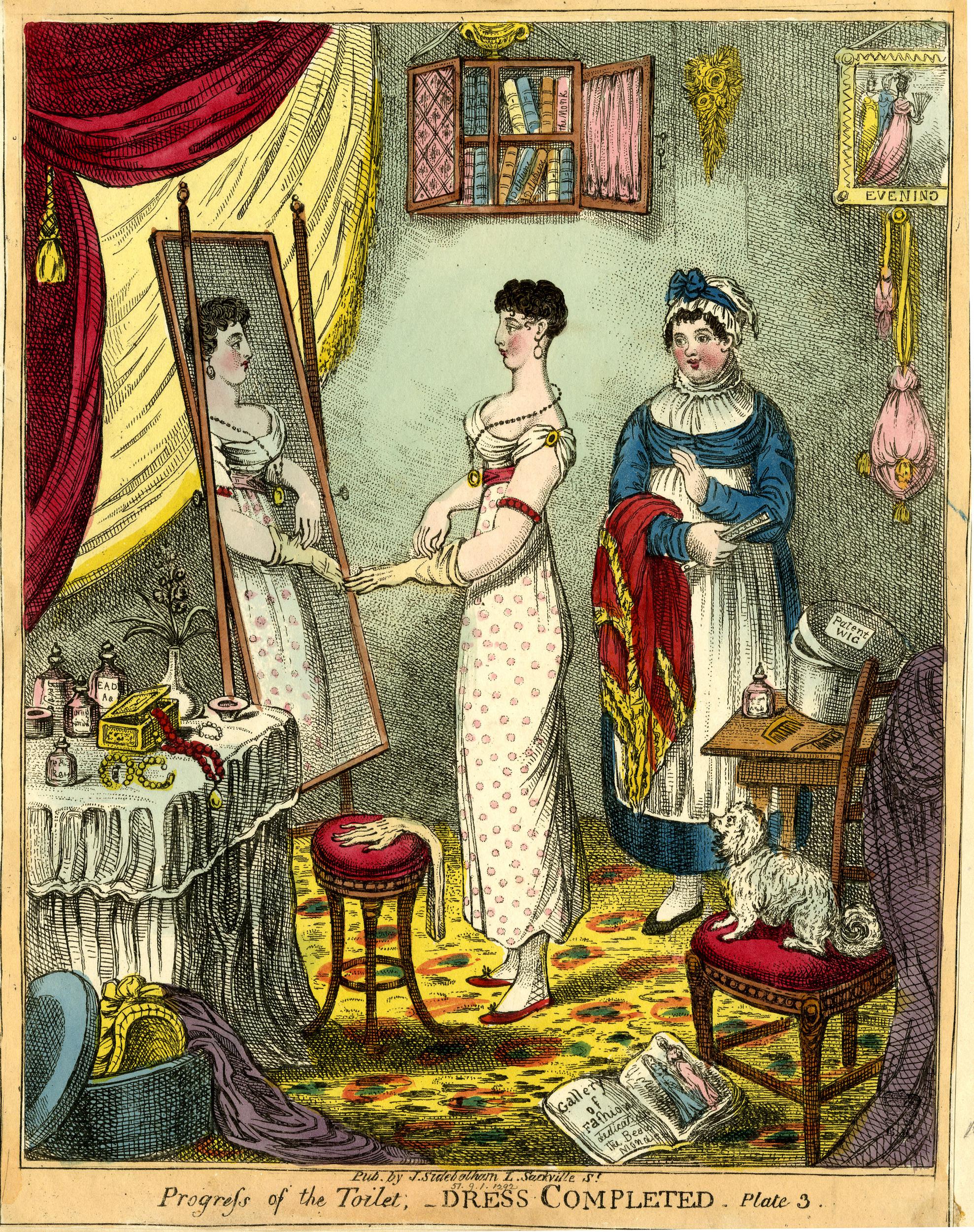
Progress of the Toilet Dress Completed Gillray 1810-British Museum

Progress of the Toilet, Plate 3, Dress Completed, James Gillray. Crude copy, 1810. British Museum. Image 4.

During a Lady’s Maid’s “Free Time”

  • In the absence of the housekeeper, she will be required to make tea and coffee for the drawing room company. 
  • At her leisure, practise reading aloud, from the best author; as it is important to acquire a proper style and manner of reading, in all the varieties of poetry or prose, ode or epistle, comedy, or sermon; avoiding, alike, the dull monotony of the school girl, and the formal affectation of the pedant, but following nature as her guide, in all that appertains to emphasis, modulation, and delivery.
  • If acquainted with the superior branches of needle work, she might afford her lady much gratification, in presenting her, occasionally, with such trifles as will be acceptable, and suitable ornaments for her person This will evince her disposition to be grateful and to oblige; and this, combined with a feminine sweetness of temper, and suavity of manners, cannot fail to be her sure recommendation to the esteem of her superiors and others, through all the various circumstances of life. 
  • She lays out and prepares the several articles that may be required for her dinner, or evening dress, and afterwards employs her self at needle work in her own room, or in her other avocations, till her mistress returns to dress for dinner, perhaps about five, when she attends her for that purpose; and having done this, it may happen that no further attendance on her mistress’s person will be required till she retires to bed: meanwhile she employs herself at needle work, as in the morning * more else in the various occupations of getting up the fine linen, gauzes, muslins, cambrics, laces, & washing silk stockings, taking the spots or stains out of silks, [text?] … for doing which the best receipts are annexed . 
  • It is her business to see that the house maid, or chambermaid, empties the slops, keeps up the fires, both in this and the bedroom, ( if wanted ) and keeps the rooms in perfect order .
  • Previous to her mistress’s  retiring for the night, she will have looked out her night clothes, and aired them well; and she will not only do (?), but at all times when she goes to dress, carry up hot water, for washing, & c. and when she is gone to bed, she will carefully examine all her clothes, and do all that is necessary to be done to them, before she folds them away. 
  • If her lady be elderly, infirm, or unwell, she will sometimes be required to bring her work, and sit with her, to administer her medicines, and sometimes to read to her. To qualify herself for this latter purpose, and to acquit herself with propriety

After years of service, she hoped that her loyal and attentive companionship would be rewarded by her mistress or the family in her old age. Sadly, this was not always the case if a widowed husband remarried or a son with his own wife inherited the estate. One would imagine that in Sense and Sensibility Mrs. John Dashwood would bring her own lady’s maid in place of the widow Dashwood’s loyal maid servant. 

A Female Servant’s Attraction to the Job of Lady’s Maid

In the early 19th century servant turnover was already surprisingly high. (This trend became more worrisome as the century wore on.) Those who remained with a household did so for job security, They might not have had other prospects for employment, or they might have moved to better employment. Some stayed for the chance of advancement; or in the hope for a pension after years of loyal service; or, as with a lady’s maid, for a chance to travel beyond her local parish or county. In those days a majority of the working poor or lower working classes lived and worked within walking distances of their villages or homes and rarely ventured beyond that during their lifetime, although there were exceptions.

The working lives of lower servants were not easy. They slept in cramped attic rooms that they shared and that were cold in winter and hot in summer. Many toiled in damp basements throughout the day, and carried heavy buckets of water to heat for food, laundering clothes, or bathing.

No wonder upper servants – land stewarts, butlers, and valets on the male side, and cooks, lady’s maids, and housekeepers on the woman’s side – were positions preferred by those who sought employment. These occupations came with the perks of private rooms and status in the servant hierarchy. Servants who worked under them deferred to their wishes, since few from the lower order spoke to the master or mistress of the house.

Upper servants took years to acquire the necessary skills for their positions, which took years of patience and planning. This personal investment was worth the wait … IF an upward bound position opened.  A century later, Barrow and Molesley in Downton Abbey experienced the travails of thinking they had achieved their goals, only to lose their positions and settle for situations lower down again. 

The Education of Sarah Neal, Whose Ambition Was to be a Lady’s Maid

The road Sarah Neall took to becoming a lady’s maid is described in The Woman’s Domain by Lumis and March. Sarah embarked on her ambitious journey as early as the age of eight. Her father, an innkeeper, sent her to a small private day school for girls in Chichester – which was named Miss Riley’s – to start her on her journey. There she  learned reading, writing, and arithmetic. Her instruction included scripture, a general knowledge of geography, the counties of England, names and dates of kings and queens, and a smattering of classical culture. Mr. Neal, a working class gent, could not afford French instruction, which was a desirable skill, but he had the means to give her a start that no laborer or unskilled worker could have afforded for their daughters. In her early years Sarah learned the foundational skills that sent her in the direction of achieving her ambitions. Miss Riley’s school and schools like hers were  a common pathway for working class girls to learn the rudiments required for an upper servant position

After attending Miss Riley’s, Sarah apprenticed to a dressmaker for four years where she honed her skills in dressmaking. She also took lessons in hairdressing and millinery. Eventually, Sarah landed a job as one of two young lady’s maids at Uppark, a 17th-century house in South Harting in West Sussex. She was the younger of the two maids, where she hoped for a possible advancement to housekeeper. In her position as lady’s maid, she kept a diary about the places she visited, which documented events but not her thoughts nor descriptions about her employers. Sarah left her position when her mother’s poor health required her to attend to her needs. (More about Sarah in Part 2 of this three part series.)
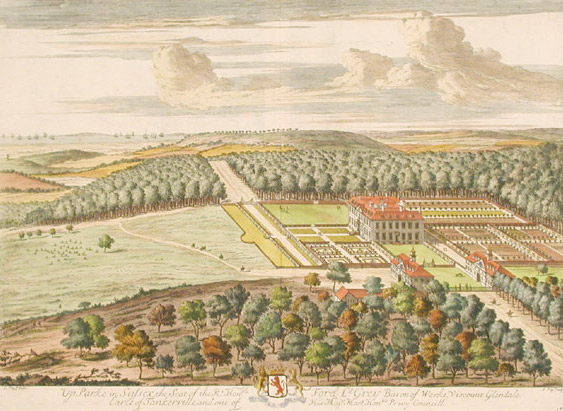
Uppark_Kip-early 18th C-Wiki

Uppark, early 18th c. This is a bird’s eye view of Uppark and its lands by Jan Kip. Wikipedia, creative commons image. Image 6.

Jane Austen in Pride and Prejudice mentions the Bennet servants at Longbourn: They were a butler, Mrs Hill, and two house maids. Very little is known about each, but Mrs. Bennet required Mrs. Hill’s services several times when she was needed, notably when Mr. Collins announced his visit. The two house maids in Pride and Prejudice dressed and cared for six women, as well as tended to the household duties along with Mrs. Hill. One only can imagine their chores. Lydia and Kitty’s requirements must have been quite a task compared to Mary’s, Elizabeth’s, and Jane’s demands, which I surmise were more restrained. Austen never described those interactions in detail, and so we can only guess.

In Longbourn, Jo Baker the author, weaves a story about Mr. Hill, the butler; Mrs Hill, the housekeeper and his wife; Sarah (16) and Polly (11,) the two house maids; and James Smith, a mysterious man of all work. Baker discussed the two young maids and their duties at length, and I wondered if she fashioned young Sarah after Sarah Neal, so aptly described in the Woman’s Domain and by her son, H.G. Wells in his autobiography (which is why we know so much about her). 

The Perks of Being a Lady’s Maid

As mentioned before, the lady’s maid spent the majority of her day above stairs in comfortable and often luxurious surroundings, ready to change her mistress’s dress or to rearrange her hair for an evening out at a moment’s notice. She received a major perk that other upper servants did not – her mistress’s old clothes that were out of fashion. It was important that she look presentable when accompanying her lady on walks, visits, or out of town trips. She could not under any circumstance outshine her employer. For extra money she had the freedom to sell her second-hand gifts or refurbish them. The travel, the visits to grand houses, her companionship with her lady when she read to her or listened to her confidences – all these were hers in exchange for loyalty, sacrifice from seeing her family freely, and for being discreet.
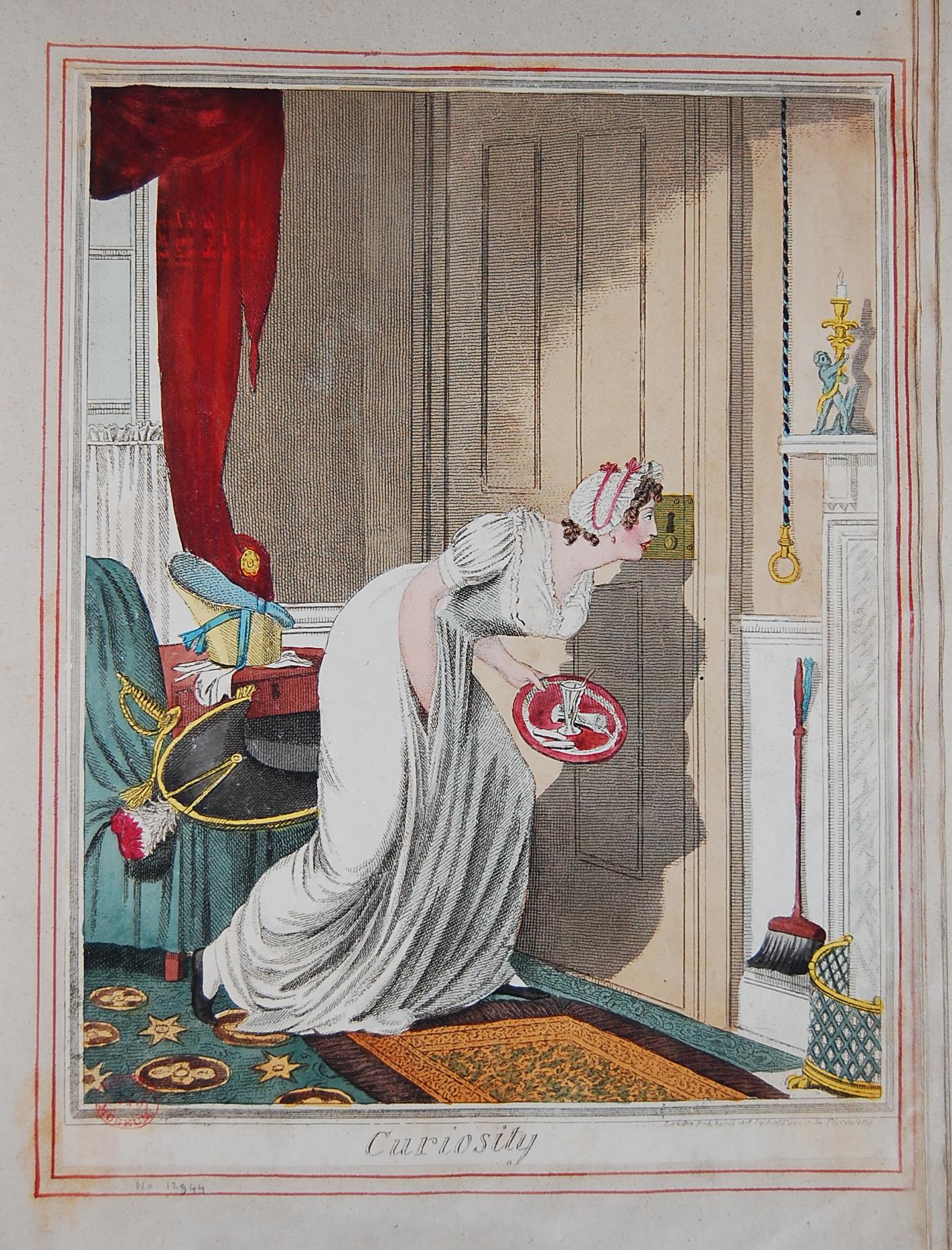
Curiosity-Ladys-Maid-British-Museum

Satirical print of a Lady’s Maid, British Museum, entitled Curiosity, Charles William, 1817.

Description (British Museum): A pretty lady’s maid stoops in profile to the right to gaze with prurient eagerness through a key-hole. She holds a salver with her left hand, letting two jelly-glasses slide off it, while her other hand is beneath her dress. A lady’s bonnet and gloves and a cocked hat and sword, carelessly laid down, show the object of her curiosity. She wears a graceful white gown and a lace cap over her curled hair. April 1817. Etching with hand-colouring.

For the reader: Think about this image re: the Lady’s Maid as discussed in this post: Knowing what is expected of the lady’s maid and her conduct, what about this image disturbs you? What in the details do you see related to her work and attire? What is the satire? Feel free to place your thought in your comment.

The Young Lady’s Maid 

Lastly, this post addresses the young lady’s maids who are hired in large families to wait on a group of young ladies or one in particular. (Recall that Sarah began her career when she was 18 or 19.) Recall Mr. Darcy’s young sister, Georgiana. He felt responsible towards her and probably made sure she was “protected” when his schedule and social activities took him away from Pemberley. The duties of her young lady’s maid were to cater to her personal needs and comfort, to be her companion during outings, and to read to her or converse with her during private periods. This young lady’s maid’s duties were similar to her more mature counterparts, and she would be expected to follow similar directions and instructions to serve her young mistress.

Her situation was considered initiatory to a better trajectory in life. A more mature upper servant in the household would provide oversight. In young Miss Darcy’s instance, this would most likely be the housekeeper. Successful young lady’s maids grew up with their mistresses and stayed with them for years, achieving a deep affection and close friendship for one another. These young charges as they matured often knew their ladies better than their own families. 

Next post in this series: Part Two: Lady’s Maid to Housekeeper and Her Responsibilities.

Resources:

Original Sources:

The Complete Servant; Being a Practical Guide to the Peculiar Duties and Business of All Descriptions of Servants, FROM THB HOUSEKEEPER TO THE SERVANT OP ALL WORK , AND FROM THE LAND STEWARD TO THE BOOT – BOY ; WITH USEFUL RECIPES AND TABLES , BY SAMUEL AND SARAH ADAMS , Fifty years Servants in different Families . LONDON : PUBLISHED BY KNIGHT AND LACEY , PUBLISHERS OF BOOKS CONNECTED WITH THE USEFUL ARTS , at the James Watt , in Paternoster – Row . MDCCCXxv (1825).  Price Seven Shillings and Sixpence. From The Pennsylvania State University Libraries. Free google play book.

The Duties of a Lady’s Maid; With Directions for Conduct and Numerous Receipts for the Toilette, LONDON : PRINTED FOR JAMES BULCOCK , 163 , STRAND . 1825 . Free Google play book, downloaded 1-11-2022. 

Wells, H.G.,  Experiment in Autobiography: Discoveries and Conclusions of a Very Ordinary Brain (Since 1866). 1934, Project Gutenberg Canada ebook #539, where this book is in the public domain with restrictions. Link to the book: Downloaded 1-14-2022.

Sources:

Lummis, T.& March, J. in association with The National Trust, The Woman’s Domain: Women and the English Country House (1993 2nd Ed.) Penguin Books, England.221 pp.

Meade-Featherstonhaugh, M. & Warner, O. Uppark and Its People (1995, 2nd ed) The National Trust, London.

Pool, D. What Jane Austen Ate and Charles Dickens Knew: From Fox Hunting to Whist – the Facts of Daily Life in 19th-Century England. 1993. Touchstone, Simon & Schuster, NY.

Servants in Regency England: Fall 2016 Adapting Jane Austen, A Xavier University First Year Seminar

Images:

Image 1: Fronticepiece, The Duties of a Lady’s Maid, 1825, Public Domain.

Image 2: Duties of a Lady’s Maid, 1825, Public Domain.

Image 3: Duties of Behavior of a Lady’s Maid, 1825, Public Domain.

Image 4: The Progress of the Toilet, Dress Completed, Plate 3, 1810. Gillray, British Museum

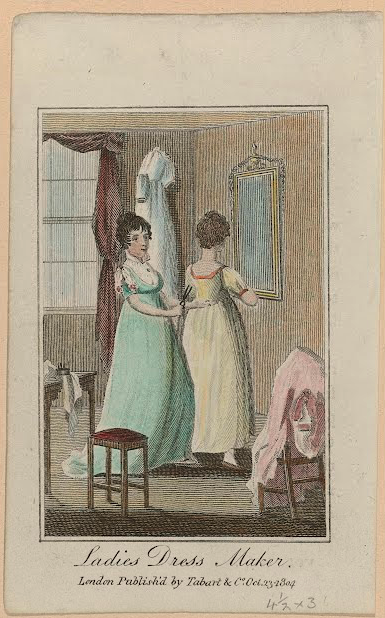
Image 5: The Dressmaker, Book of Trades, 1804, Rijks Museum, anonymous. Click on the title.

Image 6: Uppark, early 18th c. This is a bird’s eye view of Uppark and its lands by Jan Kip. Wikipedia, creative commons image.

Image 7: Satirical print of a Lady’s Maid, British Museum, entitled Curiosity, Charles William, 1817.

Read Full Post »

« Newer Posts - Older Posts »