This Jane Austen blog brings Jane Austen, her novels, and the Regency Period alive through food, dress, social customs, and other 19th C. historical details related to this topic.
Kevin Lindsey, who frequently comments to posts on this blog, forwarded the link to this 5-minute YouTube video. He writes:
As a long time subscriber to your blog, I thought you might be interested in this. It’s from a British group called Crows Eye Production. They create excellent, tasteful, and informative videos on historical clothing. They released this one on Jane & Cassandra Austen today. I thought it really well done, and thought I would share it with you, in case you wanted to pass it along. Below is a link. If you would prefer not to use that just got to YouTube and look up “CrowsEyeProductions”
Last April Brenda Cox shared a thought-provoking post about a Jane Austen Sampler. Click here to read the article. Mrs. Cox writes that Deirdre Le Faye, an expert on Jane Austen, believes that the stitcher was another Jane Austen, probably a second cousin of the author of ‘Pride and Prejudice.’
Mrs. Cox has continued her research into this fascinating topic, and writes:
A few years ago, I bought a printed copy of the “Jane Austen sampler” at the Jane Austen Centre in Bath. In 2018 I posted thoughts on my blog about that “Jane Austen Sampler.” However, I had no idea whether “our” Jane Austen had stitched it or not.
Then Deirdre Le Faye saw that post and directed me to her article for the Jane Austen Society. She speculated, for various reasons, that the sampler may have been done by a cousin of Jane Austen’s. In 2019 I wrote about her ideas in Jane Austen’s World. At the end of that article I asked if some genealogist might try to track down the history of the sampler.
Now the plot continues to thicken. Months later, Alden O’Brien, curator of the DAR Museum in Washington, D.C. saw those posts and wrote to me for details. She then did extensive research based on her specialties: the history of needlework and genealogical research. Exactly what we needed!
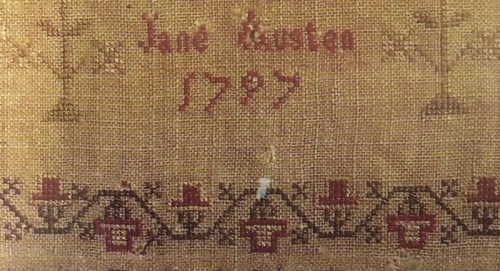
For it to be “our” Jane Austen’s sampler, we need to assume that it originally said 1787 and stitches were pulled out to make it say 1797. Deirdre Le Faye thought this was highly unlikely. Alden O’Brien thinks it even more unlikely. From the photos we have (which admittedly are not great), there is no evidence in the fabric that stitches were removed. And O’Brien compared it to Cassandra Austen’s sampler which includes all the numbers. Presumably the sisters would have been using the same style of numbers. The “9” in the “Jane Austen sampler” looks much like Cassandra’s 9, but not completed. Cassandra’s 8 is a different shape, so it’s unlikely that the original said 1787.
Even more conclusively, O’Brien was able to trace the provenance given for the sampler. She found clear records from the sampler’s previous owners back to a Jane Austen who would have been about 12-14 in 1797, the right age for making such a sampler. It appears that this Jane grew up to marry the owner of a pub. One of her sons was a servant, and her daughter married an oyster fisherman. So she was from a lower social class than the author Jane Austen. O’Brien points out that even young women of this class often went to schools where they might produce samplers like this one.
The Mr. Frederick Nicholls of Whitstable who once owned the sampler is claimed to be “a grandson of a cousin of Jane Austen.” However, from this evidence, it appears he actually was a grandson of this (alternate) Jane Austen.
So, the bad news is that the sampler almost certainly was not sewn by the author Jane Austen. Still, it did come from her time period. And unraveling the mystery has been a story in itself!
After experiencing years of an Austen drought on the large and small screen, we are treated to two adaptations within a half year–Sanditon and the newly released Emma.
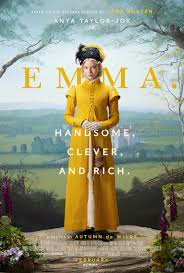
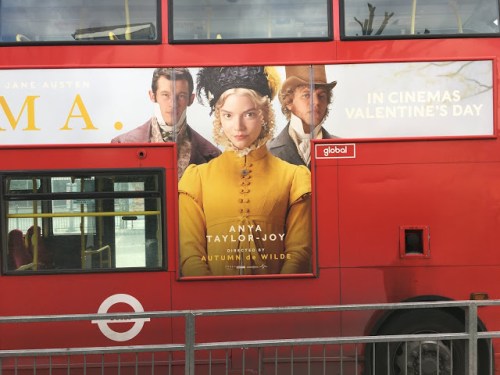
Emma film poster on a London bus. Photo courtesy of Tony Grant
Emma, the film will air in theaters in my region on March 6th. Sadly, I won’t see the film until late next week, but my British friend Tony Grant has reviewed it. He writes in part:
My thoughts were, will Autumn de Wilde’s Emma get Austen’s subtleties concerning the different relationships right? Will the actors be any good? All is lost if they can’t cut the mustard. What might we get out of this Emma that speaks to us in 2020? Will the film tell Jane Austen’s story well?
The film begins, focusing in from an expansive bucolic scene of green pastures and wooded areas to an iconic 18thcentury mansion, Hartfield. We hone down to a gothic styled greenhouse and enter to a scene of peace and calm and meditative background music as Emma, played by Anya Taylor Joy, slowly, carefully moves, almost like floating in a dream, examining her blooming red roses while servant girls hover, secateurs poised ready to snip the stem of any flower Emma thinks fit. Anya Taylor’s eyes look and roam and pierce us to our souls. Oh! those eyes. She pauses, she considers, she moves on and decides, “That one.” And the flower is cut. This opening scene is very clever and says in this silent dreamlike ballet of a scene all that Austen says in the opening words of her novel.
Emma Woodhouse, handsome, clever and rich, with a comfortable home and happy disposition, seemed to unite some of the best blessings of existence; and had lived nearly twenty one years in the world with very little to distress or vex her.”
The film is lit brightly and the colours, not just of the costumes, but of the scenery too has a pale pastel sheen, which can only be achieved through the cinematography.–-To read the rest of Tony Grant’s review, click this link to London Calling, his blog.
In anticipation of seeing the film, I’ve been reading Robert Rodi’s take on Emma in Bitch in a Bonnet: Reclaiming Jane Austen from the stiffs, the snobs, the simps and the saps. (Yes, he’s that sarcastic, but witty, wise, and fun.) I particularly liked this passage, which shows Emma’s animus towards Augusta Elton shortly after she paid Mr. Elton and his new missus a visit:
Eventually Mrs. Elton return the visit, and Emma has plenty of time for her options to coalesce. And she really, really, really does not like this chick. Not. One. Little. Bit.
Rodi then goes on to quote this Austen passage:
“The quarter of an hour quite convinced her that Mrs. Elton was a vain woman, extremely well satisfied with herself, and thinking much of her own importance; that she want to shine and be very superior…”
Rodi does not stop there, but I paused at these words for a long moment. The qualities Emma dislikes about Mrs. Elton are the same qualities she possesses. Augusta, of course is different from Emma. She’s coarse, grasping, and aggressively power hungry, whereas Emma is the well-bred young lady described in the movie’s publicity: a well meaning but selfish young woman [who] meddles in the love lives of her friends.
The comic characters in Emma are among Austen’s finest, and I look forward in revisiting them in this film, especially in the forms of Miranda Hart as Miss Bates and Bill Nighy as Mr. Woodhouse.
This slideshow requires JavaScript.
Although I won’t see the film for some time, please feel free to leave your opinions if you have them.
Meanwhile, enjoy Tony Grant’s review at the top of this blog!
Chris Brindle, who lives in Colchester, England, is a prolific writer of music and books, and also a producer. Chris has written the following post (a compilation of information on his website and from the emails & materials he sent me.) He postulates that as Austen was dying in 1817, she deliberately wrote ‘Sanditon’ as a challenge and inspiration for other people in her family to finish, particularly her niece Anna (Lefroy) and nephew James-Edward (Austen-Leigh). Here, then, is Chris’s article.
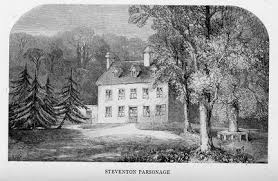
Steventon Rectory. Image Wikimedia Commons
Sanditon was Jane Austen’s last, partially completed, novel of around 24,000 words, written in 1817 between January 27th and March 18th. Jane’s niece Anna, the daughter of Jane’s eldest brother James, had been brought up in her youngest years at Steventon where her aunt, who was 18 years older, also lived. Anna remained at Steventon with her father until she married Ben Lefroy at 21. After a brief interlude, Anna moved back to Hampshire to live two miles away from Jane, then living at Chawton.
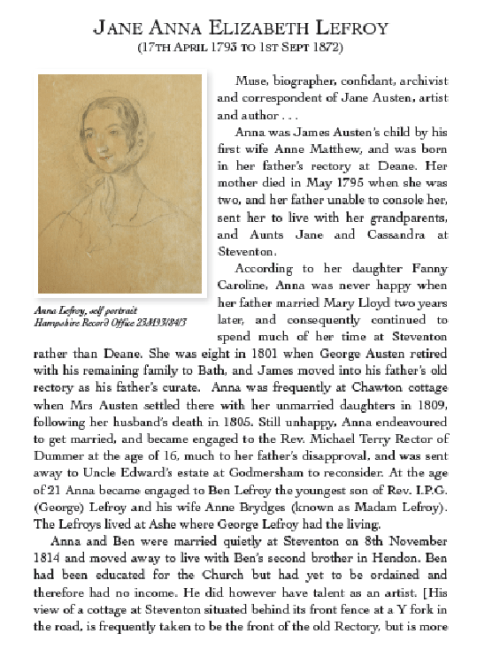
Jane Lefroy’s biography pages by Chris Brindle in his book Hampshire, Vol 2, pp. 72-73. Image courtesy of Chris Brindle. His book is available via Amazon.
Anna was surely the first ‘Janeite’ and harboured a life-long ambition to emulate and honour her aunt. In March 1845 she inherited Jane’s manuscript in the will of Jane’s sister Cassandra, and set about writing her continuation [of the unfinished novel], which is of similar length and is similarly unfinished.
By the time Austen put down her pen and finally her pencil, she had introduced all the characters that the story needed—apart maybe for a good villain, as Lefroy realised in her continuation, when she invented Mr Tracy as one of Sidney Parker’s friends (friends Austen told us would join Sidney at the Hotel). I don’t believe Austen intended Sir Edward Denham to be a villain, rather just a sexually frustrated character answering to Lady Denham’s will, who, as dowager, controlled Sir Edward’s estate.
When Austen realised she was dying, I believe she worked out a way in which her books and letters would not die with her, but would live on as the next generation took up the baton as her literary heirs. Her book and letters were her children and she wanted them to live forever.
This is the lyric in my ‘Song For Jane Austen’–YouTube link
When did you realise that your life would soon come to its end ?
Did you always know your life would be so short ?
What is a life, what is it worth ?
Is it what you leave behind you at the end ?
Your books and letters were your children
Left to others to inspire, and maybe carry on your work
Do you die if a little bit of you will live in others ?
Or memories of you will still remain ?
How do you spend your last few moments on this earth
When your journey has to come to its end
One last display of brilliance in three tiny booklets
Your sketches on a canvas for others to fill in
Your gift to God and to the world
And those you leave behind you at the end
In your pain you left us biting satire
A town built on sand in need of hope
But you left us characters who could save it
If in our imagination we could see how they would cope
May the Lord look on you with grace and favour
For this was the world you created
Reaching out for your future
A century or more away
When your pain was most intense
And your time was running out”
Anna Lefroy, whose mother died when she was two, was largely brought up with Jane at Steventon in her early years. Thus she most probably earns the right to be known as Austen’s first fan. Anna’s life was devoted to an effort to emulate her aunt. We know most about Jane’s approach to writing from the exchange of letters between her and Anna, as Anna sent the latest piece of dialogue to Jane for her comments. From the letters it was clear that Anna had no idea how to plot a novel, or to start with a strong enough idea to drive an interesting story, so Sanditon was most probably written as a starting place for Anna to complete the novel.
In 1817 Anna was starting a family and had no time to write. In any case, Anna would need to earn the right to be Austen’s literary heir by being a published author. Thus, after Jane’s death in 1817, all the letters and manuscripts went to her sister Cassandra. To keep Austen’s memory alive, it would be for Cassandra to decide who should get what. Anna Lefroy inherited the unfinished manuscript of Sanditon on Cassandra’s death in 1845.
I tell this story in my Documentary (YouTube link) and how, although Anna failed to complete Sanditon (Click here to read her unfinished text), her half brother James Edward Austen-Leigh went one better and wrote the first biography of Austen. A Memoir of Jane Austen put the life of Austen together with her fiction and made her a mega-star. It was the competition that Austen created between her nieces and nephews that made the Memoir happen. (Click here to read the Memoir.)
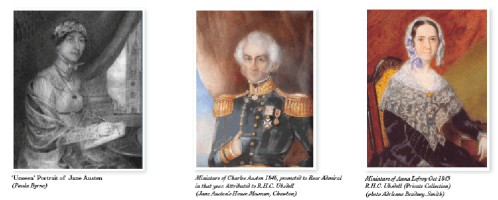
I came to realise what Sanditon actually was when writing the illustrated story of the life of my great great great grandfather R.H.C. Ubsdell (1812-1887), the Portsmouth miniaturist, portrait painter and early photographer. Ubsdell had a studio and art gallery in Old Portsmouth opposite the theatre. He painted portraits of Jane Austen’s sailor brothers Charles and Francis (Frank) and the miniature of Anna Lefroy, delivered to her in the Autumn of 1845. He probably also drew the disputed portrait in graphite on vellum of Austen (the property of Paula Byrne) as an ‘identikit reconstruction’ for Anna Lefroy circa 1845 (probably to serve as a frontispiece for her intended completion of Sanditon together with her own portrait.)
‘Unseen’ Portrait of Jane Austen (Paula Byrne), Miniature of Charles Austen, and miniature of Anna Lefroy. Images courtesy of Chris Brinkle.
A page in Hampshire, a book by Chris Brindle. This one discusses the history of the church and Rectory at Ashe, a village close to Steventon. Image courtesy of Chris Brindle.
I think it is only when one puts the Lefroy continuation together with the Austen original that one truly understands why Austen wrote Sanditon. My conclusion comes from studying the life stories of Austen and Anna Lefroy, and Anna’s diary and life story that her daughters copied out. (One copy was kindly lent to me by descendant Helen Lefroy). So perhaps one cannot complain if ITV chooses Andrew Davies to write a very modern ‘Love Island’ ‘take’ on the book. Having invested our time in a couple of episodes, most people will probably want to know how it ends.
Sanditon, the ITV/PBS Masterpiece television mini-series
Davies does little more than take the names of some of the characters, however, whilst ignoring most of the content of Austen’s original fragment, niece Anna Lefroy’s continuation, and the financial relationships between the characters that Austen very clearly outlines, and which Lefroy clearly understood. Austen’s story should be about property speculation and money, inspired by her time in London with brother Henry, when the bank of which he was a partner, Austen, Maude & Tilson was collapsing because of their ill-considering loans.
Davies and the production studio also fail to present the main character properly–a South Coast English seaside resort in its earliest stages of speculative development. Trafalgar House (Tom and Mary Parker’s house) is not part of ‘New Sanditon’, a bold new development on the cliff, instead in the TV show it is stuck down in a very squalid looking village.
The other thing that is unsatisfactory about the ITV/PBS Masterpiece production is that it ignores the actual history and real-life detail of the development of the English seaside resorts such as Brighton, Worthing and Southsea. It wasn’t an accident that Austen chose the setting of an English Seaside Resort, because she saw that this was a character in its own right. From its infancy, Sanditon would grow up over time. Therefore, for any future ‘completer’ there would be so much actual historical detail of the financial machinations to draw upon.
Chris Brindle’s works and productions
I am very gratified that people looking for something more authentic have been viewing on YouTube my original solution to the completion clues that Austen and Lefroy left, my 2014 Play:
Austen left us so little of Sanditon that I think rather than rushing ahead and inventing new story lines I thought it might be better to look at Austen’s characters in more detail, using as many of her actual words as possible, and thus my idea for a musical was born. This built on the duet ‘Blue Briny Sea’ that I had written for the original stage show (filmed at Chawton Great House) https://youtu.be/2gmrFrEdMBg
and ‘Song For Jane Austen’ (filmed in Bath) that I had written for the 200th Anniversary of Jane’s death:
In this musical the songwriter for a modern 21st Century Pop Band persuades the members of her band to take on Austen’s words, the characters in Austen’s novel, tell the story behind the novel, and reflect on what the novel means to them ‘200 Years Later’. The carriage ride from Willingden to Sanditon then becomes this song as Tom & Mary Parker and Charlotte Heywood give their respective views on the resort:
Whilst an Austen story with modern popular music might seem a strange mix, another example of a musical doing very well on tour in the UK at the moment is “Pride & Prejudice” (Sort Of ), which features the Pride & Prejudice story told by the Bennet’s servants, but in broad Glaswegian with added karaoke songs!
Everything I’ve done has been on a tiny budget driven by my fascination for the subject matter. I’m currently working on plans to develop the big stage production in the amateur sector. More details can be found on my website www.Sanditon.info, which I’ve updated.
On my website you will find the links to
The texts of both the Austen and Lefroy fragments of ‘Sanditon’ (An entirely different perspective opens up if one asks oneself line-by-line, why did the author include ‘that bit’? (If you read the Austen fragment in this way, Austen clearly leaves so many plot openers and clues in her work for future ‘completers’ to solve. This is probably what is most unsatisfactory about the Andrew Davies / ITV dramatisation in that Davies chooses not to solve any of Austen’s clues and just ‘does his own thing’.)
My 2014 Film of The Play of Jane Austen’s and Anna Lefroy’s Sanditon.
My 2014 Documentary filmed in Hampshire & Berkshire with piano music by American Composer and JASNA delegate Amanda Jacobs
My 2019 Musical “200 Years Later” Jane Austen’s ‘Sanditon’ The Pop/Rock Musical as premiered at ‘The Other Palace’, Victoria London on 26th July 2019
Fashionable Goodness: Christianity in Jane Austen's England is now available! By JAW contributor Brenda S. Cox. See Review. Available from Amazon and Jane Austen Books.
Available through December 31st, 2025. Click on image for details, and share this poster with other teachers and students!
The Obituary of Charlotte Collins by Andrew Capes
Click on image to read the story.
Comments
“My idea of good company…is the company of clever, well-informed people, who have a great deal of conversation.” – Jane Austen, Persuasion
Gentle readers: Please feel free to post your comments and continue the conversation! Due to SPAM, we will no longer accept comments on posts after 30 days of publication. In some instances, links will be removed from comments as well.
Administrators and Contributors
Vic Sanborn, founder of this blog, is supported by a team of talented and knowledgeable writers about Jane Austen and the Regency era. They are:
Tony Grant, who now contributes his photos from London and England
Click on their names to enter their own blogs.
In addition, we thank the many experts and authors who frequently contribute their posts and opinions, and who continue to do so freely or at our request.
Click here to enter the page. Topics include Regency fashion, historic foods, Jane Austen societies, British sites, related topics. Click on image.
May we suggest?
Hello, my name is Vic and I live in Maryland, USA. I have adored Jane Austen almost all of my life. I am a proud lifetime member of the Jane Austen Society of North America. This blog is a personal blog written and edited by me and my team. We do not accept any form of cash advertising, sponsorship, or paid topic insertions. However, we do accept and keep books and CDs to review.
If you would like to share a new site, or point out an error, please email us. (Yes, we are fallible. We'll own up to our mistakes and will make the corrections with a polite smile on our faces.) Write us at
Thank you for visiting this blog. Your comments and suggestions are most welcome.
Project Gutenberg: eBook of Stage-coach and Mail in Days of Yore, Volume 2 (of 2), by Charles G. Harper
STAGE-COACH AND MAIL IN DAYS OF YORE: A PICTURESQUE HISTORY
OF THE COACHING AGE, VOL. II, By CHARLES G. HARPER. 1903. Click on this link.
 Visuality in the Novels of Austen, Radcliffe, Edgeworth and Burney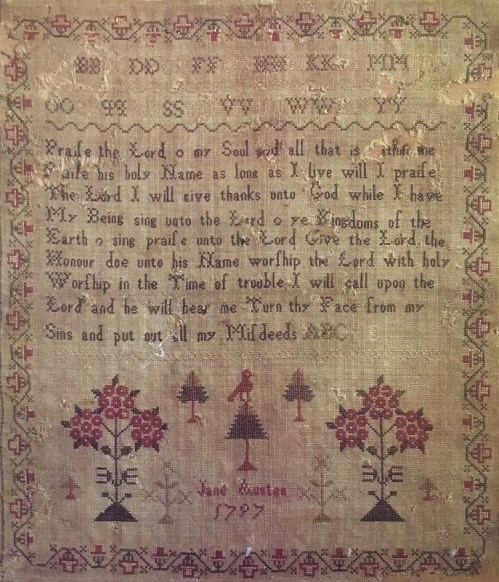









 Jane Austen's World