 Inquiring Readers: This tongue in cheek review of Wuthering Heights, showing on PBS January 18th & 25th, has been written in the spirit of fun (and illumination!). In it Dr. Phyl, Oprey’s favorite tele-psychobabbler, analyzes Heathcliff and Cathy. My more serious analysis of Heathcliff (Review Two) sits on Remotely Connected, a PBS blogger site. Enjoy.
Dear Dr. Phyl,
Catherine Earnshaw and Heathcliff have had a long and stormy relationship. After Cathy’s death, Heathcliff dealt badly with her loss, seeking revenge. One might say he handled himself in a most ungentlemanlike manner. Miss Emily Brontë, an interested bystander, wrote a book about this unique tale, which I am sending on to you. After you have read Wuthering Heights, would you mind answering a few questions? Wouldn’t you agree that loving someone too much is a bad thing? And aren’t women more prone to going crazy over a lost love than men? In other words, how realistic is this story?
Thanking you in advance, Ms. Place
Dear Ms. Place,
To answer your second point first, let me state categorically that in this day and age men have as much right to go crazy as women. Males might exhibit this character trait differently, but crazy is as crazy does.
In my long career as a tele-psychobabbler, I must say that I encounter an assortment of juvenile behaviors among my featured guests, but few possess even 1/10th of Heathcliff’s charged and emotionally unhealthy obsessions. He is as nuts as they come and I write these words with awe and respect. Seldom has a man with so many problems been able to keep up a normal façade for very long, and Heathcliff managed to fool enough people and hold them in his thrall until he could destroy them.
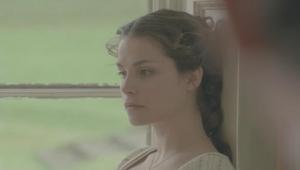 Let’s get my assessment of Cathy Linton née Earnshaw’s character out of the way. She was merely guilty of acting like a self-centered, spoiled, and willful brat. Tighter lacings and a rigid schedule pursuing ladylike endeavors would have tamed her unruly nature. Had I been her personal psychobabbler, I would have prescribed vigorous exercises in the form of housework and mucking horse stalls to tone down her narcissistic tendencies. That girl was seriously willful and needed to get an inner life. Unfortunately she died before self-actualization became possible.
As for Heathcliff, he suffers from a rare condition called Continuous Revenge Seeker Disorder, or CRSD. Every human suffering from this persistent unvegetative state has died tragically. A childhood trauma precipitates this disease, leaving all CRSD sufferers with an acute sense of insecurity and low self-esteem. Heathcliff’s traumas were manifold. He had to scrounge for a living on the street when he was a mere child. Then his stepbrother’s jealousy tainted his burgeoning relationship with Mr. Earnshaw, his protector. After that good man’s death, Heathcliff’s life at Wuthering Heights became a nightmare. He had gone from Gypsy child to cherished stepson to servant in the space of a few years and his fragile ego just couldn’t take this constant see-sawing of emotions. And then Cathy, his soulmate, goes all squirrelly on him and starts coming on to another man. Some people weep and give up; but Heathcliff vowed revenge and felt stronger as a result, a classic trait of the CRSD sufferer.
 Cathy’s obsessively close relationship with Heathcliff sealed the CRSD deal. That poor motherless and loveless boy could no more fight off Cathy’s charms than a hog can resist a nice puddle of mud. It would have been better if he had hooked up with Tess of the D’urbervilles. Now there’s a woman whose miserable experiences and continual bad luck could have coaxed him out of his self-pity, but fate had Cathy in store for this man and that was his downfall. As for his relationship with Cathy, when people start saying things like “you torment me” to each other, that’s just not healthy! Normal couples don’t spend all their time stressing, testing, and obsessing. They keep their neediness to themselves! They GROW UP!
You didn’t mention the Linton siblings in your letter. These two mealy-mouthed milque toasties chose mates that were entirely wrong for them. Hadn’t anyone bothered to teach them the warning signs of an unhealthy relationship? One minute kind, next minute cruel. Gets jealous for no reason. And angry, sulky, or withdrawing. The Lintons began changing their own behavior to keep the peace, and Isabella went so far as to think that her love for Heathcliff would be strong enough to CHANGE him. Talk about unrealistic expectations! Well she got her comeuppance, so you can’t help but feel sorry for her, because for him she was just a means to revenge. What amazes me, Ms. Place, is that this book, which is about a dysfunctional relationship that destroys lives, has become a popular and enduring classic. Now how cockamamie is that? And my guess as to why people aren’t embracing my new book – Normal Thoughts for Ordinary People -with the same enthusiasm as for this over the top gothic drivel is as good as yours.
 After Cathy married Edgar, Heathcliff ran off, got rich, and returned to torment Cathy by pretending to court Isabella. Right there that tells us that bats have entered Heathcliff’s belfry. The scene in which Ms. Brontë described Cathy dying in Heathcliff’s arms, with him clinging to her and growling at her and telling her things like “haunt me” and “I love my murderer” indicates that Heathcliff’s bats have turned rabid. Honestogod, were these folks for real or were they a figment of someone’s imagination?
I understand that a new production of Wuthering Heights is scheduled to be aired on PBS on January 18th and 25th. I’ll ask my staff to schedule Heathcliff for my show. Considering some of the loony bin guests I’ve had on recently, he will fit right in.
Sincerely,
Dr. Phyl
If you missed the first airing of Wuthering Heights, you can view past episodes at this link starting the 19th.
 My review of Masterpiece Classic’s
  where a boy will pursue a girl, then drop her because she’s a slut. “The woman that I love is not you,” he said after hearing her out, and I know this is the point author Thomas Hardy was trying to make. Different worlds. Different manners. Different mores. Clash of cultures. Regardless, I cannot forgive Angel for abandoning Tess after she’s revealed that she’s carried another man’s child. Angel’s attitude remained prevalent well into the 1960’s, and I thank my lucky stars to be living in this enlightened, more forgiving time. Without this crucial plot development, we’d be staring at a happy ending, but the viewer still has almost half of this two-part film to watch.
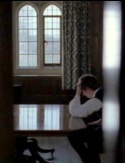 Eddy Redmayne and Gemma Arterton were splendid in this scene. Gemma as Tess is at first brimming with hope, then crestfallen as she begs for Angel’s forgiveness. Redmayne manages to show conflicting feelings – anger, hurt, and love – as he bids Tess goodbye, unable to accept from his rigid, puritanical upbringing that she’s a fallen woman.

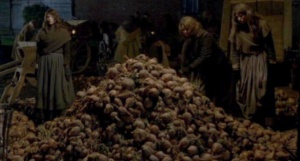

 Meanwhile Angel has been sick in Brazil and has undergone a sea change in attitude. After recovering from yellow fever, he returns home and goes on a quest to find Tess. He pays a heavy penance as he learns of her life after he abandoned her, realizing what misery she’s experienced. When he locates her in the resort town of Sandbourne, looking like the scarlet woman she’s become, she begs him to leave, crying out: “It is too late for me now, I’m already dead!” Portentous words. After coming such a long way to find her, he seems to give her up rather quickly, but Tess is made of sterner stuff.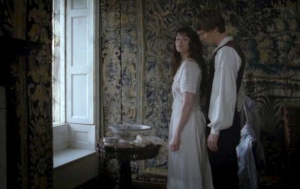
 Tess and Angel share only two days of tender bliss as he tries to help her escape from the law. Angel is now completely on her side and will not abandon her, but Tess knows it’s too late. Instead of leaving their shelter she begs him for one more night as man and wife: “Why put an end to all this joy?” Why indeed?
 cultures in a changing age. The death imagery is a bit heavy handed in these scenes, but at this point the viewer has given up on subtletly. As the law closes in on her, Tess tearfully embraces Angel: “It couldn’t have lasted,” she said, “Too much happiness.” Which is when I drew out my hanky and bawled.
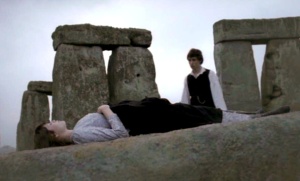 (PBS Press Release) To me, her story is heart breaking. I agree with her friend Izz Huet, who concluded after speaking with Angel, “Whatever she’s done, she doesn’t deserve this.”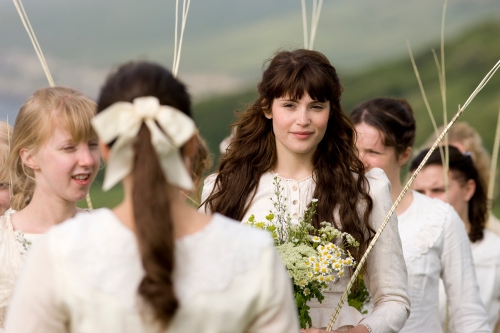

 The film opens with the parson informing Tess’s drunken father that he believes the family is descended from the aristocratic D’Urbervilles family. Life is never the same for the Durbeyfields again, for the knowledge that they might be descended from one of the finest families in the land goes to the parents’ heads.We then meet 17-year-old Tess at a May Day Dance. She is on the threshold of life and we discover that her desire is to lift herself out of the working class life by becoming a teacher. She briefly meets a lad named Angel Clare (Eddy Redmayne) during that dance and their first sight of each other is electrifying.

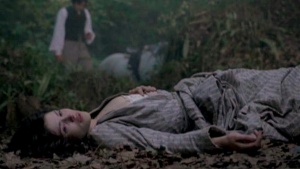 Thomas Hardy does not make it clear in his novel if Tess is seduced against her will or raped, but this film version strongly hints at rape in a nightmarish scene that ends with Tess crying on the forest floor, her bodice ripped open. Tess spurns Alec. She might have lost her virginity, but her honor remains intact. She returns home and gives birth to a bastard child whom she names Sorrow. Her father, angry that Tess has brought shame to the family name, refuses to have the child baptised. The child (a boy) dies, and when the pastor does not give Tess permission to bury her baby in consecrated ground she leaves the village.
 By this time the viewer has been reeling with Tess from one awful event to the other, wondering if luck will ever brighten her life. Her only supportive family member is her sister, Liza-Lu, who is too young to do more than lend a sympathetic ear. Even Tess’s mother gives her little support. The scene in which Gemma/Tess cries out to her mother, asking her “Why did you not warn me?” is unforgettably sad, though it is not in the novel. I had watched Gemma only as Lizzy Bennet in Lost in Austen and had no idea how affecting her performance could be. The weight of this film production rests on her shoulders and she carries her burden well.
 After Tess leaves her home village, she finds a position as a milkmaid at the Talbothays dairy farm and for the first time is among friends. This relief from constant and oppressive bad luck is a welcome one and prevents the production from completely descending into a tearjerking melodrama. Thomas Hardy wrote serialized novels, which meant that each installment offered a cliffhanger ending in order to lure the reader into purchasing the next serialized chapter and Tess of the D’Urbervilles has a tendency to tug too hard at one’s heartstrings for sympathy.
 Meanwhile, Angel, the son of a gentleman, returns home to his parents to make a case for marrying Tess, a working class girl. During their discussion the viewer learns that purity, above all, is the quality that Angel and his parents seek in his bride, casting a foreboding of doom over Angel’s and Tess’s chance at happiness. Tess and the viewer know that she can never live up to his expectation. And so the story turns once again, with Tess realizing just hours before her wedding that Angel never read her letter in which she confesses that she had born Alec D’Urberville’s child. She will wed him with her secret intact.











 Jane Austen's World