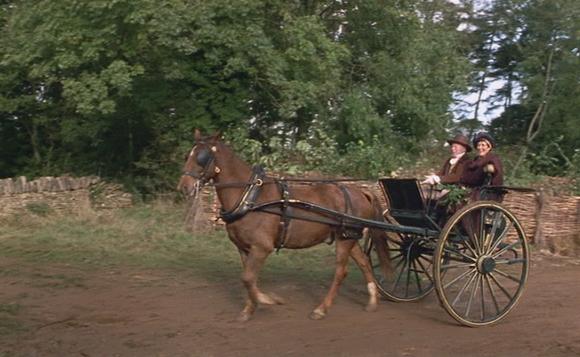
Crofts arrive in the gig, Persuasion 1995
In Persuasion, Jane Austen depicts the Crofts as the happiest couple imaginable. Sophy, who is also Captain Wentworth’s sister, follows her Admiral across the seas, sacrificing her looks in the process. She is only 38 years old, but her complexion is ruddy and has obviously been affected by the sun. Jane Austen writes about the couple in a realistic way, and like all happily married folks, these two exhibit their own idiosyncracies. Admiral Croft, it turns out, is a bad driver. Captain Wentworth says about his brother-in-law to Louisa:
“What glorious weather for the Admiral and my sister! They meant to take a long drive this morning; perhaps we may hail them from some of these hills. They talked of coming into this side of the country. I wonder whereabouts they will upset to-day. Oh! it does happen very often, I assure you–but my sister makes nothing of it–she would as lieve be tossed out as not.”
“Ah! You make the most of it, I know,” cried Louisa, “but if it were really so, I should do just the same in her place. If I loved a man, as she loves the Admiral, I would always be with him, nothing should ever separate us, and I would rather be overturned by him, than driven safely by anybody else.”
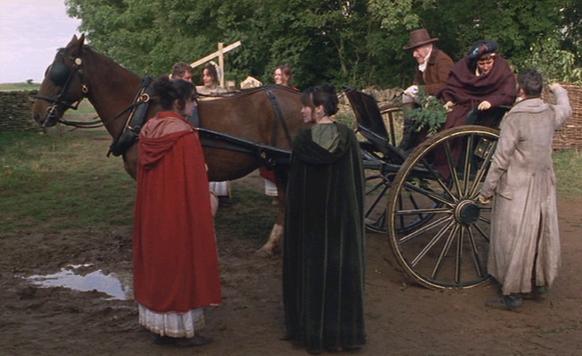
The party stops to talk to the Crofts
During their return walk from Winthrop, the party from Uppercross, which includes Anne Elliot and Captain Wentworth and a number of the Musgroves, encounter Admiral and Mrs. Croft in a gig. They offer a seat to one of the party. Everyone declines, except for Captain Wentworth, who has noticed Anne’s fatigue. He whispers something to his sister, then encourages Anne to join the Crofts in their two-seater for the rest of the way back to Uppercross (about one mile.) Anne is grateful for his thoughtfulness. But as she rides in the carriage, she hears Mrs. Croft warn her husband:
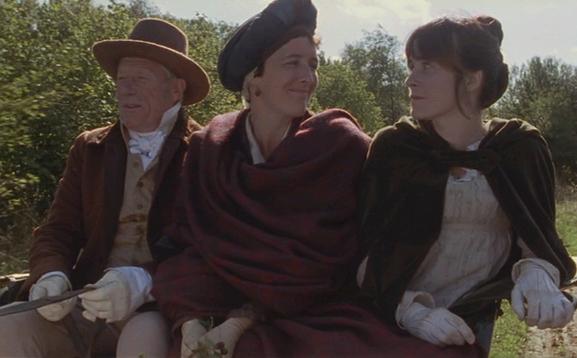
The Crofts and Anne Elliot crowded in a 2-man gig
My dear admiral, that post!–we shall certainly take that post.”
Jane Austen goes on to write:
But by coolly giving the reins a better direction herself, they happily passed the danger; and by once afterwards judiciously putting out her hand, they neither fell into a rut, nor ran foul of a dung-cart; and Anne, with some amusement at their style of driving, which she imagined no bad representation of the general guidance of their affairs, found herself safely deposited by them at the cottage.
The happy admiral is more than willing to allow his wife to steer the carriage alongside him, which many of us who have driven with “back-seat driving” spouses know is a rare attitude indeed!
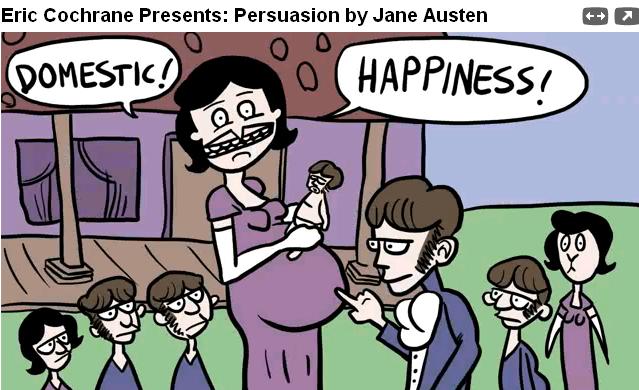
In this famous scene by Jane Austen, the Crofts moved over to make room for Anne. Mary Musgrove would rather die from fatigue than be seen crowded in a humble gig, but Anne could only feel gratitude. She is beginning to understand that while Captain Wentworth is unable to forgive her for rejecting him, he is still a kind and decent man. He knows her well enough to see that she was tired and made arrangements for her. In these small observable progressions (as with taking the child Walter from her without comment), we see the Captain’s love for Anne come to the surface. It will take a little longer for his anger at her rejection to recede. See also Shopping and Milsom Street, Bath
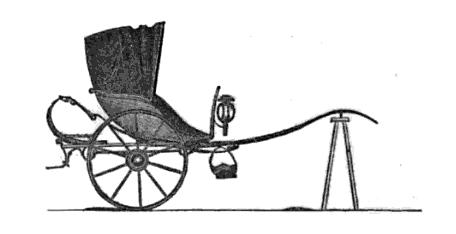
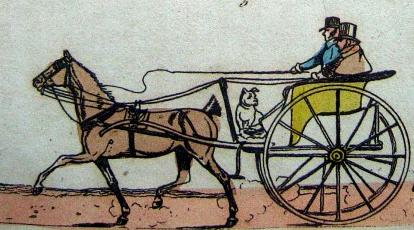
Light weight gig
About Gigs: Gigs were two-wheeled carriages equipped for one horse only. They were designed for two people, one of whom was the driver, and were considered carriages for the middle class, or for the “poorer” classes, who paid less duty on them. Because these carriages were light in weight and springy, they could be easily turned over, especially by a poor driver like Mr. Croft. Gigs were used by doctors, travelers, and people who made short journeys that would not fatigue the horse. Gigs evolved into cabriolets (early versions of cabs) Dennet, Stanhope, and Tilbury. The Stanhope was designed by Fitzroy Stanhope, the second son to the Third Earl Stanhope. This carriage became popular towards the mid-19th century for short trips between Town and the suburbs.
Road to a fight, detail by Henry Alken, 1821
The two men in this high perch phaeton show how precarious a light two-wheeled vehicle can be. One can see the difference between this “sporty” more expensive vehicle and the humble gig (above).










 Jane Austen's World