Review and Discussion by Brenda S. Cox
“Had Elizabeth’s opinion been all drawn from her own family, she could not have formed a very pleasing opinion of conjugal felicity or domestic comfort. Her father, captivated by youth and beauty, and that appearance of good humour which youth and beauty generally give, had married a woman whose weak understanding and illiberal mind had very early in their marriage put an end to all real affection for her. Respect, esteem, and confidence had vanished for ever; and all his views of domestic happiness were overthrown.”—Pride and Prejudice, chapter 42
Mr. and Mrs. Bennet’s Courtship
Have you ever wondered how on earth intelligent Mr. Bennet came to marry a woman of “weak understanding” and an “illiberal” [uncultured, unrefined] mind? Jane Austen gives us a brief explanation above: he was “captivated by youth and beauty” and an “appearance of good humour.” But what was their courtship like? Emma Wood has imagined that in the play Mr. Bennet’s Bride. First, let’s think a little more about what Austen tells us.

Hugh Thomson, 1894, public domain.
It’s often been pointed out that Mrs. Bennet, silly as she seems, has some worldly wisdom. She has legitimate concerns about providing for herself and her children after Mr. Bennet’s death. It seems that Mr. Bennet had earlier considered this, but now has more or less given up. In chapter 50, when Lydia is to marry Wickham, we read:
“Mr. Bennet had very often wished before this period of his life that, instead of spending his whole income, he had laid by an annual sum for the better provision of his children, and of his wife, if she survived him. He now wished it more than ever. . . .
“When first Mr. Bennet had married, economy was held to be perfectly useless, for, of course, they were to have a son. The son was to join in cutting off the entail, as soon as he should be of age, and the widow and younger children would by that means be provided for. Five daughters successively entered the world, but yet the son was to come; and Mrs. Bennet, for many years after Lydia’s birth, had been certain that he would. This event had at last been despaired of, but it was then too late to be saving. Mrs. Bennet had no turn for economy, and her husband’s love of independence had alone prevented their exceeding their income.
“Five thousand pounds was settled by marriage articles on Mrs. Bennet and the children. But in what proportions it should be divided amongst the latter depended on the will of the parents.”
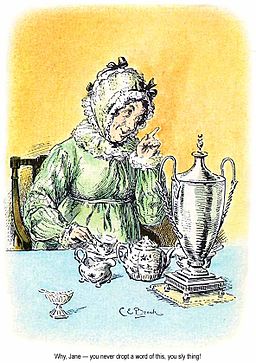
So Mrs. Bennet did have some fortune, enough to give her about £250 a year (5% of £5,000). Not enough for a gentry family to live on, but not poverty, either. However, divided between five daughters, once their father died and his estate went to Mr. Collins, it was insignificant.
C.E. Brock, 1895, public domain
While her family’s future is uncertain, Mrs. Bennet does not recognize, as her husband does, that saving money would be a help. Her extravagant plans for Lydia’s wedding clothes, and for Lydia and Wickham’s future house, servants, and carriages, show that she has no conception of limiting expenditures according to income. It is her husband whose “love of independence” (desire to avoid debt) has kept their family solvent. Mr. Bennet was at least better than that “foolish, spendthrift baronet,” Sir Walter Elliot of Persuasion, “who had not had principle or sense enough to maintain himself in the situation in which Providence had placed him.”
H. M. Brock, public domain
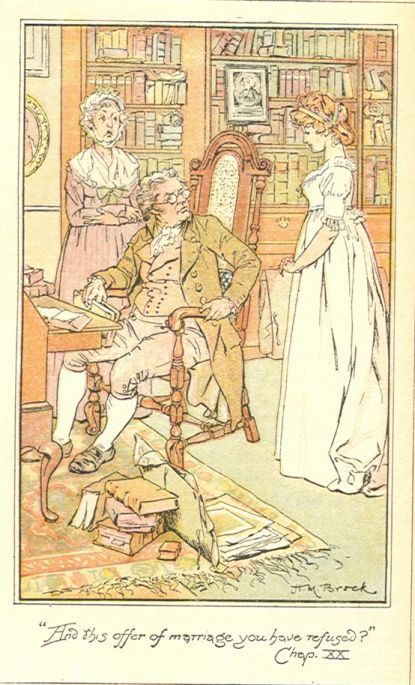
Mrs. Bennet, when she was lovely young Miss Gardiner, had enough sense to get the attention of young Mr. Bennet, heir to Longbourn estate, and wheedle him into marrying her.
And that’s where the imagination of Emma Wood, an Australian playwright, took off.
The Play, Mr. Bennet’s Bride
Wood says,
“I began to imagine the details of their courtship. I knew the end, but how did the story begin? The characters flew onto the page. It was such a joy to write. Imagining the earlier lives of the ill-suited couple and peopling the stage with other characters in the previous generation to the novel was an adventure. . . . I felt a deep sense of obligation to honour the characters and style of the novel as I wrote, aware that audiences would expect to see people and situations they recognized in a loving tribute to the novel.”

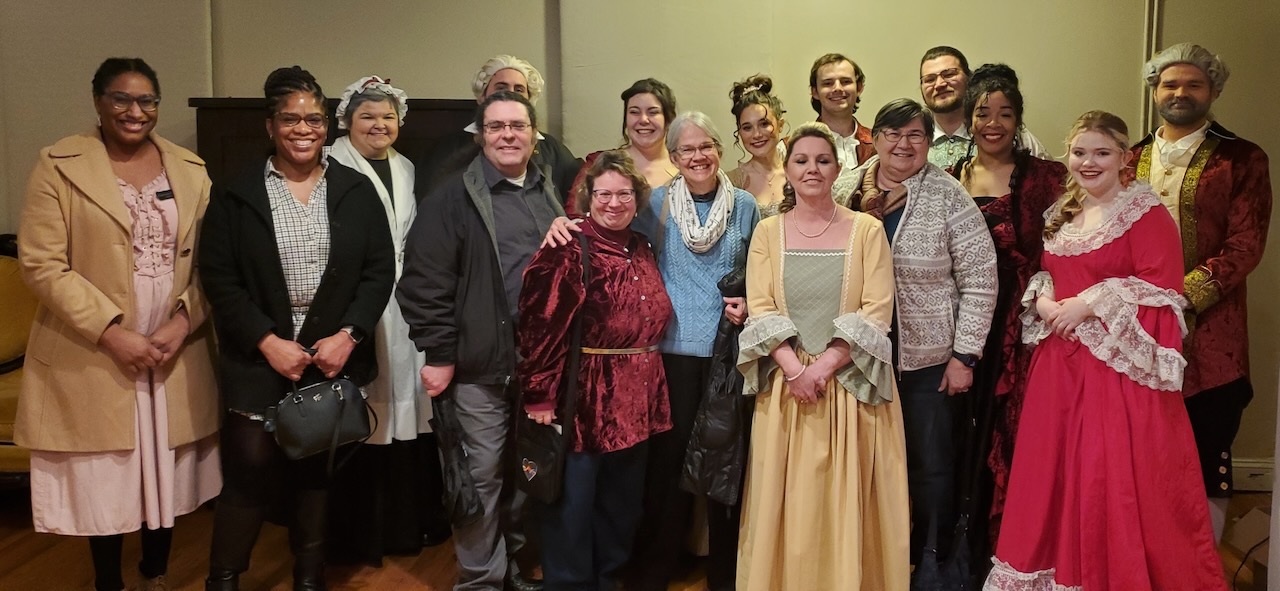
Wood’s play, Mr. Bennet’s Bride, has been delighting audiences in Australia and the U.K. since 2014. This February it premiered in the United States, in the small town of Cartersville on the outskirts of Atlanta, Georgia. I was privileged to attend a performance with a group of JASNA friends. We all loved it. The characters were engaging and fun, and the dialogue sparkled. A few little “Easter eggs” were thrown in, Austen quotes that fit well. One started with “It is a truth universally acknowledged . . .”; I won’t give away the others.
The Plot (Includes spoilers)
Here’s how Ms. Wood imagines the story:
We have James Bennet, age 29. His mother died giving birth to him, and his father has been distant all his life. His father’s sister, Aunt Mary, has raised James. His father is pressuring him to marry and produce an heir for Longbourn. His father’s cousin, Benedict Collins, has just produced his own heir, William Collins, and looks on Longbourn as William’s future inheritance.
First we see James hiding behind a sofa, reading a book. When he is discovered, he is forced to make small talk with one of the appropriate young ladies his father has been trying to set him up with. She is no more interested than he is.
Afterwards, his father lays down an ultimatum: Get married within six months, or you’ll be kicked out and have to make your own way in the world. To get James to take him seriously, he puts it into a contract, involving his lawyer (solicitor), Mr. Gardiner.
Jolly Mr. Gardiner and his wife—an earlier incarnation of Mrs. Bennet—take advantage of the situation. In a hilarious scene, Mr. Gardiner manages to introduce James to their beautiful but air-headed daughter Emily. She is in love with an officer but is savvy enough to quickly replace him in her affections with the heir to Longbourn. The story continues with much laughter.
In a serious scene, the elder Mr. Bennet has a touching reconciliation with his son, then allows him to choose his own bride. He chooses Emily. Only at the end does James get an inkling of what he’s gotten himself into.
Some flashed scenes show the new Bennet couple’s future.
Gaining Depth and Understanding
Imani Anderson did a beautiful job of directing Mr. Bennet’s Bride for the Pumphouse Players in Cartersville, Georgia. She says,
“One of the reasons why I have fallen in love with Mr. Bennet’s Bride is how James (our Mr. Bennet), Emily (Mrs. Bennet), and their families are written. They bring another level of depth and understanding for the matriarch and patriarch we’ve come to know in the classic tale. It’s clear both families want the best for their children and I think it’s so important that they admit their faults too when need be. . . . I hope that our production . . . makes you get those warm fuzzy feelings of love and laughter during this Valentine’s season.”
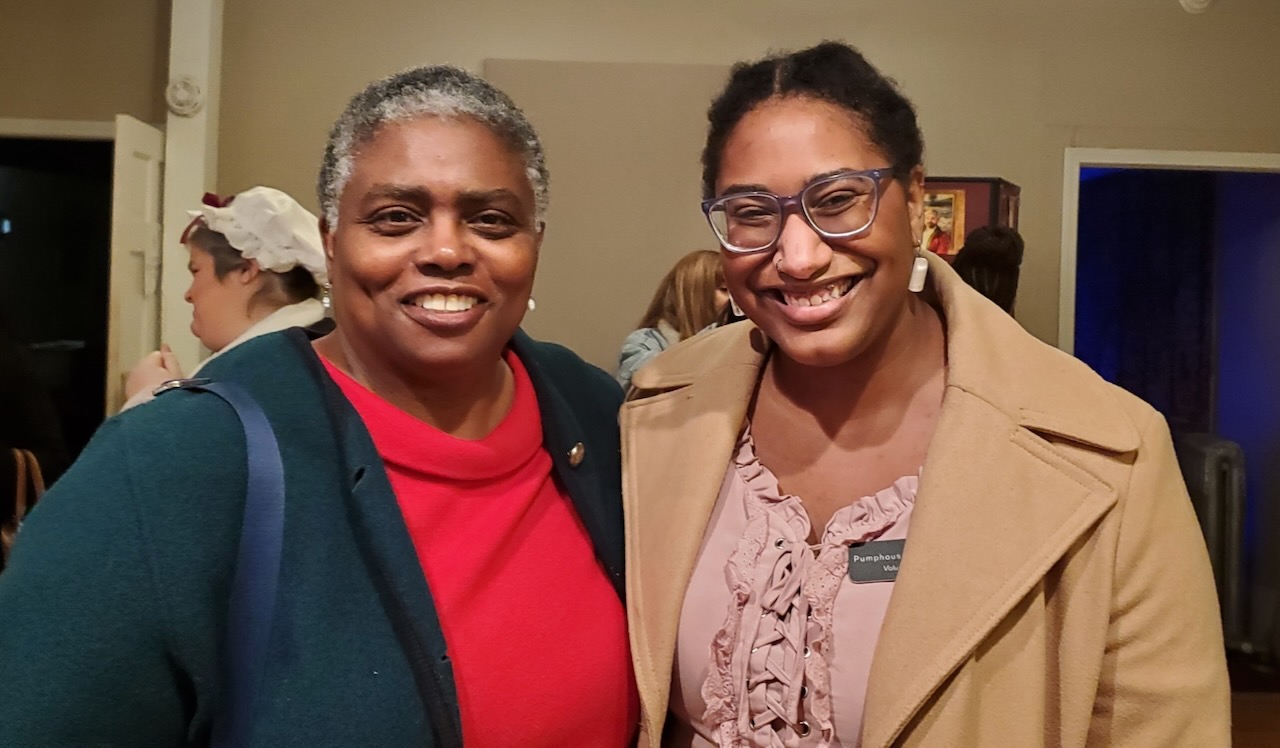
The play did indeed give a deeper understanding of Mr. and Mrs. Bennet and how their family came to be what it was.
Gentle readers, how do you imagine Mr. and Mrs. Bennet’s courtship?
Brenda S. Cox is the author of Fashionable Goodness: Christianity in Jane Austen’s England. She also blogs at Faith, Science, Joy, and Jane Austen.
Her posts on Jane Austen’s Family Churches will resume in April.










 Jane Austen's World