Inquiring Readers, This review by Lady Anne is about a Dido Kent mystery, part of a series of books by Anna Dean. McMillan  says about its author: “Anna Dean set about crafting stories at the age of five under the impression that everyone was taught to write in order to pen books. By the time she discovered her mistake, the habit was too deeply ingrained to give up. She resides in the Lake District of England.”
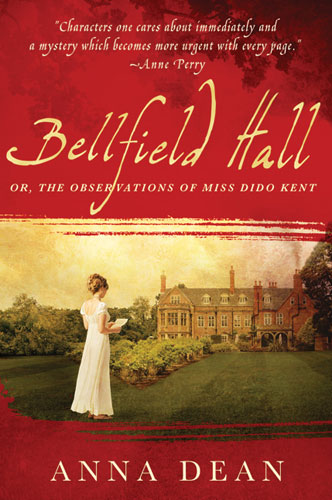
Dido Kent, the heroine of Anna Dean’s new book Bellfield Hall, is that useful family member, the unmarried sister (and aunt) whose brothers add to her income so that she is not in actual want, and so they can call on her whenever they need assistance. Dido is outspoken and curious; attractive enough not to be considered an antidote, but because she speaks her mind, has apparently frightened the young men about town enough that she has never been asked to marry. At almost thirty she is definitely on the shelf.
In this first outing for Dido, niece Catherine has called on her aunt for assistance in a most delicate situation. Catherine has just become engaged; it is a very good match, except that the bridegroom-to-be suddenly leaves the weekend party and writes Catherine a quelling note ending, in the most gracious albeit obscure terms, the engagement. Catherine, who is totally surprised and distressed, asks for her aunt to come and discover what has caused this dreadful change. To add to the worry, a woman is found dead in the shrubbery, and no one admits to knowing anything about who she may be. And so we get a delightful country-houseparty murder mystery.
The constraints of the time – this story unfolds in September of 1805 – preclude Aunt Dido from being overt in her crime solving. Nevertheless, she does accumulate a number of interesting clues, one of the most important of which involves the family dog. Other peculiarities include the gatekeeper, who is a young woman with a young child, a dress of singularly unusual construction, and two sisters whose graceful accomplishments seem to vary depending upon the audience.
Much of the story is told in letters to her sister; epistolary novels are always interesting for what they tell not only in words, but in implication. Dido’s voice is very clear, and her several false starts and stumbling efforts to discover what has happened to her niece’s intended bridegroom are explained well in the letters.
While the book has very much the flavor of the early 19th Century, several aspects of the different characters are told in a clearly 21st Century manner. One of the houseguests, Col. Walborough, is considering marriage to a wealthy young woman; strangely, he does not seem particular about which young women. He allows that it will mean a significant change in lifestyle for him. He really is not referring to his military career, but rather his predilection for young men, particularly young men in service. He cannot decide which of the two talented sisters to ask for; each has a good portion of her father’s considerable fortune settled on her. These girls have decided that they do not wish to marry, so they have their own way of keeping suitors at bay; their parents cannot comprehend that their daughters do not wish the married state.
Dido peers, pokes, and prods, and throughout the process, says what she thinks. She resolves the mystery and frees the young bride-groom-to-be from his terrible toils. The mystery is good; there is just enough that is not told to keep the puzzle intriguing.
In each of Jane Austen’s books, the characters are straightforward about the economic reasons for young women to marry well. This sometimes causes contemporary readers to consider Jane’s young heroines as mercenary, which is really not the case. They were practical and clear-sighted. Georgette Heyer shows the fiscal reality that young ladies of gentle birth and little means faced: they became governesses like Ancilla Trent in The Nonesuch, or Elinor Rochdale of The Reluctant Widow, or poor Kate Malvern in Cousin Kate, whose rescue from that life by her aunt created an even worse situation. If they tried to live by their wits, as Deb Grantham in Faro’s Daughter did, society frowned and sneered. They were not good times for gentlewomen without income. This reality gives Heyer a hook for her books, and the wealthy and handsome suitor, even if he is sardonic, is a welcome rescue from a life that would only become harder.
Anna Dean’s Dido Kent talks about the strictures she faces in a very contemporary fashion. Ladies could marry money, or they could inherit money. Lacking those options, their lives were not their own. Dido also speaks plainly to and about the two wealthy sisters who actually can choose not to marry because they are so comfortably fixed; even they must resort to subterfuge to carry out their convictions. At the end of this book, Dido must go to another brother’s household because “unmarried women must not expect to remain where they cannot be useful.” Her dependent situation, however, serves as a useful device for involvement in another mystery, and indeed, we can hope for another gently delivered tale of problems solved by Dido, in a new locality and with a different cast of characters. We can also continue to hope that she will find someone who she feels can marry Tom Lomax, with whose family she will remain connected. Once she accomplishes that, she perhaps will no longer be at her family’s beck and call.
Afterword: Lady Anne, who has written a number of reviews for Jane Austen’s World, is Vic’s special friend. She is often rewarded for her critiquing efforts with an outing to one of our favorite watering holes in a nearby fashion park. Whether perched on stools in an elegant bar or at an outdoor table adjacent to a bocce ball court, we can dis and gossip with the best of them. Think of Sex in the Burbs with bite. Well trod (Lady Anne is more often found sampling foods and wares in far flung places) and well shod (think of a Nordic Carrie with sensible 3″ stilettos), and you have an idea of why I find my dearest Janeite friend so appealing.
Read Full Post »
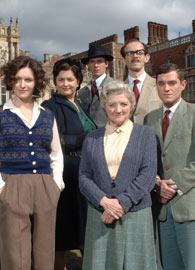 I should have guessed the ending of The Secret of the Chimneys, the latest Miss Marple episode on PBS on Sunday, June 20, but I so enjoyed going along for the ride that I deliberately missed the cues until the very end. The mysterious County Ludwig Von Stainach wishes to purchase The Chimneys, a house that has seen better days. Assembled at the mansion are a motley sort, even for a Miss Marple mystery. Once again things go bump in the night and someone is murdered.











 Jane Austen's World