“They who buy books do not read them, and … they who read them do not buy them.” – Robert Southey
Introduction:
Circulating libraries benefited Jane Austen and authors of her era in two ways. They rented out books, pamphlets, and magazines economically to people of modest means, like Austen. After books were published, library subscriptions made them available to a wider readership than was previously possible.
A short history of circulating libraries:
Circulating libraries were first mentioned in the Oxford English Dictionary in 1740, when Dr. Samuel Fancourt used the words to advertise his store in Salisbury. He had started his library five years before to rent out religious books and pamphlets, then moved his store to London in 1742, where it thrived.
Other already existing London bookshops adopted Fancourt’s commercial library model and its descriptive term. In a little over 30 years, the circulating library had sprung up all over London, as well as Bath and other resort spas, and by 1801 an estimated 1,000 of these libraries had spread all over England. This library concept traveled to British Colonies the world over. A monthly parcel of books could also be ordered by subscription from a London circulating library and shipped to a foreign location, such as a plantation in Ceylon (“Parasols & Gloves & Broches & Circulating Libraries,” Mary Margaret Benson).
The difference between subscription and circulating libraries:
An article about subscription vs circulating libraries by JASACT (Jane Austen and all that – in Canberra), explains that the two terms are often confused with each other. Subscription libraries consisted largely of serious book collections that covered specific topics, such as science, history, travel, or theology. Annual fees from male subscribers went towards purchasing books for the collections, which tended to be lofty and not open to the public.
“The Roxburghe Club was a club for book lovers established after the sale of the library of the Duke of Roxburghe, which was one of the great libraries of the day, which concluded June 17, 1812. Its membership was men who loved and who could afford books, comprised of a mixed group of aristocrats, businessmen and academics.” – Club London in the Georgian and Regency Eras, Lauren Gilbert
Circulating libraries were established as businesses with the aim of making money from a mass market that consisted of men, the rising middle classes, and women. Instead of focusing on narrow subjects, circulating libraries offered a variety of materials designed to please as many reading tastes as possible (JASACT). These included the novel, which quickly rose in popularity with the fairer sex.
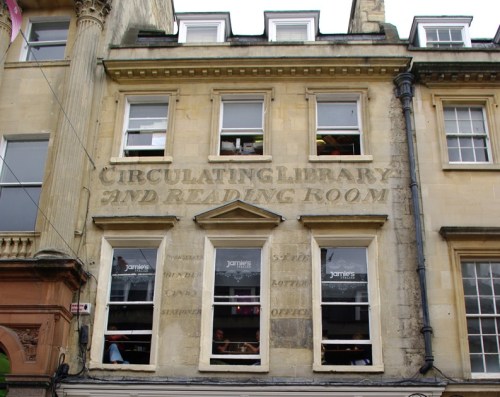
Lettering on a building in Bath that was once a Circulating Library and Reading Room on Milsom Street. Image courtesy of Tony Grant.
The libraries began to expand from London and leisure resorts to more rural communities across England. Paul Kaufman in an article entitled “The Community Library: A Chapter in English Social History” mentions a circulating library in 1790 operated by Michael Heavisides in Darlington, Durham, a provincial market town. His 16-page catalogue offered only 466 books in 1,014 volumes with a modest list of topics, many of which were not au courant:
“All types of fiction predominate, standard and cheapest contemporary types, many with the thinly veiled “history” and “memoir” titles…Shakespeare’s Poems (1 vol.), Milton’s Works, the Odyssey, Pilgrim’s Progress and Holy Ward, translations of Lucan and Ovid, Knox’s Essays, Cook’s Voyages, Spectator, Tatler, and Mirror, Smollett’s History of England (10 vols.), Salmon’s History of England (13 vols.), Thompson’s Poems, Rousseau’s Emile, Berkeley’s Minute Philosopher, Arabian Tales, and two apparently separate Persian Letters.” (The Bodleain.)
While the selection was small, even for regency libraries, Mr. Heavisides was successful enough to run his business for 30 years.

Darlington in 1830
Circulating libraries as consumers:
A new business relationship between booksellers and publishers emerged during the last quarter of the 18th century. Circulating libraries were
“…business enterprises, aimed at readers who could not afford to buy books, but who would be willing to pay perhaps half a guinea a year as a subscription fee, and then a few pence rental fee for each volume, or at readers who were away from town-perhaps at a seashore spa!-for a time, as well as those voracious readers who wanted the latest books at bargain prices.” – “Parasols & Gloves & Broches & Circulating Libraries,” Mary Margaret Benson.
The British book industry first began to sell books to the libraries. Publishers then realized they could increase profits by owning a library and renting out their own books.
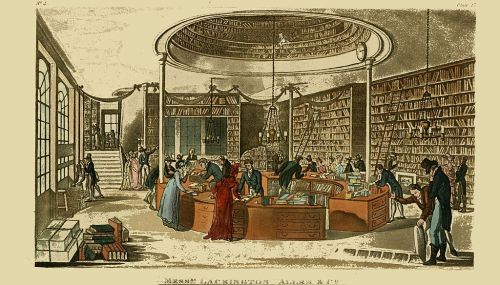
Circulating library of Messrs Lackington Allen & Co, 1809. Image in the public domain
John Lane, who was the proprietor of the Minerva Press, and both the leading publisher of gothic fiction in England and “the principal wholesaler of complete, packaged circulating libraries to new entrepreneurs,” realized that he could make substantial profits from catering to the tastes of readers like Isabella Thorpe and Catherine Morland of Northanger Abbey. (Lee Erickson, p. 583)
“People were quite willing to rent a novel they were unwilling to buy.”- Lee Erickson
Only the rich could afford to purchase books in Austen’s day. Publishers generally did not print their own books. They contracted a printer and estimated the number of copies that would sell. Since paper was expensive (much of it was handmade and then taxed), publishers would order new books when the first estimated run sold out. As the popularity of books and novels rose, so did their price. Between 1810 and 1815 books cost the equivalent of $90 to $100 American dollars today.

Trade Card of Thomas Clout, Printer. Notice the printing press at the top center of the card. Public domain image, courtesy of the Metropolitan Museum of Art.
To increase rentals, publishers began printing three-decker novels, also known as leviathans. These 3-volume novels became the standard until almost the end of the 19th century. The advantage of three volumes was that each book was rented out one at a time to a customer. When a reader finished Volume the First, she would turn it in and check out Volume the Second, and so forth. This meant that three customers would read one book at any one time. In Northanger Abbey, Henry Tilney described a typical three-decker set to his sister, Eleanor:
“Miss Morland has been talking of nothing more dreadful than a new publication which is shortly to come out, in three duodecimo volumes, two hundred and seventy–six pages in each, with a frontispiece to the first, of two tombstones and a lantern …”

Three-volume first edition of Pride and Prejudice bound in simple publishers board. National Library of Scotland
New authors like Jane Austen often took the financial risk of publishing their novels. Jane took this gamble after her father sold her first novel Susan in 1803 for £10 to Benjamin Crosby, who allowed it to languish unpublished on his shelves. Six years later, she wrote the publisher under the pseudonym of Mrs. Ashley Dennis, or M.A.D., for the return of her manuscript. Crosby quickly shot back a reply, saying her MS. would be hers if she paid the same amount for it that he paid her. For Jane that £10 represented almost half her yearly allowance, and so the book remained unpublished until after her death.
Austen learned her lesson from this experience and in 1811 she published Sense and Sensibility on commission, which guaranteed its publication. The novel’s success (which made Austen a profit of £140) ensured that she would not have to self publish again.
The rise of the novel:
“What shall we say of certain books, which we are assured (for we have not read them) are in their nature so shameful, in their tendency so pestiferous, and contain such rank treason against the royalty of Virtue…that she who can bear to peruse them must in her soul be a prostitute…” – James Fordyce, Sermons to Young Women
Jane wrote her “pestiferous” novels, as Fordyce called all fiction largely aimed at the female market, at an auspicious time. The leisured upper and rising middle classes’ demand for books increased during a period when their costs went up. In addition, the number of literate people was rapidly expanding. In Jane Austen’s England, Roy and Lesley Adkins wrote:
“…it has been estimated that two out of three working men could read to some extent, thought rather fewer had writing skills, and not nearly as many working women could read.” (p 231)
In Emma, Austen wrote about Mr. Martin’s sensible taste in reading and of his neat writing skills, which astonished Emma. Individuals who could not read enjoyed hearing a book read to them during group reading, a form of entertainment that the literate Austen family also followed. Paul Kaufman in “The Community Library” (p. 46) mentioned that reading also became a liberating force for the higher servant level. One imagines that cooks, butlers, housekeepers, and governesses were among them.
Circulating libraries fulfilled an insatiable appetite for subscribers. Library proprietors followed the money and increasingly offered more novels to accommodate female readers, although men generally had little regard for fictional stories. Many, like Mr. Collins (Pride and Prejudice), a devotee of Fordyce, held them in great contempt. Sir Edward Denham (Sanditon), could hardly contain his disdain for novel reading:
“Sir Edward, approaching Charlotte, said, “You may perceive what has been our occupation. My sister wanted my counsel in the selection of some books. We have many leisure hours and read a great deal. I am no indiscriminate novel reader. The mere trash of the common circulating library I hold in the highest contempt. You will never hear me advocating those puerile emanations which detail nothing but discordant principles incapable of amalgamation, or those vapid tissues of ordinary occurrences, from which no useful deductions can be drawn. In vain may we put them into a literary alembic; we distill nothing which can add to science. You understand me, I am sure?”
Pity poor Charlotte having to listen to that drivel. Contrast Lord Denham’s pompous opinions with Henry Tilney’s charming and succinct statement:
“The person, be it gentleman or lady, who has not pleasure in a good novel, must be intolerably stupid.” (Northanger Abbey)
It is interesting to note that Austen rewrote Susan (Northanger Abbey) before she began to write her unfinished novel, Sanditon, and that she and her family were avid novel readers. Still, reading fiction belonged largely to the pervue of women. Gothic and romance novels, popularized by Frances Burney, Maria Edgeworth, and Ann Radcliffe, were regarded as disposable throwaways only good enough for one-time reading. Few people purchased novels or kept them on their shelves, and so they were cheaply published with a simple binding known as publishers boards. The Prince Regent owned a handsome three-volume book of Emma, but this was the exception, not the rule.
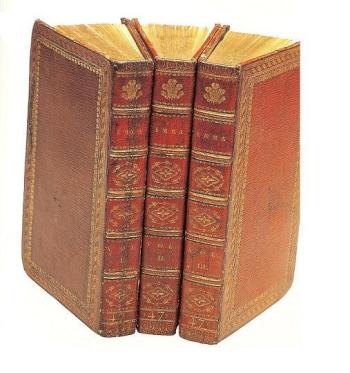
The Prince Regent’s edition of Emma by Jane Austen, courtesy Deirdre Le Faye via Jane Austen in Vermont.
Despite Fordyce’s dire warnings, by the end of the 18th century fully 75% of books rented out by circulating libraries were novels. Ninety percent of Mr. Heavisides books in his circulating library in Darlington were listed as standard and “cheapest contemporary” fiction.
This short discourse, gentle reader, brings Part One of Circulating Libraries to an end. In the second installment, discussions will center on subscription fees, libraries as social hubs, subscription books, reading rooms, characteristics of large city and small rural libraries, and Jane Austen’s descriptions of circulating libraries in her novels and letters.
Sources:
- “The Circulating Library in Regency Resorts,” Vic Sanborn, Jane Austen’s World, August 30, 2010 Accessed on October 4, 2020. https://janeaustensworld.wordpress.com/2010/08/30/the-circulating-library-in-regency-times/
- Erickson, Lee. “The Economy of Novel Reading: Jane Austen and the Circulating Library. “Studies in English Literature 1500-1900 30, no. 4 (1990): 573-90. Accessed September 16, 2020. doi: 10,2307/450560
- Kaufman, Paul. (1967). The Community Library: A Chapter in English Social History. Transactions of the American Philosophical Society, 57(7), 1-67. doi:10.2307/1006043. https://www.jstor.org/stable/1006043 Accessed October 4, 2020: https://www.jstor.org/stable/1006043?seq=67
- “The first edition of Pride and Prejudice,” 1813. Treasures, National Library of Scotland. Accessed September 18, 2020. https://www.nls.uk/exhibitions/treasures/pride-and-prejudice/first-edition
- Subscription and Circulating Libraries, JASACT (Jane Austen and All That – In Canberra), October 2018 meeting. Accessed October 4, 2020. https://jasact.wordpress.com/2018/11/07/october-2018-meeting-subscription-and-circulation-libraries/
- “Club London in the Georgian and Regency Eras,” Lauren Gilbert, Friday, July 24, 2020, English Historical Fiction Authors. Accessed September 20, 2020. https://englishhistoryauthors.blogspot.com/2020/07/club-london-in-georgian-and-regency-eras.html
- “Parasols & Gloves & Broches & Circulating Libraries,” Mary Margaret Benson, Northup Library, Linfield College, McMinnville, OR., JASNA, No. 19-1977. Accessed October 4, 2020. http://jasna.org/publications/persuasions/no19/benson-m/
- “The Romance of Business and the Business of Romance: The Circulating Library and Novel-Reading in Sanditon,” Susan Allen Ford, Division of Languages and Literature, Delta State University, Cleveland, MS 38733, Journal of the Jane Austen Society of North America, Persuasions #19, 1997, www.jasna.org. ISSN 0821-0314
- “Why Jane Austen Self-Published Her First Novel,” Caroline Jane Knight, Austen Heritage, November 4, 2017. Accessed on October 4, 2020. https://www.austenheritage.com/blog/2017/11/4/why-jane-austen-self-published-her-first-novel
- The Making of Regency Books, Kathryn Kane, Regency Redingote, October 7, 2011. Accessed on October 4, 2020. https://regencyredingote.wordpress.com/2011/10/07/the-making-of-regency-books/
- “Who Jane Read, Who Read Jane: Austen’s Readers and Favorite Books,” Book Riot, James Wallace Harris Jul 18, 2017. Accessed on 9/30/2020: https://bookriot.com/who-jane-read-who-read-jane/
- “Eighteenth-Century British Circulating Libraries and Cultural Book History,” Edward Jacobs, (ejacobs@odu.edu) Old Dominion University, 2003. ODU Digital Commons, English Faculty Publications, 2003. Accessed on October 4, 2020: https://core.ac.uk/download/pdf/217283473.pdf
- Adkins, Roy and Lesley. Jane Austen’s England: Daily Life in the Georgian and Regency Periods, 2014, Penguin Random House, ISBN 9780143125723.
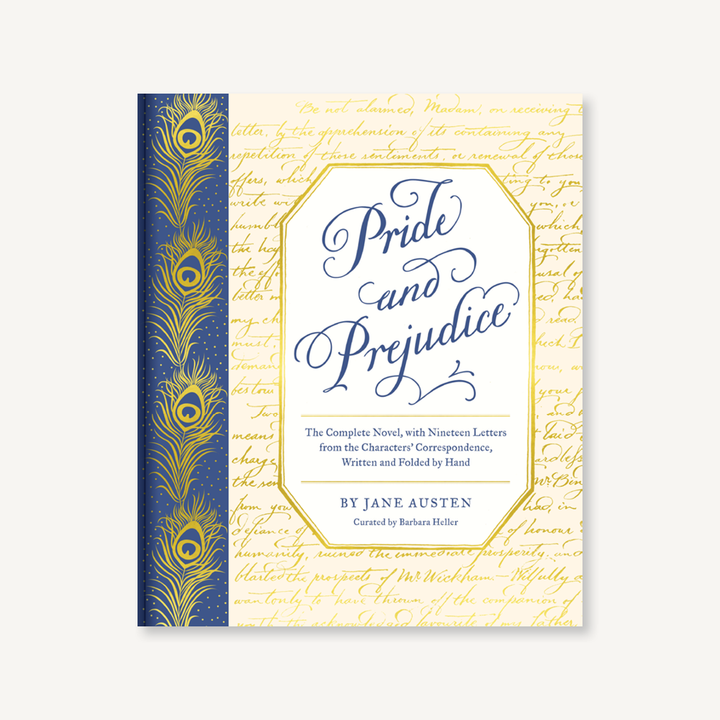 Inquiring Readers, On September 15th Chronicle Books will release an edition of Pride and Prejudice: The Complete Novel, with Nineteen Letters from the Characters’ Correspondence, Written and Folded by Hand, By Jane Austen, Curated by Barbara Heller. I received my lovely copy along with this text: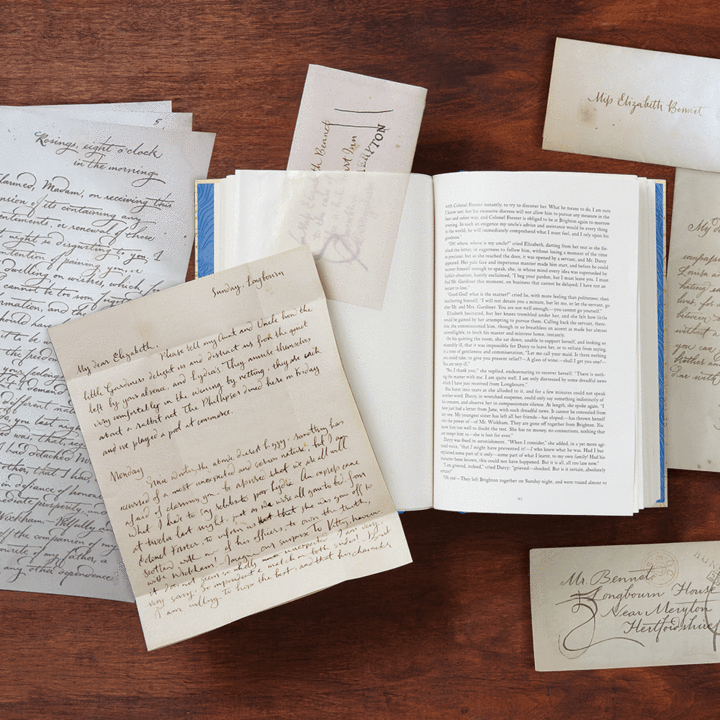






 Pride and Prejudice, an opera written by Kirke Mechem, will make its debut November 20th-23rd at the Miriam A. Friedberg Concert Hall, located at historic Mt. Vernon Place in Baltimore. This event is part of the Peabody Opera Theatre, Johns Hopkins University.










 Jane Austen's World