Feeds:
Posts
Comments

Archive for the ‘Regency Life’ Category

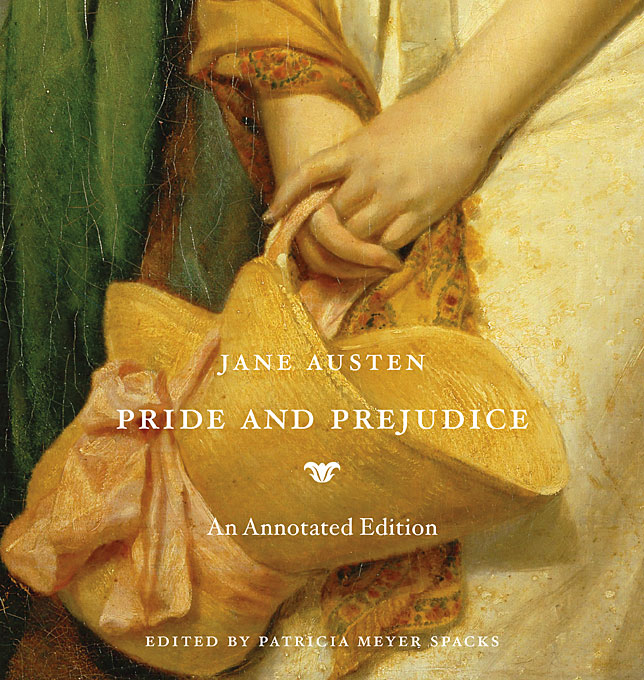
Jane Austen scholar Patricia Meyer Spacks has written many books, but none so lush and lovely as Pride and Prejudice: An Annotated Edition. Not only will this beautiful annotated edition of Jane Austen’s beloved novel look fabulous on your coffee table, but after reading it you will feel that you’ve come to understand Pride and Prejudice as you never have before.

Dr. Spacks’s definitions, descriptions, and clarifications of arcane words, Regency customs, and obscure passages add dimension to a novel that I have read over 22 times and thought I knew inside and out. But I was wrong. Take her annotation of this rather unassuming sentence in Chapter 4, for example:

With no greater events than these in the Longbourn family, and otherwise diversified by little beyond the walks to Meryton, sometimes dirty and sometimes cold, did January and February pass away.”

Dr. Spacks explains that in this instance, dirty meant muddy. Thinking of how uneventful life in a semi-rural setting must be, she adds, “Aside from the arrival of the militia and of Wickham, virtually everything of significance that has happened in the novel so far has been psychological…” She then goes on to describe the states of mind in Jane, Elizabeth, Darcy and Mr. Collins as they interact with each other.

In Chapter 2, Volume III, she introduces Michael Kramp’s idea that Mr. Darcy’s kindness to Mrs. Gardiner during Elizabeth’s and the Gardiners visit to Pemberly is evidence of the changing nature of England’s social arrangements and that “the gap between new and old money is shrinking.” (p. 307)

Dr. Spacks’s new annotated edition provides an erudite commentary on Pride and Prejudice, refers to many scholarly sources, and includes a large assortment of images. As she explained in a recent interview with me: “we looked for images that were beautiful in themselves and that illuminated some aspect of Austen’s period.”

Her 24-page introduction explores the continuing appeal of Pride and Prejudice: that it is considered safe for teaching in school and appeals to both feminists and sentimental individuals who are attracted to a romantic English past.

It has also emerged clearly as a repository for and stimulus of fantasy, and thus possibly less safe than it seems. In the film versions…Darcy, romanticized, tends to turn into a Heathcliff figure, passionate, beautiful, and overwhelmingly physical.”

A visitor to this blog recently asked how this annotation of Pride and Prejudice differed from David M. Shapard’s 2004 annotation. The Spacks volume comes in a lavishly color-illustrated, hardback edition, while Shapard’s book was published as a trade paperback. Scattered thinly throughout its pages are a few black and white illustrations. Aside from the difference in physical appearance, Spacks’s annotations are more scholarly.

Flipping through the first page of the novel, you can immediately spot the difference between the two approaches. Dr. Spacks, the Edgar F. Shannon Professor of English, Emerita at the University of Virginia, discusses the famous first sentence as material for a critical debate on the ambiguity of “want”, whereas Dr. Shapard, an 18th century expert, emphasizes the introduction of two central themes of the novel – marriage and financial considerations. These two annotations are so different, that I believe there is room on the shelves for both of them.

Jane Austen Pride and Prejudice: An Annotated Edition, edited by Patricia Meyer Spacks is a perfect gift for oneself and for a beloved friend or family member. If the $35 purchase price is a bit steep in this economic downturn, place it on your Holiday gift wish list. You will not be disappointed when you unwrap your package.

Read Full Post »

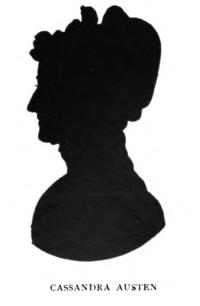
Cassandra Austen in later life

Gentle readers, I am often asked questions by readers, some of which I answer and some of which go unrecognized. Be assured that if you are a student looking for me to do your research when all you have to do is poke into my pages, I shall remain silent. But if your question is intriguing enough, I might be stirred to action. Such is the case with Craig Piercey’s recent question, which goes like this:

Hi Vic

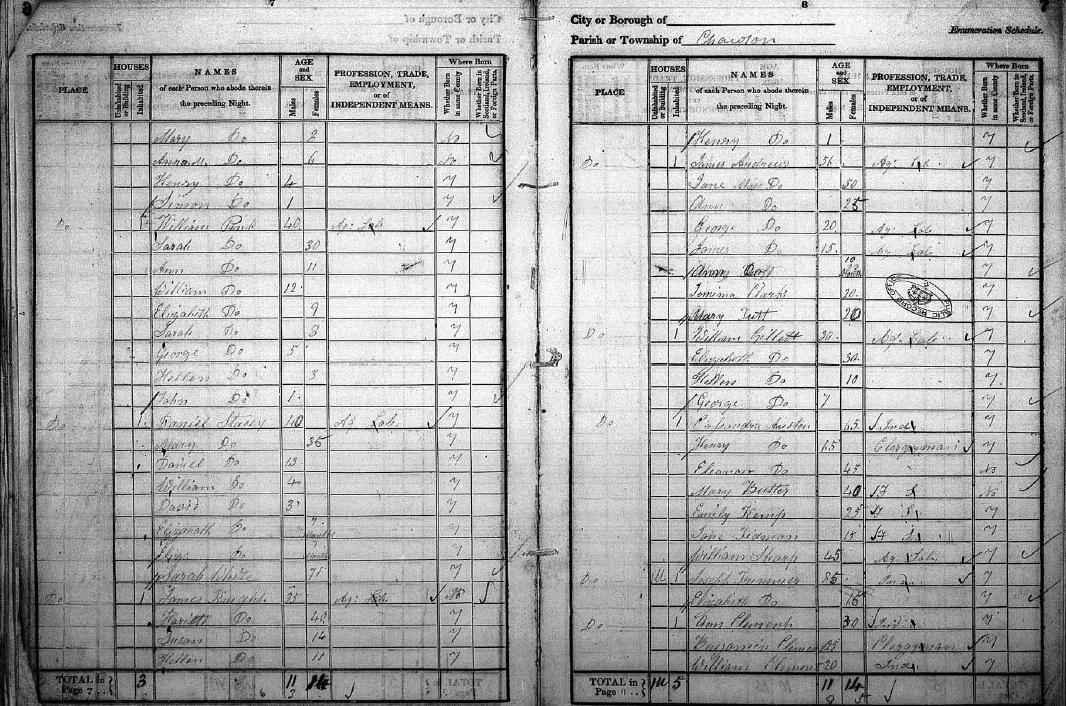
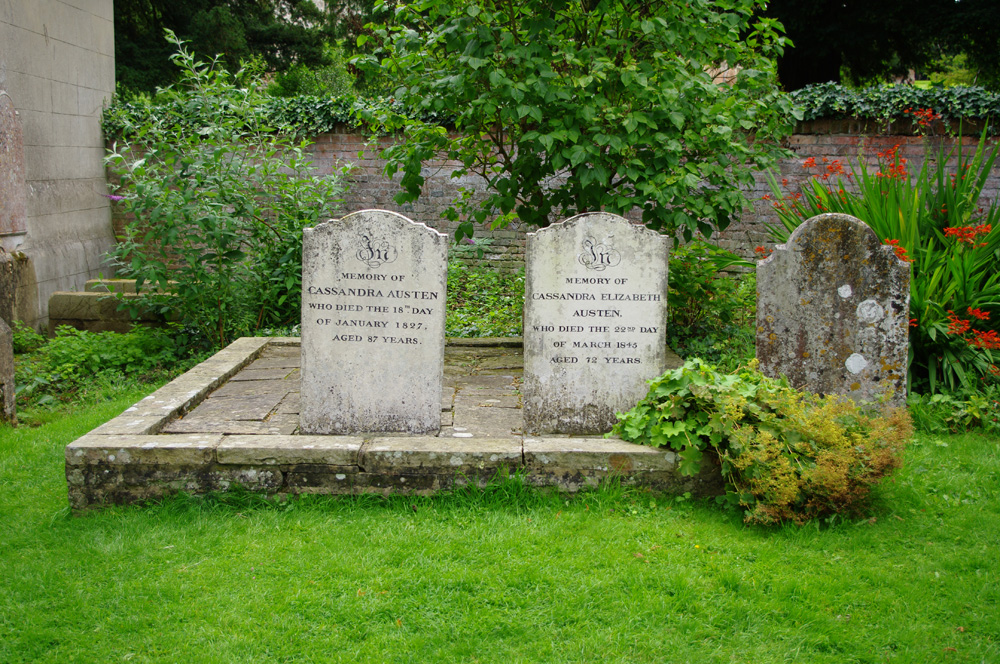
I was rummaging through the Census of 1841 when I came across something interesting. It lists Cassandra Austen of Chawton as 65 however, she died in 1845 aged 72 years. So, something is not right somewhere, either the census is wrong, there were two Cassandra Austen’s in Chawton (unlikely) or her age is wrong on her Grave Stone.

I enclose the census ledger – its on page 8 half way down. It has her listed as being of independent means.

Let me know your thoughts.

Cheers

Craig.

Ledger of the Chawton census, 1841

I could not give Craig an intelligent answer, for the first thought that came to me was that vanity had caused her to give the census taker a wrong age, but then I reasoned that perhaps an honest mistake had been made. I next thought of Tony Grant, who writes for both my blogs. Tony, a retired teacher, arranges customized tour packages for small groups of tourists. His resources are varied, and because he lives in England, he has quick access to historical registers and individuals who can help him. I asked Craig if I could share the question with Tony.

Hi Vic

Please feel free.

What confuses me is, somebody would have had to go round the houses in the village as it looks like the ledger was done by hand – no forms here… So, I’m guessing the nominated person must have actually met her and asked her her age. This would make the age on the Census probable but of course, not completely reliable. I seem to recall somewhere that it was originally clergymen who filled in the Census forms making her age being wrong even more unlikely as the clergyman at the time was her Nephew I think…

As for her grave stone… Well, I have never been to the church or the Great House, although I have been to her house and what I can say is that I have seen pictures of Cassandra’s grave and it look like it may have been moved as there was a fire in the late eighteen hundreds which gutted the original church and maybe the grave stones as well… Who knows, the age on the stones could be wrong… But, unlikely as there would have been family alive that would have known her intimately and surely would have noticed.

I would be interested to know the findings from this, maybe I’m just being stupid and have missed something obvious but, I think not.

Hope you are well, always a pleasure.

Craig.

After Tony returned from yet another of his tour excurions, I put the question to him. Still logy from his trip, he responded off the cuff:

Hi Vic

There were two Cassandras. Mrs Austen was also called Cassandra. This is off the top of my head…

Here’s a picture  of the Chawton Church yard. Tell me if this answers the question.

No it doesn’t. Just checked Craig’s message. Need to look at this further.

Gravesite, Cassandra and Cassandra Austen

Tony then got in touch with the Hampshire records office in Winchester, and “asked them about the discrepancy between the census of 1841 and the inscription on Cassandra’s grave stone.” The answer came almost immediately.

Hi Vic,

Hampshire archives are on the ball today. They got back to me. Here is what they said:

Dear Mr. Grant,

Thank you for your enquiry.

Indeed Cassandra Austen was 72 at the time of her death, her birth being in 1773. I checked the 1841 census and I must admit Cassandra’s age does appear to be 65 on the census return. Her Brother, Henry, born in 1771, is correctly recorded as being 65 and Cassandra should, depending on the date of the census, be recorded as being 68. Either, the census enumerator recorded her age incorrectly at the time of the cenus or there could be a possibility that the number 65 is badly faded and the five was originally an 8 as the original copy of the census return is quite badly faded. Apart from this it is a mystery why she would record her age as 65.

I hope this is of some assistance to you.

Yours Sincerely
Steve Jones

Steve Jones, Archives and Local Studies Assistant

Tony still wasn’t finished.

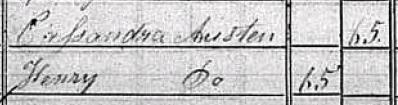
Closeup of the 1841 Census at Chawton

Hi Vic,

Just had a close look at the copy of the 1841 census you attached. There is no way that 5 was an 8. Somebody made a mistake in recording her age.They probably recorded Henry’s first,correctly as 65 and then got overawed by the domineering presence of Cassandra and either didn’t ask her her age or misheard out of confusion and recorded the same age as her brother.

You can just imagine the scene.

ANOTHER little dramatic episode one of our ,”writers,” could use.

All the best,
Tony

And there you have it, readers. Sometimes even the simplest question involves a great deal of thinking and searching. I am not sure we will ever solve the mystery, but I believe Tony and the Hampshire Records Office got as close to solving the mystery as anyone.

Update: But wait! The plot thickens. Who is the Henry below Cassandra Austen? If Henry Austen was born in 1771, he would have been 70 at the time of the census. Could the census taker have gotten the ages of both siblings wrong, or is this another Henry listed below Cassandra? I find it curious that his last name is not listed as Austen. The case becomes curiouser and curiouser.

Update #2: Laurel Ann pointed me to the site of the 1841 Census, which states,

Age and sex of each person:
Ages up to 15 are listed exactly as reported/recorded but ages over 15 were rounded to the nearest 5 years
(i.e. a person aged 53 would be listed on
the census as age 50 years).

If that is the case, what about Henry, who is already 70? His age would then be listed wrong, not Cassandra’s.

Thank you Craig and Tony for providing the content of this most enlivening and enlightening post! Vic

Update #3: Sarah Parry and Ray Moseley from Chawton House discussed the 1841 Census, as did Laurel Ann from Austenprose, which I featured on this post. Along with the comments below, we have a fairly comprehensive answer to the question. Thank you all for participating.

More about Tony Grant:

Read Full Post »

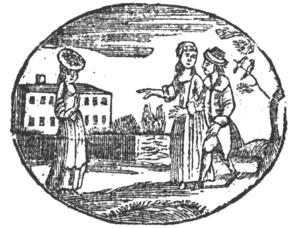
Punctuation Personified, 1760 version of A Pretty Little Pocket Book. Image from the British Library

This post about Jane Austen’s experiences in boarding school at a young age was written by Tony Grant, who is a frequent contributor. Tony also writes for his own blog, London Calling.

In 1782 at the age of 7 Jane Austen went to school for the first time. Theories go that she wanted to go to school because her elder sister Cassandra was being sent to Mrs Cawley’s school in Oxford to accompany their cousin Jane Cooper who was being sent there. Cassandra was to go as a companion for Jane Cooper. Jane did not like to be separated from Cassandra and Mrs Austen in later years suggested that Jane was insistent that she accompany Cassandra. However this may have been defensive reasoning by Mrs Autsen because of the near disaster that befell the girls whilst in the care of Mrs Cawley. So the real reasoning for sending Jane to this school at the age of seven is obscure.

Behavior at the School, from A Pretty Little Pocketbook, 1744

Mrs Cawley moved the school to Southampton because a measles outbreak had occurred in Oxford. However in 1783 troops, returning to the port of Southampton brought an infectious disease with them and Jane, Cassandra and their cousin Jane Cooper caught it. The three of them became very ill. It was only a letter from Jane Cooper to her mother and father in Bath that alerted the Austens to the predicament. Mrs Austen and Mrs Cooper both went to Southampton to collect their daughters. Mrs Austen had to nurse Jane back to health. Mrs Cooper caught the disease and later that year,died from it.

Reading Abbey, 1783, public domain image

One wonders what sort of education the girls actually got under the direction of Mrs Cawley. Sewing and French were taught, they read a lot and I presume they were able to write letters.

The adult Jane Austen wrote scathingly of girls schools. She found it hard to see schools as anything more than places of torment.

In1784 Jane was still at home after this first experience of school. She had free run of her fathers extensive library. After a year at home with the now motherless Jane Cooper the girls were sent off to school again. This time to A Mrs La Tournelles in Reading. Madame La Tournelle, she was not French by the way and spoke no French , was really called Sarah Hackit. She used the French name to impress prospective parents. She enjoyed telling stories about actors and actresses. She involved children in drama productions. They learned spelling, needlework and did get some French from one of the other teachers. Jane might have also learned to play the piano there.

Instruction with delight, from A Pretty Little Pocketbook, 1744

In 1786 a Gloucestershire cousin of Mr Austen, the reverend Thomas Lea of Adlestrop, visited the girls while passing through Reading. Later that year The Reverend Austen removed Jane and Cassandra from the school. Maybe Thomas Lea gave a poor report of the school and Jane’s father thought he was wasting his money. Jane never had any formal education again.

From their experience of school we can gather that Jane and Cassandra had perhaps learned some social skills, had had the opportunity to read, take part in plays, learn some French and learn the piano. These were things that were all available at home anyway.

B is for Bull, from an old alphabet book

So what makes for a fantastic, brilliant, inspiring, life changing, learning experience and how did Jane Austen actually learn?

With all those intelligent older brothers Jane had some great roll models. The vitally active and mentally agile and alert Jane must have passionately absorbed and lapped up what her brothers were doing, saying and experiencing. She must have had this inner drive and force to want what they had mentally and imaginatively. Inspiration is a great motivator. An inner need and hunger for something can’t be beaten when we want to learn. Jane must have had this in spades.

Cruikshank, Alphabet book

James Austen passionately loved the theatre and plays. He organised and directed dramas in their barn at Steventon. So Jane had acting and playwriting modelled for her to copy and use as her own skill. She began to write some juvenile works.

The there was her fathers library. She had a whole range of books covering many subjests to read and peruse. Somebody with Jane’s brain and need to know and explore would have been asking questions and finding answers that created more questions and so more reading and more asking. You can imagine an explosion of questions, ideas and exploration going on in that mind of hers.

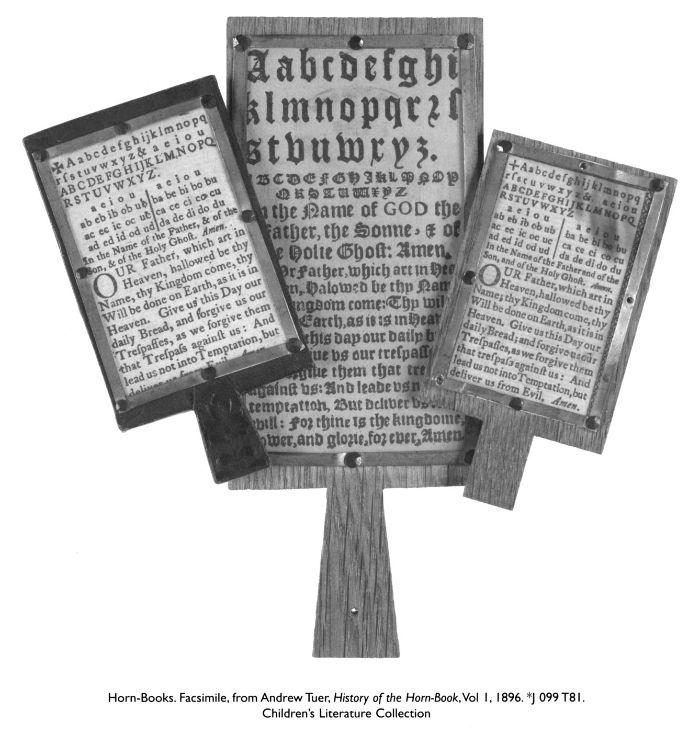
Children's horn books

From the point of view of a teacher what I aspire to do for my pupils is to make them independent, passionate learners, for life. But what gets them started? What gets that spark going? What ignites it all? I, as a teacher, have to try and provide experiences, I have to be a roll model, I have to demonstrate and model all sorts of different skills , I have to break things down into manageable learning experiences that have a progression. As an example of what I mean, here is how a might get a class to write a poem. On a fine sunny day I could take a group of children outside of the classroom to lie on the grass and look at the sky. We could talk about the clouds, the blue sky in-between, we could talk about the shapes they see, their feelings and all the while I would be coaxing them along by introducing new vocabulary, asking them, What? Why? How? What if? When? to get them to think in new ways and see and feel and think about things differently. Talking together is so important for the children. Teachers should talk less by the way.

Most of the lessons were given in a building next to the Gateway. Image from Austenized.

Then we could go back into the classroom. I would gather some vocabulary and ideas from the children and I would model the structure of a poem and maybe write a couple of lines of my own for them to see. The children now ready with words, a structure, ideas, concepts, similes and metaphors, some support materials for those who need it and with all this churning around in their heads, can write their poem.

The next time I wanted to write poem I would give them a little more independence. I would get them to tell me the process we did last time and they could use this. Those who needed my help would get more focussed support.

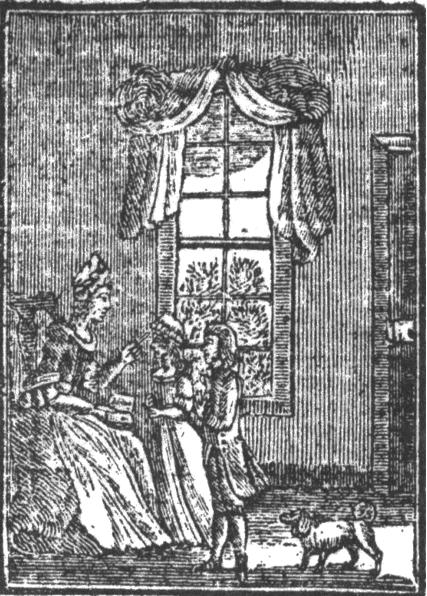
A little boy and girl reading, A Pretty Little Pocket Book, 1744

I can see this learning process in the story of our Jane. The way humans learn hasn’t changed, ever; it’s just that teachers through the centuries have gone against the natural process of learning. Nowadays we are far more enlightened and are actually trying to find out how our pupils can learn in the classroom and out of it. All those great learning experiences were there for Jane. Her mind was open to learning. She craved it. Children who tell me they hate school I always think is because nobody has tuned into their learning style, found out what inspires them, found out what WOWS!!! them. It’s all about close relationships really. A teacher should be able to get into the minds and feelings of their children, get under their skin.

Thank God Jane’s experiences, relationships and the world around her became her , “school,” and using the experiences and world around her, ignited her genius mind.

The idea of education in the 18th century was all about enforcing ideas and behaviours. Jane set free from that, was released into her real learning environment.

Read Full Post »

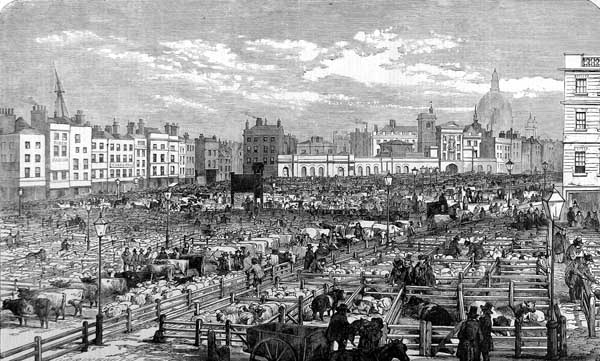
Last day of Old Smithfield, 1855

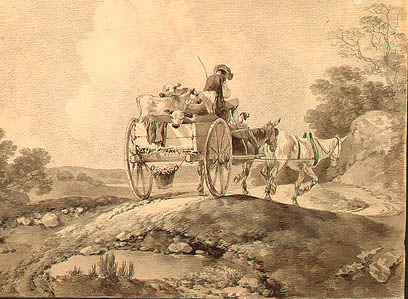
By the turn of the 19th century, over one million people lived and worked in London and its environs. The challenge in feeding so many people was no mean feat. Surrounding  farms sent produce to London’s markets, and drovers brought sheep and cattle over deeply rutted and ancient roads  from as far north as Scotland. Every September and October, enormous numbers of animals converged in Smithfield market, where they were sold and slaughtered for consumption. In Oliver Twist (1838), Charles Dickens described the filth of Smithfield Market, and the bellowing of frightened animals who had been forced to trudge from their peaceful pastures to what must have been a frightful, bewildering and nightmarish place.

It was market morning. The ground was covered nearly ankle deep with filth and mire; and a thick steam perpetually rising from the reeking bodies of the cattle, and mingling with the fog, which seemed to rest upon the chimney tops, hung heavily above … Countrymen, butchers, drovers, hawkers, boys , thieves, idlers, and vagabonds of every low grade, were mingled together in a dense mass: the whistling of drovers, the barking of dogs, the bellowing and plunging of beasts, the bleating of sheep, and the grunting and squealing of pigs; the cries of hawkers, the shouts, oaths, amd quarrelling on all sides, the ringing of bells, and the roar of voices that issued from every public house; the crowding, pushing, driving, beating, whooping and yelling; the hideous and discordant din that resounded from every corner of the market; and the unwashed, unshaven, squalid, and dirty figures constantly running to and fro, and bursting in and out of the throng, rendered it a stunning and bewildering scene which quite confused the senses.’

Drover with calves in a country cart, Gainsborough, 1755

Smithfield Market Days.-Monday for fat cattle and sheep. Tuesday, Thursday, and Saturday, for hay and straw; Friday, cattle and sheep and much cows, and at 2 o’clock for scrub-horse and asses. All sales take place by commission. The customary commission for the sale of an ox of any value is 4s., and of a sheep 8d. The City receives a toll upon every beast exposed to sale of 1d. per head, and of sheep at 2d. per score, and for every pen 1s. The total produce to the Corporation is from 5000l. to 6000l. a-year. Smithfield salesmen estimate the weight of cattle by the eye, and from constant practice, approach so near exactness, that they are seldom out more than a few pounds. The sales are always for cash. No paper is passed, but when the bargain is struck, the buyer and seller shake hands and close the sale. Several millions, it is said, are annually paid away in this manner in the narrow area of Smithfield Market.

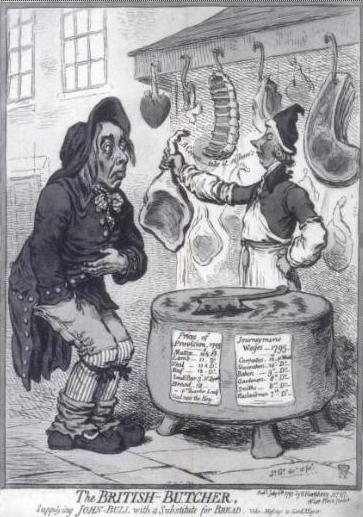
The British butcher

Quantities sold -The average weekly sale of beasts is said to be about 5000 ; and of sheep about 30,000 ; increased in the Christmas week to about 4000 beasts, and 47,000 sheep. As a sheep market, Smithfield has been constantly on the decrease within the last ten years. The following return shows the number of cattle and sheep annually sold in Smithfield during the following periods – Peter Cunningham, Hand-Book of London, 1850 – Victorian London Markets

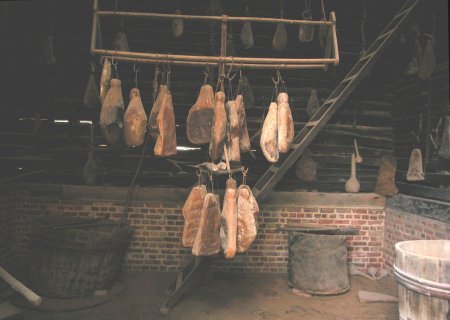
Smoke house, Mt. Vernon, Virginia. Image @Donald Mark

Without refrigeration and cookstoves, food storage and preparation presented challenges to the housewife and innkeeper alike. Fortunately, salt needed for preservation was plentiful in England. Cattle were brought into the market towns in September and October. The beef was salted and then hung up in smoke to preserve it. Pork was likewise both salted and smoked to make bacon and ham. For poorer families, these were practically the only meats eaten during the winter months. – Merrye Olde England: Food

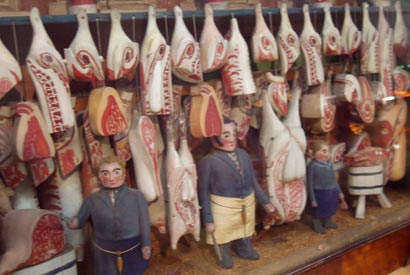
Toy 19th century butchers. Image @The Royal County Arbiter

The preservation of meat turned out to be a relatively simple technique. The meat was salt cured, which meant preserving it with a mixture of salt and saltpetre. Flavorings could be added, such as honey, sugar, pepper, and juniper berries. The salt in the meat drew out moisture, reducing the weight of the meat by as much as 18%-25%, and preventing the meat from decomposing.  The salted meat was hung to dry cure from a few months to a year. This process deepened the color of the meat and produced an intense flavor. Dried and cured, the meat was cut into thin slices and could be served at any time. – Historical Recipes: Dry Cured Ham


Read Full Post »

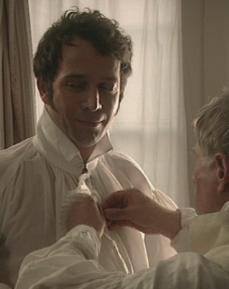
James Purefoy as Beau Brummel

Of course it became a fashion to exaggerate the Beau’s fastidiousness concerning his toilet. He is said to have employed at least two glovers to make his gloves — the first being entrusted exclusively with the making of the thumbs, the second with the fingers and the rest of the hand; to have made his blacking with champagne, to have had the ties of his cravats designed for him by an eminent portrait painter; to have engaged three hairdressers arrange his hair, one being entrusted with temples, one with the front, and the third his occiput [back of the head].

Quote from: Once a Week, by Eneas Sweetland Dallas, 1864,   p 242-243

Read Full Post »

« Newer Posts - Older Posts »