Feeds:
Posts
Comments

Archive for the ‘Regency Period’ Category

Over a year ago I read a fabulous blog post on the Regency Redingote entitled  Boy to Man: The Breeching Ceremony. The article is thorough and I was quite satisfied with its information until I ran into this quote, written by Jane Austen in 1801 to her sister Cassandra:

Mary has likewise a message: she will be much obliged to you if you can bring her the pattern of the jacket and trousers, or whatever it is that Elizabeth’s boys wear when they are first put into breeches; so if you could bring her an old suit itself, she would be very glad, but that I suppose is hardly done.”

This short passage told me much more about the topic and I decided to pursue it further.

Portrait of William Ellis Gosling, 1800 , Sir William Beechey, R.A. Image @Wikipedia

Portrait of William Ellis Gosling, 1800 , Sir William Beechey, R.A. Image @Wikimedia Commons

During the 18th century boys and girls were dressed alike in baby clothes during their infancy and in petticoats as toddlers. In Beechey’s image, our modern eyes would not identify the infant as a boy unless he was labeled as such.
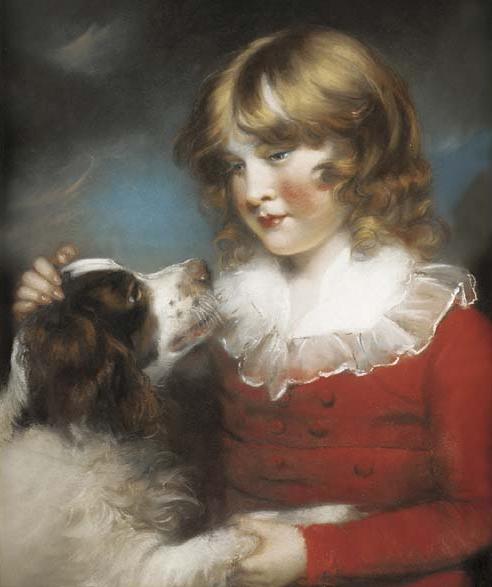
John Russel, Boy with spaniel. Image @ Christie's.

John Russel, Boy with spaniel. Image @ Christie’s.

At some point, the boys** would be placed in skeleton suits or a form of pantaloons and a frilly tunic. Their hair was still worn long and they still lived in the nursery, if the household was wealthy enough, or were overseen by women – their mothers, older sisters, grandmothers, aunts, nursemaids, etc.
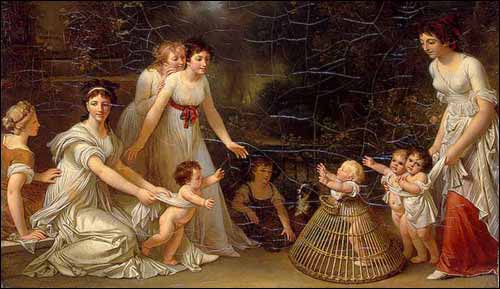
Fathers rarely stepped inside the nursery, the province of women.

Fathers rarely stepped inside the nursery, the province of women. In this idealized scene, the infants are guided on leading strings and a special “cage” that enabled toddlers to learn to walk. Image, source unknown. (Does anyone know the provenance?)

Between the age of 4-6, they would have their hair shorn and graduate to wearing trousers. This important event was marked by a breeching ceremony, a significant milestone in a young boy’s life. I can liken it to my first communion at the age of six. It was an event so important and memorable that I can still vividly recall my pretty white dress and veil, and the details of receiving my first communion wafer and celebrating the occasion with close family and friends. I felt different after that day, and in that way can relate to the pride that 18th and 19th century boys must have felt as they changed into the clothes that marked their first step to manhood.
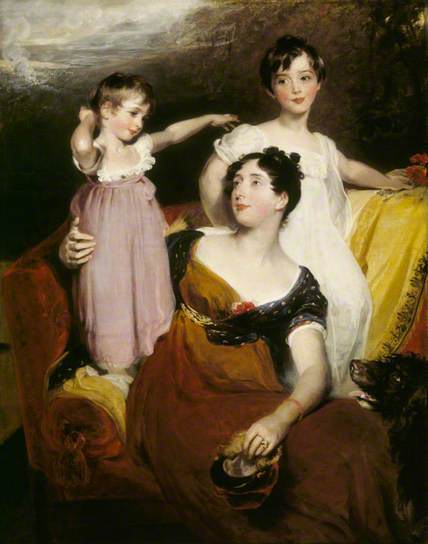
The modern eye would regard these two children as girls. Lydia Elizabeth Hoare (1786–1856), Lady Acland, with Her Two Sons, Thomas (1809–1898), Later 11th Bt, and Arthur (1811–1857) by Thomas Lawrence   Date painted: 1814–1815. Image @National Trust Collection

The modern eye would regard these two children as girls. Lydia Elizabeth Hoare (1786–1856), Lady Acland, with Her Two Sons, Thomas (1809–1898), Later 11th Bt, and Arthur (1811–1857)
by Thomas Lawrence
Date painted: 1814–1815. Image @National Trust Collection

The breeching ceremony had little to do with social status and was practiced across all class lines. The rich could afford any amount of new clothes for their children, made by tailors or seamstresses, no doubt, but at the start of the Industrial Revolution, the cost of clothing was still prohibitive for even the gentry, the class to which Jane Austen’s family belonged. As Jane Austen so often mentioned in her letters, clothes were generally remade and recycled rather than discarded. Ribbons, buttons, lace, or other embellishments were added to update a garment, and sleeves were reshaped or cut down to size, and hems raised or lengthened as current fashion required. If the garment was no longer suitable for one person, it could be cut down to size for someone who was smaller. The refashioned garment was worn and patched until it was given to the poor or used as rags.

Jane Austen’s comments about her sister-in-law’s request to Cassandra to bring back a pattern to share or an old suit for her boy’s breeching ceremony now makes sense. The women of the house sewed the clothes (for mass production of garments and textiles was still in the future), and shared patterns and borrowed sartorial ideas from each other. Hand me downs were de rigeur, I am sure, for most parents of that era with large families could scarcely afford new clothes for each of their many children.
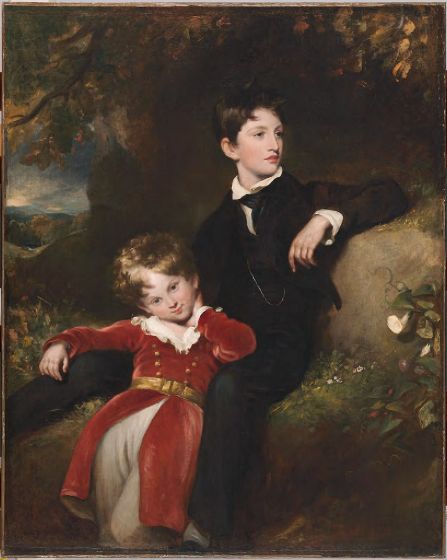
Thomas Lawrence English (Bristol, England 1769 - 1830 London, England) Sir Walter James, Bt., and Charles Stewart Hardinge, 1829. Image @Harvard Art Museums

Thomas Lawrence
English (Bristol, England 1769 – 1830 London, England)
Sir Walter James, Bt., and Charles Stewart Hardinge, 1829. Image @Harvard Art Museums

Regardless of social standing, all boys,  even those from the lower sorts, would receive a new pair of breeches around the age of six (four to six, to be more precise). The breeching event provided a cause for private celebration, to which family and friends were invited. For the parents, this ceremony also acknowledged that their child had survived past infancy. In an age when so many children died before reaching their majority (almost a fourth of them would die before the age of 10), the breeching ceremony might well have been the only significant event in a young boy’s life. In addition, he received a set of brand new clothes – a milestone indeed!

To put a perspective on how a parent felt about this event, Samuel Taylor Coleridge proudly writes of his son Hartley’s breeching ceremony in 1801:

Hartley was breeched last Sunday — & looks far better than in his petticoats. He ran to & fro in a sort of dance to the Jingle of the Load of Money, that had been put in his breeches pockets; but he did [not] roll & tumble over and over in his old joyous way — No! it was an eager & solemn gladness, as if he felt it to be an awful aera in his Life. O bless him! bless him! bless him!” – Samuel Coleridge to Robert Southey, November 9, 1801
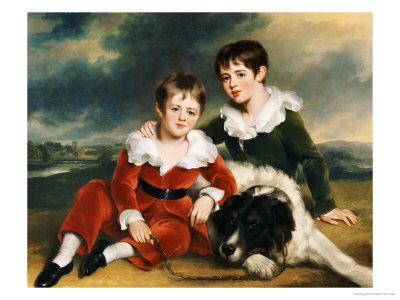
Portrait of Two Boys in Green and Red Velvet Suits by Ramsay Richard Reinagle

Portrait of Two Boys in Green and Red Velvet Suits
by Ramsay Richard Reinagle

What a vivid description! Relatives and friends, including the godparents, showered the young boy with coins and gifts. This ceremony marked an important occasion in which the boy left the world of women (nursery). After this momentous event, his father would become more involved with his upbringing or he would be mentored by other men in his life. He might be placed in a nearby boarding school with the young sons of other gentry, such as the one that Rev. Austen ran, for example, or in a more prestigious school if his parents were richer. Opposed to a young boy of the same age, a little girl’s life remained essentially the same – she would learn the art of running a household and catching a suitable man, but her young male counterpart would learn the art of running an estate or, if he was a second son, the skills required to make his way in life. (Click here for a modern image of breeches.)
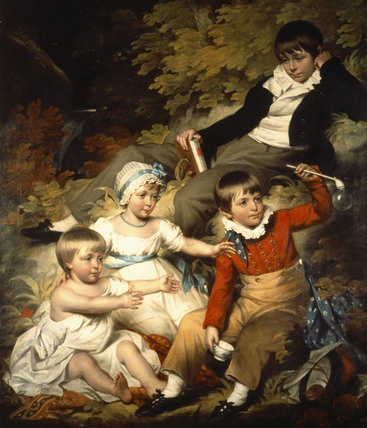
THE CHILDREN OF RICHARD CROFT, 6TH Bt.,c.1803, by John James Halls, R.A.  In this image one can see the three stages of boyhood - petticoats, skeleton suit, and jacket, shirt, and trousers.

THE CHILDREN OF RICHARD CROFT, 6TH Bt.,c.1803, by John James Halls, R.A. In this image one can see the three stages of boyhood – petticoats, skeleton suit, and jacket, shirt, and trousers.

**The type of clothing that young boys wore after the breeching ceremony depended on the century. During the 17th century, children’s clothes looked like miniature versions of adults. Young boys wore waistcoats, shirts, breeches, stockings and leather shoes. But by the time Jane Austen and Samuel Taylor Coleridge wrote their remarks in 1801, childhood was extended. Little boys wore skeleton suits until the age of nine, and then were graduated into more adult like clothing. Sons of the working class and poor did not wear skeleton suits, but wore clothing that resembled that of their farmer and laborer fathers.

More on the Topic:

Other links and resources:

Read Full Post »

The REAL Jane Austen_Byrne

Musings from a blogger:

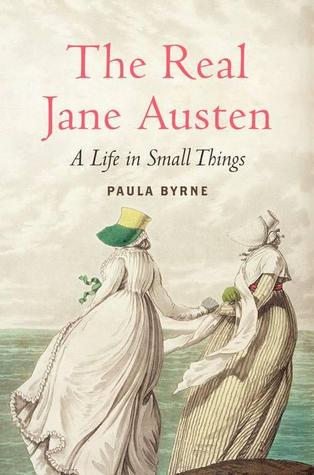
I meant to write a review of The Real Jane Austen: A Life in Small Things by Paula Byrne in February shortly after the book came out, but life intervened – life in the form of visitors, a busy schedule at work and move to new offices, a bum knee that required an operation and recuperation, and the book itself, which – several pages into it – urged me to read it to the last before recommending it (or not) to others. I carried the book every day to work hoping to complete it during lunch, but my best laid plans were inevitably derailed.

In addition to this blog and my interest in Jane Austen and the world she lived in, I have been reading other authors: Virginia Woolf, F. Scott Fitzgerald and Georgette Heyer, to name a few. David Stockman’s The Great Deformation, a great big bear of a book that holds economic insights that will chill the confidence of avid savers like myself, is my most recent acquisition. And then there’s Netflix. I admit to being a serial viewer of series that I missed seeing: The West Wing, for example, The Walking Dead, and now 30 Rock. Warmer weather now pulls me to spring gardening and walking in the great outdoors.

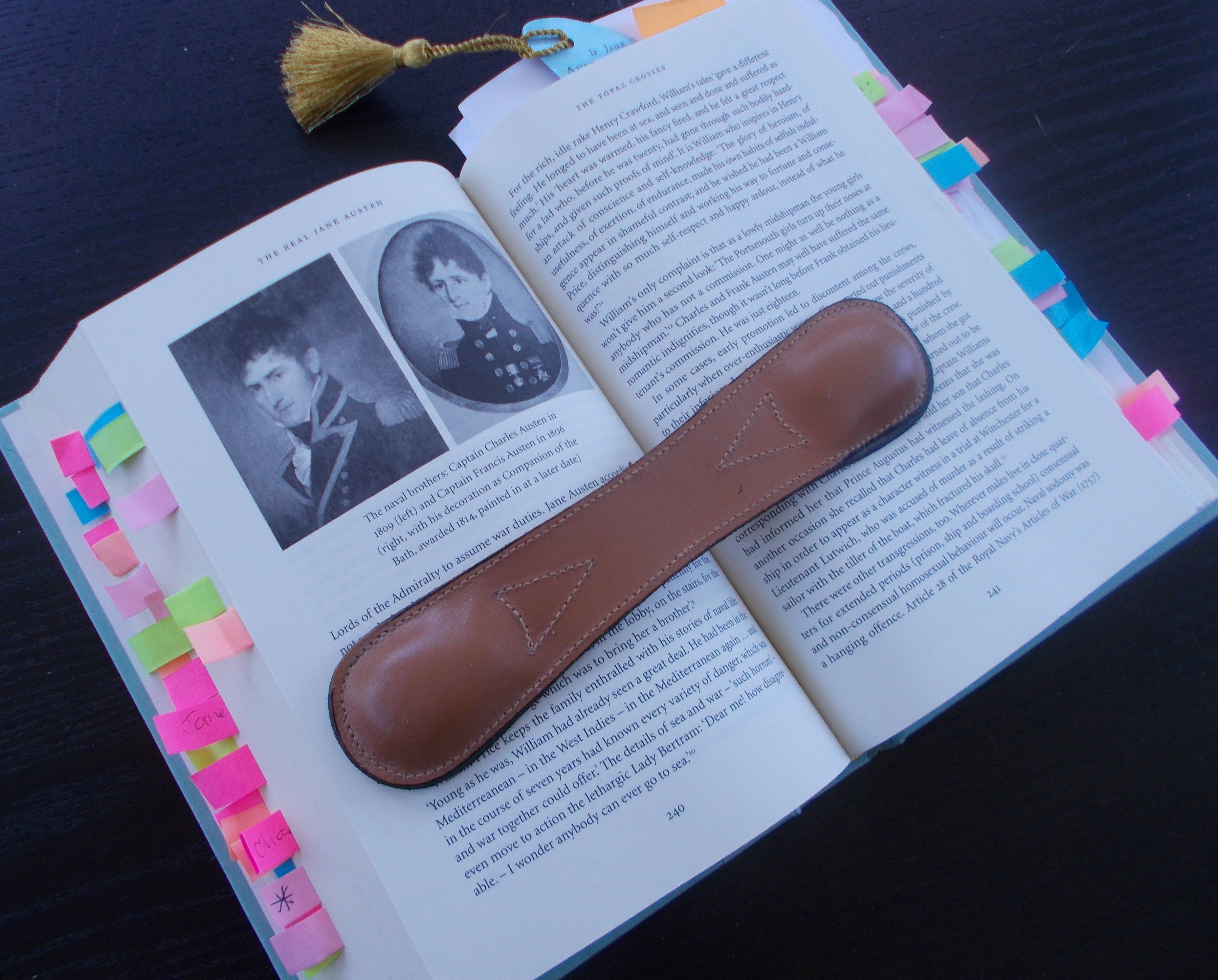
The real life of Vic Sanborn has been getting in the way of her quest to know more about the real Jane Austen, which is why this blog’s entries have been so spare of late and why I took so long to finish Paula Byrne’s book. Not that I didn’t enjoy it. This image of my copy of The Real Jane Austen will tell you all.

My well thumbed copy of The Real Jane Austen

My well thumbed copy of The Real Jane Austen

One would think that as a devoted Janeite who has read almost all the major biographies and articles about Jane, plus her books and letters and a great number of sequels about her novels and life, that I would have my fill of reading about Miss Austen. But I haven’t.

One acquaintance asked me how I could continue reading books that, on the surface, seemed all so similar. It’s simple, really. I rarely tire of talking about Jane and her works. I love the conversations in our book group. I enjoy attending conferences and meetings about her, listening to Janeite scholars and reading the insights of other bloggers who bring their own unique perspectives to her life and work. No matter how much I learn, I am still eager to know more. Just a slightly different take on her life and novels will provide me with new insights that spur me to uncovering more information. Full-fledged Janeite that I am, I can now publicly confess: I am dotty about Jane Austen and crazy about the Regency era.

My review of The Real Jane Austen

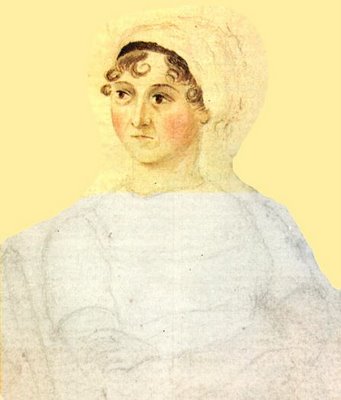
I frankly did not think I would like this book, my preconception coming from the blitz of publicity last year about the lost image of Jane Austen that Paula Byrne discovered. (I much prefer Cassandra’s tiny amateurish watercolour, which I viewed at the National Portrait Gallery.) When I received the book for review, I was mightily sick of the hoopla surrounding the portrait and began reading Dr. Byrne’s biography with some skepticism. Imagine my joy when the book held my interest from the start.
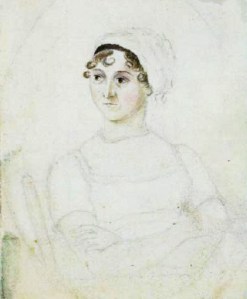
My preferred image of Jane Austen painted by Cassandra Austen. Image @National Portrait Gallery.

My preferred image of Jane Austen painted by Cassandra Austen. Image @National Portrait Gallery.

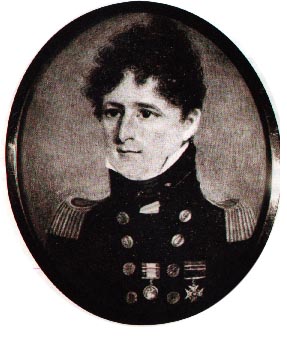
The Real Jane Austen focuses on specific objects, like the topaz crosses that Jane and her sister Cassandra received from their brother Charles. The conversation segued into a discussion of Charles and Frank Austen’s careers in the Royal Navy, and the lives of sailors in general, including that of William Price in Mansfield Park and those of the sailors in Persuasion. Details of letters and visits home flesh out our knowledge of Jane’s relationship with her brothers, as well as the background for some of the characters in her novels. While life on board ship was harsh, a career in the navy was one way in which the Austen men could seek their fortune through promotions and the spoils of war. At the tender age of eighteen, Frank obtained his lieutenant’s commission.
In some cases, early promotion led to discontent among the crews, particularly when over-enthusiastic young officers meted out punishments to their inferiors. Logbooks taken from Frank’s ships show the severity of the punishments. Forty-nine lashes would be given for theft and a hundred for insolence to a superior officer.”

Janeites who have read Jane Austen’s Sailor Brothers by John Henry Hubback, Edith C. Hubback, J.H. Hubback would already know many of these sailor details, but they are new for many. Dr. Byrne threads the influences in Jane’s life in such a way that a seasoned Janeite is happily reminded of well-known facts and a new reader is introduced to them in the context of Jane’s life, her letters and novels, and her influences.

Dr. Byrne uses other objects to develop Jane’s biography: a vellum notebook; a card of lace, which led to a discussion of the shoplifting trial of her aunt, Jane Leigh Perrot; the laptop writing box given to her by her father; her royalty check, which confirmed her as a professional writer; and a bathing machine, commonly used by bathers at seaside resorts. While at Lyme, Jane caught a fever and took to bathing to recover, using bathing machines and the services of a dipper named Molly:

Jane Austen enjoyed the experience of being dipped so much that she continued to take advantage: “The Bathing was so delightful this morning and Molly so pressing with me to enjoy myself that I believe I staid in rather too long, as since the middle of the day I have felt unreasonably tired.”

We learn that Jane, while a doting aunt, viewed children much as she did adults – some were simply easier to like than others. Her observation of Anna Lefroy’s girls is not unlike one that I can make of my family members, including myself: “Jemima has a very irritable bad Temper (her Mother says so) – and Julia a very sweet one, always pleased and happy.” Jane fondly thought about her fictional characters and how their lives would unfold, telling her relatives the details of Jane Fairfax’s and Kitty Bennet’s futures, for example – details that we Janeites crave.

There are other pleasant tidbits, of which I shall name a few. They include Tom Fowle’s letter to Cassandra, her fiance who tragically died at sea before he could afford to wed her; Cassandra’s deep romantic nature and her humorous side; the fact that Elizabeth Bridges preferred Cassandra over Jane, whom she did not like; details of Jane’s travels in an age when 90% of the populace sojourned only a few miles from their own community (This proves her to be less provincial than the myth of the isolated, rural spinster); Jane’s knowledge of the larger world, including the Napoleonic wars, slave and opium trades, and life at sea; that serious Frank Austen lacked a sense of humor but that he was quite generous towards the Austen women after Rev. George Austen’s death; and that Henry, Jane’s favorite brother called his sisters and mother “The Dear Trio”.

Frank Austen

Frank Austen

Many of these details are well-known to those of us who have researched Jane’s life for a number of years, but their presentation is delivered in a unique package that ties biographical influences to key moments and objects, and that weaves a view of Jane Austen which is both personal and well-researched. Unlike dry scholarly endeavors, filled with footnotes and references and a dense academic tone, Byrne keeps her wide readership in mind with a writing style that is relaxed and quite readable. There are just enough images to add another layer of depth to our reading experience.

Five out of five regency teacups

Five out of five regency teacups

I recommend The Real Jane Austen: A Life in Small Things highly to readers who are new to Jane Austen’s life and times, as well as to committed Janeites who simply cannot read enough about their favorite author. I imagine there will be some Janeites who will find this biography somewhat repetitive – I am not one of those. My rating is five out of five regency teacups.
Product Details
Hardcover: 400 pages
Publisher: Harper; First Edition edition (January 29, 2013)
Language: English
ISBN-10: 0061999091
ISBN-13: 978-0061999093

More on the topic:

Read Full Post »

Image copyright @Venn Studios 2013

Image copyright @Venn Studios 2013

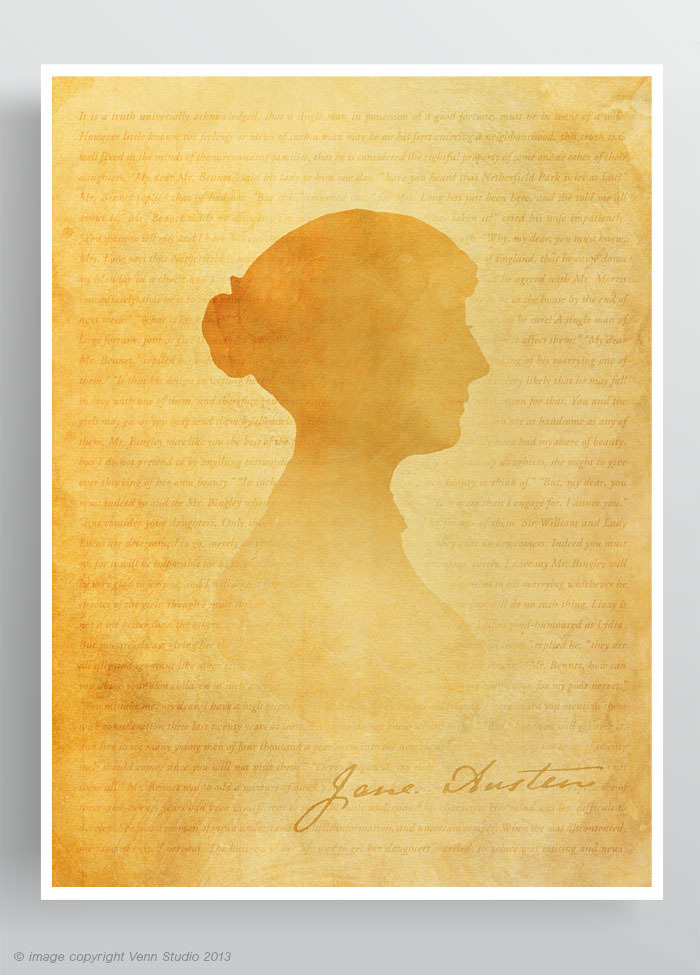
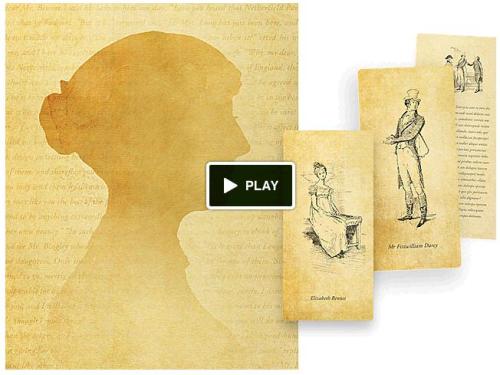
Congratulations to the four winners of the previous two books contests, which ended on April 1 and April 3 respectively. They are Raquel M. for Jane Austen’s World, Brenda B for The Jane Austen Handbook, and Rosalie A. and Monica Z. for Pride and Prejudice and Zombies. It was fun to read your comments! Continuing our Pride and Prejudice celebration is this Kickstarter project which aims to produce a new fine-art silhouette print of Jane Austen. The project details (and gently amusing video) can be be found by clicking on the image below or this link: http://www.kickstarter.com/projects/443052805/jane-austen-poster-print-and-pride-and-prejudice-c.

Jane Austen Poster

Image copyright @Venn Studio 2013

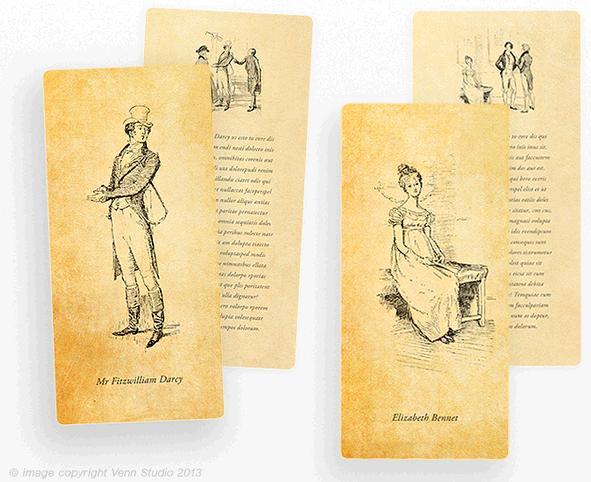
As a companion piece to the silhouette, a ‘pamphlet series’ will also be produced featuring much-loved characters from the book. Each pamphlet will feature a delightful illustration by Hugh Thomson – the talented artist commissioned to produce a series of drawings for the 1894 publication of Pride and Prejudice. The back of each pamphlet will contain a literary synopsis outlining the characters and their personalities. Each individual pamphlet measures 165mm x 78mm.

Jane Austen character pamphlets

Image copyright @Venn Studio 2013

Read Full Post »

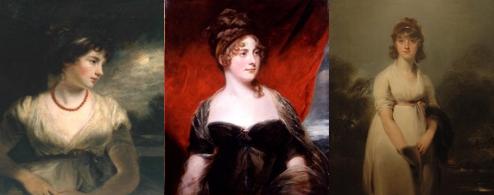
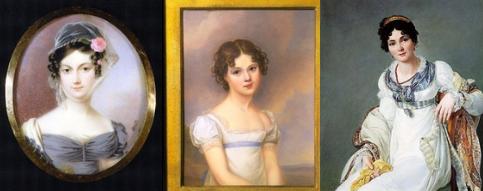
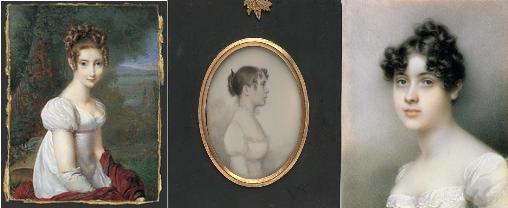
Several years ago I wrote a post on Regency Hairstyles and their Accessories. This series of images starts much earlier than the Regency. Jane Austen, who was born in 1775, would have been familiar with the hairstyles depicted here up to 1817, the year of her death. Her mother and aunts would have worn longer curls and powdered hair in her childhood. As teenagers and young women just coming on the marriage mart, she and Cassandra would have worn their hair much like the women in the 1790s.

Jane Austen's World image

1780s, 1781, 1790

As can be seen from the paintings, hairdos were elaborate in the 1780s and 1790s. Wigs made from real human hair were often used to build up elaborate hair structures. These confections took so many hours to create that a woman would wear them for days on end, protecting the hairdo at night.

Wigs and hair were covered with hair powder made of starch (potato or rice flour, not wheat flour). Oily pomades applied to the hair allowed the powder to stick and fragrant oils masked odors.

Jane Austen's World image

1790, 1792, 1795

Jane Austen's World image

1795, 1796, 1797

Hairdos became increasingly less elaborate and by the end of the 18th century women began to look to antiquity for role models.  (Regency Hairstyles and their Accessories.) A woman’s natural hair color was allowed to shine. More often than not, women tied back their hair in chignons that exposed the neck. In some instances, hairdos were cut boyishly short. Lady Caroline Lamb cut her hair short, as did the two girls shown in 1810.

Jane Austen's World image

1797, 1800, 18001801, 1801, 1802 1801, 1801, 1802

I cannot anyhow continue to find people agreeable; I respect Mrs. Chamberlayne for doing her hair well, but cannot feel a more tender sentiment – Jane Austen, 1801

1802, 1802-1804, 1804

1802, 1802-1804, 1804

1804, 1804, 1804

1804, 1804, 1804

1804, 1805, 1804-1806

1804, 1805, 1804-1806

1806, 1906, 1807

1806, 1906, 1807

1807, 1807, 1808

1807, 1807, 1808

Even when wearing hats, curls were coaxed out to frame the face. The woman below right with straight hair pulled back into a severe chignon wears curls in front of her ears. Curling tongs were very much in use during this era, as were paper and cloth curlers worn at night.

1809, 1809, 1809

1809, 1809, 1809

1810, 1810, 1810

1810, 1810, 1810

1810, 1810, 1810

1810, 1810, 1810

1810, 1810, 1810

1810, 1810, 1810

1810, 1811, 1812

1810, 1811, 1812

She looks very well, and her hair is done up with an elegance to do credit to any education.” – Jane Austen, 1813

1813, 1813, 1815

1813, 1813, 1816

1816, 1816, 1816

1816, 1816, 1816

Jane Austen wore caps over her light brown hair, but allowed curls to peep out from under them. I imagine that her nieces at a ball looked much like the young miss at top left in 1813. Hairdos became slowly more elaborate as dresses as dresses were embellished with frills, lace, and other furbelows. Jane would not have recognized the more elaborately decorated dresses and stylized hairstyles of the mid-1820s and 1830s, in which natural flowing lines were taken over by elaborately ruffled collars and skirt hems. Had she lived, she might even have made a joke at the expense of ladies who wore  the popular but elaborately built-up hairstyles at the crown, with ringlets cascading down the sides, and flowers and feathers arranged artfully into the curls. (Modes des Paris image.)

1818, 1819, 1820

1818, 1819, 1820

1824, 1825, 1825

1824, 1825, 1825

1828, 1828-1833, 1830

1828, 1828-1833, 1830

1831, 1834, 1835

1831, 1834, 1835

Modes des Paris image, 1832

Modes des Paris image, 1832

More on the topic

To see a Regency timeline of headresses and hairstyles for Regency evenings and their descriptions, click here.

Read Full Post »

matters-of-fact-in-jane-austen-2012-x-2001Jane Austen scholars and fans have always known that there’s so much more to her novels than the mere surface description of a romantic tale. Janine Barchas, author of Matters of Fact in Jane Austen, points out that in addition to Jane’s wit, intelligence , humor, and creativity in penning her novels, she associated her fictional characters with famous British families.  For the contemporary Regency reader, the Woodhouses, Fitzwilliams, Wentworths, and Dashwoods were the celebrities of their day. In  choosing famous names, Jane Austen ramped up her readers’ interest in her fictional characters by associating them with notable names, places, and events.

In her book, Barchas examines genealogy, history, and geography and comes up with some fascinating information that has recently surfaced via online documents and texts. I had always assumed that Jane pulled names out of a hat, or picked them for how well they fit the character. (Mr. Wickham for the charming villain, Mr. Knightley, who is kind and good and a bit of a knight in shining armor.) According to Barchas, that is not necessarily the case. Take Northanger Abbey, for instance. Among Bath’s wealthiest residents n the 18th century were the Allens from Prior Park, a grand and beautiful Palladian mansion that was visible from #4 Sydney Place, the house in which the Austens resided before Rev. Austen’s death.

Janine Barchas (l) and Juliette Wells (r) at the Brooklyn JASNA AGM.

Janine Barchas (l) and Juliette Wells (r) at the Brooklyn JASNA AGM.

The Dashwood family gained a notorious reputation, with one of its members, Sir Francis Dashwood, becoming a prominent libertine in the Hell-Fire Club. The garden in his mansion, West Wycombe Park, featured risqué statues and Hell Fire caves. In contrast, the Ferrars (Ferrers) lived staunch Catholic lives in their medieval manor, Baddesley Clinton. Interestingly, Stoneleigh Abbey, where Jane stayed with her mother, whose family were the Leighs of Stoneleigh Abbey, is only a half day’s ride from Baddesley Clinton.

And then there are the Wentworths, the grandest family of them all. Names seen on the Wentworth genealogy tree include Woodhouse, D’arcy, Bertram, Watson, and Fitzwilliam. Wentworth House in Yorkshire is quite grand, with vast grounds and public paths. After the “real” Frederick Wentworth died in 1799, his estate was passed on to the Vernons. (Shades of Lady Susan!) The contemporary Regency reader would have known that the Whig Wentworths resided in Wentworth House, while the Tory Wentworths lived in Wentworth Castle.

history of england_jane_cassandraThe History of England from the reign of Henry the 4th to the death of Charles the 1st, by a partial, prejudiced, and ignorant historian.

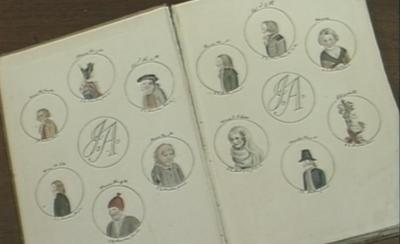
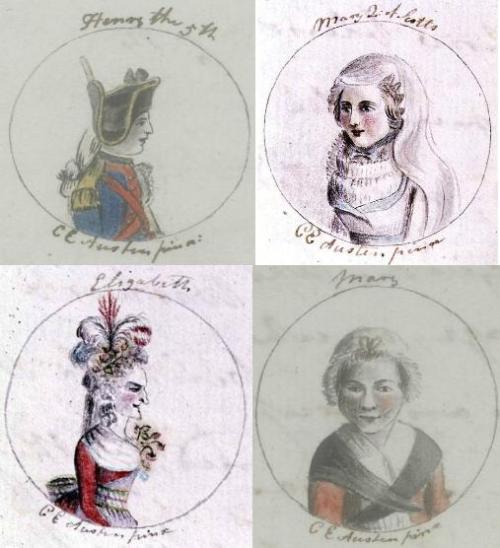
At the books beginning, Barchas mentions Jane Austen’s love for word play, riddles, and puzzles. The History of England, written when Austen was 15, was illustrated with 12 small watercolor portraits by Cassandra, Jane’s older sister.

CassandraAusten-JaneAusten(c.1810)reversed

Portrait of Jane Austen by Cassandra, 1810.

According to Annette Upfal and Christine Alexander: “the portraits which Cassandra drew into her sisters’ historical satire are encoded with veiled meaning.”

Mrs Casandra Austen

Mrs Cassandra Austen

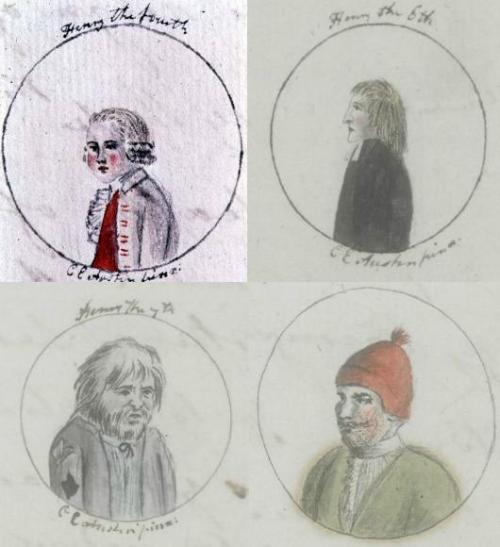
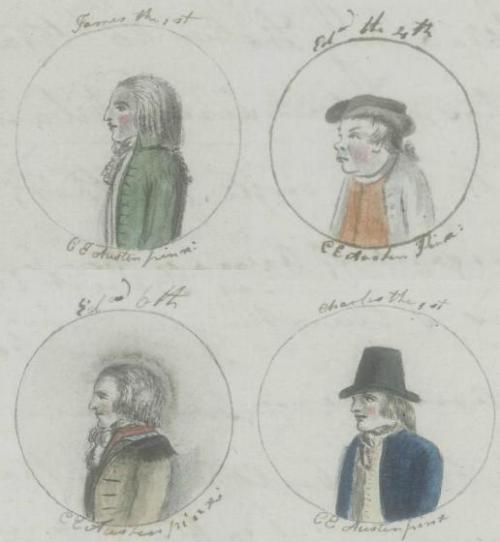
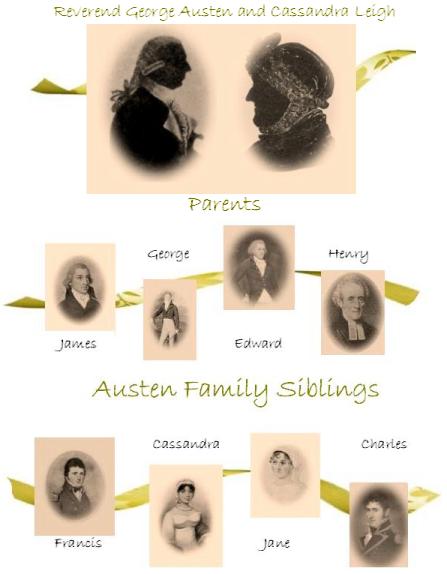
They argue that Austen’s summary discussion of kings and queens was comically interpolated with recognizable portraits of namesakes: brothers Edward, Henry, and James Austen, for example, stand in for Edward VI, Henry V, and James I, respectively. Similarly, cousins Mary Lloyd and Edward Cooper may have served Cassandra as models for Mary I and Edward IV. “

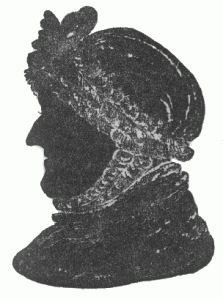
Upfal and Alexander also matched the profiles and portraits of Jane and her mother to those of Mary, Queen of Scots (Jane) and that of Elizabeth I (Mrs Austen). Barchas devotes scarcely a full page to this information and yet, as you can see, one can spend many minutes trying to decide how Jane and Cassandra used their family members and friends as models for the historical characters.

The Nenries

The Henries: the 4th, 6th, 7th, and 8th. Images from Jane Austen Fiction Manuscripts.

Marys Elizabeth and Henry

Henry the 5th, Elizabeth the 1st, Mary Queen of Scots, and Mary I. Some images from Wikimedia Commons. All others from Jane Austen Fiction Manuscripts.

cassandra james edward charles

James the 1st, Edward the 4th, Edward the 6th, and Charles the 1st

Austen family

Austen family

Matters of Fact in Jane Austen is not an easy read, for the book is crammed with facts, information, and new insights. One simply cannot skim over its pages, but should read each new chapter closely in order to learn what Jane’s contemporaries knew readily and well. Imagine an author writing a satirical novel today about a family going bankrupt and the daughters having to work for a living, using the Kardashian/Jenner family names and Los Angeles as a setting, and throwing in a crooked politician, lobbyist, Wall Street banker, and well-known radio talk show host. We would laugh and guffaw and understand the associations and jokes, but two hundred years from now, readers would be left clueless. In this book Barchas acts as our Regency guide, pointing out to us what was once obvious.

This is a serious, scholarly work, one that I highly recommend to readers who enjoy new and illuminating perspectives about Austen’s novels and life.

Janine Barchas is an associate professor of English at the University of Texas, Austin. She is the author of Graphic Design, Print Culture, and the Eighteenth-Century Novel.

Order the book here:

More on the topic:

Read Full Post »

« Newer Posts - Older Posts »