Feeds:
Posts
Comments

Archive for the ‘Regency style’ Category

1800-1819 Cover Fashion Plates
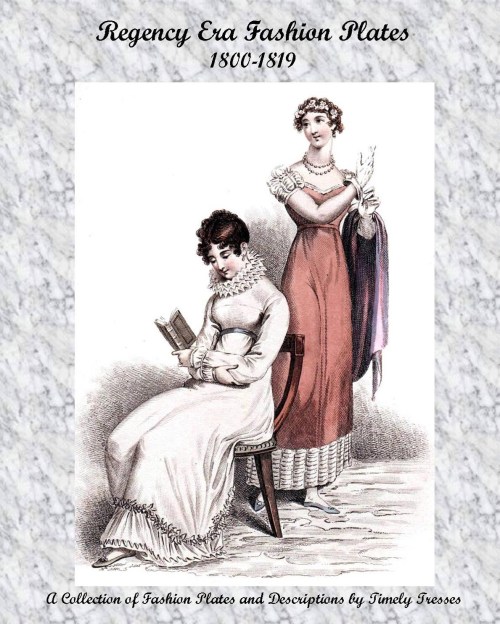
The moment I learned of Regency Era Fashion Plates, 1800-1819: A Collection of Fashion Plates and Descriptions by Timeless Tresses, I ordered it. Available in the U.K. through the Jane Austen Centre and at Amazon.com in the U.S., the book is not inexpensive. (My copy cost $44.) When it arrived I immediately tore open the package and began to peruse the book, which contain pages upon pages of colored fashion plates almost full copier paper size. That’s the good news. Compiled from the personal collections of Timely Tresses, the book is the joint venture of Mandy Foster and Dannielle Perry, two participants in living history who research fashion and create costumes based on the plates of a particular historic era. This is not the team’s first compilation. If you visit their site, you can choose from a variety of fashion plate books. But as I went through the book I was disappointed to find out that, while the fashion plates are arranged in date order, very few come with descriptions, nor are they identified by the season for which the dresses were designed. The plates are so large that in some instances they are blurred, and except for the cover, their colors are washed out.
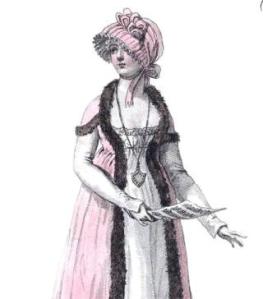
Detail of a plate in the book, Costume Parisien, 1799

Detail of a plate in the book, Costume Parisien, 1799

For those who are new to Regency fashion, it would have been helpful if these two seasoned collector/historians had shared some pertinent information about their fashion plates, helping the reader to “see” the changes in the silhouettes and styles of the gowns, where the fashion influences came from, and the difference between British fashion of the era and French fashion. Over half the plates are from Le Journal des Dames et des Modes Costumes Parisien or Costumes Parisien.  The Journal des Dames et des Modes was published in Paris from 1797 to 1803 and called Costume Parisien from 1803 to 1839. Until about 1825 the plates were drawn by Horace Vernet, which means that all of the Parisien plates in this book were drawn by him.

Before the Napoleonic wars, there had been a “pan-European” approach to dressing in which the rich and fashionable from countries across Europe largely wore similar fashions influenced by Parisian designs. But because of the war between the two countries, Britain and France took distinctly different approaches to dress design between 1808-1814. During this time period, very little information about fashion trends was shared. French waistlines remained high as British waistlines were lowered. Except for a few Ackermann plates, Regency Era Fashion Plates, 1800-1819, largely ignores British fashion during this 6-year time span, with most of the plates coming from Costumes Parisien. Since the book aims to be a resource for those desiring to make accurate costumes of the era, these differences need to be pointed out. A costumer for a film or play might mistakenly use  a French fashion plate to create a gown for a British character, for example. When British women were finally allowed to visit Paris after the war, they saw a stark difference between their British designed gowns and Parisian high fashion. In no time the French influence took over once more and British waistlines crept up again. After 1820, French designers looked across the Pond for inspiration and English-inspired motifs became all the rage.

The most obvious differences between British and French fashion would have been in the use of lace. Through a decree by Napoleon, French ladies were forbidden to use British fabrics, resulting in the revival of the French Valenciennes lace industry. British dresses began to be heavily influenced by Romantic motifs, such as the Gothic, whose embellishment looked ridiculous and cumbersome to the French.  I had hoped that these trends would have been pointed out clearly in the book and discussed at some length by the authors, but the annotations were sorely lacking, and only the end plates and a very few plates at the beginning describe the details of cloth and trim that the gowns were made of.  Even the simple expedient of sorting the plates according to year AND season would have made the plates easier to understand. (It is hard to tell whether the dresses were to be worn in fall or spring, for example.) Thankfully we can turn to the Ladies Monthly Museum on Cathy Decker’s site for some of the descriptions, but, frankly, this is a lot of work that the book could have saved us. One other point: the book concentrates solely on women’s fashion. Anyone looking for examples of men’s or children’s clothes of the era must look elsewhere.
3 regency fansFor the number of fashion plates, I give the book 3 out of three Regency fans. For overall impact and usefulness, I give it 2 out of three.

More links:

Regency Era Fashion

From Classic to Romantic: Changes in the Silhouette of the Regency Gown

Read Full Post »

The clothing that families have saved over the centuries were usually those items that were special or particularly treasured. This blog – Trouvais – features samples of the most lush 18th and 19th clothing imaginable.  Combined with luxury items of today, the site is a feast for the eyes.

Detail, early 19th c. redingote

Detail, early 19th c. redingote

Meg Andrews is another site worth visiting. Delectible clothing and items from the past are featured. Visiting the site makes you feel as if you have entered a museum.

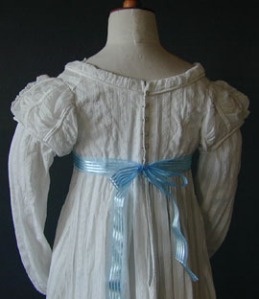
Striped cotton dress, 1810

Striped cotton dress, 1810

David Brass Rare Books may seem like an odd site to feature as a fashion site, but its rare and illustrated colored books show images of people in the past. One can easily concentrate on the Regency period and have plenty to view. One image, which I have shown previously, is from a book entitled The Fashions of London and Paris, 1798-1810.

Close up, Promenade in Kensington Gardens, 1804

Close up, Promenade in Kensington Gardens, 1804

I must also brag a little about my site. I don’t feature commentary about every facet of fashion like Cathy Decker, but I have gathered an extensive list of links . You may click on Social Customs During the Regency Era in the tab above and scroll down to fashions, or view the fashion links to the right in my sidebar, where such gems as Vintage Textiles sit. You can also read my fashion posts at this tagged link: Regency Fashion. Enjoy!

Sold Directoire dress from Vintage Textiles

Sold Directoire dress from Vintage Textiles

Five Old Things showcases three posts of a trip to the Costume Museum in Bath. The three posts are heavy with images, like this one of an 18th century man’s coat, embroidered waistcoat and pants.

Man's suit with embroidered waistcoat

Man's suit with embroidered waistcoat

Read Full Post »

Once upon a time children wore miniature versions of their parents’ clothing styles. Then, in 1780 or 1790, depending on the source you read, children began to be dressed differently, wearing fashions designed just for them.

Bowden Children, John Hoppner, late 18th c.

Bowden Children, John Hoppner, late 18th c.

Skeleton suit, Kate Greenaway

Skeleton suit, Kate Greenaway

Not that small boys, left to their own devices, would have worn high-waisted, ankle length trousers made of heavy cotton or linen and white cambric shirts with ruffled trim, but these “skeleton suits” as they were called were popular for at least fifty years. The pants had high waists, because they were buttoned onto the long sleeved jacket.

Although these long-sleeved, trousered suits were meant to be comfortable, they had three layers at the waist, not including underwear. Heaven knows how hot the boys must have felt in the summer or during active play! Or how quickly the white ruffed shirts soiled! Completing the outfit were white stocking, flat-soled strap slippers, and a military-style cap. The strapped slippers can best be seen in the 1841 fashion plate image at the bottom of this post.

Boy with cap

Boy with cap

A skeleton suit, one of those straight blue cloth cases in which small boys used to be confined before belts and tunics had come in … An ingenious contrivance for displaying the symmetry of a boy’s figure by fastening him into a very tight jacket, with an ornamental row of buttons over each shoulder and then buttoning his trousers over it so as to give his legs the appearance of being hooked on just under his arm pits. (Charles Dickens, Sketches by Boz, 1838-39.)

webmedia.php

Adding insult to injury, was the underwear that young boys wore under these layered clothes. This sample comes from the Manchester Art Gallery.

Detail of The Hoppner Children, 1791. Formal skeleton suit.

Detail of The Hoppner Children, 1791. Formal skeleton suit.

The smaller the boy, the more elaborately frilled the collar. Colors were generally light, with the most popular being blue or green. Sometimes the suits were made of scarlet or mustard as well. For more formal occasions, a colorful sash might be added and the trousers made of silk or velvet and trimmed with lace. A young man about to go to Eton would wear the larger Eton collar.

Detail of Fluyder Children, Sir Thomas Lawrence. Skeleton suit with sash

Detail of Fluyder Children, Sir Thomas Lawrence. Skeleton suit with sash

Detail, 1841 fashion plate

Detail, 1841 fashion plate

More Links:

Little Anne illustration, Kate Greenaway

Little Anne illustration, Kate Greenaway

Read Full Post »

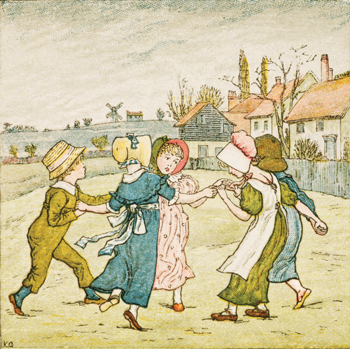
Kate Greenaway was a Victorian artist who drew incidents from every day life in the Regency era from a nostalgic point of view. Although infused with Victorian sensibility, her drawings are charming and still quite popular today. A contemporary illustrator, Walter Crane, said about her:

The grace and charm of her children and young girls were quickly recognized, and her treatment of quaint early nineteenth century costume, prim gardens, and the child-like spirit of her designs in an old-world atmosphere, though touched with conscious modern ‘aestheticism,’ captivated the public in a remarkable way.

kate greenaway different kinds of blind

For Crafters: Find free Kate Greenaway clip art at this site.


Kate was born in March 1846 in Hoxton. At the age of twenty Kate produced her first printed piece.
She also started doing greeting card, calendar and book illustrations.  One of her card designs sold over 25,000 copies in just a few weeks.  Although she was paid only 3 pounds she was starting to be noticed. Her first book [Under the Window] was produced in collaboration with Edmund Evans, with whom her father had apprenticed.  Evans spared no expense and the 20,000 copies sold almost immediately so a second printing of 70,000 was produced. –  Kate Greenaway
Today many of her illustrated books can be seen online.  The Queen of the Pirate Isle, autored by Bret Harte in 1885 and offered on Project Gutenberg, is illustrated by Kate. Check it out at this link.

Illustration from The Queen of the Pirate Isle.
In 1884,  The Language of Flowers, considered by many to be the finest of Kate Greenaway’s books, was published. Only 19,500 copies were issued in all.  While Kate continued to paint watercolours for the rest of her life, she could not match the spectacular success of her earlier career. She died in 1901.

Language of Flowers, Illustrated by Kate Greenaway, 1884

Language of Flowers, Illustrated by Kate Greenaway, 1884

Kate Greenaway by David Levine

Kate Greenaway by David Levine

More links: Listed in this section are a series of books with Kate’s masterful illustrations. 

Greenaway_11_lady_sitting

Read Full Post »

Inquiring reader, in honor of this week’s tepid heat wave in Richmond, I continue my coverage of all things seaside during the Regency era. To our moderns eyes, Regency fashions by the seashore covered as much of the body as ordinary clothes, and were as complicated as regular fashions. Let’s take a closer look.

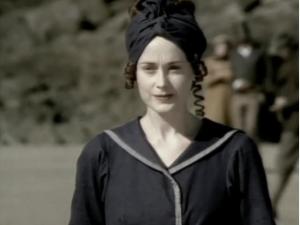
Becky Sharpe (Natasha Little) in bathing costume, Vanity Fair 1998

Becky Sharpe (Natasha Little) in bathing costume, Vanity Fair 1998

I question this image from 1998’s Vanity Fair, in which Natasha Little as Becky Sharpe looks more like a Victorian seaside gamboller than a proper Regency lady. In addition, she would have changed into this bathing costume inside the bathing machine and gone into the water largely unnoticed. She is shown in full view of both men and women on the beach wearing this outfit, which was clearly meant for swimming.

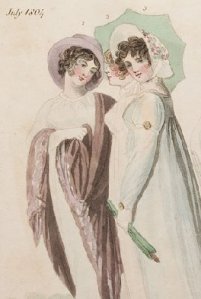
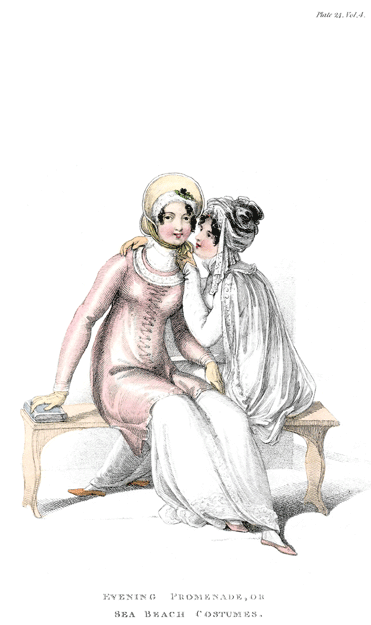
This Belle Assemblee fashion plate depicts a more demure approach to seaside fashion. The muslin gowns are rather plain, meant for the day, but it is only 1810 after all, when dress silhouettes were still classically severe. These dresses could be worn in full view of other vacationers on the beach. One sees the “wrapping” in the style of the turbans and pelisse and cape. A seaside outing was meant to be bracing and restorative, and therefore people would venture to the beach regardless of the weather.
1810_October sea beach costume

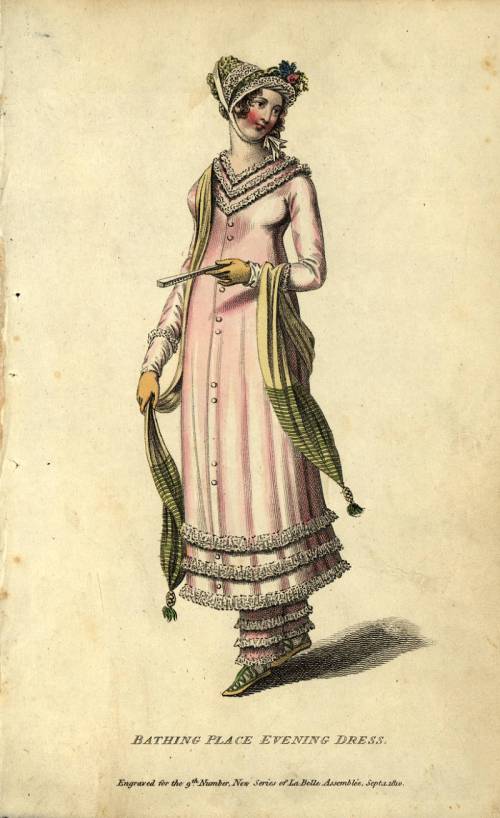
The women are sitting, or else the length of the dress would become obvious. The length of dresses meant to be worn when walking along the shore were cut a little higher, one supposes to accommodate a walk along the beach when sand and waves would wreak havoc with delicate hems. The lady in the illustration is dressed for the evening, perhaps for a fete on a public pier, who knows? Either way, she is dressed to be seen in high style, even if the tiered lacy hems of her bloomers are showing.

Bathing place evening dress, 1810

Bathing place evening dress, 1810

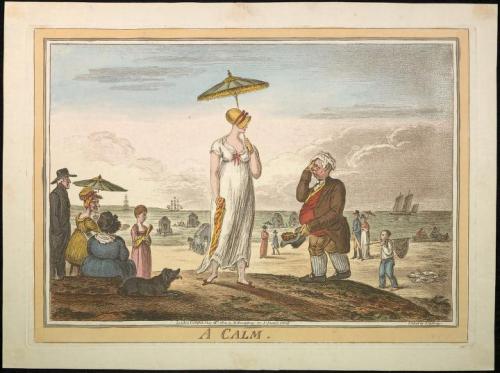
Famed illustrator James Gillray showed seaside fashion in all its glory. From the high tide hem of the lady in the center, to the completely covered up garb of the women sitting on the beach. This lovely illustration from 1810, “The Calm,” shows the seashore on a calm day, with our fashionable miss as exposed as she can decently be – her arms and neck bare, her head covered by a small straw bonnet, and her tiny parasol barely protecting her delicate skin from Sol’s harmful rays.a calm 1810 gilray
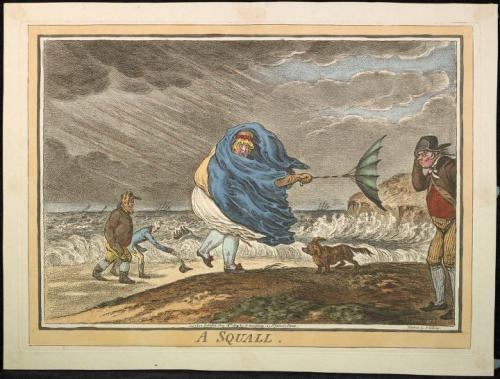
This illustration shows the sea shore on a raw day that many Britons will recognize, with the winds whipping up waves, woolen capes, and muslin skirts. Even covered up, this lady exposes more to prying eyes than was appropriate!

A squall, Gilray 1810

A squall, Gilray 1810

Taking cold dips in the ocean and drinking foul-tasting spa water were two of the health benefits derived from visiting a seaside resort. Inhaling the fresh sea air was another. These fashions again show how thoroughly one covered up before venturing out of doors.

Poetical Sketches of Scarborough, 1813

Poetical Sketches of Scarborough, 1813

Regardless of their location in or out of the water, non-swimmers remained covered up. It is ironic that once in the water, so many men and women would swim completely naked, but there you have it: Seaside, Regency style.

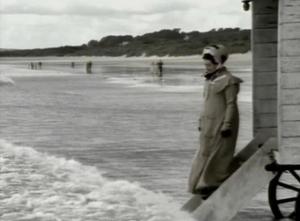
Steps to the sea, Vanity Fair, 1998

Steps to the sea, Vanity Fair, 1998

On a side note, a dog lover like myself will find the Gilray prints and the Scarborough print quite interesting, for dogs are prominently displayed as realistic touches.

Read Full Post »

« Newer Posts - Older Posts »