Feeds:
Posts
Comments

Archive for the ‘Regency style’ Category

Wednesday, June 27, 1711, Mr. Addison writes a letter to The Spectator:

Mr. Spectator – Women are armed with fans as men with swords, and sometime do more excution with them. To the end therefore that ladies may be entire mistresses of the weapon which they bear, I have erected an academy for the training up of young women in the exercise of the fan, according to the most fashionable airs and motions that are now practiced at court. The ladies who carry fans under me are drawn up twice a-day in my great hall, where they are instructed in the use of their arms, and exercised by the following words of command: – Handle your fans, Unfurl your fans, Discharge your fans, Flutter your fans – By the right observation of these few plain words of commands, a woman of a tolerable genius, who will apply herself diligently to her exercise for the space of but one half-year, shall be able to give her fan all the graces that can possibly enter into that little modish machine… For the rest of Addison’s letter to The Spectator, please click here.

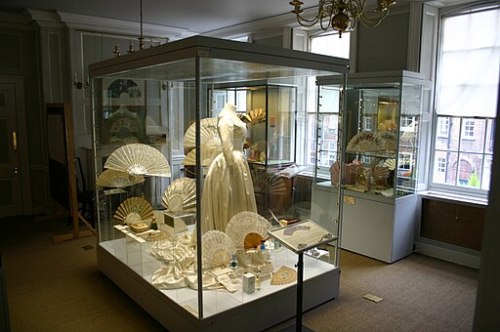
Wikimedia Commons, Image of the Fan Museum, Greenwich, UK

A lady’s fan carried far more symbolism than the mere act of cooling by agitating the air. At first considered a novelty, the fan gained popularity in Europe in the mid-sixteenth century and could be seen in the paintings of fine Elizabethan ladies. The folding fan, which was introduced from the Far East, gradually replaced the fixed fan. Made from vellum or paper, these fashionable and expensive accessories lent themselves well to elaborate painting and decoration. By 1709, fans began to be manufactured in London and a Fan Makers’ Company was established. Commemorative fans that celebrated an historic event were quite popular among the well to do, and their styles echoed the fashion of the day. Neoclassical fans, like the commemorative fan depicted above, lacked color and were generally bare of decoration, reflecting the simple white muslin dresses so popular during the Regency era. When dresses became more ornate and colorful again, fans followed the trend. They were highly prized for their aesthetics, for “in the ordinary fan of the present day Art has not strayed far from Nature.”

Over the centuries, a language of the fan evolved. Legend has it that by the time the Victorian era began fan gestures had been rigidly codified, wherein each movement and snap of the wrist carried a message fraught with meaning, although some experts dispute this. (See comment below made by Pierre Henri Biger, a fan expert.)  Once popular both during the day and evening, fans gradually became restricted only for the evening, increasing in size in the last two decades of the nineteenth century.  Their popularity waned and waxed as the quote below suggests, but until they could be cheaply manufactered in large quantities, they remained the province of only those who could afford them. In the late 19th century to early 1920’s, fans were made in profusion to carry advertisements, and were given away as souvenirs by hotels, restaurants, and businesses.*

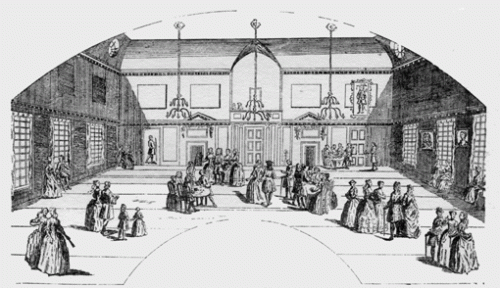
Fan Design, The Lower Rooms, Bath

Fan Design, The Lower Rooms, Bath

For just a century after Addison wrote, the fan figured prominently in polite society, matched, when the sword went out of fashion, against the snuff-box and the clouded cane, and often victorious. The satirists and dramatists wore in turn bitter and pleasant in their references to it. Painters and their sitters paraded it ostentatiously. It is said to have done wonders in diplomacy, and who could wonder at the success of flying sap and masked battery against garrisons defended by an eye-glass, a pinch of snuff, and a malacca. The fan’s apogee was in the days of the minuet de la cour. But since athletic waltzes, polkas, and mazurkas have elbowed out their courtly predecessors, the once ” modish little machine” has retired into obscurity with the “wall-flowers,” or, if at all, is used by the dancers as inartistically as though it were the archetypal ” vanne” or wind engine. Brighter days may, however, dawn, and society which, in its way back to costumes of the Watteau and Pastoral periods, has already reached the stage of short waists and long trains, may over in our time reclaim the little exile from its temporary partial shade. – Nature and Art, by Day & Sons, 1866, p62

More about this fascinating fashion accessory

Read Full Post »

In Sense and Sensibility, Elinor and Marianne Dashwood receive their first unflattering glimpse of a finnicky Robert Ferrars in Gray’s Jewelers  as he takes his time choosing a toothpick case:

He was giving orders for a toothpick-case for himself, and till its size, shape, and ornaments were determined, all of which, after examining and debating for a quarter of an hour over every toothpick-case in the shop, were finally arranged by his own inventive fancy, he had no leisure to bestow any other attention on the two ladies, than what was comprised in three or four very broad stares. – Jane Austen

Good dental hygiene is not a modern concept. Toothpicks have been found alongside their owners in ancient Egyptian tombs, and the Chinese freshened their breath as early as 1600 B. C. by chewing on aromatic tree twigs.  The world’s first known recipe for toothpaste, a mixture of rock salt, mint, dried iris flower, and pepper, came from Egypt. The development of toothpastes in more modern times started in the 18th century. A bicarbonate of soda or baking soda, the main raising agent in baking powder, was traditionally used for cleaning teeth and included in tooth-powder . A 19th century London Times advertisement promised an assortment of wonderful results for those who used tooth powder:

For the TEETH. Patronized and used by his Royal Highness the Duke of Kent. TROTTER’s ORIENTAL DENTIFRICE, or ASIATIC TOOTH POWDER, had been for 20 years acknowledged by the most respectable Medical authorities, used by many, and recommended. The Powder cleanses and beautifies the teeth, sweetens the breath, posses no acid that can erode the enamel, and puts a beautiful polish on the teeth. From its astringency, it strengthens the gums, eradicates the scurvy (which often proves the destruction of a whole set of teeth), preserves sound teeth from decay, secures decayed teeth from becoming worse, fastens those which are loose, and proves the happy means of preventing their being drawn. – Next Year, Last Century

A dentist named Peabody was the first to add soap to toothpowder in 1824. Betel nut, though to reduce cavities, was also mixed into certain recipes.  By the 1850s chalk was included and in the 1860s a home-made toothpaste recipe incorporated ground charcoal. Recipes for tooth powder varied and were zealously guarded by their creators:

Toothpowders were based on three or four components: abrasives such as chalk, orris root, heavy magnesium carbonate or cuttlefish bone; antiseptics and detergents, represented by powdered hard soap and borax; and astringents which could be the tannins found in cinchona bark, bayberry leaves, essence of sassafras, and, very commonly, tincture of myrrh. Aromatic substances were often added as breath sweeteners, common ones being cardamon, cloves, peppermint, oil of lemon and aniseed. – Dental practice in Europe at the end of the 18th century By Christine Hillam, p. 214

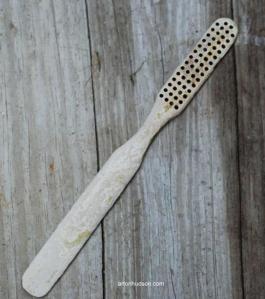
The first toothbrush was made around 1780 by William Addis of Clerkenald. Addis also manufactured tooth brushes made of cattle bone.  Boar bristles were placed into bored holes and kept in place by a thin wire.  Interestingly, boar bristles remained in use until 1938, when nylon bristles began to replace the natural fiber.

Toothbrush holder made of bone, early 1800

Toothbrush holder made of bone, early 1800

Toothbrush bristles were the stiff, coarse hairs taken from the necks and shoulders of swine who lived (preferably) in the colder climates of  Siberia and China. Tooth powder was packed in a variety of boxes, like the one in the image below.

19th c. toothpowder box

19th c. toothpowder box

By the early 1800s, a variety of toothbrush and toothpowder manufacturers were competing with each other for a rapidly growing number of clientele in a thriving toothpowder trade. Tooth powder recipes proliferated, and toothbrushes began to be sold in great quantities. Sometimes both the tooth powder and toothbrush were sold together  ( ‘Bott’s Tooth Powder and Brushes’, Newspapers (1798).

M. Trotter, a widow, manufactured tooth powder and tooth brushes in her warehouse on No. 36, Surrey-street  in the Strand. Her tooth powder cost 2s 9d a box and her India Tooth Burshes cost 1s each. She was so successful that in a few years she moved into larger premises.  Dental Practice in Europe, p. 212

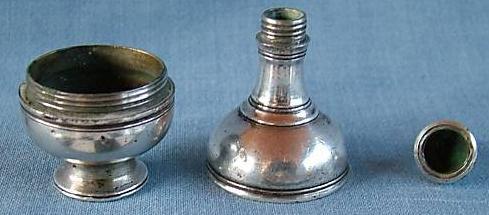
18th c. silver flask-shaped comfit box

18th c. silver flask-shaped comfit box

Anise comfits

Anise comfits

Breath fresheners took the form of comfits made of anise, caraway, and fennel seeds. These sugary seeded confections were laborious to make,  requiring dozens of thin sugar coatings. The seeds needed to be continually stirred in order to spread the coat evenly, and each sugared coat had to harden before the next coat was poured on. The process was repeated until the comfits had reached the proper size.  When a comfit is chewed, the fennel or anise seeds are crushed open, freshening the breath for 15 minutes up to half an hour.  People are still served this type of candied seed in Indian restaurants today.

More information on this topic:

Read Full Post »

Gentle Reader, July 18th marks the anniversary of Jane Austen’s Death. This post was first published in 2007:

Mary Austen nee Lloyd, the wife of James Austen, was present at Jane’s death. She wrote the following passage in her diary (See image below)

17 July 1817 “Jane Austen was taken for death about ½ past 5 in the Evening”
18 July 1817 Jane breathed her last ½ after four in the morn; only Cass[andra] and I were with her. Henry came, Austen & Ed came, the latter returned home”

Read a sad but fascinating account of Jane’s final hours, Jane Austen’s Final Resting Place, at Hantsweb.
Jane spent her last days in a small house in Winchester, near a doctor of some repute. She wrote in May:

I live chiefly on the sofa, but am allowed to walk from one room to the other. I have been out once in a sedan-chair, and am to repeat it and be promoted to a wheeled chair as the weather serves.” And speaking of her illness she remarks, “On this subject I will only say further that my dearest sister, my tender watchful, indefatigable nurse has not been made ill by her exertions. As to what I owe to her, and to the anxious affection of all my beloved family on this occasion, I can only cry over it, and pray to God to bless them more and more. – Chapter XXIII, Jane Austen: Her Homes & Her Friends (John Lane The Bodley Head, 1923) by Constance Hill.


Jane died on July 18, 1817. Cassandra, Jane’s dear sister, wrote these affecting words:

Since Tuesday evening, when her complaint returned, there was a visible change, she slept more and much more comfortably; indeed, during the last eight-and-forty hours she was more asleep than awake. Her looks altered and she fell away, but I perceived no material diminution of strength, and, though I was then hopeless of a recovery, I had no suspicion how rapidly my loss was approaching.

I have lost a treasure, such a sister, such a friend as never can have been surpassed. She was the sun of my life, the gilder of every pleasure, the soother of every sorrow; I had not a thought concealed from her, and it is as if I had lost a part of myself. I loved her only too well — not better than she deserved, but I am conscious that my affection for her made me sometimes unjust to and negligent of others; and I can acknowledge, more than as a general principle, the justice of the Hand which has struck this blow.

You know me too well to be at all afraid that I should suffer materially from my feelings; I am perfectly conscious of the extent of my irreparable loss, but I am not at all overpowered and very little indisposed, nothing but what a short time, with rest and change of air, will remove. I thank God that I was enabled to attend her to the last, and amongst my many causes of self-reproach I have not to add any wilful neglect of her comfort.

She felt herself to be dying about half-an-hour before she became tranquil and apparently unconscious. During that half-hour was her struggle, poor soul! She said she could not tell us what she suffered, though she complained of little fixed pain. When I asked her if there was anything she wanted, her answer was she wanted nothing but death, and some of her words were: “God grant me patience, pray for me, oh, pray for me!” Her voice was affected, but as long as she spoke she was intelligible.

Read the rest of the letter on the Republic of Pemberley website.

Read Full Post »

Ransome's HonorKaye Dacus is an author and editor who has been writing fiction for more than twenty years. A former Vice President of American Christian Fiction Writers, Kaye enjoys being an active ACFW member and the fellowship and community of hundreds of other writers from across the country and around the world that she finds there. She currently serves as President of Middle Tennessee Christian Writers, which she co-founded in 2003 with three other writers. Each month, she teaches a two-hour workshop on an aspect of the craft of writing at the MTCW monthly meeting. But her greatest joy comes from mentoring new writers through jer blog and seeing them experience those “aha” moments when a tricky concept becomes clear. In June 2006, she received her Master of Arts in Writing Popular Fiction from Seton Hill University. Her thesis novel, Happy Endings Inc., beca,e her first published novel, re-titled Stand-In Groom.Romance novels were amongst the first books Kaye Dacus read, so it was natural when she started writing as a young teen, that would be what she penned. Kaye, who lives in Nashville, Tennessee, is a Jane Austen fanatic and loves watching and discussing British costume-drama movies with friends.

1. How long have you been a writer? Correct that, how long have you wanted to be a writer and have you always wanted to write Christian romance novels?

I’ve always had a very active imagination, making up my own internal stories, complete with characters, my entire life. Around age twelve or thirteen, I wanted to be able to remember what I’d been imagining, so I started writing it down on paper. And even though I majored in English/Creative Writing in college, it wasn’t until my late 20s/early 30s that I realized I wanted to pursue publication and learned not only how to finish a novel, but the craft and skill that goes into writing one that’s going to catch a publisher’s eye.

I wouldn’t say I’ve always wanted to write “Christian” romance novels. Everything I’ve written has always had a romantic theme to it. They happen to have a spiritual worldview to them because that’s my own personal worldview. Therefore, it was logical to seek publication in the Christian publishing industry, since that’s where they fit best. But pretty much, my goal is to write stories that entertain and uplift—and that I can let my mom and my grandmother and my fourteen-year-old niece read without worrying about offending them.

2. What is a Christian romance novel exactly?

There are actually a few different levels of religious content within books that are considered “Christian”—those that are published by CBA (Christian Booksellers Association) and ECPA (Evangelical Christian Publishers Association) publishers. The first is “moral” fiction—those that are clean (no foul language, no sex on the page—it only happens behind closed doors and between married couples) but without an overt spirituality/religious flavor to them; they may not even mention God or any kind of religion at all. The next is what I write, which is “inspirational” fiction—those that are spiritual, but the characters usually start out as Christians—it’s just a normal part of their daily lives—and though there is a spiritual lesson that a character must learn in the course of the book, the spiritual theme takes a back seat to the plot of the novel. The final is “Christian” fiction, in which the spiritual theme is one of the driving forces of the story, the entire gospel message is usually verbalized by at least one character, along with sermons and Bible verses, and at least one character will “come to Jesus” in the course of the book—in fact, the entire plot may hinge on that person’s becoming saved for the story to have a satisfying conclusion.

3. You chose Portsmouth as the setting for Ransome’s Honor. Describe your process of deciding on a setting and how long you research a book before actually beginning to write.

I chose Portsmouth as the setting for Ransome’s Honor because it was the home of the Royal Navy, and it’s the city that my initial research pointed toward as being a logical place for the story to happen—a city where naval officers would be in abundance in 1814. My research process is a little different, because the idea for the story stemmed from two distinct arenas—my literary criticism thesis as an undergraduate and falling in love with a particular character in the Horatio Hornblower movies/books.

My senior year of college (when I had gone back to complete my degree as an adult learner), I wrote my lit-crit thesis on the topic of “Wealth and Social Status as a Theme in Jane Austen’s Pride and Prejudice.” Jane Austen is my favorite author, and while Persuasion is my favorite of the six major novels, background information and critical essays on P&P were much easier to come by. So through writing that thesis, much of my research on the era—on the social norms, on the lifestyle, on the economics (both public and private)—was already done. But doing the research for that paper put so many good resources into my hands that delve into so many other aspects of the era, and I read most of those for pleasure. Then, A&E aired the final two Hornblower films (Loyalty and Duty) released. I’d never seen any of the others, but as soon as I watched those, I was in love . . . not with Horatio Hornblower, because I almost never fall for the hero. No, it was Lt. William Bush, the side kick, who caught my eye. Which led me to the books. And because Persuasion is my favorite JA novel, and because Frederick Wentworth is my favorite of all the Austen heroes, I naturally started dreaming of a Royal Navy captain as a hero for a book of my own. Because I started the story somewhat on a whim my second year of graduate school (when I was in heavy revisions on my contemporary romance novel, Stand-In Groom), I didn’t do a lot of heavy research at the beginning. But when I realized the story had teeth and might actually go somewhere, that’s when I started really diving into the research on the Royal Navy and its ships and officers. And I knew it was the right era for me to write about—because the more I learned, the more I wanted to know and pass along to others in the form of a fictional, romantic story.

4. This is a trilogy. Did you plot out the three books before you embarked on Ransome’s Honor?

When I first started writing the story, I thought it would be a single book. But then, the further I got into it, and the more interested I became in the era as well as the characters I was developing, the more I realized there was way too much story for just one book. And a two-book series, believe it or not, is a harder sell than a three-book series. But I had to be sure I would have enough story to support a trilogy, so I sat down and just started brainstorming the whole thing out. The middle book of the three (the one I’m writing right now) scares me the most, because it’s all about following up on the consequences of things that happen in the first book and setting up what’s going to happen in the final book—while still giving a complete, satisfying story in and of itself. I started the book three times (writing/rewriting six to ten chapters each time) until I hit on the right opening and the right pacing for the story.

I am a loose-plotter when it comes to writing. I have to know where I’m going, and what my key, pivotal conflict and action scenes will be. But when it comes to the rest of the story—everything that fills in between those scenes—I’m very much a “seat of the pants” writer. I listen to what my characters want to tell me and let them drive the narrative. (Yes, it’s true about authors and the “voices” in our heads!).

kaye Dacus5.  I see in your publicity that you were inspired by Jane Austen and Horatio Hornblower. If a movie were to be made of your book, who would play the major characters?

Originally, the character of Captain William Ransome was based on the Real World Template of Paul McGann in the role of William Bush in the Hornblower films. But since my William is only supposed to be in his 30s, I could see Jack Davenport in that role. The character of Julia is based on the RWT of Anna Friel, especially with the way she looks in the movie St. Ives. Charlotte, in looks alone (because I’m not really fond of her as an actress) is based on Natalie Portman. And Sir Drake is based on Adrian Paul, though I believe that Blake Ritson or Jude Law might make an acceptable alternative, since Adrian isn’t as young as he was in his Highlander days, which is how I was picturing him as I wrote. And of course, Admiral Sir Edward Witherington is none other than the inimitable Sir Robert Lindsay from the Hornblower and Jericho films.

Thank you for taking the time to answer my questions, Kaye, and good luck on the success of your book. I look forward to your second installment of the trilogy.

Read Full Post »

Gentle Readers, Georgette Heyer’s The Grand Sophy has been reissued by Source Books. This 1950 novel features a feisty Mark I heroine who flies against social conventions at almost every turn. Georgette Heyer, who was known for her research and historical accuracy, wrote a novel about a single young woman who frequently bent the rules. Given the strictures of the age, this post explores why Sophy’s actions were tolerated.

Lady Sarah Jersey, Almack's patroness, from a drawing by Richard Cosway

Lady Sarah Jersey, Almack's patroness, from a drawing by Richard Cosway

By 1820, a strict code of conduct had evolved for polite society that protected the upper crust from vulgar and improper behavior. The code was particularly stringent for young ladies of good breeding, for one false step could permanently injure their chances of making an excellent match. As the century progressed, the rules of precedence became so complicated that inexperienced Victorian hostesses would often consult Burke’s Book of Precedence or their relatives and friends in order to avoid critical mistakes in leading guests to the dining room in the right order and seating them properly at the table. Rules of conduct covered visitations, invitations, introductions, balls and assemblies, morning and afternoon walks, rides in the park, relations between men and women, and modes of dress. A budding young hostess would spend countless hours learning the code in order not to offend family, friends, strangers, and guests.

While a young lady of high rank would enjoy some protection from Society’s censure when she made a mistake, those who were rising up the social ladder or whose families were placed on the lower rungs or moved along the fringes of the Ton, were given no such license. It was particularly important for them to develop a certain elegance of manners and deportment, and to adhere strictly to the rules. One snub from a major patron could end one’s social standing, as Beau Brummel fatally discovered when he offended the Prince Regent. In Georgette Heyer’s The Grand Sophy, Miss Eugenia Wraxton never quite understood how highly placed Miss Sophy Stanton-Lacy was in the eyes of the world. While it was true that Sophy had largely lived abroad with her father and had been allowed a great deal of freedom in her actions, her father’s exalted rank protected her to a certain degree and allowed her some leeway when she broke the rules outright* (as in the case of visiting the money lender unescorted in a bad part of Town) or disregarded its strictures (as when she drives Charles’s carriage without his permission through The City.)

The snobbish Miss Wraxton, mistakenly thinking that Sophy has no social standing to speak of, tells her fiance, Charles Rivenhall: “I am afraid her visit has brought extra cares upon you, my dear Charles. Much must be forgiven as a girl who has never known a mother’s care, but I confess I had hoped that under your Mama’s guidance she would have tried to conform to English standards of propriety.” Charles, who at first sides with Miss Wraxton in his opinion of his cousin, exclaims,  “It’s my belief she delights in keeping us all upon tenterhooks!”

How true. Miss Sophy Stanton-Lacy is a larger than life heroine who oozes self-confidence. Combining  brains, connections, and ability, she is an unstoppable force. Although she is the object of Miss Wraxton’s jealousy, Sophy commands the respect of her influential family and father’s friends, as well as that of Lady Jersey, Lady Castlereah, Countess de Lieven and Princess Esterhazy, who were the gatekeepers of Almack’s. Just after Miss Wraxton cautions Sophy about the difficulty in obtaining vouchers at Almack’s, she discovers, much to her chagrin, that Sophy is already well acquainted with these ladies and that her entry into that select club is assured.
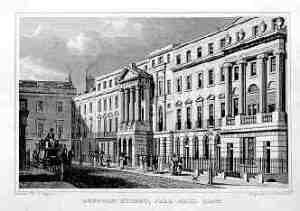
Pall Mall

Pall Mall

Miss Wraxton is the sort of person who outwardly follows the rules of propriety, but whose sense of self-importance and mean-spirited intentions prompt her to overstep the boundaries time and again. Sophy will brook none of her interference and her hackles are raised when Miss Wraxton lectures her, “I wonder if I might venture to put you a little on your guard! In Paris and Vienna I am sure you would be able to tell me how I should go on, but in London I must be more at home than you.” Miss Wraxton continues in this vein, saying, “I do not think you can be aware of what is expected of a woman of quality! Or – forgive me! – how fatal it is to set up the backs of people, and to give rise to such gossip as must be painful to the Rivenhalls…” Unaware that she has put Sophy’s aristocratic nose out of joint, Miss Wraxton goes on with her harangue, prompting Sophy to say, “I am only afraid that you may suffer for being seen in such a vehicle as this [high perch phaeton], and with so fast a female!” Miss Wraxton reassures her, saying that her own character was sufficiently well established to withstand a faux pas or two.

“Now, let me understand you!” begged Sophy. “If I were to do something outrageous while in your company, would your credit be good enough to carry me off?”

“Let us say my family’s credit, Miss Stanton-Lacy. I may venture to reply, without hesitation, yes.”

This is all the boasting Sophy needs to spur into action, and she swings her phaeton out of Hyde Park and into the streets of Mayfair. When Miss Wraxton orders her to stop, Sophy tells her she can always walk. “What, and walk along Piccadilly unattended?” Miss Wraxton retorts. Heedless of her pleas and saying that Miss Wraxton’s spotless reputation will protect them, Sophy drives her phaeton down the exclusive male haunts of Pall Mall and past the famed bow window of White’s Club. “No lady would be seen driving there! Amongst all the clubs – the object of every town saunterer! You cannot know what would be said of you!” Miss Wraxton screeches. But Sophy, intent on teaching her a lesson, continues to drive along a section of London that is strictly forbidden to single young ladies. By the time Sophy drops her rival off in Berkeley Square, Miss Wraxton is white with rage.

Berkeley Square, 1813

Berkeley Square, 1813

In this masterful scene, Georgette Heyer captured the essence of Sophy’s and Miss Wraxton’s characters, and taught us in her delightful style about the 19th century’s narrow expectations of women and how their every move was controlled. Except for her spitefulness, Miss Wraxton represents the traditional Regency society woman, whose life was strictly proscribed by a seemingly endless list of rules. The most important decisions in her life were made by her male relatives and, because she was not allowed to work  or manage her own money, she had almost no opportunity to break out of her gilded prison. When she had no choice but to work, only a few poorly paid positions were open to her. A rich widow seemed to have the most liberty in leading a self-fulfilled life, but even she needed to arrange for an acceptable companion when traveling or attending public gatherings.

By disregarding society’s rules, Sophy demonstrates her independence of spirit, as well as the absurdity of those strictures. In reality, many smart, capable, and resourceful women of that era, like Mary Wollstonecraft or the Duchess of Devonshire, must have chafed against these constant restraints. Thankfully, Sophy’s father was rather progressive and he provided her with sufficient funds to allow her a degree of freedom in making her own choices, such as purchasing her own carriage and arranging for a stable. Sophy’s independence and control over her own finances rubs her cousin Charles the wrong way, for this goes counter to everything he knows about dealing with women.
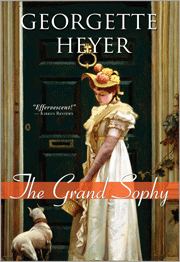
Grand SophyWith the exception of her visit to the money lender, Sophy ignores the more banal rules that define her world, but she does adhere to a strict code of honor, which sets her apart from Miss Wraxton. It is this code, her unerring sense of what is right and wrong, her loyalty, generosity of spirit, and her unassailable rank in Society that save her time and again. Towards the end of the book, Charles eyes are opened to Sophy’s warmth and humanity, but he is still stuck with his pragmatic and unromantic fiancee, for, in another one of Society’s arcane rules, a man cannot cry off an engagement. Only the woman has that power. Half the fun of the plot is in discovering how Sophy manipulates Miss Wraxton into seeing Charles’s “true character” and releasing him from his bond.

The Grand Sophy is so much more than a mere love story. In this outrageous and funny tale set in London two hundred years ago, Georgette Heyer manages to inform the reader in the most charming way about the customs and mores of a bygone era, and how dramatically women’s lives have changed since then.

*Plot spoiler: Some comments about Sophy’s visit to Mr. Goldhanger in a seemy part of London – because she told no one where she was going and because no one caught her in the act of visiting such a disreputable man unescorted, Sophy’s reputation escaped being ruined. Had she been caught in the act, her Social standing would not have provided her with enough protection to save her. By the time Charles learned of Sophy’s actions, he had become inured to her willfulness. Because her intentions were pure and because she was successful in saving his brother, he cut her some slack and chose to remain silent about her deed. He even found humor in her use of the pistol. Had Miss Wraxton learned of the visit, she could have used the information to harm Sophy, and then the novel would have taken another turn.

More links:

Read Full Post »
« Newer Posts - Older Posts »