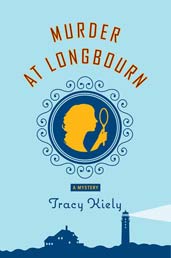
 Gentle Reader, Tracy Kiely’s first book, Murder at Longbourn, is set to be released tomorrow, September 1st. I had the pleasure of interviewing Tracy, who was kind enough to provide these fascinating insights in response to my questions. Her murder mystery is a rollicking fun read in the style of a modern Agatha Christie with Austenesque overtones. I think that Tracy summarizes her book best on her website:
If you are a fan of Jane Austen’s Pride and Prejudice, and love classic English mysteries, then you just might enjoy Murder at Longbourn. Set in a picturesque Cape Cod B&B on New Year’s Eve, the story follows Elizabeth Parker, a young woman on the mend from a bad breakup. Instead of a peaceful retreat, she finds herself in the middle of a murder investigation and in the company of the nemesis of her youth, Peter McGowan – a man she suspects has matured in chronological years only. As she investigates her fellow guests, some bearing more than a striking resemblance to characters in Pride and Prejudice, Elizabeth fights to keep her inner poise while she hunts down a killer who keeps killing.
1) Hi Tracy, thank you for agreeing to chat with me. I can’t tell you how much I am enjoying reading your book. Murder at Longbourn, while echoing Jane Austen (and I suspect the cottage industry that has grown up around it) is refreshingly not an Austen sequel, but an original story with Austenesque overtones. How did you conceive of the plot? Can you share with the reader one of your “inside” Jane Austen references? I simply laughed out loud as I encountered them.
The plot for Murder at Longbourn, is something of a mishmash of my favorite forms of entertainment. I grew up reading Agatha Christie, Jane Austen, and watching Alfred Hitchcock movies (I am something of an Anglophile, much to the consternation of my Irish Catholic family). I love the twisty, deviously clever plots of Christie, the sublime wit of Austen, and the “average man caught in extraordinary circumstances” themes of Hitchcock. When I began to think of writing my own mystery, I realized it would have to have those elements. Then one day I was watching the news and – I kid you not – there was a story about a woman who killed her husband at a B&B after they attended a Host-A-Murder Dinner. I was off to the races! However, while there are many references to Pride and Prejudice throughout the book, I didn’t want it to be a retelling of Austen’s classic. Instead, it’s a gentle wink at the reader who is familiar with Pride and Prejudice, but one doesn’t necessarily need to be a fan to “get” the book. That said, I had such fun weaving in the Austenesque aspects. I think my favorites are Henry Anderson’s pride in securing a rare first edition of Fordyce’s Sermons for his client and the ill-mannered white Persian cat, aptly named Lady Catherine.
2) This is your debut novel in print. Due to the maturity of your writing style, I suspect this is not your very first attempt at writing. How long have you been writing? How many first attempts lie upon dusty shelves? And has your work been published in other forms before, such as a magazine?
I have wanted to be a mystery writer since I was a kid. I did briefly entertain a dream of being a cartoonist for The New Yorker but even the early cave dwellers would have rejected my sketches. Several years ago, I wrote a mystery titled An Ostentation of Peacocks. It never really went anywhere (a fact I refuse to attribute to its title) and I put it aside. But it was a bit like taking a SAT prep class; you get an idea of what you’re in for. When I felt ready to write again, I decided to start fresh. However, I was able to use some of the research I did for Ostentation in Murder on the Bride’s Side (the second in the series).
3) The book is funny at times. It is so nice to read an Austenesque novel that echoes Jane Austen’s wit. When did you become a Jane Austen fan, and would you describe yourself as an acerbic wit in real life?
I became a fan of Jane Austen in high school when I first picked up Pride and Prejudice and one of the many aspects of it that I loved was the wit. I would categorize my humor as “acerbicous tardious” which, I believe, is the Latin for thinking of zingers ten minutes too late. I think the French have a term for it too, but I prefer the Latin because it is a dead language and no one can make fun of my pronunciation. However, the beauty of writing is that my characters don’t need to respond in real time.
4) I did you a disservice by calling your book Austenesque, for it is a stand alone novel that even non-Jane Austen fans will like. What are your plans for a second novel? Will it be another mystery?
If calling my book Austenesque is a disservice, then hit me again, dear sir! Luckily, St. Martin’s signed me for the first two in the series. The second, Murder on the Bride’s Side, is due out September 2010 and continues Elizabeth’s sleuthing adventures. My goal for each book is to parallel a different work of Austen’s. The first, obviously, was Pride and Prejudice. The second weaves in elements of Sense and Sensibility. Should the gods smile on me, I will be asked for the third, which is tentatively titled Spirit of Murder and parallels Northanger Abbey. In it certain events occur while Elizabeth is staying in a historic house on Nantucket, which lead her to wonder if her imagination is getting the best of her due to a recent re-reading of The Mysteries of Udolpho or if there is a more sinister explanation.
5) Tell us a little about yourself and your family. How do you fit writing into your schedule when you are raising three children who, I presume, are young?
My husband and I have three kids aged 13, 9 and 6. Throw in a puppy, an uppity cat, and a few fish and there’s precious little time for sanity, let alone a set writing schedule. So I do it when I can: while the kids are brushing their teeth, while the dog is chasing the cat through the dining room, while my youngest is painting his room with crayon. For me, writing is something I can’t not do. Jasper Fforde put it best when he said “Writers write because they can’t stop. They scribble notes in books, write poetry, jot down good snippets of dialogue and generally exist in their own little world.”
Thank you for your wonderful insights, Tracy. I wish you the best of luck as your book hits the stores. You can read my review at this link. Readers may order copies here, and enter Tracy’s website at this link.
 About the Author: Tracy Kiely graduated from Trinity College in 1990 with a degree in English. This accomplishment, however, merely seemed to prompt most job interviewers to ask “how fast can you type?” Her standard answer of “not so fast” usually put an end to futher questions.
She was eventually hired by the American Urological Association (AUA), who were kind enough to overlook the whole typing thing, mainly because they knew just what kind of stuff she’d be typing. Beggars can’t be choosers, you know. After several years, Tracy left the AUA taking with her a trove of anecdotal stories that would eventually result in her banishment from polite society.


 Episode Two,

 Episode Five:

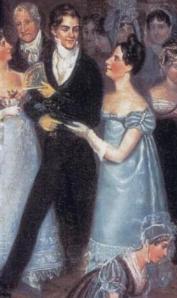
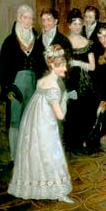 Rolinda Sharples’s 1817 painting of the Cloak-Room, Clifton Assembly Rooms is a familiar one to most Jane Austen fans. This image graces many book covers and has been used for depicting life in the Regency era. Looking closely, one sees that the assembled party seem to be enjoying the occasion as they wait and chat. A lady’s maid is helping a woman exchange her shoes, a man holds a lady’s fan, and the ladies are wearing an assortment of pale dresses, and colorful headwear and shawls. John Harvey, author of


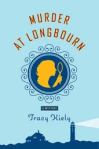 Murder at Longbourn will be available in book stores on September 1. My review for Tracy Kiely’s debut novel will be up next week.






 Jane Austen's World