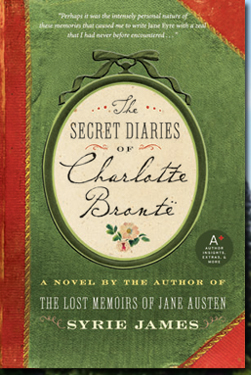
 The days when I can read a book cover to cover in one or two sittings are gone, but if I’d been able to free up such a large block of time, I would have finished Syrie James’s new book, The Secret Diaries of Charlotte Brontë, a month ago. As it was, the book became a constant companion in my briefcase. I would fish it out at opportune moments to steal a few minutes reading about Charlotte, her sisters Emily and Anne, her brother Branwell, and Arthur Nicholls, the young curate who’s been hired to help out Charlotte’s father, Reverend Patrick Brontë, and who eventually marries her.
I’ll be the first to admit that my knowledge of the Brontë family was minimal at best. While I count Jane Eyre and Wuthering Heights as among my favorite 19th century novels, I knew very little about the authors, except that Charlotte was no fan of Jane Austen’s writing style. Note that I wrote “was,” for after having finished this book I feel that I have gotten to know the Brontë clan quite well.
Syrie’s modus operandi in writing a fictional biography is to inhabit her character and take on her persona as she writes in the first person. She meticulously researches her subjects and uses original sources as much as possible. The result, in this instance, is a first person account of Charlotte Brontë in a style that is not quite Syrie’s and not quite Charlotte’s, but that is serviceable and believable. When using such a technique, one is always in danger of awkward transitions and a choppy style, but I found the story so compelling that I stopped noticing the transitions and began to read the book out of pure interest and enjoyment. The author illuminates certain facts by adding footnotes that link to the actual historical event, enhancing the richness of this reading experience. She also “shows” and doesn’t “tell”, which demonstrates her maturity as an author. Syrie’s introduction to Mr. Nicholls, the “hero” of this romance, instantly tells us something about his character without hitting us over the head with unnecessary exposition. Keeper, the mastiff at the parsonage, is an aloof and particular dog who can take a fierce dislike to strangers, yet here is his reaction to the new cleric:
“To my astonishment, the fire now instantly dissipated from Keeper’s bull-dog eyes; he descended onto all fours; and, as if a child responding to the Piper of Hamelin’s call, he trotted obediently back to the curate’s feet and calmly settled on his haunches.”
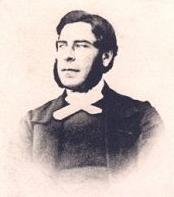
Arthur Bell Nicholls
Syrie strikes a nice balance between the past and the present, going back in time only to illuminate details about Charlotte’s life that were the inspiration for her novels, and she keeps the flow of the story going with as much suspense as Charlotte’s life offered. I found Syrie’s description of Bramwell’s, Anne’s, and Emily’s deaths not only unutterably sad, but she also depicts a despondent Charlotte who went from living in a house filled with supportive siblings to one that was largely silent and empty in a year. For fans of biographical tales and romance, Syrie’s story of Charlotte offers it all: longing and yearning, struggle and success, the searing pain of immeasurable loss, and the happiness of a love that came unbidden and unsought. I did not want this story to end. Thankfully, the book offers an appendix filled with Charlotte’s letters, Brontë poetry, and an interview with Syrie that explains why and how she wrote the book. I also want to learn more about Charlotte and cannot wait to read Mrs. Gaskell’s account of the author’s life.

Charlotte Bronte
Additional Links
 Gentle readers, Afficionados of Agatha Christie mysteries will have one more chance to see an original Miss Marple mystery on Masterpiece Mystery! this Sunday. My good friend Hillary Major has reviewed the last episode. What did she think? She thought it was well worth her while, as did I. See this episode on Sunday, July 26th, at your local PBS television station. The series airs 9 pm local time.









 Jane Austen's World