In Sense and Sensibility, Elinor and Marianne Dashwood receive their first unflattering glimpse of a finnicky Robert Ferrars in Gray’s Jewelers as he takes his time choosing a toothpick case:
He was giving orders for a toothpick-case for himself, and till its size, shape, and ornaments were determined, all of which, after examining and debating for a quarter of an hour over every toothpick-case in the shop, were finally arranged by his own inventive fancy, he had no leisure to bestow any other attention on the two ladies, than what was comprised in three or four very broad stares. – Jane Austen
Good dental hygiene is not a modern concept. Toothpicks have been found alongside their owners in ancient Egyptian tombs, and the Chinese freshened their breath as early as 1600 B. C. by chewing on aromatic tree twigs. The world’s first known recipe for toothpaste, a mixture of rock salt, mint, dried iris flower, and pepper, came from Egypt. The development of toothpastes in more modern times started in the 18th century. A bicarbonate of soda or baking soda, the main raising agent in baking powder, was traditionally used for cleaning teeth and included in tooth-powder . A 19th century London Times advertisement promised an assortment of wonderful results for those who used tooth powder:
For the TEETH. Patronized and used by his Royal Highness the Duke of Kent. TROTTER’s ORIENTAL DENTIFRICE, or ASIATIC TOOTH POWDER, had been for 20 years acknowledged by the most respectable Medical authorities, used by many, and recommended. The Powder cleanses and beautifies the teeth, sweetens the breath, posses no acid that can erode the enamel, and puts a beautiful polish on the teeth. From its astringency, it strengthens the gums, eradicates the scurvy (which often proves the destruction of a whole set of teeth), preserves sound teeth from decay, secures decayed teeth from becoming worse, fastens those which are loose, and proves the happy means of preventing their being drawn. – Next Year, Last Century
A dentist named Peabody was the first to add soap to toothpowder in 1824. Betel nut, though to reduce cavities, was also mixed into certain recipes. By the 1850s chalk was included and in the 1860s a home-made toothpaste recipe incorporated ground charcoal. Recipes for tooth powder varied and were zealously guarded by their creators:
Toothpowders were based on three or four components: abrasives such as chalk, orris root, heavy magnesium carbonate or cuttlefish bone; antiseptics and detergents, represented by powdered hard soap and borax; and astringents which could be the tannins found in cinchona bark, bayberry leaves, essence of sassafras, and, very commonly, tincture of myrrh. Aromatic substances were often added as breath sweeteners, common ones being cardamon, cloves, peppermint, oil of lemon and aniseed. – Dental practice in Europe at the end of the 18th century By Christine Hillam, p. 214
The first toothbrush was made around 1780 by William Addis of Clerkenald. Addis also manufactured tooth brushes made of cattle bone. Boar bristles were placed into bored holes and kept in place by a thin wire. Interestingly, boar bristles remained in use until 1938, when nylon bristles began to replace the natural fiber.
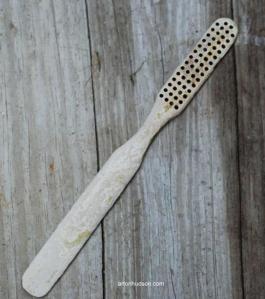
Toothbrush holder made of bone, early 1800
Toothbrush bristles were the stiff, coarse hairs taken from the necks and shoulders of swine who lived (preferably) in the colder climates of Siberia and China. Tooth powder was packed in a variety of boxes, like the one in the image below.

19th c. toothpowder box
By the early 1800s, a variety of toothbrush and toothpowder manufacturers were competing with each other for a rapidly growing number of clientele in a thriving toothpowder trade. Tooth powder recipes proliferated, and toothbrushes began to be sold in great quantities. Sometimes both the tooth powder and toothbrush were sold together ( ‘Bott’s Tooth Powder and Brushes’, Newspapers (1798).
M. Trotter, a widow, manufactured tooth powder and tooth brushes in her warehouse on No. 36, Surrey-street in the Strand. Her tooth powder cost 2s 9d a box and her India Tooth Burshes cost 1s each. She was so successful that in a few years she moved into larger premises. Dental Practice in Europe, p. 212
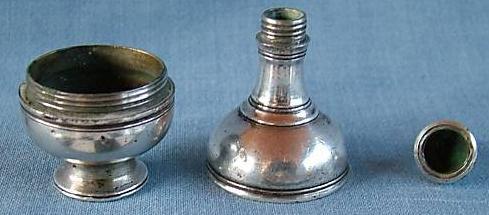
18th c. silver flask-shaped comfit box

Anise comfits
Breath fresheners took the form of comfits made of anise, caraway, and fennel seeds. These sugary seeded confections were laborious to make, requiring dozens of thin sugar coatings. The seeds needed to be continually stirred in order to spread the coat evenly, and each sugared coat had to harden before the next coat was poured on. The process was repeated until the comfits had reached the proper size. When a comfit is chewed, the fennel or anise seeds are crushed open, freshening the breath for 15 minutes up to half an hour. People are still served this type of candied seed in Indian restaurants today.
More information on this topic:


 My enjoyment of the series does not blind me to the dated quality of these Agatha Christie plots. Also, Miss Marple is a woman of her time, and seeing how she boosts the egos of the males around her and makes polite “suggestions” that lead the inspectors in the right direction makes me cringe. This is how smart women once lived and how many women still get their point across – through manipulation. The murders are often solved through coincidences that are sometimes too convenient, and the mysteries themselves are contrived, too convoluted, and in many instances, weak. Despite all the red herrings thrown my way, in two out of three instances I had solved the murder halfway through the show, but I am being picky. I still prefer a good Agatha Christie mystery over almost anything aired on the cultural wasteland that t.v. has become. For production value I give this murder series. 5 stars. For entertainment, 4 stars. For quality of mystery, 3 stars.
 Missed the first three episodes? You can watch two episodes online on PBS’s website
  Jane Austen wrote six novels. You can almost count them on one hand. Those books, and a smattering of Juvenilia, a few uncompleted manuscripts, and a number of letters – some fragmented, most missing blocks of years – are all that we have of Jane Austen’s legacy in writing. Yet these little bits of ivory contain such a vastness of riches that one can spend a lifetime exploring them.
 You haven’t truly arrived until you’ve been imitated. Like Shakepeare, Jane’s works invite hordes of copyists, with new books, movies, games, and comics based on her work and life cropping up monthly. Satirists are having as much fun with our Jane as with Shakespeare. Action figures and finger puppets abound, and famous lines are quoted with a modern twist every day. With Shakespeare it might be, “To eat, or not to eat, that is the question,” while Jane’s famous opening line morphs into, “It is a truth universally acknowledged, that a writer in need of a plot must steal from Jane Austen.” We quoth our Jane evermore, but, lacking her biting wit and brilliant insights, we fall short every time.
 And now it seems that the Jane Austen industry has descended into monster sequel and adaptation madness, regurgitating these popular culture books at an unholy rate. The new crop of Jane Austen adaptations include Pride and Prejudice and Zombies, Mr. Darcy, Vampyre Slayer, Pride and Predator, Sense and Sensibility and Sea Monsters. What’s next? Emma and the Loch Ness Monster? King Kong Conquers Northanger Abbey? Mr. Bingley, Werewolf?


 Kaye Dacus is an author and editor who has been writing fiction for more than twenty years. A former Vice President of American Christian Fiction Writers, Kaye enjoys being an active ACFW member and the fellowship and community of hundreds of other writers from across the country and around the world that she finds there. She currently serves as President of Middle Tennessee Christian Writers, which she co-founded in 2003 with three other writers. Each month, she teaches a two-hour workshop on an aspect of the craft of writing at the MTCW monthly meeting. But her greatest joy comes from mentoring new writers through jer blog and seeing them experience those “aha” moments when a tricky concept becomes clear. In June 2006, she received her Master of Arts in Writing Popular Fiction from Seton Hill University. Her thesis novel, Happy Endings Inc., beca,e her first published novel, re-titled Stand-In Groom.Romance novels were amongst the first books Kaye Dacus read, so it was natural when she started writing as a young teen, that would be what she penned. Kaye, who lives in Nashville, Tennessee, is a Jane Austen fanatic and loves watching and discussing British costume-drama movies with friends.
 5. I see in your publicity that you were inspired by Jane Austen and Horatio Hornblower. If a movie were to be made of your book, who would play the major characters?






 Jane Austen's World