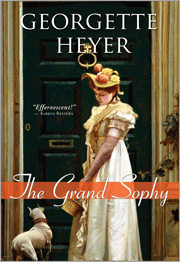
Gentle Readers, Georgette Heyer’s The Grand Sophy has been reissued by Source Books. This 1950 novel features a feisty Mark I heroine who flies against social conventions at almost every turn. Georgette Heyer, who was known for her research and historical accuracy, wrote a novel about a single young woman who frequently bent the rules. Given the strictures of the age, this post explores why Sophy’s actions were tolerated.

Lady Sarah Jersey, Almack's patroness, from a drawing by Richard Cosway
By 1820, a strict code of conduct had evolved for polite society that protected the upper crust from vulgar and improper behavior. The code was particularly stringent for young ladies of good breeding, for one false step could permanently injure their chances of making an excellent match. As the century progressed, the rules of precedence became so complicated that inexperienced Victorian hostesses would often consult Burke’s Book of Precedence or their relatives and friends in order to avoid critical mistakes in leading guests to the dining room in the right order and seating them properly at the table. Rules of conduct covered visitations, invitations, introductions, balls and assemblies, morning and afternoon walks, rides in the park, relations between men and women, and modes of dress. A budding young hostess would spend countless hours learning the code in order not to offend family, friends, strangers, and guests.
While a young lady of high rank would enjoy some protection from Society’s censure when she made a mistake, those who were rising up the social ladder or whose families were placed on the lower rungs or moved along the fringes of the Ton, were given no such license. It was particularly important for them to develop a certain elegance of manners and deportment, and to adhere strictly to the rules. One snub from a major patron could end one’s social standing, as Beau Brummel fatally discovered when he offended the Prince Regent. In Georgette Heyer’s The Grand Sophy, Miss Eugenia Wraxton never quite understood how highly placed Miss Sophy Stanton-Lacy was in the eyes of the world. While it was true that Sophy had largely lived abroad with her father and had been allowed a great deal of freedom in her actions, her father’s exalted rank protected her to a certain degree and allowed her some leeway when she broke the rules outright* (as in the case of visiting the money lender unescorted in a bad part of Town) or disregarded its strictures (as when she drives Charles’s carriage without his permission through The City.)
The snobbish Miss Wraxton, mistakenly thinking that Sophy has no social standing to speak of, tells her fiance, Charles Rivenhall: “I am afraid her visit has brought extra cares upon you, my dear Charles. Much must be forgiven as a girl who has never known a mother’s care, but I confess I had hoped that under your Mama’s guidance she would have tried to conform to English standards of propriety.” Charles, who at first sides with Miss Wraxton in his opinion of his cousin, exclaims, “It’s my belief she delights in keeping us all upon tenterhooks!”
How true. Miss Sophy Stanton-Lacy is a larger than life heroine who oozes self-confidence. Combining brains, connections, and ability, she is an unstoppable force. Although she is the object of Miss Wraxton’s jealousy, Sophy commands the respect of her influential family and father’s friends, as well as that of Lady Jersey, Lady Castlereah, Countess de Lieven and Princess Esterhazy, who were the gatekeepers of Almack’s. Just after Miss Wraxton cautions Sophy about the difficulty in obtaining vouchers at Almack’s, she discovers, much to her chagrin, that Sophy is already well acquainted with these ladies and that her entry into that select club is assured.
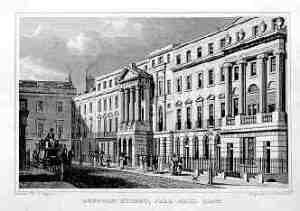
Pall Mall
Miss Wraxton is the sort of person who outwardly follows the rules of propriety, but whose sense of self-importance and mean-spirited intentions prompt her to overstep the boundaries time and again. Sophy will brook none of her interference and her hackles are raised when Miss Wraxton lectures her, “I wonder if I might venture to put you a little on your guard! In Paris and Vienna I am sure you would be able to tell me how I should go on, but in London I must be more at home than you.” Miss Wraxton continues in this vein, saying, “I do not think you can be aware of what is expected of a woman of quality! Or – forgive me! – how fatal it is to set up the backs of people, and to give rise to such gossip as must be painful to the Rivenhalls…” Unaware that she has put Sophy’s aristocratic nose out of joint, Miss Wraxton goes on with her harangue, prompting Sophy to say, “I am only afraid that you may suffer for being seen in such a vehicle as this [high perch phaeton], and with so fast a female!” Miss Wraxton reassures her, saying that her own character was sufficiently well established to withstand a faux pas or two.
“Now, let me understand you!” begged Sophy. “If I were to do something outrageous while in your company, would your credit be good enough to carry me off?”
“Let us say my family’s credit, Miss Stanton-Lacy. I may venture to reply, without hesitation, yes.”
This is all the boasting Sophy needs to spur into action, and she swings her phaeton out of Hyde Park and into the streets of Mayfair. When Miss Wraxton orders her to stop, Sophy tells her she can always walk. “What, and walk along Piccadilly unattended?” Miss Wraxton retorts. Heedless of her pleas and saying that Miss Wraxton’s spotless reputation will protect them, Sophy drives her phaeton down the exclusive male haunts of Pall Mall and past the famed bow window of White’s Club. “No lady would be seen driving there! Amongst all the clubs – the object of every town saunterer! You cannot know what would be said of you!” Miss Wraxton screeches. But Sophy, intent on teaching her a lesson, continues to drive along a section of London that is strictly forbidden to single young ladies. By the time Sophy drops her rival off in Berkeley Square, Miss Wraxton is white with rage.

Berkeley Square, 1813
In this masterful scene, Georgette Heyer captured the essence of Sophy’s and Miss Wraxton’s characters, and taught us in her delightful style about the 19th century’s narrow expectations of women and how their every move was controlled. Except for her spitefulness, Miss Wraxton represents the traditional Regency society woman, whose life was strictly proscribed by a seemingly endless list of rules. The most important decisions in her life were made by her male relatives and, because she was not allowed to work or manage her own money, she had almost no opportunity to break out of her gilded prison. When she had no choice but to work, only a few poorly paid positions were open to her. A rich widow seemed to have the most liberty in leading a self-fulfilled life, but even she needed to arrange for an acceptable companion when traveling or attending public gatherings.
By disregarding society’s rules, Sophy demonstrates her independence of spirit, as well as the absurdity of those strictures. In reality, many smart, capable, and resourceful women of that era, like Mary Wollstonecraft or the Duchess of Devonshire, must have chafed against these constant restraints. Thankfully, Sophy’s father was rather progressive and he provided her with sufficient funds to allow her a degree of freedom in making her own choices, such as purchasing her own carriage and arranging for a stable. Sophy’s independence and control over her own finances rubs her cousin Charles the wrong way, for this goes counter to everything he knows about dealing with women.
 With the exception of her visit to the money lender, Sophy ignores the more banal rules that define her world, but she does adhere to a strict code of honor, which sets her apart from Miss Wraxton. It is this code, her unerring sense of what is right and wrong, her loyalty, generosity of spirit, and her unassailable rank in Society that save her time and again. Towards the end of the book, Charles eyes are opened to Sophy’s warmth and humanity, but he is still stuck with his pragmatic and unromantic fiancee, for, in another one of Society’s arcane rules, a man cannot cry off an engagement. Only the woman has that power. Half the fun of the plot is in discovering how Sophy manipulates Miss Wraxton into seeing Charles’s “true character” and releasing him from his bond.
The Grand Sophy is so much more than a mere love story. In this outrageous and funny tale set in London two hundred years ago, Georgette Heyer manages to inform the reader in the most charming way about the customs and mores of a bygone era, and how dramatically women’s lives have changed since then.
*Plot spoiler: Some comments about Sophy’s visit to Mr. Goldhanger in a seemy part of London – because she told no one where she was going and because no one caught her in the act of visiting such a disreputable man unescorted, Sophy’s reputation escaped being ruined. Had she been caught in the act, her Social standing would not have provided her with enough protection to save her. By the time Charles learned of Sophy’s actions, he had become inured to her willfulness. Because her intentions were pure and because she was successful in saving his brother, he cut her some slack and chose to remain silent about her deed. He even found humor in her use of the pistol. Had Miss Wraxton learned of the visit, she could have used the information to harm Sophy, and then the novel would have taken another turn.
More links:

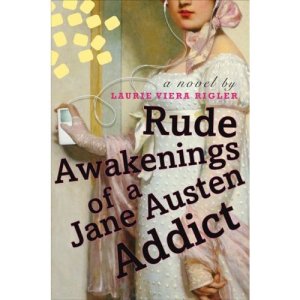 Having traveled back to the Regency era in Confessions of a Jane Austen Addict, Courtney Stone is now living Jane Mansfield’s life. It happened like this: One evening, the very American, extremely modern Courtney is grieving over the end of her engagement to a cad and the betrayal of her best male friend, Wes. The next morning she wakes up in Regency England in the body of a tall, elegant woman whose relationship with her mother can best be described as rotten. Confessions ended with Courtney falling in love with Jane’s beau, Mr. Edgeworth, and overcoming the inconvenience of living without indoor plumbing or electricity. But if Courtney has taken over Jane Mansfield’s body and life, what became of her regency counterpart?
 Meanwhile, I can think of no better way of spending a Sunday afternoon than to curl up in a hammock and read Rude Awakenings of a Jane Austen Addict. Just make sure to have enough ice tea and sun screen at hand, for you won’t be able to put this gently humorous book down until you are finished. Three out of three Regency fans.
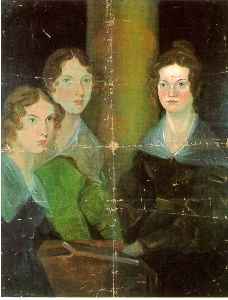 Syrie James: For my first two books, I chose challenging topics which meant a great deal to me. I decided to “become” my favorite authors, so that I could not only tell their love stories, but also showcase their love of writing and their personal struggles on the road to becoming published authors–a subject I could truly relate to.







 Jane Austen's World