 I read Pride and Prejudice and Zombies and it made me chuckle, but purists will vomit from the moment they read the opening line: “It is a truth universally acknowledged that a zombie in possession of brains will be in want of more brains.” If ever a classic was treated with tongue in cheek irreverence, author Seth Grahame-Smith managed to do it. Oh, I imagine that the coldly calculated jingle of cash was also a great motivator. After all, Seth allowed Jane Austen to do the bulk of the writing (85% of the text is hers) and she had already plotted the basic outline of the book. To give him his due, he’s given her half the credit, although he and his publisher will be raking in all the profits of this high concept book.
So what’s all the fuss about and why are film studios fighting over film rights to this story? Well, long ago in the island of Britain a zombie plague threatened its inhabitants. Thankfully, zombies are slow moving, dead, and stupid, else they would have overwhelmed the English population, decimating the land. The longer zombies have been dead, the less recognizable as humans they become, having lost eyes and limbs and patches of skin, and wearing clothes that are rotten and in tatters. Some zombies are so gross in both looks and eating habits that they cause the observer to vomit, The merest scratch from a zombie will turn a human into one, as poor Charlotte Collins discovers. A comic character rather than a tragic one, her tongue and mouth degenerate early on, causing Charlotte to lisp and talk like, well, a zombie. The thing is, nobody but Elizabeth notices. Hah! In the land of the dead and stupid, even the living are stupid. This plague has been threatening England for at least a generation, but people are still dumb enough to sit near windows at Assembly Balls where zombies can get at them and scoop out their brains, or open doors and windows in steamy kitchens, as the cooks did at Netherfield Park, so that those who were making dinner BECAME dinner.

The Bennet family lives in an age when they must be ever vigilant if the girls are to survive until marriage and beyond. Mr. Bennet ships his girls off to China to learn the fine art of fighting zombies with sword and knife. Elizabeth Bennet becomes an especially talented fighter, and is renowned for the ease with which she can fend off an entire horde of zombies, slicing and dicing with the best of them. She had to do just that when she walked three miles to Netherfield Park to check on her ill sister, Jane. A skeptical Lady Catherine de Bourgh tests her mettle by siccing her Ninja Warriors on her at Rosings, but Elizabeth dispatches them so quickly that she nary raises a sweat. Mr. Darcy is a fine zombie slayer as well, but the Bingley sisters can’t even carry a sword or knife. You get the drift. In Seth’s book, if you’re a poor zombie slayer you are either the villain or your brain is toast. The entire book is a satire, from the inclusion of the gross but well-drawn illustrations to the suggested book club questions at the end, which are quite clever. You must read this novel with an open mind and maintain a sense of humor or, like the denizens of Meryton when they see a zombie feast on one of their friends, you will upchuck your lunch.

The Bennet Sisters in a perfect pentacle fight formation
Seth makes one huge miscalculation in his otherwise spot on satire. Not knowing the workings of the female brain, he makes a mess of Wickham, a bad boy who is secretly admired by over half of Jane’s female fans. While they admit he is a scoundrel, they would not mind having a go at taming this deliciously fun male character. But Seth turns Wickham into a diapered mess of a man, who must be constantly tended after wetting his bed. Not well done, Seth. That’s like forcing Willoughby to drive a donkey cart when you know full well he is a phaeton man. This plot development tells me that Seth wrote the book more for teenage boys and girls, not women.
I predict that Seth Grahame-Smith will become rich and famous from this endeavor. Drat the man for thinking of this high concept first, but there are still five Jane Austen books left to cannibalize and I thought I’d pitch a few ideas of my own. Like Seth’s, my books will be co-written with Jane. I readily admit a desire for earning cold hard cash and that I am willing to prostitute my high ideals in order to obtain the wealth that I think I so richly deserve. Are you reading this blog Quirk Books and Random House? Please tell Dream Works and Universal to hop on over too. My plots are available to the highest bidder, starting at a cool mil and upward. Let the auction begin:
Rosemary’s and Henry Tilney’s Baby – Inspiration: Northanger Abbey and Rosemary’s Baby
The book opens with Catherine Morland feeling she is the luckiest woman alive in England. She has married her Mr. Tilney, who turns out to be as witty in bed as out of it. Better yet, General Tilney died of apoplexy upon hearing that his son was to wed her, and Captain Tilney died in a duel over cheating at cards, making Catherine the mistress of Northanger Abbey. She has spent her days and nights dismantling General Tilney’s improvements, including the Rumford fireplace, and returning Northanger Abey to its Gothic, spider-webbed origins. One day, Catherine follows the sound of mewling down a long, dark, and dank corridor. Opening a creaking door, she enters a redecorated space that is light and airy and (quelle horreur) modern. Catherine approaches a cradle and peeks inside. She gasps when she sees the baby – a miniature Henry, only with yellow slanted eyes, two horn buds sprouting from its forehead, and cloven feet. Catherine doesn’t know which emotion affects her more: the one of betrayal or disappointment that the nursery has been remodeled in the modern neoclassical style.
Willoughby’s Tell-Tale Heart – Inspiration: Sense and Sensibility and The Tell-Tale Heart
After Willoughby’s rejection, Marianne Dashwood falls ill. When she awakens from her fever, she overhears Willoughby reveal to Elinor that he loves Marianne but that he has no choice but to marry for money. The knowledge pushes the poor girl over the edge. While everyone is asleep, a still weakened Marianne sneaks out of the house, rides to Comb Magnum, creeps into Willoughby’s bedroom and stabs him in the heart as he lies snoring. She cuts out his still beating heart, wanting something of Willoughby to remember him by. Marianne tries to live a normal life and agrees to marry Colonel Brandon. But not once can she take her mind off Willoughby (whose murder goes unsolved), or his heart, which has now shriveled and dessicated to 1/10th its size. Regardless, she still can hear it beating 24/7. Desperate to get away from the sound, Marianne encases the organ in a cement box and buries it under the floorboards in the basement, but the constant thump thump thump of Willoughby’s beating heart drives her wild. Colonel Brandon, not knowing what is wrong with his crazed bride, tries to tempt her with sweetmeats and poetry and lovemaking. One day, a wild-eyed Marianne hands the colonel a small cement box.”There”, she cries out. “There is Willoughby’s beating heart!” Upon opening the box, the colonel sees only a shriveled up prune and has his wife committed.
Dr. Jekyll and Fanny Price – Inspiration: Mansfield Park and Dr. Jekyll and Mr. Hyde
Angered that Fanny has attracted the attentions of rich Henry Crawford, Mrs. Norris arranges for Dr. Jekyll to create a potion that will turn the sweet girl into a vicious and nasty harridan. Unbeknownst to Dr. Jekyll as he was making the potion, drops of Mrs. Norris’s sweat plopped into the boiling cauldron as she watched him stir it, infusing her evil personality into the liquid. After Fanny drinks some tea (which to her mind was foul and bitter, but which she politely sipped anyway), she feels Mrs. Norris’s anger and spite invade her bloodstream. While she remains sweet and tractable during the day, she turns loathsome at night, waking the servants at all hours to do her bidding, clean every nook and cranny in the house, and muck out the stalls. One by one the staff drop dead from exhaustion or quit, unable to perform double duty without a moment’s rest. While Edmund is turned off by the new Fanny, Henry is enthralled with her transformation, for he had harbored some doubts that she’d be capable of overseeing the staff of his houses. Servants come a dime a dozen, but a capable wife comes only once in a lifetime.
Persuading Moby – Inspiration: Persuasion and Moby Dick
Captain Wentworth and his new bride Anne are sailing the high seas on his fine boat as they ply the waters defending England’s shores from pirates, boot-leggers, and invasions. Anne revels in her life on board ship, loving the rocking motion of both the boat and marital bed. Then one day Captain Wentworth spies a white whale and Anne’s life changes. Her husband becomes obsessed, wanting to hunt the whale down and kill it, for, as he tells his bride, albinos lead a tough life out in the wild. They can’t camouflage their color and hide from danger. “We might as well put the poor creature out of its misery,” he gallantly says. But the whale, whom Anne had secretly named Moby, was not easily persuaded to swim within catching distance. The captain, consumed by his obsession, begins to neglect Anne. After a few weeks of putting up with the Captain’s distraction and lack of amorous advances, Anne decides to take matters into her own hands. She commandeers a rowboat and heads towards the whale, who, not scared of a puny boat with a mere woman in it, stays around long enough to listen. This provides Anne with ample time to persuade Moby to leave under cover of night and go blow his blowhole elsewhere.
Bride of FrankChurchillStein – Inspiration: Emma and Bride of Frankenstein
Jane Fairfax is no longer beautiful, having fallen asleep in her tester bed waiting for Frank to return from a night of gambling, carousing, and drinking. The spark from a sputtering candle ignited the bedsheets, burning the house down and rendering poor Jane lifeless and burnt crisp to the bone. Frank, distraught and feeling guilty for neglecting his long-suffering bride, directs a dissipated priest to unearth Jane from her grave and return her to him by enacting an undead ritual he found in an ancient Egyptian manuscript. Jane does indeed come back to life, but she is not quite herself, looking more like a roasted quail than a human. Angered that Frank yanked her out of Heaven to resume her life of living hell with him, she extracts her revenge with cool and deliberate calculation, murdering all of Frank’s cronies and mistresses. Frank, desperate to undo the spell, discovers to his horror that Jane has killed the priest. Frank sinks into despair knowing his cushy days of debauchery are over for as long as his reconstituted Jane roams the earth.
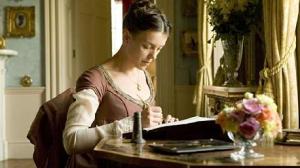 In Miss Austen Regrets, Olivia Williams as Jane Austen is seen at her sloped writing box writing her novels or composing letters during her visits to Chawton House. While portable writing desks similar to Jane’s were popular all through the 19th century, they did not become widespread until travel became more convenient for the middle and upper classes in the late 18th century. Writing boxes were versatile and portable and could easily be carried. They were placed on a table or one’s lap, and were as personal as a diary, containing paper, pens, ink, and hidden compartments.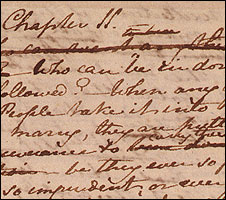


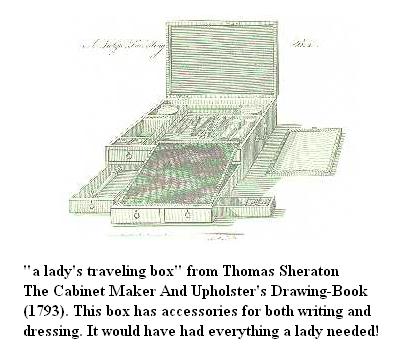 The wood rectangular box opened to reveal a sloped writing surface embossed in leather. Compartments stored writing implements like paper, pens, ink, stamps, sealing wax, etc. From the black and white image of Jane’s writing desk, hers seems to be a simpler model than the Sheraton writing box depicted above.





 The author of this recent post writes about the






 Jane Austen's World