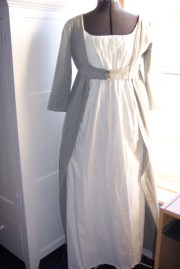
 The blog, Pemberley Couture, features a gallery of costumes made by Anna Kristine. She has made copies of Jane Bennet’s coat from Pride and Prejudice 2005, and the yellow dress Gwynneth Paltrow wore as Emma.
Posted in Fashions, jane austen, Jane Austen's World, Regency style, Regency World | Tagged Making a regency gown, Regency Fashion, Regency Gowns. Regency fashion |
It’s perfectly fine with me that the weather’s too miserable for outdoor activities. I’ve purchased new books to keep me warm.
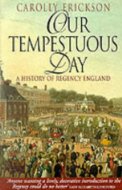 Our Tempestuous Day: A History of Regency England, Carolly Erickson, ISBN 1-86105-341-X
In her book’s preface, the author writes: “Beneath the surface glitter of Regency life-the opulent interiors, the elegant dress, the grand, scenic architecture-was an underlying malaise, a pervasive emptiness and sense of loss that afflicted a wide spectrum of the populace. Equally powerful was a shift in the moral tone, an urge to uplift, improve and spiritually regenerate the realm-and the world, if possible. These forces, along with the explosive undercurrents of popular unrest and political radicalism, gave the decade its tensions, which worked themselves through amid war, recurrent economic crises and brutally rapid social change.”
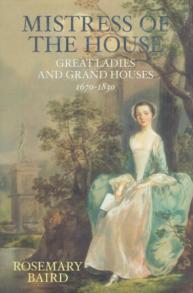 Mistress of the House: Great Ladies and Grand Houses, 1670-1830, Rosemary Baird, ISBN 0-297-83078-3
One reviewer said of this book: “The chief pleasure of the book lies in the way Baird brings the personalities of the chatelaines to life. She has drawn skilfully on family archives and deploys a dry wit to pleasing effect. For example, when discussing the correspondence of the 5th Duke of Rutland and his Duchess, the former Elizabeth Howard, who rebuilt Belvoir Castle, the author observes of the Duke, ‘He was, like most men, not very interested in moans and complaints.’ The Duchess ‘had been taught by her mother that men only liked happy women and that whingeing was unattractive’. For all her scholarship, Baird has a refreshing taste for the demotic. Thus she has fun with ‘the celebrity culture of the 18th century’, refers to 18th-century Sloane Rangers and calls Louise de Keroualle, Charles II’s mistress who became Duchess of Portsmouth, ‘the ultimate material girl’.”- Where There’s a Will There’s a Wife
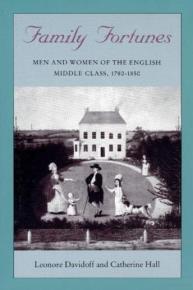 Family Fortunes: Men and Women of the English Middle Class, 1780-1850, Leonore Davidoff and Catherine Hall, ISBN 0-226-13733-3
Considered a seminal work in class and gender history, this book’s tone is dry and academic. But it is jammed with fascinating information and thus perfect to use as a reference. “The book explores how the middle class constructed its own institutions, material culture and values during the industrial revolution, looking at two settings—urban manufacturing Birmingham and rural Essex—both centers of active capitalist development. The use of sources is dazzling: family business records, architectural designs, diaries, wills and trusts, newspapers, prescriptive literature, sermons, manuscript census tracts, the papers of philanthropic societies, popular fiction, and poetry.” – Google book quote
Posted in Book review, jane austen, Jane Austen's World, Regency Life, Regency style, Regency World | Tagged Family Fortunes, Mistress of the House, Our Tempestuous Day, Regency Books | 1 Comment »
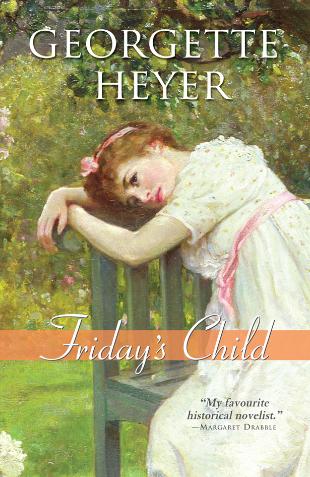 Inquiring reader: The January doldrums are upon us. The days are short, the weather is bleak, and it will be months before we can seriously garden again. What to do on a cold and wintry day? Why sit by the fire, of course, curled up with a good book, a pet warming one’s feet, a pot of hot chocolate at one’s disposal, and hours of entertainment in the form of romantic entanglements set in the regency era. To help you choose a good book, my elegant friend Lady Anne reviewed Friday’s Child, a comedic novel written by Georgette Heyer, now available through SourceBooks.
Headstrong, spoiled and impetuous, Lord Sheringham wants to be married. Not because he is in love, but because he wants control of his fortune, his father having left it so that he would be either 25 or married before he could rid himself of his trustees. He has some difficulties with debts, certainly, but the main reason he wishes to have that trust drawn up is that one of his trustees is plundering his estate.
The book opens with his proposal to the Incomparable, Isabella Milborne, a lifelong neighbor and friend. She refuses him because they don’t love each other, and he, furious at her level-headed thwarting of his plans, vows to marry the next lady he sees. This would be Hero Wantage, another lifelong neighborhood friend, just out of the schoolroom and unschooled in any of the ways of Society. Hero, who has adored her friend Sherry for years, is an orphan who has been under the care of her cousin, who never intended to provide a Season for her ward, but rather to prepare her for marriage to the local curate, or for life as a governess. At just seventeen and full of fun, Hero is not ready for either quelling prospect.
So the two decide that they will get married. Lord Sheringham’s cousins Gil and Ferdy and his friend George, Lord Wrotham, all of whom seem to travel in a pack, among them arrange for the marriage by special license. The young Lord and Lady Sheringham set up house, and Sherry and his friends seek to establish young Lady Sherry in London society, where they have been cutting a pretty wild and dashing swath. What follows is a madcap romp, as Hero falls in and out of scrapes as fast as she can. All through innocence, or from following her husband’s sayings. She is bright, educated, and has a mind of her own, and when she takes umbrage at her husband’s scolding her for something, she will say, “but you said…” To his credit, he hears his words and begins to reconsider his own way of life.
Finally, Lord Sheringham has had enough and, recognizing that his wild past has not prepared him for establishing a lady in the upper reaches of Society, he decides to send Hero off to stay with his mother. Hero is clear-eyed enough to know that this woman, far from wishing her well, will do what she can to destroy their marriage, so Hero runs away. To Gil and Ferdy and George, who decide to take Hero to Lady Saltash, a matriarch of the family, who will school Hero in the ways of the ton. Incidentally, as far as these young men are concerned, Hero’s disappearance will also show Lord Sheringham what he has not yet learned – that he really loves his wife.
Friday’s Child is said to be Heyer’s favorite of her novels. This is undoubtedly because of the countless amusing conversations among the many young men we see throughout the novel. Heyer’s deft comic touch sets her apart from the usual run of romance novelists, and the bright and worldly patter of this novel is certainly its strong point. Like all the best of Heyer’s heroines, Hero Wantage Sheringham is willing to stand up for herself. She shows a sharp tongue to her cousin after her marriage, and a strong desire to cut a dash in Society. If she is a little slow to learn which people to trust in the early days of her marriage, she still is sure of what she wants in a home, is capable of running a household with servants, and, when she runs away, shrewd enough to keep her abigail alongside with her baggage. The final chapters involve virtually everyone, including the Incomparable, in a pair of failed elopements, considerable miscommunication – most of it funny – a timely theft, and assorted miscues. At the end, the Incomparable and her swain Lord Wrotham are united, and the Sheringhams are back together, this time on a different level, wiser in the ways of love. Friday’s Child is an enjoyable romp, more comedy than romance, and great fun for a rainy day read.

A Fascinating Prisoner of War Story About Friday’s Child:
In her excellent biography of Georgette Heyer, The Private World of Georgette Heyer, Jane Aiken Hodge relates the following story about Friday’s Child:
The letter of thanks from the Romanian political prisoner who had kept herself and her fellow prisoners sane by telling the story of Friday’s Child over and over again reached Georgette Heyer that autumn [1963], and she treasured it. The woman who wrote it was safe in the United States, and Georgette Heyer was able to thank her for the heart-warming tribute.
Excerpts from a letter by Norma Samuelli, Lake Placid, September 6, 1963:
In 1948, a year before my arrest, I had read – and revelled in – Friday’s Child, and as I have a very rententive memory I was able to tell it to my cell-mates, practically verbatim…Truly, your characters managed to awaken smiles, even when hearts were heavy, stomachs empty and the future dark indeed!
During the 12 years I spent in prison I didn’t see a written page. My memory however, could not be sealed up and thanks to it and to you, my fellow-sufferers begged, again and again, to hear “What Kitten Did Next”.
Click on More Book Links Here:
- Georgette Heyer: Fantastic Fiction
My Other Georgette Heyer Reviews Sit Below
Posted in Book review, jane austen, Jane Austen's World, Popular culture, Regency World | Tagged Friday's Child, Georgette Heyer, Georgette Heyer Book Reviews | 16 Comments »
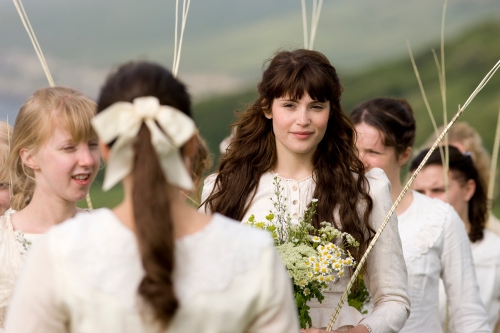
Poor Tess Durbeyfield. Sweet, obedient, and intent on following the rules, she doesn’t get many breaks in life. In this 4-hour Masterpiece Classic film adaptation of Thomas Hardy’s classic novel, Gemma Arterton plays the heartbreakingly beautiful Tess with innocence, grace, and an innate dignity that prevents her character from becoming a pathetic caricature.

 The film opens with the parson informing Tess’s drunken father that he believes the family is descended from the aristocratic D’Urbervilles family. Life is never the same for the Durbeyfields again, for the knowledge that they might be descended from one of the finest families in the land goes to the parents’ heads.We then meet 17-year-old Tess at a May Day Dance. She is on the threshold of life and we discover that her desire is to lift herself out of the working class life by becoming a teacher. She briefly meets a lad named Angel Clare (Eddy Redmayne) during that dance and their first sight of each other is electrifying.
As the family’s oldest child, Tess must take on more responsibilities than her younger siblings. When her father is too drunk to move the bee hives, Tess is appointed to drive the wagon in the dead of night, where she is involved in an accident and loses her father’s horse, his main means of employment as a pedler. She is sent to her D’Urbervilles relatives at Tantridge to claim kin and solicit them for support and money for a new horse.

Tess is forced to eat a strawberry from Alec's hand
Instead of meeting Mrs. D’Urbervilles she meets her son Alec, played by the darkly handsome Hans Matheson. He is instantly drawn to the innocent girl and bent on winning her over. With the promise of taking care of her family he offers her a job on the D’urbervilles estate. Unbeknownst to Tess, Alec is really a Stokes. His family has purchased the ancient D’Urbervilles name in order to disassociate themselves from trade, where the family fortune originated.

Tess and Alec
Alec is a diabolical character who toys with Tess and plays on her naivete and inner goodness. Born bad, as he describes himself, he wants her and – lets admit it – stalks her. Hans Matheson’s Alec is attractive and repulsive at the same time, traits that his sharp facial features reflect. A typical seducer, he takes advantage of Tess’s total dependence on his family’s largesse. His marked attentions to Tess make the other workers jealous, effectively isolating her from a support group. As Tess, Gemma shows just the right amount of resistance and attraction to this suave but oily man, who will not leave her alone. As with many women who have little power and few choices in life, these controlling men tend to get away with their actions, which are not taken seriously until it is too late.
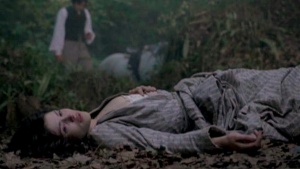 Thomas Hardy does not make it clear in his novel if Tess is seduced against her will or raped, but this film version strongly hints at rape in a nightmarish scene that ends with Tess crying on the forest floor, her bodice ripped open. Tess spurns Alec. She might have lost her virginity, but her honor remains intact. She returns home and gives birth to a bastard child whom she names Sorrow. Her father, angry that Tess has brought shame to the family name, refuses to have the child baptised. The child (a boy) dies, and when the pastor does not give Tess permission to bury her baby in consecrated ground she leaves the village.
 By this time the viewer has been reeling with Tess from one awful event to the other, wondering if luck will ever brighten her life. Her only supportive family member is her sister, Liza-Lu, who is too young to do more than lend a sympathetic ear. Even Tess’s mother gives her little support. The scene in which Gemma/Tess cries out to her mother, asking her “Why did you not warn me?” is unforgettably sad, though it is not in the novel. I had watched Gemma only as Lizzy Bennet in Lost in Austen and had no idea how affecting her performance could be. The weight of this film production rests on her shoulders and she carries her burden well.
Thomas Hardy examine the plight for rural women during the nineteenth century when rigid moral judgments superseded compassion. While a fallen woman was judged harshly and castigated, a man would get away with a mere slap on the wrist for immoral behavior.
 After Tess leaves her home village, she finds a position as a milkmaid at the Talbothays dairy farm and for the first time is among friends. This relief from constant and oppressive bad luck is a welcome one and prevents the production from completely descending into a tearjerking melodrama. Thomas Hardy wrote serialized novels, which meant that each installment offered a cliffhanger ending in order to lure the reader into purchasing the next serialized chapter and Tess of the D’Urbervilles has a tendency to tug too hard at one’s heartstrings for sympathy.
During Tess’s lyrical interlude she re-meets Angel Clare and falls in love with the young, handsome clergyman’s son. He falls for her in turn. Tess blossoms in this new environment, but her secret haunts her and she knows she must never marry.
 Meanwhile, Angel, the son of a gentleman, returns home to his parents to make a case for marrying Tess, a working class girl. During their discussion the viewer learns that purity, above all, is the quality that Angel and his parents seek in his bride, casting a foreboding of doom over Angel’s and Tess’s chance at happiness. Tess and the viewer know that she can never live up to his expectation. And so the story turns once again, with Tess realizing just hours before her wedding that Angel never read her letter in which she confesses that she had born Alec D’Urberville’s child. She will wed him with her secret intact.

Angel Clare
Eddie Redmayne’s Angel is a perfect foil to Alec, and he carries the part off well. I prefer his Angel to Peter Firth’s depiction of him in Roman Polanski’s 1979 movie adaptation of Tess. (Peter Firth also fell down, in my judgment, in playing Henry Tilney in Northanger Abbey, so perhaps I merely dislike the actor in those roles.) Eddie’s Angel is both sensitive and believable. He truly wants to make his own way in the world, but he is still governed by his conventional upbringing.
The next installment of Tess of the D’Urbervilles promises many plot twists and surprises. The production is long, but so is the novel. When I read it in college I could not put it down, crying for Tess and hoping (against hope) that events would turn her way. Even knowing the fate that awaits her, I will be glued in front of my flat screen t.v. next week to watch the second installment of this excellent production. Watch Tess of the D’Urbervilles on PBS’s Masterpiece Classic Sunday, January 4 & January 11 at 9 PM EST.
Posted in jane austen, Movie review, Popular culture | Tagged Eddie Redmayne, Gemma Arterton, Hans Matheson, Masterpiece Classic, PBS Movie Adaptation, PBS Movie Review, Tess, Tess of the DUrbervilles | 17 Comments »
London grew by leaps and bounds during the 18th century, becoming the largest city in Europe with a population of over one million people. Formal squares sprung up in the tony West End, where it became de rigeur for the upper classes to rent a “First rate” townhouse and spend the Season in “Town.” These Palladian-influenced townhouses, though a vast improvement over the helter-skelter, hodgepodge buildings of medieval London, were not huge by today’s standards. Four stories high and at least over 900 square feet in size, town dwellings were much smaller than a family’s country house counterpart.

Successful parties and dances were deemed to be crushes and squeezes when over a hundred invited guests attempted to circulate in townhouses no more than two rooms wide. As with theatre or stadium traffic today, it would often take an hour for a carriage to queue up before it reached the front door and could disgorge its passengers. The guests would then be announced by the butler (in stentorious tones, no doubt) as they entered inside. Jane Austen described a crush in the Upper Assembly Rooms in Bath as Mrs. Allen and Catherine Morland made their way around the rooms, and such a situation was frequently mentioned in Georgette Heyer’s novels. The illustration by George Cruikshank below visually sums up the experience:

Image from Wikimedia Commons
“The inconveniences of a crowded drawing room”, a famous May 6th 1818 caricature by George Cruikshank. Shows a crowded royal “drawing room” reception (in a London palace). The woman at the left (whose train is being stepped on) is wearing the old-fashioned hooped “court dress” (abolished 1820), while the man in the door is wearing formal breeches (many of the other men are wearing military uniforms). The moustache of the man on the right had connotations of foreign (Continental) and/or military dandyism at the time. – Wikimedia
Even Carlton House was not immune to crushes, where George IV as Prince Regent entertained his guests on a massive scale. On one occasion he opened the lavish banqueting room to the public. The prince regent had acquired a 4,000-piece Grand Service made of silver gilt, which included 140 dishes, 288 silver plates and a variety of cutlery from goldsmith, Rundell, Bridge, and Rundell at a cost of £60,000 (more than £3million in today’s money). Heavily in debt, this profligate prince held a banquet on June 19, 1811 for 2,000 people at Carlton House to celebrate his elevation to Prince Regent, though he excluded the queen, his wife, and Princess Charlotte, his daughter. His mother chose not to attend.
The guests were invited to arrive at 9 pm for a dinner which did not commence until 2 am, and they found the most extraordinary thing they had ever seen. Along the length of the building was a table, 200 ft long, with a stream running down the middle of it. Not only was this babbling brook lined with banks of moss and aquatic flowers, but it even had real fish swimming in it.
Beyond the main building, extra rooms and marquees had been erected to cope with the numbers while covered walks through the gardens were lined with rose-filled trellises and mirrors. The tradesmen’s bills for temporary fittings alone came to £2,585 (more than £130,000 today).
‘Nothing was ever half so magnificent,’ wrote one guest, Thomas Moore. ‘It was, in reality, all that they try to imitate in the gorgeous scenery of the theatre.’
The source of the artificial river was a fountain in the Gothic Conservatory. Above this fountain, in a feather-backed mahogany chair, sat the Prince Regent himself, dressed in the uniform of a Field Marshal. George III had always refused to give his son the rank of Field Marshal, but now the heir to the throne was also Regent, he bestowed it on himself anyway.
Behind the Prince, an enormous display of gold and silver plate had been piled high, just in case anyone needed reminding of his wealth and status. But because the Prince had yet to buy much of the Grand Service, even he was still a little short of silver for a party of this magnitude.*
To accommodate such an enormous number of guests, the prince had to borrow seven tons of gold and silver plate for the occasion. Sixty servants waited on the guests, some of whom stayed until 5:30 AM. The prince opened the palace to the public for three days afterwards. Instead of diminishing, the crowds arrived in increasing numbers, creating chaos.

State banquet room, Buckingham Palace
‘The condescension of the Prince in extending the permission to view the arrangements for the late fete at Carlton House has nearly been attended with fatal consequences,’ reported one newspaper.
‘Wednesday being the last day of the public being admitted, many persons took their station at the gates so early as seven o’clock. By twelve, the line of carriages reached down St James’s Street, as far as Piccadilly, and the crowd of pedestrians halfway up the Haymarket.
At three o’clock the crowd had so much increased that the Guards were forced to give way; several ladies were unfortunately thrown down and trampled upon; and we regret to learn that some were seriously hurt, among whom were Miss Shum of Bedford Square, and a young lady, daughter of a gentleman at the British Museum.
‘Another young lady presented a shocking spectacle; she had been trodden on till her face was quite black from strangulation, and every part of her body bruised to such a degree as to leave little hopes of her recovery.’
The crush led to acute embarrassment as people lost their clothes – or control of their bladders. As the Rev G.N. Wright observed, those ‘fortunate enough to escape personal injury, suffered in their dress; and few of them could leave Carlton House until they had obtained fresh garments’.*
The prince’s brother climbed a wall and told the crowd that there would be no further public admission, and the crowd dispersed, but not before leaving an indelible impression. Prinny continued to add to his Grand Service and held another grand fete in the Duke of Wellington’s honor five years later.
More links on this topic
- *Article about the Buckingham Palace fete: Mail Online (Banquet image from this site)
Posted in jane austen, Jane Austen's World, Regency Life, Regency style, Regency World | Tagged Buckingham Palace, Prince Regent, Prinny | 5 Comments »
-
Join 7,218 other subscribers
-
2025 AGM in Baltimore
-

-
Items of Interest
Blog Stats
- 18,540,974 hits
- Follow Jane Austen's World on WordPress.com
-
RECOMMENDED BOOKS AND RESOURCES
-
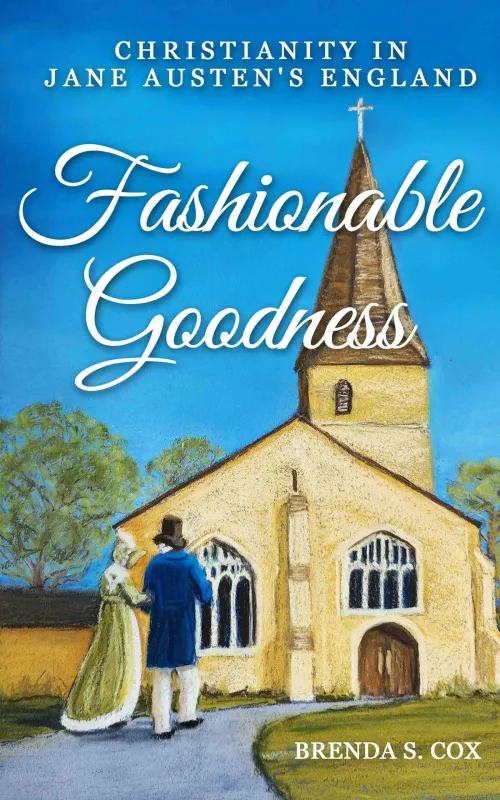
Fashionable Goodness: Christianity in Jane Austen's England is now available! By JAW contributor Brenda S. Cox. See Review. Available from Amazon and Jane Austen Books. 
We also recommend JAW contributor Rachel Dodge's devotionals based on Jane Austen's prayers and classic literature. Reviews:
Praying With Jane: 31 Days Through the Prayers of Jane Austen
The Anne of Green Gables DevotionalThe Little Women Devotional
The Secret Garden Devotional
The Tour of Doctor Syntax. Edited by Ben Wiebracht. Read the review of the book at this link. Click to order the book on Amazon US or Amazon UK or Jane Austen Books FREE Student Membership to JASNA
Available through December 31st, 2025. Click on image for details, and share this poster with other teachers and students!

The Obituary of Charlotte Collins by Andrew Capes

Click on image to read the story.
Comments
“My idea of good company…is the company of clever, well-informed people, who have a great deal of conversation.” – Jane Austen, Persuasion

Gentle readers: Please feel free to post your comments and continue the conversation! Due to SPAM, we will no longer accept comments on posts after 30 days of publication. In some instances, links will be removed from comments as well.
Administrators and Contributors
Pin It!

Top Posts
-
Recent Posts
Links to Jane Austen Blogs
May we suggest?
Hello, my name is Vic and I live in Maryland, USA. I have adored Jane Austen almost all of my life. I am a proud lifetime member of the Jane Austen Society of North America. This blog is a personal blog written and edited by me and my team. We do not accept any form of cash advertising, sponsorship, or paid topic insertions. However, we do accept and keep books and CDs to review.
If you would like to share a new site, or point out an error, please email us. (Yes, we are fallible. We'll own up to our mistakes and will make the corrections with a polite smile on our faces.) Write us at

Thank you for visiting this blog. Your comments and suggestions are most welcome.
Project Gutenberg: eBook of Stage-coach and Mail in Days of Yore, Volume 2 (of 2), by Charles G. Harper
STAGE-COACH AND MAIL IN DAYS OF YORE: A PICTURESQUE HISTORY
OF THE COACHING AGE, VOL. II, By CHARLES G. HARPER. 1903. Click on this link.
Top Posts & Pages
- Regency Fashion: Men's Breeches, Pantaloons, and Trousers
- Men's hair styles at the turn of the 19th century
- Regency Hygiene: The Bourdaloue
- Pictorial History of Regency Hairstyles
- Regency “Privy” Matters: Feminine Hygiene, Bodily Functions, and Childbirth
- Social Customs During the Regency
- Highclere Castle Floor Plan: The Real Downton Abbey
- Cheapside, The Gardiners, and Pride and Prejudice
- Jane Austen’s Regency Women: A Day in the Life, Part 1
- The Servant's Quarters in 19th Century Country Houses Like Downton Abbey
Tour Chawton Cottage on YouTube
-
Disclaimer: Our team makes no profit from this blog. We may receive books (physical or digitized) for review purposes.
-
Copyright Statement: © Jane Austen's World blog, 2009-2024. Unauthorized use and/or duplication of this material without express and written permission from this blog’s author and/or owners is strictly prohibited. Excerpts and links may be used, provided that full and clear credit is given to Jane Austen's World with appropriate and specific direction to the original content.




 Jane Austen's World