Feeds:
Posts
Comments

Assembly Rooms, Bath

Catherine too made some purchases herself, and when all these matters were arranged, the important evening came which was to usher her into the Upper Rooms. Her hair was cut and dressed by the best hand, her clothes put on with care, and both Mrs. Allen and her maid declared she looked quite as she should do. With such encouragement, Catherine hoped at least to pass uncensured through the crowd. As for admiration, it was always very welcome when it came, but she did not depend on it. – Jane Austen, Northanger Abbey

Jane Austen fans are familiar with the assembly room scenes in Northanger Abbey, where Catherine Meets Mr. Tilney (1986 film). In the recent 2007 ITV NA production, Catherine and Mrs. Allen encounter a crush in the Upper Assembly Rooms, and they had to push through the throng to make it to the ballroom where Catherine had difficulty seeing the dancers. Although they were surrounded by people, no one talked to Catherine or Mrs. Allen because they had received no proper introductions. Henry Tilney fixed the problem by asking the Master of Ceremonies to formally introduce him to Catherine and her escort.
The Upper Assembly Rooms (top) as Jane knew them remained essentially unchanged during Constance Hill’s day, but by the time she wrote her 1923 biography of Jane, the Lower Rooms no longer existed. Miss Hill wrote in Jane Austen: Her Homes and Her Friends:

The portion that remains of the lower rooms

The old Assembly or Lower Rooms no longer exist, having been destroyed by fire many years ago. The author of a Bath Guide which appeared early in the century, speaks of them as situated “on the Walks leading from the Grove to the Parades,” and as containing “a ball-room ninety feet long, as well as two tea-rooms, a card-room,” and “an apartment devoted to the games of chess and backgammon”; and tells us that they were “superbly furnished with chandeliers, girandoles, &c.” – For Constance’s delightful description of a gathering in the Assembly Rooms, please click on this link.

The Upper Assembly Rooms’ irreplaceable crystal chandeliers were taken down and kept in safe storage during World War II. This foresight paid off, for the rooms were bombed by the Germans in 1942. They were restored in 1988-1991, almost fifty years later, by R. Wilkinson & Sons of London. The process of lowering them and cleaning them is laborious and precise, as the photograph below attests.

According to the Fashion Museum in Bath’s website, “The chandeliers in the three rooms are each an average height of eight feet and they are made of Whitefriars crystal from the Whitefriars Glassworks in London.” The  ballroom chandeliers were originally lit by forty candles each.

For more information about the Assembly Rooms and their crystal chandeliers, click on the posts below:

May I Recommend …

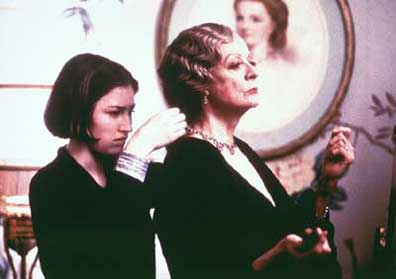
I’m Watching: Gosford Park … again. Each time I see this 2001Robert Altman film I pick up another nuance of how the upper crust interacted with the servant class. This movie is particular about the details, from the counting of knives (one was ominously missing), to rotating the linens so that they wear out evenly, to paying each servant a tip for services rendered. Maggie Smith, wonderful as always, plays the always complaining “poor” aunt, Constance Trentham. In one of the last scenes in the film, Constance is seen filling envelopes with money and writing the names of the servants she’s tipping.  Click here to view the trailer.

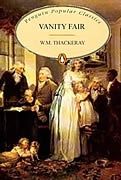
I’m listening: To Vanity Fair by William Makepeace Thackeray. This novel is filled with so many characters and so many details of Regency life that I recommend it for the serious student of the Regency era. Here is Thackeray’s description of Jos in his uniform. One can almost see Mr. Wickham in this description: ” Jos was even more splendid at Brighton than he had been at his sister’s marriage. He had brilliant under-waistcoats, any one of which would have set up a moderate buck. He sported a military frock-coat, ornamented with frogs, knobs, black buttons, and meandering embroidery. He had affected a military appearance and habits of late; and he walked with his two friends, who were of that profession, clinking his boot-spurs, swaggering prodigiously, and shooting death-glances at all the servant girls who were worthy to be slain.”

I’m reading: Aristocrats by Stella Tillyard. This historical biography of the Lennox sisters is based on true facts AND reads like a novel. Stella weaves history and biography in a way that’s accessible and informative. This novel was made into a Masterpiece Theatre film in 1999. Here is a passage regarding a Georgian lady’s attitude towards her husband’s infidelity: “Caroline approved of ‘gallantry’ for her brothers, and she was to encourage her sons’ affairs, saying that being ‘in love’ was very good for boys. But from her own husband she wanted a commitment that any affairs he might have would be confined to the level of sex with servant girls. She was not prepared to tolerate a mistress, certainly not a mistress from her own circle.”

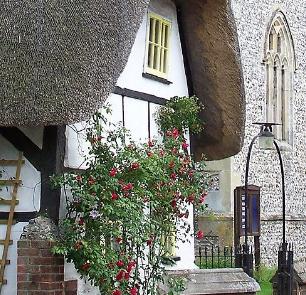
I’m visiting Autumn Cottage Diarist. This English lady maintains a pretty garden and posts photos of her plants, pets, and the trips she takes around England. In this blog one can see the line that connects gardening techniques from days past to today’s gardens. It helps that the blog’s author is a keen observer of nature and life: “We had very heavy rain last night – but this morning, everything is washed fresh and clean. The pond, which has been gravitating towards a congested puddle, has filled up again, as I discovered when I went to check it just now. Peering into the depths, I noticed how murky it still was under the surface – and then, in front of my eyes, a pair of glittering wings sped past. “

We have had Mrs. Lillingstone and the Chamberlaynes to call on us. My mother was very much struck with the odd looks of the two latter; I have only seen her. Mrs. Busby drinks tea and plays at cribbage here tomorrow; and on Friday, I believe, we go to the Chamberlaynes’. Last night we walked by the Canal. – Jane Austen, Letter to Cassandra, 1801

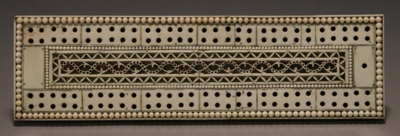
In cribbage, a game still popular today, following the rules of etiquette is important, and a certain order was kept in cutting, dealing, pegging, playing, and using terminology. Sir John Suckling (shades of Mrs. Elton in Emma), a 17th century courtier and poet who was known for his gaming skills, is credited with having invented the game. Based on an earlier English game, Noddy, cribbage was played with five cards in its earliest form, and the crib consisted of one card discarded by each player.

Cribbage board made of bone, 1820

Cribbage board made of bone, 1820

Learn more about the game in the following links:

Ingres Portrait of Bernier, 1800

Detail of a portrait by Ingres of Bernier, 1800

The cravat rose in popularity during an an age when cleaning dirty linen and ironing clothes presented an enormous challenge. Influenced by Beau Brummell’s penchant for wearing simple clothes and snowy- white cravats, these intricately-tied neckcloths became all the rage among the gentleman of the upper crust. The lower classes, for lack of servants and resources, wore a simpler version of the neckcloth in the form of a square folded and tied around the neck.

Men’s neckcloths hark back to ancient traditions in Egypt, China, and Rome where these pieces of cloth denoted a man’s social status. During the Elizabethan period a high ruffed neckline forced a stiff posture and confined movement, which only the leisure class could afford to adopt. Servants, tradesmen and laborers had to wear more functional clothing in order to perform their duties. During the mid-17th century the French adopted the fashion of neckerchiefs after seeing Croatian mercenaries wear them. The French courtiers began sporting neckcloths made of muslins or silk and decorated with lace or embroidery. These soft cloths were wrapped around the throat and loosely tied in front.

The cravat as seen in Regency portraits attained its distinctive appearance under Beau Brummell’s expert fingers and experimentation with his valet. Brummell’s philosopy of simple menswear was in stark contrast to the dandified Macaroni who pranced about in wigs, lace, and embroidered waistcoats.  In Beau Brummell, His Life and Letters (p 50), Louis Melville writes:

“Brummell’s greates triumph was his neck-cloth. The neck-cloth was then a huge clinging wrap worn without stiffening of any kind and so bagging out in front. Brummell in a moment of inspiration decided to have his starched. The conception was, indeed, a stroke of genius. But genius in this case had to be backed by infinite pains. What labour must Brummell and his valet, Robinson – himself a character – have expended on experiment to discover the exact amount of stiffening that would produce the best result, and how many hours for how many days must they have worked together – in pivate – before disclosing the invention to the world of fashion. Even later, most morning could Robinson be seen coming out of the Beau’s dressing room with masses of rumpled linen on his arms – “Our failures” – he would say to the assembled company in the outer room.

Two examples of cravat styles

Two examples of cravat styles

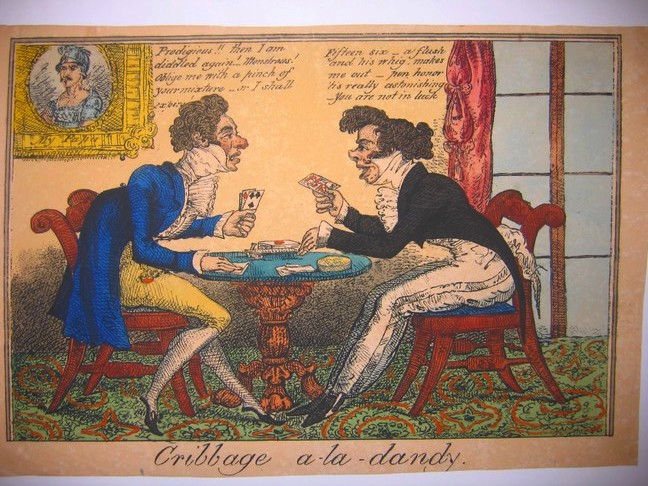
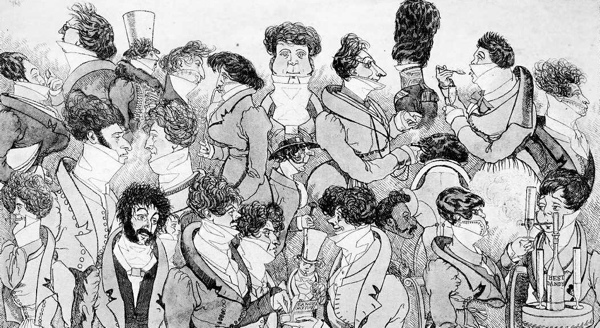
Regency dandies who wore enormous cravats that prevented movement of their necks – similar to the effect Elizabethan ruffs had – were known as les incroyables or the “incredibles”. Can you spot them in the contemporary cartoon below? To learn about the social implication of extreme fashion in pre-Napoleonic France, click on this link and read Les Incroyables et Merveilleusses: Fashions as Anti-Rebellion.


More links on the topic:

  • Regency Reproductions: Scroll down to read about neck cloths. Includes a free cravat pattern and illustrations of how to tie a neckcloth.
  • Francis Morris, “An Eighteenth Century Rabat”, The Metropolitan Museum of Art Bulletin, Vol. 22, No. 2 (Feb., 1927), pp. 51-55   (article consists of 5 pages)

Middle illustration from H. Le Blanc’s The Art of Tying the Cravat.

Gentle reader, This post from my archive ties in several elements – Louis Simond’s 19th century observations with current links and photographs. As you can see, the Earl of Pembroke’s magnificent house, the embodiment of the Palladian ideal, has been a favorite visiting destination for centuries:

Wilton House, located in Wiltshire, is the ancestral home of the Earls of Pembroke. In 1811, Louis Simond wrote about his visit to the great house in An American in Regency England. Here is his description of the park and grounds.

I measured an evergreen oak (not a large tree naturally); it covered a space of seventeen paces in diameter, and the trunk was twelve feet in circumference. An elm was sixteen feet in circumference, and many appeared about equal. Beyond the water, which before it spreads out into a stagnant lake, is a lively stream, you see an insulated hill covered with wood. We went to it by a very beautiful bridge. The view from that eminence is fine, and its slope would have afforded a healthier and pleasanter situation for the house. The deer came to the call, and ate leaves held to them – too tame for beauty, as they lose by it their graceful inquietude and activity and become mere fat cattle for the shambles. Deer are a good deal out of fashion, and have given way to sheep in many parks.

Deer in Richmond Park

Learn More About This Topic By Clicking on the Following Links:

Veteran Oak, Windsor Park

Arial view of the Wilton House grounds