Feeds:
Posts
Comments

In my private library I own many versions of Jane Austen film adaptations, starting with the BBC Jane Austen Collection. Two of the films, Emma and Persuasion, were made in the early seventies, the other four films were produced in the 1980’s. In the space of one decade the changes in sets, costumes, and acting were remarkable. During the 1970’s the actors would rehearse their roles for several weeks before the movie was filmed on video tape, which was grainy. These 70’s costume dramas had an old-fashioned, static and staged feel to them, and from our modern perspective the 70’s hair styles and make-up were glaringly wrong. It was hard to look past the 70’s teased ringlets and see a Regency lady. By the 1980’s, staged sets were beginning to be replaced by outdoor shots and actual interiors. (Persuasion, 1971 showed Anne Elliot in Bath and Lyme Regis, but these were transition shots.)

My (relative) aversion for these earlier staged films explains why I have not seen the 1971 adaptation of Sense and Sensibility. I checked Netflix to see if the film was available for rent, but one has to purchase the film in order to view it, unless a VHS copy is available at a local library. So, when Professor Ellen Moody wrote about Sense and Sensibility 1971, I asked her if I could showcase her thoughts on my blog. Ellen is an authority on Jane Austen and, just as importantly, on the films based on Jane’s novels. Reading her reviews, I am always struck by how Ellen can view these older BBC films dispassionately and compare and contrast the plots against newer, more sophisticated film adaptations and Jane’s novels. She is not put off by dated staging or costumes, and stilted camera shots; instead she hones in on the characters and how faithful they are to a Jane Austen novel. When she read my previous observations, she responded with these words:

The earlier films are worthy — the way earlier famous painting or illustrations or books are. You have to get into the aesthetics of the era, sort of “see through” them to the core experience. We are doing this for Austen when we read her. I’ve even (by dint of rewatching) learnt to accept the extravagant hairdos of these later 60s early 70s films. The 72 Emma does not have them and I’ve noticed the faultline or divider is around 1972. Before that these hairdoes; after that either historically accurate ones or natural (meaning some mildly historized version of contemporary modern) ones.

Marianne and Willoughby (Ciaran Madden and Clive Francis )

Here, then, are Ellen’s thoughts about S&S 71:

I’m now closely watching the 1971 Sense and Sensibility, written by Denis Constanduros, and it has many merits. If faithfulness and originality were really prized, it’d be prized. It’s the most original of the S&S adaptations as it had nothing to build on. One can see that Alexander Baron in his 1981 S&S script used the 1971 outline to some extent, such as having Brandon at the ball/assembly where Marianne is snubbed, a scene also used by Andrew Davies for S&S 2008; and it’s faithful to the original proportions. The climax of Jane Austen’s Sense and Sensibility, Volume I is Lucy telling Elinor her secret and triumphing over her (not the snubbing at the ball, not Willoughby’s departure, and certainly no duel); the climax of Austen’s Volume II is Lucy’s invitation to go live with Fanny Dashwood, which is the result of her encounter with the Dashwoods and Mrs Ferrars at the dinner party where Mrs Ferrars snubs Elinor over her fire screen.

In the book, Willoughby’s desertion of Marianne occurs about half-way through Volume I. Therefore, Volume I climaxes not on Willoughby’s leaving but on Lucy’s revelation she’s engaged to Edward. That’s the deeply painful ending. In the book, Willoughby’s snubbing of Marianne occurs midway in Volume II; the climax of II occurs when Lucy is invited to stay with the Dashwoods in London, after the party where Mrs Ferrars humiliates Elinor. The 71 S&S keeps an equal emphasis on Lucy torturing Elinor and Elinor humiliated at Mrs Ferrars (with Marianne defending her) as it has on Willoughby’s snubbing Marianne. The 95 S&S and 08 S&S lengthen out the stay in Barton cottage and make the London sequence much much shorter; they make the relationships with the women much less emphatic, give it much less time than the relationships of the men and women; the 95 in particular loses the social satire. (I still think it the masterpiece of film art above the others, but it is very different from Austen’s proportions and emphasis.) The 81 keeps the proportions better but downplays the poisonous relationships among the women and social satire.

Of all the S&S film adaptations I’ve watched thus far, the 1971 version does this scene of Mrs Ferrars’s cruelty (even Fanny Dashwood in the book thinks it a bit much) most thoroughly (as it builds Lucy far more thoroughly and keeps Nancy and Lucy’s cruelties to Nancy), and what I want to say is how remarkable it seems to me that it still pains me to go through it. After all these years, I find myself averting my head not to look when Marianne cracks. Elinor has to watch her crack and this is where the gut of the scene lies. The 81 film has this too – to be fair, but the 1981 has not given us the full portrait of Lucy as this one has; the latter film has begun to build up Brandon more and the men.

In the 1971 film adaptation of Sense and Sensibility one can watch a close reenactment of the text in Volume I, Chapter 1. What happens there is Mrs Jennings (a comic character) comes in to tell Marianne and Elinor Dashwood what she has heard from someone about what happened with another group of characters. Those who know the novel will know that Mrs Jennings is told her story by a doctor who was called in to treat Fanny Dashwood after Fanny gets hysterical when she learns from Nancy Steele that her sister Lucy is engaged to Edward Ferrars. Mrs Jennings’ speech is inordinately long and in a paper I published I argued this was once originally a long letter written by Mrs Jennings, a comic one to someone else telling this story. The effect of this is to intersperse what happened dramatically with lots of explicit explanation from Mrs Jennings, some of it comic and incongruous and some of it philistine, but much spot on.
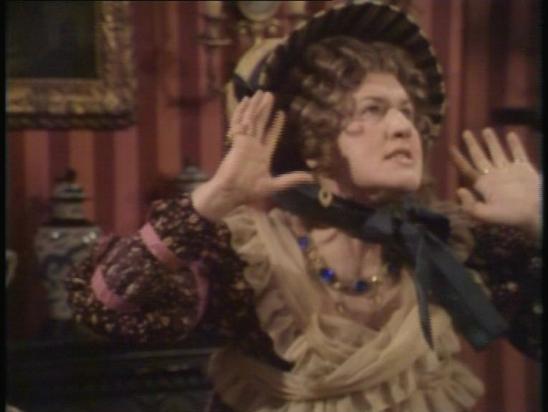
In the book we get another long (unusually long) speech by John Dashwood who comes in to tell the rest. Again I argued this was an epistolary narrative, a letter by Mr Dashwood telling another part of the story — about how Edward was disinherited. The scriptwriter, Constanduros, departs by having Mrs Jennings tell the whole. Mrs Jennings is played by an inimitable comic actress named Patricia Routledge who eventually became a Dame and she is just marvelous in this retelling (which is interrupted by the actress who plays Marianne who interperses with “Madame, how can you …” and “Don’t believe her … Don’t listen to her,” which Mrs Jennings interrupts her flow to object to, “It is true. It is, it is! ……)

In the two other S&S (1981 and 1995) the long monologue is scantier, just a bit given to the actress playing Mrs Jennings (Elizabeth Spriggs in the 1981 adaptation, another marvelous actress, who died in early July (click on link), but short so we can get onto the real business that interests scriptwriter Emma Thomson, which is Elinor’s misery and revelation of deep emotion (same goes for the ’81 film if not acted with the same effectiveness). In a way the recent adaptation by Andrew Davies (S&S 2008 ) is closer to Jane’s script in that he dramatizes the matter in what I think were originally two letters. But by doing this he loses not only the comedy but the explicit statement, the penumbra of nuances and inferences to be drawn and we get a strained melodramatic theatrical scene.

While it may seem crude to a modern audience to have this kind of material presented as comic, it is what is in the original book and I think a chapter which shows just this drive towards explicit
explanation, for in Austen we then get the two sisters talking and Elinor does make explicit how she has suffered for four months and tells all and the drama of withholding makes that long explanation believable.

I submit that the popularity of epistolary narrative in the 18th century is testimony to the drive to make explicit what is implicit, to bring what Carol Shields taught us in _Unless_ is the back story (or explanation into the public gaze where normally all one gets is the front (conventional and often untrue) explanation.

It has been said by some literary scholars of the 18th century (long ago by Irvin Ehrenpries and recently in one of John Richetti’s edited volumes on 18th century history and the 18th century novels) that there is a strong drive to give readers an explicit and full explanation of what’s happening in the novel and the procedures used to present them. It’s my view that the drive to the explicit statement may be part of the impetus which creates the epistolary narrative and makes it so popular in the era.

As a postscript, I’d like to add that in the literary criticism of Sense and Sensibility Marianne is nowadays occasionally called the Cassandra figure of the novel. The use of the term would seem to suggest Christa Wolf’s novel [ Cassandra, a masterpiece in German, later 20th century, 1988] and Wolf’s reading of the meaning of the figure have entered the general conversation of feminism and also literary criticism.

Despite the comedy of the ’71 S&S, the actress who plays Marianne (Ciaran Madden) does enact a Cassandra role. When Elinor is humiliated (as I’ve just described), Marianne comes forward to vigorously protest, point out Mrs Ferrars’s lies and support Elinor’s drawing. Alas, human beings being what they are instead of being grateful, she is seen as a pariah to have shouted out these truths. When in the ’71 film Willoughby tries to brush Marianne off in a famous scene at a ball, he cannot as she will not play the social games he expects her to. In this film he does not exactly snub her but tries to hint at ways she can save face for him and her, and she just won’t.

Click here to read Ellen’s post about the film on her blog, Ellen and Jim Have a Blog Too
A Memoir of Jane Austen

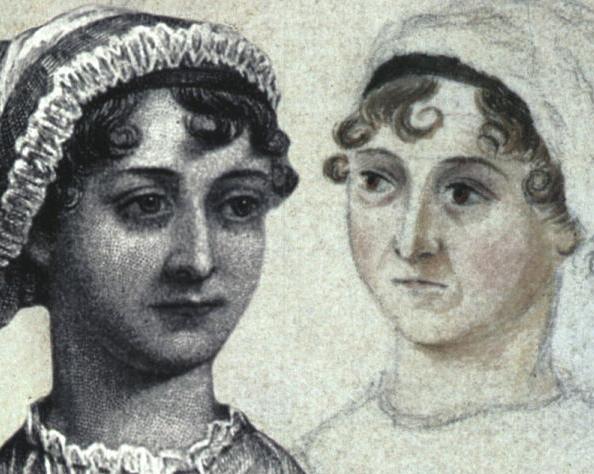
Dear Readers, This post was originally published in 2007. Since then, Oxford World’s Classics has reissued A Memoir of Jane Austen and Other Family Recollections by J.E. Austen-Leigh with a list of illustrations, a family tree, an introduction by Kathryn Sutherland, and additional family recollections by Henry Austen, Anna Lefroy, and Caroline Austen. Letters are included in the appendix of this rich book, which is filled with the most interesting details about Jane’s life and thoughts:

She certainly took a kind of parental interest in the beings whom she had created, and did not dismiss them from her thoughts when she had finished her last chapter. We have seen, in one of her letters, her personal affection for Darcy and Elizabeth; and when sending a copy of ‘Emma’ to a friend whose daughter had been lately born, she wrote thus: ‘I trust you will be as glad to see my “Emma,” as I shall be to see your Jemima.’ She was very fond of Emma, but did not reckon on her being a general favourite; for, when commencing that work, she said, ‘I am going to take a heroine whom no one but myself will much like.’ She would, if asked, tell us many little particulars about the subsequent career of some of her people. In this traditionary way we p. 158learned that Miss Steele never succeeded in catching the Doctor; that Kitty Bennet was satisfactorily married to a clergyman near Pemberley, while Mary obtained nothing higher than one of her uncle Philip’s clerks, and was content to be considered a star in the society of Meriton; that the ‘considerable sum’ given by Mrs. Norris to William Price was one pound; that Mr. Woodhouse survived his daughter’s marriage, and kept her and Mr. Knightley from settling at Donwell, about two years; and that the letters placed by Frank Churchill before Jane Fairfax, which she swept away unread, contained the word ‘pardon.’ Of the good people in ‘Northanger Abbey’ and ‘Persuasion’ we know nothing more than what is written: for before those works were published their author had been taken away from us, and all such amusing communications had ceased for ever.


During her life and shortly after her death, Jane Austen’s novels were not popularly known. Oh, she had her admirers, most notably the Prince Regent, to whom she dedicated Emma, and a few other distinguished personages, such as Lord Macaulay, Lord Byron’s wife, Ann, and writers Philip Sheridan and Robert Southey. But her works languished in relative obscurity until her nephew James Edward Austen-Leigh wrote A Memoir of Jane Austen in 1869. His book was well so well received that he quickly published a second edition in 1871 that expanded on the first one.

In the memoir, Edward’s recollections and those of his family, including Jane’s nieces and nephews, all of whom remembered their aunt fondly, made Jane accessible to a fresh, new audience. Along with these family recollections, are letters from Jane to various people outside her family. The one below is written to a Mr. J. S. Clarke, librarian, Carlton House in 1815, two years before her death:

Dec. 11. ‘Dear Sir,—My “Emma” is now so near publication that I feel it right to assure you of my not having forgotten your kind recommendation of an early copy for Carlton House, and that I have Mr. Murray’s promise of its being sent to His Royal Highness, under cover to you, three days previous to the work being really out. I must make use of this opportunity to thank you, dear Sir, for the very high praise you bestow on my other novels. I am too vain to wish to convince you that you have praised them beyond their merits. My greatest anxiety at present is that this fourth work should not disgrace what was good in the others. But on this point I will do myself the justice to declare that, whatever may be my wishes for its success, I am strongly haunted with the idea that to those readers who have preferred “Pride and Prejudice” it will appear inferior in wit, and to those who have preferred “Mansfield Park” inferior in good sense. Such as it is, however, I hope you will do me the favour of accepting a copy. Mr. Murray will have directions for sending one. I am quite honoured by your thinking me capable of drawing such a clergyman as you gave the sketch of in your note of Nov. 16th. But I assure you I am not. The comic part of the character I might be equal to, but not the good, the enthusiastic, the literary. Such a man’s conversation must at times be on subjects of science and philosophy, of which I know nothing; or at least be occasionally abundant in quotations and allusions which a woman who, like me, knows only her own mother tongue, and has read little in that, would be totally without the power of giving. A classical education, or at any rate a very extensive acquaintance with English literature, ancient and modern, appears to me quite indispensable for the person who would do any justice to your clergyman; and I think I may boast myself to be, with all possible vanity, the most unlearned and uninformed female who ever dared to be an authoress. ‘Believe me, dear Sir, ‘Your obliged and faithful humbl Sert. ‘Jane Austen.’

As a result of Edward’s memoirs, the public embraced Jane Austen’s novels. Josephine Ross writes on page 3 in Jane Austen: A Companion, “Jane Austen had won the ‘admiration, even to fanaticism, of innumerable readers’; and in the years that followed, amid a surge of articles, essays, critical studies and reprints of her novels, the unmarried daughter of a Georgian vicar, who had feared to be made ‘a wild beast’ by her contemporaries, was to become one of the best-known authors in the English language.”

You can read Edward Austen-Leigh’s memoirs by clicking on this link to the Gutenberg Project. However, the Oxford’s World’s Classics edition will give you a more detailed view of Jane through her family’s memoirs and letters.

For additional information, you can also trace the origins of Jane Austen’s popularity in this link. Click here.

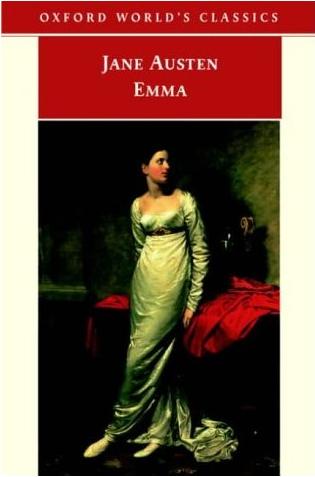
  • Image of Jane Austen’s portrait: Oxford World’s Classics book cover, which is available at Amazon.com in the UK and the U.S.

A particularly nasty trojan horse infected my main computer when I was searching for information on the film adaptation of Sense and Sensibility, 1971. I will have to wipe my hard drive clean and reinstall. Thankfully, I have an external hard drive, so most of my files are already backed up. This nasty invasion comes at a particularly busy period in my work life, and thus I might not be able to write new posts for the time being. Except for one post, which is nearly completed, I shall have to resurrect some old posts that have not seen the light of day in a while. BTW, why do these cyber thugs invent spyware that disables pcs? Isn’t this counter productive to their intent, which is to get you to view their sites?

Thank you for your patience and support!  Vic

Image: Scarfe, New Yorker

Excellent Blog Award

Edwardian Promenade, one of my favorite blogs, awarded me with an Excellent Blog Award. Thank you for the honor! This truly made my day, especially since other sites that have been chosen are fabulous and outstanding. You have placed me among august company. There are so many worthy blogs and I am having a hard time choosing. My criteria for passing this award on are that the blog must be well-written and researched; offer topics of historical, literary, cultural, or cinematic interest; and look visually luscious. Many of the blogs I would have nominated have already received this award, so here goes …

(Inhaling deeply) I would like to nominate the following ten, er, twelve sites.

  1. Austenprose: Laurel Ann, my blog partner on Jane Austen Today, always meticulously researches her topics and fits the appropriate image to the subject matter. You can tell that visual proportions count, and that she puts a great deal of thought and effort into her posts.
  2. Paris Parfait: If you have never seen this blog, hurry and click on the link. My one wish is to have enough money to visit Paris any time I like. Paris Parfait assuages those yearnings.
  3. Silver Screen Surroundings: This is Linda Merrill’s latest blog. I also visit ::Surroundings::, her interior design blog, but these days I am more drawn to her analysis of movie sets.
  4. 18th Century Blog: This blog’s visual feel is that of an 18th century confectioner’s shop. Most of the posts are written in English, but not all.
  5. The Period Movie Review: You will find movies reviewed within their centuries. The stills are gorgeous and I agree with the ratings more often than not.
  6. Emma Adaptations: Kali includes anything and everything about Jane Austen’s Emma. Her blog is a one-stop shop for all things Ms. Woodhouse, and I am amazed at the depth and scope of information on just this one novel.
  7. Ripple Effects: Arti’s interests turn to literature, movies, art, and other assorted topics that also interest me. I never know what I’ll find when I visit.
  8. Molland’s: This site is not a blog, strictly speaking, but it contains the excellent Austen.blog, and other worthy links about Jane Austen, her life, novels, and letters that draw me back over and over.
  9. Paris Breakfasts: The blogger of this site combines her watercolours of Parisian food and objects with photos of that astounding city. I am amazed at the scope of paintings and variety of photos of Paris foods, such as in this link. This site is definitely memorable!
  10. Ellen and Jim Have a Blog Too: Ellen is so knowledgeable and so productive. I am always amazed at the thoughts, connections, and ideas that come from Professor Moody’ mind. Her blog has a simple design, but you will spend hours reading and rereading her posts. She connects her topics to literature, history, art, philosophy, poetry, and film. Connectedness – isn’t that what blogging is all about?
  11. My eleventh blog (I know I went over the limit, but I could not resist) is Georgianna’s Gossip Guide. Click on the link and you will see why. These two art historians are wickedly witty and delightful.
  12. Bygone Beauty. I promise that this is my last nomination. Stopping by Kalianne’s world is like taking a trip down memory lane.

Thank you Edwardian Promenade for nominating me. I enjoyed passing this award on.

100 Books Meme

The People’s Republic of Mortimer published “A Whole New Way With Memes.” Like Alix, the blog’s author, I am not tagging anybody. If you like to participate, just copy and paste this list of books into your own blog, and follow the instructions below, or add up the books you’ve read.

This list was compiled in the U.K. by the BBC. The average adult has read only 6 of the books on the list. I’ve read 59. (62)

1) Look at the list and bold those you have read.
2) Italicize those you intend to read.
3) Underline the books you love.
4) Strike out the books you have no intention of ever reading, or were forced to read at school and hated.
5) Reprint this list in your own blog. (This list in no way represents the top 100 books. It’s missing the Iliad and Odyssey by Homer. For shame.)

1 Pride and Prejudice – Jane Austen
2 The Lord of the Rings – JRR Tolkien
3 Jane Eyre – Charlotte Bronte
4 The Harry Potter Series – JK Rowling
5 To Kill a Mockingbird – Harper Lee

6 The Bible
7 Wuthering Heights – Emily Bronte
8 Nineteen Eighty Four – George Orwell

9 His Dark Materials – Philip Pullman
10 Great Expectations – Charles Dickens
11 Little Women – Louisa M Alcott
12 Tess of the D’Urbervilles – Thomas Hardy
13 Catch 22 – Joseph Heller
14 Complete Works of Shakespeare
15 Rebecca – Daphne Du Maurier
16 The Hobbit – JRR Tolkien
17 Birdsong – Sebastian Faulks

18 Catcher in the Rye – JD Salinger

19 The Time Traveller’s Wife – Audrey Niffenegger
20 Middlemarch – George Eliot
21 Gone With The Wind – Margaret Mitchell

22 The Great Gatsby – F Scott Fitzgerald

23 Bleak House – Charles Dickens
24 War and Peace – Leo Tolstoy
25 The Hitch Hiker’s Guide to the Galaxy – Douglas Adams
26 Brideshead Revisited – Evelyn Waugh
27 Crime and Punishment – Fyodor Dostoyevsky
28 Grapes of Wrath – John Steinbeck

29 Alice in Wonderland – Lewis Carroll
30 The Wind in the Willows – Kenneth Grahame
31 Anna Karenina – Leo Tolstoy
32 David Copperfield – Charles Dickens
33 Chronicles of Narnia – CS Lewis
34 Emma – Jane Austen
35 Persuasion – Jane Austen
36 The Lion, The Witch and The Wardrobe – CS Lewis
37 The Kite Runner – Khaled Hosseini
38 Captain Corelli’s Mandolin – Louis De Bernieres
39 Memoirs of a Geisha – Arthur Golden
40 Winnie the Pooh – AA Milne
41 Animal Farm – George Orwell
42 The Da Vinci Code – Dan Brown
43 One Hundred Years of Solitude – Gabriel Garcia Marquez
44 A Prayer for Owen Meaney – John Irving
45 The Woman in White – Wilkie Collins
46 Anne of Green Gables – LM Montgomery
47 Far From The Madding Crowd – Thomas Hardy
48 The Handmaid’s Tale – Margaret Atwood
49 Lord of the Flies – William Golding
50 Atonement – Ian McEwan
51 Life of Pi – Yann Martel
52 Dune – Frank Herbert
53 Cold Comfort Farm – Stella Gibbons
54 Sense and Sensibility – Jane Austen
55 A Suitable Boy – Vikram Seth
56 The Shadow of the Wind – Carlos Ruiz Zafon
57 A Tale Of Two Cities – Charles Dickens
58 Brave New World – Aldous Huxley

59 The Curious Incident of the Dog in the Night-time – Mark Haddon
60 Love In The Time Of Cholera – Gabriel Garcia Marquez
61 Of Mice and Men – John Steinbeck

62 Lolita – Vladimir Nabokov
63 The Secret History – Donna Tartt
64 The Lovely Bones – Alice Sebold

65 Count of Monte Cristo – Alexandre Dumas
66 On The Road – Jack Kerouac
67 Jude the Obscure – Thomas Hardy
68 Bridget Jones’s Diary – Helen Fielding
69 Midnight’s Children – Salman Rushdie
70 Moby Dick – Herman Melville
71 Oliver Twist – Charles Dickens
72 Dracula – Bram Stoker

73 The Secret Garden – Frances Hodgson Burnett
74 Notes From A Small Island – Bill Bryson
75 Ulysses – James Joyce
76 The Bell Jar – Sylvia Plath
77 Swallows and Amazons – Arthur Ransome
78 Germinal – Emile Zola
79 Vanity Fair – William Makepeace Thackeray
80 Possession – AS Byatt
81 A Christmas Carol – Charles Dickens
82 Cloud Atlas – David Mitchell
83 The Color Purple – Alice Walker
84 The Remains of the Day – Kazuo Ishiguro
85 Madame Bovary – Gustave Flaubert
86 A Fine Balance – Rohinton Mistry
87 Charlotte’s Web – EB White
88 The Five People You Meet In Heaven – Mitch Albom
89 Adventures of Sherlock Holmes – Sir Arthur Conan Doyle

90 The Faraway Tree Collection – Enid Blyton
91 Heart of Darkness – Joseph Conrad

92 The Little Prince – Antoine De Saint-Exupery

93 The Wasp Factory – Iain Banks

94 Watership Down – Richard Adams
95 A Confederacy of Dunces – John Kennedy Toole
96 A Town Like Alice – Nevil Shute
97 The Three Musketeers – Alexandre Dumas
98 Hamlet – William Shakespeare
99 Charlie and the Chocolate Factory – Roald Dahl
100 Les Miserables – Victor Hugo

As you can see, I’ve struck out no books, as they are all readable – eventually.