Feeds:
Posts
Comments

With the love of nature and classical statuary, the young male body became prized. British tailoring enabled better fit and thus could reveal the new athletic ideal. The lower body was encased in extremely fitted coverings that left little to the imagination.
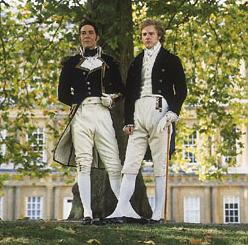
The above quote comes from the Kent State University Museum website, which features the following links to an exhibition entitled “Of Men and Their Elegance”: 1780’s – 1830’s: Sir, You Have Forgot Your Horse! and 1840’s to 1880’s: From Undress to Full Dress. To completely experience this site, click on the headings under the images, and you will be taken to an explanatory page.

The Dandy, Regency Life. Find a short history and description of dandies on this informative site.

Brassiere Pattern, circa 1800: Click on the photos for details. It comes from this amazing living history site. Click on Civilian Clothing, and go to women’s clothing

Comment about dyeing cloth . Unfortunately, no citations were quoted in this informative comment, written by syntenin_laulu. However, I found a source related to the topic, which includes the history of dyeing cloth: How to Dye Cloth, by Sophronia Gallop

There wasn’t really much specific gender distinction in colour (certainly not for small children). Ladies’ riding habits particularly (worn not only for riding, but for every kind of outdoor activity, travel and informal winter wear) occupied pretty much the identical colour range to men’s coats. There was far more of an age distinction – the older you got, the darker and more subdued were the colours you wore.

Strong and bright shades of all colours were expensive and therefore desirable, either because the dyestuff itself was costly (e.g. the cochineal used to make true scarlet) or because it took repeated dyeings to make the colour take well (e.g. a really good navy blue), or because they could only be got by skilled over-dyeing with more than one colour (e.g. bright green) . Good black was expensive and stylish; cheap black dye did – and still does – quickly fade to grey, or go patchy or rusty.

Printed fabrics in more than one colour had been expensive until the end of the 18th century as they had to be hand-blocked. With the rapid development of roller-printing, they now came within the price-range even of the working classes. Printed fabrics were still fashionable, and the latest and nicest prints still much sought after; but the mere fact of wearing printed fabric no longer signalled luxury.

In women’s fashion, the “must-have” colour changed from season to season, and in modish circles a colour such as poppy red or celestial blue might be a sign of (relative) poverty simply because it was obviously “last year’s colour”.

One wrinkle you might use is re-dyeing. Very few outer clothes were launderable, partly because of the non-fastness of the dyes of the period but also because the different fabrics used for the outer layer and the lining would shrink differentially. Coats, habits and gowns could be brushed, aired, sponged, and treated with things like fuller’s earth and hot sand to draw out grease-marks; but sooner or later your good garment would acquire a conspicuous stain, or just become incurably grubby-looking. The solution was to send it to the dyer (many launderers were also dyers) and have it re-dyed a stronger colour. That would give your coat or gown a new lease of life, but I bet a sharp-eyed person could always tell (“That redingote Miss Bates is wearing isn’t new, it’s her old one dyed”).
Elizabeth continued her walk alone, crossing field after field at a quick pace, jumping over stiles and springing over puddles with impatient activity, and finding herself at last within view of the house, with weary ankles, dirty stockings, and a face glowing with the warmth of exercise. – Jane Austen, Pride and Prejudice, Chapter Six

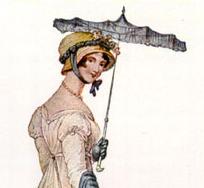
Exercise, cleanliness, and good skin care were as important in the 19th century as today. Back then a proper lady would not leave the house without covering her head with a bonnet, protecting her hands with gloves, and shading her skin with a parasol. Pale white skin had been highly prized for centuries, for it set a lady of quality apart from the working classes. Some women used dangerous cosmetics made of lead oxide to whiten their skin. These lotions, when used repeatedly, could lead to death or paralysis. It made more sense to follow a natural and safer regimen for preserving one’s looks:

“When the freshness of virgin youth vanishes; when Delia passes her teens, and fastly approaches her thirtieth year, she may then consider herself in the noon of the day, but the sun which shines so brightly on her beauties, declines while he displays them, and a few short years, and the jocund step, the airy habit, the sportive manner, all must pass away with the flight of Time. Before this happens, it would be well for her to remember that is is wise er to throw a shadow over her yet unimpaired charms, than to hold them in the light till they are seen to decay. (The Mirror of Graces, A Lady of Distinction, 1811, p 30)

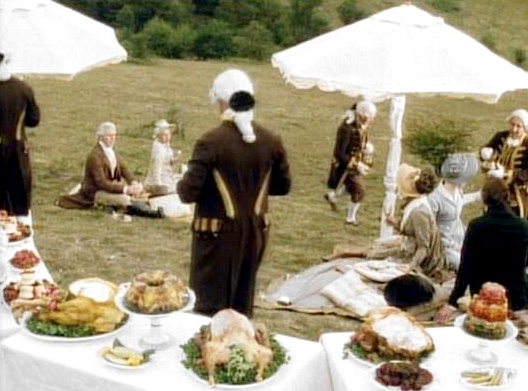
Such a shadow would be provided by a parasol, a canopy over a carriage, or an awning when eating out of doors. Exercise, while considered healthy, would have been performed in moderation. Daily walks were encouraged, but too vigorous an exertion was not deemed wise. A lady should not exercise to the point of sweating or turning her face red, as Elizabeth Bennet did when she walked three miles to Netherfield to be with her sick sister. In this regard, a Lady of Distinction noted:

The preservation of an agreeable complexion (which always presupposes health,) is not the most insignificant of exterior charms….The frequent and sudden changes from heat to cold, by abruptly exciting or repressing the regular secretions of the skin, roughen its texture, injure its hue, and often deform it with unseemly, though transitory, eruptions. All this is increased by the habit ladies have of exposing themselves unveiled, and frequently without bonnets, in the open air. The head and face have no defense against the attacks of the surrounding atmosphere, and the effects are obvious. (The Mirror of Graces, P 42)

Almost a century later, the Household Companion: The Home Book Of Etiquette, written by Alice A. Johnson, Mrs. Janet McKenzie Hill, and Dr. Henry HartShorne extolled a similar beauty regimen. In addition to protecting the skin from the sun and encouraging mild forms of exercise, the book also recommended adequate sleep. The authors quoted a charming old lady, who …

… revealed the secret of her fair and rosy complexion to a group of young women as follows : ” Late hours,” said she, ” and oversleeping ruin the complexion. Go to bed early, arise early, and you will grow old slowly, and retain your good looks to an advanced age. If, however, your position forces you into society and you are obliged to be up late at night, sleep an hour every afternoon. Before going to bed take a hot bath and remain in the water only a few moments. Then drink a cup of bouillon, and a small glass of Malaga wine. Sleep will soon follow, and last until the natural time of awakening, which is about ten o’clock in the morning under these circumstances. Take a cold plunge or sponge bath, a light breakfast of café au lait, and bread without any butter.” She continued: “Out-of-door exercise is an absolute necessity, but must not be carried to excess. A daily walk is excellent, and it is scarcely necessary to say that whole days of lawn tennis, croquet, etc., are not favorable to the complexion.”

One imagines that this elderly lady had heard these beauty tips from female friends and relatives who had lived during the early 19th century. Milky white skin remained a hallmark of beauty until the 1920s when Coco Chanel created a stir with the tan she acquired on the Duke of Westminster’s yacht.

  • 2nd image: picnic on Boxhill, Emma 1996

I love old-fashioned, sentimental movies filled with likable characters and well told stories. I like films that take me out of time and place and land me smack dab in another world. I adore ensemble casts made up of famous and not so famous British actors. Ergo, I am wild about Cranford, which will air at 9 pm tonight on PBS’s Masterpiece Classic

This early Victorian tale, based on the writings of Elizabeth Gaskell, is about change and resisting change. Cranford is a sleepy town that time passed by until the coming of the railroad. It is ruled by women – Amazons, as Elizabeth Gaskell described them.

Eileen Atkins as Miss Deborah Jenkyns and Francesca Annis as Lady Ludlow are at the pinnacle of Cranford society: the former rules over poor widows and spinsters, and the latter commands everyone’s respect as the lady of the manor. These two powerful women are suspicious of anything that upsets their well-ordered lives. Miss Jenkyns cannot abide Charles Dickens’s modern stories, or suck juice from an orange in front of others, since to her the very thought of the word ‘suck’ is abhorrent. News that a railroad is coming to ruin her perfect town is so distressful that it brings on an apoplectic fit.

Lady Ludlow firmly believes that people should remain in their station and behave accordingly. She will not hire servants who can read or write, declaring that too much education upsets the natural order of things and would foment a revolution, as it did in France. This subplot sets up the film’s dramatic ending.

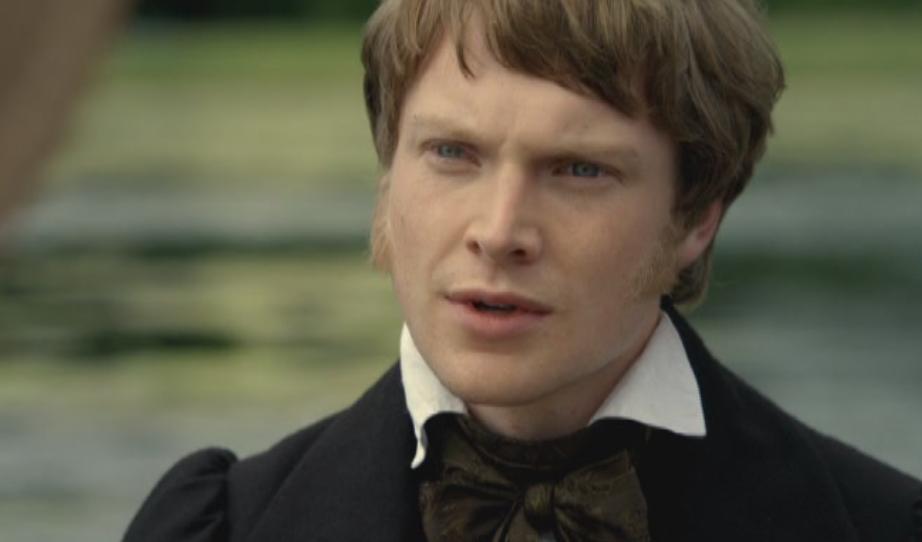
Simon Woods as Dr. Harris, represents new ideas and innovation. A frisson goes through the community when he elects to save Jem Hearne’s injured arm rather than amputate it. After the young doctor’s successful but revolutionary treatment of setting the bone and stitching the wound, his partner Dr. Morgan (John Bowe) declares testily, “Cranford has been disturbed by you.” The old doctor, thinking to relieve his work load and to turn his practice over to a younger physician once he retires, is completely taken aback by his assistant’s newfangled ways. “Cranford is a town that knows itself, he admonishes the doctor. “It is a town at peace.”

Cranford is also a town that takes care of its own. The staid ladies of Cranford donate their expensive candles to allow the doctor to practice his modern surgical techniques on the young carpenter before it is too late. They are charmed by this single man, a rare commodity in a town filled with spinsters. Many of the plot’s developments and misunderstandings that ensue are caused by their wishful thinking.

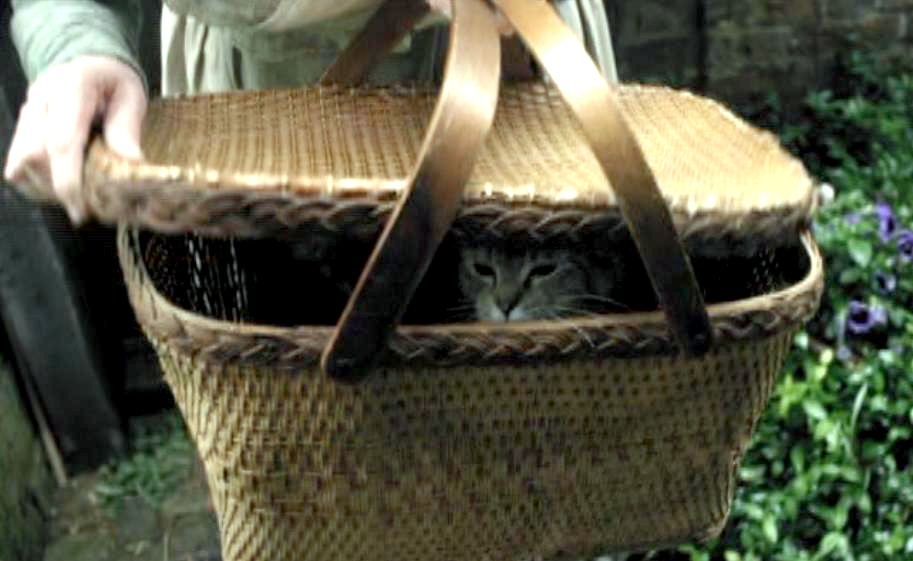
The people of Cranford are adept at hoarding scarce goods, such as candles and coal for fire. The lace incident, which, next to the cow incident, is one of my favorite scenes in the film, is all about recycling. Hand made foreign lace was a precious commodity, especially for a widow living on a meager income of 100 pounds. Any article of clothing that still had value was laundered, mended, or reworked rather than thrown out. When the cat swallowed the lace, along with the buttermilk that was bleaching it, it led to a series of events that had me choking with laughter. The ladies’ expressions as they watched a cathartic mixture being forced down the poor cat’s throat and listened to the ignominious expulsion of milk and lace into a boot were priceless.

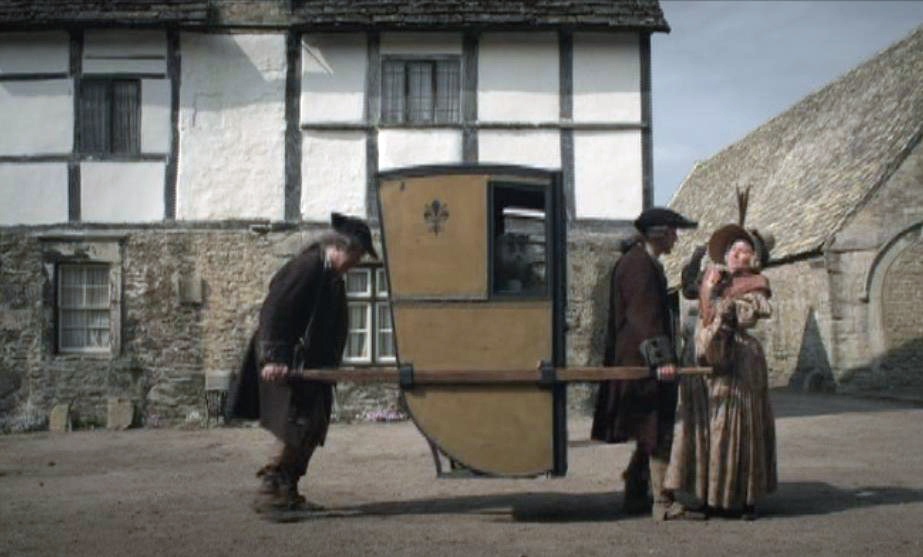
Careful attention to detail was paid in this production, from costumes, such as the frayed bonnet of the impoverished widow (played by Julia McKenzie with Imelda Staunton at left), to the setting (the British Heritage village of Laycock), to props (two footmen huffing and puffing as they run while carrying their mistress in a sedan chair), to the plaintive wails of the cat as it expels the sadly abused lace.

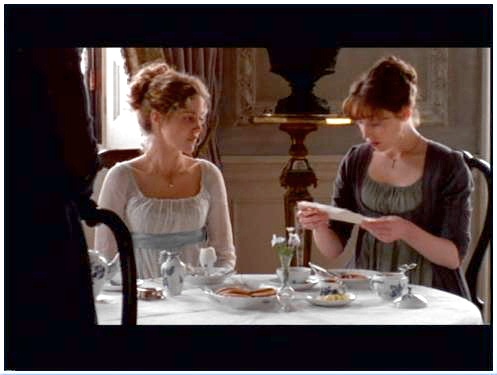
As a drama, Cranford has it all: young romance (Kimberley Nixon as Julia Hutton at right), old romance, sweet comedy, dreadful calamity, deep sorrow and profound happiness. The town is populated with individuals who do what is right for themselves, their families, and their fellow man, even if it means breaking the law. I’ve read the book and was struck by how well Heidi Thomas’s script holds up against Mrs. Gaskell’s novel, which was actually a series of vignettes written for Household Words, a magazine published by Charles Dickens. Oh, the story is melodramatic and there are a few too many coincidences to be believed, but the characters are so well defined and likable that one forgives the script’s treacly overtones and neatly tied up ending.

Jane Austen’s novels were never so sugary sweet, but this film production offers us an interesting glimpse of a world that Cassandra Austen, Jane’s beloved sister, must have known before she died. Changes caused by the industrial revolution had swept England, and new inventions in manufacturing, machines, science, and travel caused wholesale changes in how people lived and worked. Jane Austen only caught a glimpse of what was to come, but Cassandra lived long enough to see macademized roads replace dirt roads, gas lights put up on public streets, and steam engines overtake stage coaches as public transportation. Other aspects of society remained the same, such as the plight of widows and spinsters whose income was inadequate, and a high mortality rate among children.

Post Script: Winning her first BAFTA award at the age of 73, Eileen Atkins edged Judi Dench for best actress for her performance as Miss Jenkyns. Eileen wasn’t sure about the role at first, saying, “I didn’t think it was too good a part – I thought she was the only one who wasn’t funny.”

More about Cranford:

  • Penny for Your Dreams features a series of great Cranford reviews. Here is the link to Episode One if you don’t mind spoilers, along with the other four posts.

I would also like to direct you to Laurel Ann’s Cranford review on Austenprose, and Kay Daycus’s take on this movie adaptation. Mrs. Elton offers a unique perspective about this first episode on Jane Austen Today. Learn more about Elizabeth Gaskell in Jane Austen in Vermont. See you next week for the second installment!

The Moody Connection

Inquiring readers, Ellen Moody, has been writing a series of interesting posts about Jane Austen movie adaptations, comparing several movies of the same novel.

Click here to read Sense and Sensibilities Alter the Landscape of Austen Films.

Update: Every once in a while, I plan to revisit old posts to update links and include additional information, as in this instance. My original post about John Nash (1752-1835) was woefully inadequate.

John Nash’s buildings exemplified the neoclassical style of early 19th Century Architecture. His sweeping changes transformed London, from the graceful curve of Regent Street to the majestic terraces and vistas in Regent’s Park, to the clearing of the area which was to become Trafalgar Suare. John Nash’s transformations reflected the Prince Regent’s grand plan for London. J.B. Priestly wrote in The Prince of Pleasure:

Over and over above [the Prince’s] collections and rebuilding of royal houses, there was his grand plan, designed and carried out by John Nash, of demolishing a clutter of little streets and miserable buildings to drive a broad way, as straight as possible, between Carlton House and the newly created Regent’s Park, itself one of the most charming city parks in the world. Some of Nash’s work has gone, notably Regent Street as he left it, but the broad thoroughfares and his delightful terraces are still with us. (The Prince of Pleasure, p 290)

View some of his edifices below:

  1. Regent’s Park
  2. Regent Street
  3. Buckingham Palace
  4. Brighton Palace .

More About John Nash:

View a Powerpoint Presentation here: Modern Architecture: Nash and the Regency