The author of this guest post, Professor Ellen Moody, needs almost no introduction. If you haven’t come across her timelines of Jane Austen’s novels, I highly recommend that you visit her website. For Jane Austen’s World and Jane Austen Today, Ellen chose to write a comparative piece on the Northanger Abbey. After reading one of Ellen’s posts, you will never quite view a Jane Austen movie adaptation or read her novels in the same way again. Welcome, Ellen, and thank you for writing this post for Jane Austen’s World and Jane Austen Today.
Gentle Austen readers,
The other day a friend told me that many people do not know there is a third Northanger Abbey movie. All who have been faithfully watching the Jane Austen movie festival on PBS this year know at least something of the most recent: the 2007 WBGH/Granada Northanger Abbey (directed by Jon Jones, written by Andrew Davies). Many may have heard of the 1987 BBC Northanger Abbey (directed by Giles Foster, written by Maggie Wadey). But it seems that a free adaptation, the 1993 independent Ruby in Paradise (directed and written by Victor Nunez), has been effaced from Public Memory[note 1]. Rumor (who Virgil told us long ago is not to be trusted) has committed yet further mischief. She has spread abroad a notion the 87 Northanger is completely bad. She also went on and on about how the PBS people cut the 07 Northanger so crudely (constantly clipping as they went and omitting a nude and playful episodes), that she had not time to divulge why it is so cheering and unbearably touching when at the film’s close hero and heroine fall over one another in their eagerness to kiss and hug tight at last.
So when asked to write about the recent Austen movies for Jane Austen Today, I decided to write about how all three Northanger Abbeys films enriched our experience of Austen’s novel. Beguiled by Austen’s parody of Ann Radcliffe’s 1790s gothic romances and allusion to the imprisoned dying bleeding nun of Matthew Lewis’s 1796 horror gothic, The Monk, all three gothicize Austen’s book. The beauty of the 87 and 07 Northanger films lie in their visual recreation of female gothic dreams. The 87 film is beautifully picturesque, and filled with thoughtful conversations taken from Austen’s book. Very like Amy Heckerling’s Clueless (the 1995 free adaptation of Emma, starring and narrated by Alice Silverstone as Cher Horowitz), Ruby in Paradise is an updated “young lady’s entrance into world:” Ruby dramatizes a teenage heroine’s struggle to discover what is and to make a good place for herself in world that can put her at serious risk. The core of the appeal of the 07 film is the capital way the two principals, Felicity Jones and J. J. Feild, jell as a pair of characters whose mutual kindness, intelligence, and integrity of heart emerges gradually as very precious indeed against the film’s “crimes of heart.”
We begin with Austen’s ungothic gothic. The gothic section of Austen’s Northanger Abbey begins in Vol II, Chapter 3: the book is all Bath up to there. The “visions of romance” (as our narrator tells us) are over by Vol II, Chapter 10, after which we take a trip to Woodston, return to Bath by way of letters, and experience a real crisis and bereftment whose sources are greed, gossip, and resentment. We experience a lot before we get to the felicitious close. There is little gothicism in Austen’s book.
Some contrasts: the way to Bath in Austen’s novel is wholly uneventful. Nothing happens. Both the 87 and 07 Northanger films open with a nightmare visions as Catherine (Katharine Schlesinger and Felicity Jones respectively) lies in a tree and reads Radcliffe: Wadey’s nightmare is straight out of the 1968 horror gothic, Rosemary’s Baby; Davies’ comes from modern female ghost-gothics. During the trip both films dramatize nightmares: in the 87 film, an archetypal sexually-motivated abduction scene (which closely recalls one in the 1980 Jane Austen in Manhattan, a free adaptation of Austen’s Sir Charles Grandison); in the 07 film violent duelling, which includes Mr Allen (Desmond Barrit) dealing blows with his crutches, surrounds our fainting two heroines. Mrs Allen (Sylvestre Le Tousel) faints too. Both films contain six dreams or nightmare sequences nowhere in Austen’s book. When Austen’s Catherine at long last fulfills her desire to see a real historical building and drives into the grounds of the abbey, she is surprized because she barely notices the quick appearance of a low building, whose appearance she just about entirely misses because “a scud of rain” hits her in the face. Austen’s Catherine’s room is modern, well-lit, with a good fire, and near her friend, Eleanor Tilney’s. General Tilney boasts of his progressive modernization of his house; Mrs Tilney’s ex-room is neat, clean, spruce, not a shroud in sight. And so it goes.
The case is drastically altered in both films. I defy anyone to miss the abbey in Davies’ film:
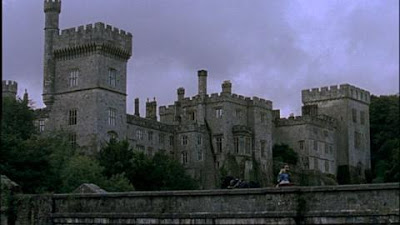 In Wadey’s the film comes out of a mist across a lake, and when come close is looms overhead as a scary ancient military fortress:
 I think viewers want to revel in gothic dreams. The catch is Austen allows us to glimpse these alluring visions through parody, and filmic visual romance resists ironizing. I was intensely delighted when in the 07 film, Catherine reached her room (a long way up the stairs, and not near Eleanor) and we are treated to this mastershot:
 It was perfect (as Felicity Jones’s face shows), though not in Austen. The film-makers have given us what Austen’s Catherine longed for. The 87 film has the advantage of having been filmed in Bath, but nowhere on their walk in Austen’s book do Henry (Peter Finch), Catherine (Katherine Schlesinger), and Eleanor (Ingrid Lacey) come upon anything as perfectly picturesque as Wadey’s trio does continually, e.g,
 I turn to the 87 Northanger Abbey. As Wadey’s Henry, Eleanor and Catherine walk and talk so companionably in front of Radcliffean waterfalls, amid green forests, and drifting along in a boat on an oneiric lake, the 87 film offers us a reproduction and extension of the conversation Austen meant her Volume I to culminate in. I quote Wadey’s Henry teasing Catherine: “Art is as different from reality as water is from air, and if you mistake water for air, you drown. Of course if you are a fish, then the danger lies in the air.” The scene is psychologically believable; intimacy and trust between the friends has been established, and they talk, repeating a slightly simplified and yet expanded version of Austen comic meditation on history, the picturesque, and art. Like Austen’s, Wadey’s Henry slights women, discusses politics (there are added real references to the troubled 1790s scattered throughout the film), and is put down by Wadey’s Eleanor. The music provides another dimension of harmony.
Throughout Wadey’s film includes far more of Austen’s original language, conversations, and literary and artistic themes than Davies’ 07 Northanger film, and in so doing, includes, adds to and comments on Austen’s general outlook and her appreciation of Radcliffe’s female gothic. At moments Wadey’s Catherine’s brand of proto-feminism reminded me of Austen’s Fanny Price when Fanny tells Austen’s hero, Edmund Bertram, she does not think all women should be expected to jump at any man who proposes and then tells Austen’s other heroine, Mary Crawford, that she cannot like a man who can enjoy hurting women’s hearts even if it might be in this instance that the woman’s heart was not hurt (but Fanny thinks Maria Bertram’s was, and it turns out she is right). In the playful conversation while dancing where Wadey’s Henry makes his analogy between a dance and marriage, Wadey’s Catherine (an addition) emphatically brings in the woman’s right of refusal as not nothing, as important; this assertion is brought back late in the film ironically as we find the right of choosing is the more effective: it’s Henry’s role to come to Catherine.
Yes, some of the horror nightmares in this film are ghastly: not all, two of the six are lovely, visionary as in the sequence following a late afternoon of delicate opera-like eroticism in a baroque aria sung by Henry. The historically-accurate bathing scenes have been made much of; I like also how memories of Mrs Tilney’s suffering are given visual symbolic representation in statues found in the garden and Catherine’s window, the dramatization of Henry’s defiance of his father (played by Robert Hardy) and the father’s scorn for Henry’s loyalty; and the use of witch imagery in the costumes of characters who manifest a sublime indifference to other people (e.g., Googie Withers as Mrs Allen, Elaine Ives-Cameron as the Marchioness whose husband has been guillotined).
In the still, Catherine grows nervous as she sees herself in her mirror wearing Mrs Tilney’s riding outfit and decides not to ride in it; we see a statue we’ve seen before now presiding over Catherine:
 Paradoxically, it’s in the free adaptation, Ruby in Paradise, that Austen’s insistence on the prosaic realities of life are clung to. Ruby Gissing (Ashley Judd) is our Catherine Morland character. As the movie begins, Ruby is leaving a young man (boyfriend, partner? it’s not clear) and driving herself to Florida because her few good memories of her time with her family come from when they went to Florida on vacation. Ruby has to integrate herself into the community by getting a job; she is hired by Mildred Chambers (Dorothy Lyman) who eventually tells Ruby she hired her because saw herself in Ruby:
 The older woman becomes the younger one’s mentor and friend, eventually herself partly dependent on Ruby. Mrs Chambers runs a tourist souvenir and clothing store whose downscale nature does not deter people from buying sprees.
Ruby is also befriended by an African-American teenage girl who works in the store, Rochelle Bridges (Allison Dean): Rochelle is also taking a business course in a local college and looks forward to marriage. They eat together, go dancing, walk on the beach, share past memories, dreams and hopes.
 Rochelle functions like Eleanor Tilney in a number of the conversations, including one where she gives Ruby money when Ruby desperately needs it. A memorable moment occurs when they speak of “how to survive with your soul intact.” One of Davies’ dialogues for his Catherine and Eleanor take up this subject too.
Mrs Chambers’ sexy show-off lying boorish son, Ricky (Bentley Mitchum), combines characteristics of John Thorpe and Captain Tilney. He persuades Ruby to ignore his mother’s prohibition against the staff going out with her rich son. When late in the film, Ruby has far superior boyfriend and does not want to continue this forbidden hollow relationship, Ricky attempts to rape her; enraged at Ruby’s resistance, he fires her, insinuating he will tell her mother about their relationship. Many readers have suggested Austen had Richardson’s much earlier (1740s) realistic epistolary novel, Pamela, in mind: there a servant refuses to have sex with her boss, and he rewards her virtue by marrying her. Here we see the realistic results of such refusal. More realistic yet (and Austen-like) is the lack of irretrievable crisis. Yes we have a series of anxiety-producing hard scenes where Ruby is continuously refused jobs, sinking lower and lower, even considering topless dancing, and finally working as a laundress, but when Rochelle explains to Mrs Chambers what happened, and Mrs Chamber also remembers how good an employee, Ruby, has been, she is rehired. The film ends with Ruby opening the shop as its assistant manager.
As is common in many of these free adaptations (e.g., Whit Stillman’s Metropolitan, a Mansfield Park, Nora Ephron’s You’ve Got Mail, Helen Fielding and Andrew Davies’ Bridget Jones Diary, both in part replays of Pride and Prejudice), the Northanger Abbey framework of the tale is signalled strongly for us when in Ruby’s boyfriend, Mike McCaslin’s (played by Todd Field) considerable library, Ruby stumbles upon and reads Austen’s Northanger Abbey. Ruby reads aloud from the book and pronounces it a story like her own: she too is a heroine “against the odds.”
 She reads it on the sly at work to finish it; Ricky appears to recognizes it and pronounces that he “never got around to it.” The book’s use for him is to lord it over Ruby: “Don’t let Mom catch you.” Mike recalls Henry Tilney in his strong intellectualism, idealism (he’s an environmentalist Josh played by Paul Rudd, the Mr Knightley character in Clueless), supportive love and trust; he does not pressure Ruby for sex; the parallel of teacher and pupil is strikingly close, down to a discussion of local history and landscape. However, at the movie’s close Ruby does not take the easy way out of marriage with Mike as they clash in some important ways. Their way of discussing Austen epitomizes these:
Mike: “Take it. Then you can join my fools reading society, meetings nightly after lovemaking.”
Ruby. “Lot of good it’s done you.” Mike: “Saved me from evil. Restored my soul. Brought peace to my troubled mind. Joy to my broken heart … [and in another later scene he adds] Isn’t it wonderful the way Austen seems to dwell on the superficial and comic yet all the while revealing the contradictions and value system of an entire society. I don’t think there’s been anyone so subtle and elusive. What do you think?” Ruby. “It was a neat story.”
There are other counterparts to characters and predicaments in Northanger Abbey, and (as across Austen), we get a continuum of young women who make different choices in life [Note 2]. I’d like to emphasize the many scenes where Ruby writes in her diary and we get Judd’s musing voice-over where she thinks about parts of her story and we watch striking montage. This too is a part of an Austen film: they are unusual for the frequency in which we find ourselves with female narrators guiding us through the story. Some write letters, some read them, and some keep diaries, Ruby is repeatedly pictured writing in a journal; it sustains her.
In my view in the past year we have had four new superb Austen films: this past fall, Robin Swicord’s The Jane Austen Book Club; and this spring on the PBS Festival, the extraordinarily powerful and brilliant film-making of Snodin, Shergold, and Burke’s Persuasion; Davies’ latest, a dark and romantic Sense and Sensibility, and his Northanger Abbey [Note 3] As with Ruby in Paradise, the human dimension of Austen’s story is made intensely appealing; as in his Sense and Sensibility, Davies has rewritten Austen’s key dialogues to bring home to us the cost of coldness, material aggrandizement, and ego-centered behavior. Our villains include Liam Cunningham as General Tilney, a frightening Dracula figure whose brand of “vampirism” we are told “drained the life out of” Mrs Tilney; John Thorpe (William Beck) is let off more lightly than Captain Tilney (Mark Dymond) and Isabella Thorpe (Carey Mulligan) who actually deserve one another, partly because he appears briefly and is allowed to justify his lies. It is not uncommon for Davies to show sympathy for amoral and unadmirable characters. Where he hits a new note is consonant with J.J. Feild’s strength as Henry Tilney: he projects a sensitive intelligence and emotional vulnerability.
 As one of the older BBC mini-series, the 1972 BBC Emma transformed Austen’s novel to dwell on a slow and subtle presentation of the relationship between the hero, Mr Knightley (John Carson) and heroine, Emma (Doran Goodwin); so Davies has chosen to develop those scenes and parts of scenes where Henry and Catherine are in deep communication; he adds to this a more emphatic presentation of Eleanor (Catherine Walker) as equally bereft of life’s joys because of her father’s meanness (in every way) and the death of their mother. The letter scenes late in the film take lines given to Henry Tilney in the book and give them to Eleanor. With her quiet self-control, feeling of staying in the background, and sadness Catherine Walker is as superb as Eleanor Tilney as Emma Thompson and Hattie Morahan as the Elinor Dashwoods of the 1995 and 2007 Sense and Sensibility.
 In one of the many delightful scenes Davies adds to Austen’s script to develop the triangular relationship at the heart of his film (one alas cut from the American version), when the general leaves the Abbey, the young people go into the garden. We see Henry get a ladder, climb a tree, and to the accompaniment of the bouncy cheerful music that accompanies the normative time-passing prosaic sequences of the scene, Henry rains apples on the girls, and they run about to catch them in their skirts:

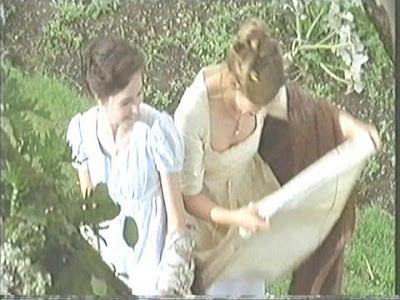 The imagery denies there is any sin here; it’s a sunlit moment in a paradise of congenial supportive companionship.
There is a painful moment which betrays Austen’s art and book in two of the movies: Wadey and after her Davies have their heroines burn Radcliffe’s Mysteries of Udolpho. It was to Radcliffe and other contemporary female novelists Austen tells us she went to learn her art. I also find troubling Nunez’s Ruby’s sudden thrust at her Henry (Mike), “Stop looking down” on people. Mike has not looked down on anyone in the film; like Austen’s Henry he respects those “games of life” whose rules are clear, fair, and understandable.
So gentle reader, read Austen’s book again, watch all three films, and then reread. And then recall Isabel’s words in Austen’s Love and Freindship (which I here play upon): “Beware, my Laura, of the unmeaning Nonsense of Rumor and dangerous treacheries of Memory; Above all, Avoid the fetish Goddess, Literalism.”
Note 1: I am using some common terms for the three major types of film adaptation. The 2007 Northanger Abbey is an apparently faithful film (sometimes called “transposition”). Davies tries to match the original story, and to reproduce most of the characters, dramatic turning-points, and famous lines, with some allowance for modernizing interpretations and advantageous alterations provided by film. The 1987 Northanger Abbey is an intermediate adaptation (sometimes called “commentaries”): Wadey is far closer to Austen’s language and includes most of Austen’s central incidents, but she departs with the intention of commenting on, critiquing, and updating Austen’s text. The 1993 Ruby in Paradise is a free adaptation (these are called “analogies”). Nunez abandons historical costume drama, but reproduces enough recognizable incidents, type characters, character functions, and themes to make his film also function as an adaptation; in addition, his heroine reads and she and the hero discuss Northanger Abbey and Jane Austen.
Note 2. Ruby in Paradise took top honors in the 1993 Sundance Film Festival and got rave reviews. There’s a published review which goes over the parallels to Northanger Abbey: see Zelda Bronstein, review of Ruby in Paradise, Film Quarterly, 50:3 (1997):46-51.
Note 3. I would call The Jane Austen Book Club is a free adaptation of all the Austen novels! This is clearer in Karen Joy Fowler’s witty novel. The 2007 Persuasion and Sense and Sensibility are like the 1987 Northanger, intermediate adaptations or commentaries. I should mention that The Jane Austen Book Club was produced by Julie Lynn; the 2007 Sense and Sensibility produced by Vanessa de Sousa and Anne Pivcevic, and directed by John Alexander. It starred Hattie Morahan as Eleanor and Charity Wakefield as Marianne Dashwood; David Morrissey (now the central character) plays Colonel Brandon.
Note 4. Although clearly of the faithful type, the 1972 BBC Emma, like the best Austen films, recreates a work in its own right. It was directed by John Glenister, written by Denis Constanduros. In my view Fiona Walker is the best Mrs Elton we’ve seen.
Biography: Ellen Moody, a Lecturer in English at George Mason University has a blog of her own where she frequently discusess Austen and her films, _Ellen and Jim have a blog, too_. She devotes part of her website to “Jane Austen and Time”, where she offers timelines for each of Austen’s six novels and three fragments, a chronology of her writing life, as well as reviews of books, essays, films, and records of readings and discussions of Austen’s novels conducted on Austen-l and Janeites a few years since. She is now working on a book, The Austen Movies.
 When Jane Austen’s brother, Edward Austen-Knight returned from his grand tour, he brought back as one of his souvenirs the solemn portrait that we have come to associate
  with his image. Since the 17th century, it was de rigeur for young English gentleman of privileged background to embark on a 2-4 year trip to see the historic and cultural places of Europe with their tutors.
 Such a protracted trip came with a hefty price: during the 18th century, a grand tour of three years could cost as much as 5,000 pounds to visit these “museums of history, civility, and culture.”* Many young men, such as Edward Austen-Knight, returned with portraits painted of themselves; others returned with entire collections, influencing the styles at home. It was no coincidence that Neo-classicism and the Palladian ideal were popularized during this era. “In high society, milord anglais on this Grand Tour pillaged the Continent for old Masters (genuine, fake or retouched), took an artist or two in tow, and built and embellished at every opportunity.” (Porter, p 243).
 Colston Pyranees Mountain View








 Jane Austen's World