Feeds:
Posts
Comments

Beauty is often in the eye of the beholder. Women who were considered the epitome of beauty in bygone years, might not be considered beautiful a century later. However, some aspects of beauty never change. According to a recent scientific theory, the features of classically beautiful people conform to the proportions of Phi.

It is generally acknowledged that Lady Emma Hamilton was the beauty of her age. Despite her base background and lack of education, she managed to attract the admiration of artists, writers, and aristocratic lovers and husbands.

“Emma was luscious,” history tells us, “with a lovely girlish face on a full woman’s body barely concealed by the thin muslin dresses she wore” (Russell 31). And it was the juxtaposition of those soft facial features with a decadently opulent figure–a voluptuous goddess with the face of an angel–that made Lady Hamilton the definitive contemporary incarnation of timeless beauty:

Nothing could be more beautiful than her countenance or more commanding than her figure at this time; the first had an unusual mixture of angelic softness . . . the other . . . would equally have served for the splendour of an Imperial throne, or the couch of voluptuous sensuality. (Sherrard 232)

Her peaches-and-cream complexion, a “velvet skin of lilies and roses (Barrington 375), endowed her with the fair features that have been revered as the epitome of feminine loveliness throughout history. In her letters, Emma herself marvelled: “I am remarkably fair, that every body says; I put on red and white” (Sherrard 93). She also possessed “long auburn hair (with a hint of gold) and blue-grey eyes” (Peakman 7). Society raved about her “rounded arms” (Barrington 96). For the source of the above quotes, click here to enter The Judgment of Paris site.


The painter George Romney became obsessed with Lady Hamilton’s features, depicting her in a variety of mythical disguises over the years. Viewing his paintings of her, one can gain a fairly accurate idea of the kind of beauty Jane Austen was thinking about when she described Emma Woodhouse:

“I either depend more upon Emma’s good sense than you do, or am more anxious for her present comfort; for I cannot lament the acquaintance. How well she looked last night!””Oh! you would rather talk of her person than her mind, would you? Very well; I shall not attempt to deny Emma’s being pretty.”

“Pretty! say beautiful rather. Can you imagine any thing nearer perfect beauty than Emma altogether—face and figure?”

“I do not know what I could imagine, but I confess that I have seldom seen a face or figure more pleasing to me than her’s. But I am a partial old friend.”

“Such an eye!—the true hazel eye—and so brilliant! regular features, open countenance, with a complexion! Oh! what a bloom of full health, and such a pretty height and size; such a firm and upright figure! There is health, not merely in her bloom, but in her air, her head, her glance. One hears sometimes of a child being ‘the picture of health;’ now, Emma always gives me the idea of being the complete picture of grown-up health. She is loveliness itself. Mr. Knightley, is not she?”

“I have not a fault to find with her person,” he replied. “I think her all you describe. I love to look at her; and I will add this praise, that I do not think her personally vain. Considering how very handsome she is, she appears to be little occupied with it; her vanity lies another way. – Emma, Volume 1, Chapter 5

Learn more about Emma Hamilton in the following links:

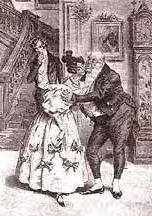
Project Gutenberg has scanned a Sense and Sensibility novel illustrated by Hugh Thompson. “You can view all of Hugh Thomson’s illustrations in this complete edition. Only the illustration on p. 290 (“I was formally dismissed”) is missing, and the introduction by Austin Dobson seems incomplete and ends abruptly.” (From PG foreword)

Mr. Dashwood Introduced Him, Fronticepiece

Hugh Thomson was one of the most popular and successful book illustrators of the Victorian era. He was born in Ireland in 1860, where his skills as an illustrator were recognized when he was still a teenager. Hugh was trained by John Vinycomb, the head designer at Marcus Ward & Co, a prominent Belfast publishing house. He moved to England, where he worked for MacMillan & Co. from 1883 and on, illustrating all six of Jane Austen’s novels and other literary classics. By 1900 he had become one of the most popular illustrators of his time. He died in 1920.

His son’s son is a child four years old

Learn more about the artist at these sites:

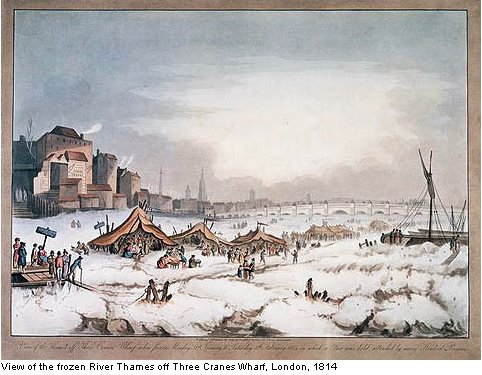
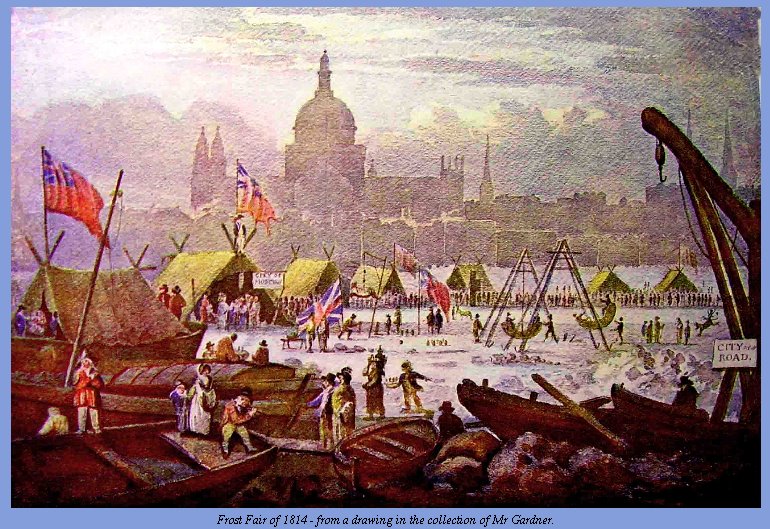
1814 Frost Fair

During a mini ice age two hundred years ago, the winters were so cold that the river Thames would freeze in solid sheets of ice. The old London Bridge was bulkier than the new London Bridge built in 1823, and it acted like a dam. After the new bridge was built and the old one was demolished, and after embankments were erected (which narrowed the channel), the river flowed too swiftly for the waters to freeze.

But in the days of yore, a Frost Fair was held whenever the river iced over. People ventured out on the ice, vendors set up stalls, and a variety of entertainments were offered. The last time such an event occurred in 1814, Jane Austen was still alive. She must also have felt the chill of that cold February in which London experienced the hardest frost it had known in centuries.

And this is what they did with the Great Frost. By February, as Lord William Pitt Lennox tells us in his Recollections, the Thames between London Bridge and Blackfriars became a thoroughly solid surface of ice. There were notices at the ends of all the local streets announcing that it was safe to cross the ice, and, as in times of Elizabeth 1, full advantage was taken of this new area and the public interest in it. As before, there now sprang up a Frost Fair. The people moved across the river by way of what was called Freezeland Street. On either side, crowded together, were booths for bakers, butchers, barbers and cooks. There were swings, bookstalls, skittle alleys, toyshops, almost everything that might be found in an ordinary fair. There were even gambling establishments and the ‘wheel of fortune, and pricking the garter; pedlars, hawkers of ballads, fruit, oysters, perambulating pie-men; and purveyers of the usual luxuries, gin beer, brandy-balls and gingerbread.’The Prince of Pleasure and His Regency, J.B. Priestley, p 113.

Read more on the topic at these links

This post was updated in this link.

This story was commissioned to appear in the Victoria Times Colonist newspaper on December 27th 2004 as part of a tradition of short stories during Christmas week. – Jo Beverly. Click here to read it.

Under the Kissing Bough

Sweet emblem of returning peace, the heart’s full gush and love’s release,
Spirits in human fondness flow and greet the pearly mistletoe.
Oh! Happy tricksome time of mirth, giv’n to the stars of sky and earth!
May all the best of feeling know, the custom of the mistletoe.
Married and single, proud and free, yield to the season, trim with glee:
Time will not stay … he cheats us so … A kiss? … ’tis gone … the mistletoe.

The poem above was written in December, 1826, and last line refers to the custom of plucking a berry every time a kiss was stolen beneath the kissing bough. Once the berries were gone, the kissing was over. – All About Mistletoe

A number of free Holiday Stories and E-Texts can be found at this link: Christmas Potpouri

Bringing Home the Boughs

To learn more about holiday traditions with mistletoe, or the kissing bough, visit the links below:

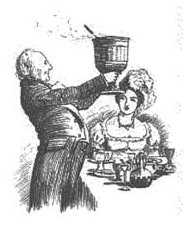
Wassailing

Wassailing goes back to pre-Christian times in a tradition meant to bring luck for the coming year. Wassail gets its name from the Old English term “waes hael”, meaning “be well”. At the start of each year, the Saxon lord of the manor would shout ‘waes hael’. The assembled crowd would reply ‘drinc hael’, meaning ‘drink and be healthy’. In cider producing regions, the wassailers went from door to door, with a wassail bowl filled with spiced ale, and sang and drank to the health of those they visited. In return people in the houses gave them drink, money and Christmas food. Traditionally Wassailing was held on Old ‘Twelvy’ Night, before the Georgian Calendar aligned the calendar year to the solar year. The true date for Wassailing, therefore, was the 17th of January.

Listen to a traditional wassailing song on this YouTube link.

In cider producing regions, the tradition varied, and was known as the wassailing of trees:

…it was the custom for the Devonshire people on the eve of Twelfth Day to go after supper into the orchard with a large milk-pan full of cyder with roasted apples in it. Each person took what was called a clayen cup, i.e. an earthenware cup full of cyder, and standing under each of the more fruitful trees, sung —

“Health to thee, good apple-tree,
Well to bear, pocket-fulls, hat-fulls,
Peck-fulls, bushel-bag-fulls.”

After drinking part of the contents of the cup, he threw the rest, with the fragments of the roasted apples, at the trees, amid the shouting of the company. Another song sung on such occasions was

“Here’s to thee, old apple-tree,
Whence thou may’st bud, and whence thou may’st blow,
And whence thou may’st bear apples enow
Hats full! caps full!
Bushel-bushel-sacks full,
And my pockets full, too, huzza!”

From Wassailing

Update: Tim writes: Wassailing refers to the practice of both door-to-door carol-singing on Christmas Eve and the apple wassailing on Old Twelth Night. The naming comes from the common imbibing of the wassail. Both traditions co-exist and the carolling occurs not just in cider-growing areas.

Thanks for the information, Tim. I should have been clearer about the distinction between the two traditions at the start of this post. These days wassailing does mean carolling, but it did not always have this connotation.

Wassail Bowl
La Belle Cuisine, Recipe from the Gourmet Archives

4 cups apple cider
1/2 cup firmly packed dark brown sugar
1/2 cup dark rum
1/4 cup brandy
1 tablespoon orange liqueur
1/4 teaspoon cinnamon
1/4 teaspoon ground cloves
1/8 teaspoon ground allspice
Salt to taste
1/2 lemon, thinly sliced
1/2 orange, thinly sliced
Whipped cream
Freshly grated nutmeg

In a saucepan bring the apple cider to a boil over medium heat, add
the brown sugar and cook mixture, stirring, until the sugar is dissolved.
Remove pan from heat and add the rum, brandy, orange liqueur,
cinnamon, cloves, allspice, salt, and fruit slices. Heat mixture over
moderate heat, stirring, 2 minutes. Pour the wassail into wine glasses
and top it with whipped cream and freshly grated nutmeg.

View my other holiday posts: A Jane Austen Christmas, Yule Log, New Year’s Eve, Boxing Day, Christmas Pudding, etc. here.