 In The Mirror of Graces (1811), A Lady of Distinction writes
“The utmost in dancing to which a gentlewoman ought to aspire, is an agile and graceful movement of her feet, an harmonious motion with her arms, and a corresponding easy carriage of her whole body. But, when she has gained this proficiency, should she find herself so unusually mistress of the art as to be able, in any way, to rival her professors by whom she has been taught, she must ever hold in mind, that the same style of dancing is not equally proper for all kinds of dances.
 For instance, the English country-dance and the French cotillion require totally different movements.”
 The Encyclopedia Britannica describes the cotillion as:
“late 18th-century and 19th-century French court dance, popular also in England. A precursor of the quadrille, the cotillion was danced by four couples standing in a square set. The first and third, then the second and fourth, couples executed various series of geometric figures.”
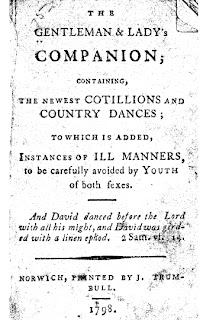
In The Gentleman & Lady’s Companion, Printed by J. Trumbull, 1798, the author describes the cotillion as thus:
“Balance all eight, then half round, the same back again, 1st and 2d couple (opposite) take your partners with both hands, chasse with her to your side with five steps, back again to your places, balance with the opposite couples, then cross hands half round, back again with four hands round, a gentleman with a lady opposite balance in the middle, and set, the other gentleman with the opposite lady do the same, right and left quite round until to your places. The 3d and 4th couples do the same figures.”
Click here to read this original source from the Library of Congress.
Also in this blog: Shall We Dance? Regency Style








 Jane Austen's World