Feeds:
Posts
Comments


Jane Austen’s characters attended assemblies, routs, and parties so often that one is left to wonder: Did these people never stay home?

When the social whirl was in full swing during the London social season, a well-connected, rich, well-born, or idle person could attend several gatherings in one night. Here is a first-hand description of an assembly by Louis Simond, a transplanted Frenchman in America, inveterate traveler, and author of An American in Regency England (p. 31):

“Great assemblies are called routs or parties; but the people who give them, in their invitations only say, that they will be at home such a day, and this some weeks beforehand. The house in which this takes place is frequently stripped from top to bottom: beds, drawers, and all but ornamental furniture is carried out of sight, to make room for a crowd of well-dressed people, received at the door of the principal apartment by the mistress of the house standing, who smiles at every new comer with a look of acquaintance. Nobody sits; there is no conversation, cards, no music; only elbowing, turning, and winding from room to room; then, at the end of a quarter of an hour, escapting to the hall door to wait for the carriage, spending more time upon the threshold among footmen than you had done above stairs with their masters. From this rout you drive to another, where, after waiting your turn to arrive at the door, perhaps, half an hour, the street being full of carriages before the house–then every curtain, and every shutter of every window wide open, shewing apartments all in a blaze of light, with heads innumerable, black and white (powdered or not), in continual motion. This custom is so general, that having, a few days agao, five or six persons in the evening with us, we observed our servants had left the windows thus exposed, thinking, no doubt, that this was a rout after our fashion.”

Indeed, with such a throng of people inside an enclosed space and candles blazing on hot spring and summer nights, the rooms would have been stifling. Had the windows and doors not been kept open, the heat and lack of fresh air would have been insufferable. People often needed to step outside to the terrace or gardens to gain some relief from candle smoke, body odor, and fetid air.

As you can see from this illustration of the Assembly Room in Bath by Thomas Rowlandson, the public assemblies also provided opportunities for dancing. One must surmise that private and public assemblies differed in character. The size of a hostess’s house and her budget must also have dictated whether she could also provide music and dancing at her gathering.
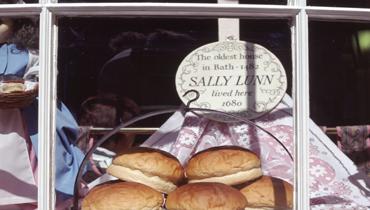
Sally Lunn’s House in Bath

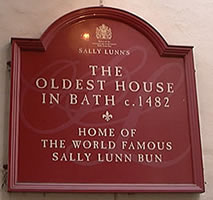
The oldest house in Bath is now know as Sally Lunn’s House, a picturesque building built in 1482 and located near Bath Abbey. The shop’s specialty for over 300 years has been the Sally Lunn Bun, a semi sweet bread made from brioche dough that tourists still purchase by the dozens to take home or eat on the spot in a small tea room setting.

Sally’s history may be more lore than fact. Some say she was a young French woman who lived in the late 17th century and sold bread on the street for a baker. Eventually she found work in a kitchen and began making a bun with sweet or savory toppings that became famous. Others say that the bun was originally created in France, while still others claim that Sally was English and the daughter of a local pastry chef.

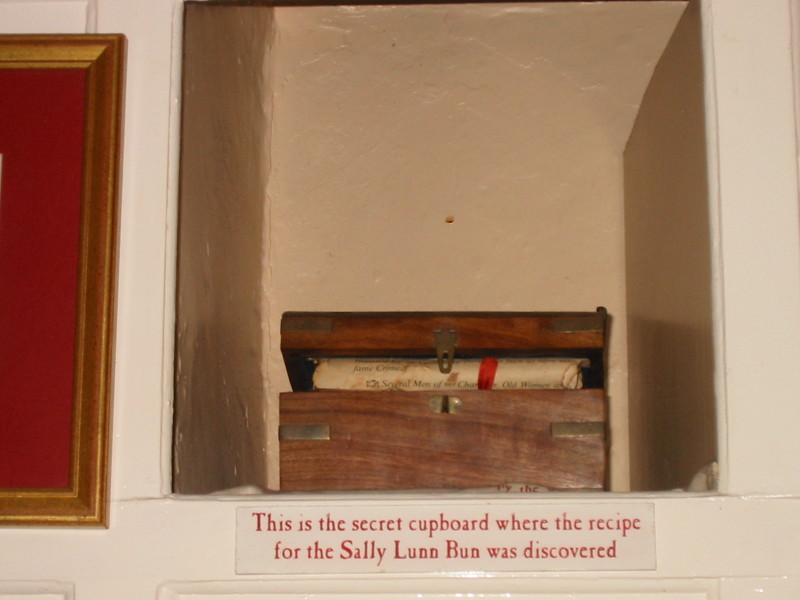
Whichever is the case, the shop, wildly popular during the Georgian Era and open for breakfast and tea, still attracts customers in droves. The orginal recipe of the Sally Lunn Bunn was discovered in the kitchen and was passed down along with the deed to the house.

Today’s visitors can visit the cellar to see the Roman foundations (c. 200 AD) and medieval kitchen (c. 1150 AD). The building itself was erected in 1482, and the stone facade added in 1720.

The following comes from the Sally Lund’s Museum in Bath, England:

“Legend has it that from her home in France, where the Protestant Huguenots were being cruelly persecuted, came young Sally Lunn to find employment with a baker who rented premises in Lilliput Alley. She sold his wares in the street, but when her skill at baking Brioche was discovered she no doubt spent for more time in the bakery itself. Sally Lunn’s Buns were a tremendous success; others tried hard to copy them, but her skill with the rich, soft and delicate dough inspired customers specifically to request the Sally Lunn. ”
Sally Lunn’s

4 North Parade PassageBath BA1 1NXTelephone: 01225 461 634

Jane Austen Online


The Jane Austen novels available as podcasts or audio files on Librivox are:

Emma
Northanger Abbey
Pride and Prejudice

Books that are being taped:

Lady Susan
Mansfield Park
Persuasion
Sense and Sensibility

The completed audio books can be downloaded for free at this site: http://librivox.org/

The complete novels can be downloaded at two sites:

Project Gutenberg
Bibliomania

Decorative Arts


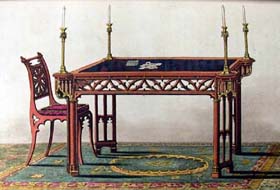
Prints and images of Gothic revival and design in late 18th Century to early 19th Century furniture and interiors reveal elaborate recreations of a bygone era. Many Georgian and Regency houses were crammed with furniture and artifacts similar to those represented in these pages.

Jane Austen and Bath


Jane Austen and Bath from Ellen Moody’s website leads to a fascinating article and photographs of the places in Bath Jane Austen visited or wrote about. Most of the photos were taken during the 1940’s or before.