Feeds:
Posts
Comments

Posts Tagged ‘Chawton House’

Gentle Reader: This is Christine Stewart’s fifth post for this blog. Christine has embarked on a year-long journey on a Sense and Sensibility inspired project that she chronicles on Embarking on a Course of Study. Herewith are her impressions of Country Dancing, her interview with Rebecca Smith, writer in residence at the Jane Austen House Museum, and her chat with Juliette Wells, the Burke-Austen Scholar-in-Residence at Goucher College

I’m officially six months in to this project and, lately, many things have happened to move me forward, as well as set me back due to my own occasional tendency towards doubt that got the best of me!
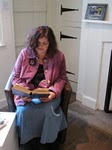
The most exciting was a correspondence with Rebecca Smith, writer-in-residence at the Jane Austen House Museum. Ms. Smith is the great, great, great, great, great niece of Jane Austen and is installed there for six months (until May 2010) working on a novel (she has already written two, which can be found on Amazon).

In response to my question, “How has being in Jane Austen’s house affected your writing and your feelings about yourself as a writer?” Ms. Smith writes:

“Well, I think the first thing I have noticed is how 200 years now seems to be such a short time, and I think this has changed the way I feel about everything.
If 200 years isn’t so long, the past and its people are more present, and less seems to be lost. I find this comforting. One of the odd and lovely things about being here is that some of the objects in the Museum are things that were once owned by my great aunts. For instance, a box that was carved by Jane’s brother, Francis, was, until not that long ago, something that my Aunt Diana kept cereal box and cracker toys in for the amusement of visiting children; and some of the smaller portraits I recognize as having once hung on their walls. I only had vague ideas of who these various Austens were when I was growing up – I probably wasn’t paying attention – but here they are now. It is as though I am following them round and we have all ended up where we should be. I do have this feeling – probably quite misplaced – of coming home. And this is ridiculous – why should I pay more attention to this branch of my family tree than any others? I have some really interesting Scottish ancestors too, including a captain who was shipwrecked on an island and was rescued to tell the tale. I had an Indian grandmother who died when my father was tiny – we know close to nothing about her. These stories are what I’m interested in writing about at the moment. It will be fiction, but the novel I’m trying to finish follows the story of five generations of a family from Hampshire to Canada and India and back again. I’m only going as far back as the Edwardians and the novel isn’t to do with Jane Austen.
I’m interested in ideas about home and belonging (and not belonging). But I can see that it is rather convenient of me to feel the pull of Jane Austen’s cottage in Chawton, which happens to be gorgeous and only 27 miles from where I live, rather than the houses in Scotland or India or Canada or the north of England where other ancestors dwelt.”

The title of the novel she is working on is tentatively called The Home Museum, which sounds welcoming and intriguing all at the same time. I can only imagine how thrilling it must be to write in the same house in which one’s ancestor wrote so brilliantly. There’s a longer answer to other questions on my website.

I also hosted an English Country Dancing lesson that took place at the end of January in the ballroom of the Baltimore Hostel, a renovated 19th Century home in downtown Baltimore. There are pictures on my website of the room and the dance in progress. We had a wonderful professional, English, caller, Mr. Michael Barrelclough, who taught us five dances. We had eighteen people and by the end of the second dance, I could look down the set and see everyone becoming more comfortable and familiar with the style of English Country Dancing and the steps.
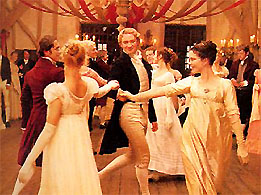
English Country Dancing, Emma with Kate Beckinsale

We still stumbled and Michael led us through some sections several times until we got it, and we laughed and laughed. It was one of the happiest evenings, and I felt so much more confident about my ability to remember steps and understand the calls. I worried less about messing up and just had a marvelous time. There’s something about these dances that is both down-to-earth and elegant and you feel both giddy and graceful at the same time. Everyone wants to have another dance so, we shall!

I’d like to say I’ve made progress on the dating ‘the Jane Austen way,’ but I have not. December – February is my busiest time of year at the arts council and I’m barely keeping my head above water – or should I say snow? The back-to-back snowstorms in the last few weeks set me back quite a bit and rescheduling meetings and Poetry Out Loud competitions completely took over.

There’s also the cost. I’m a state employee and due to our mess of a budget, state employees are required to take 8 furlough days, which is shredding my paycheck. I can’t afford a $30 or more fee for online dating services every month. Maybe in a few months, once the fiscal year ends and we, hopefully, have a balanced budget (or I have a decent tax return!).

In the meantime, I will do what practicing I can at any events I attend, of which there are many when one works in the arts!
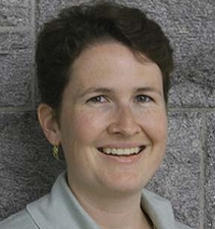
Most recently I sat down with Juliette Wells, the Burke-Austen Scholar-in-Residence at Goucher College this year. Dr. Wells teaches at Manhattanville College in New York and was here for a week to give a talk, meet with faculty and students, and do research in Goucher’s Austen collection, donated in 1975 by alum Alberta Hirshheimer Burke (1928) at the time of her death. This nationally-recognized collection consists of Austen first editions, rare period publications related to the life and landscape of rural England, and Alberta Burke’s own notebooks of Austen-related memorabilia and correspondence with Austen collectors and scholars. The Burkes also donated letters to The Morgan Library in New York, where the current Austen exhbit is taking place.

A little trivia: apparently, her husband, Henry Burke, cofounded JASNA with Joan Austen-Leigh and J. David Gray just a few years later in 1979, so the first 25 years of JASNA’s archives are also housed at Goucher.

Dr. Wells was interested in, and supportive of, the project, and I’ll be posting more info about our meeting soon, along with a picture and a podcast of her talk at Goucher. She is writing a book called Everybody’s Jane: Austen in the Popular Imagination, and is exploring how Austen has been appropriated and absorbed by popular culture through film, television, and books. She completed a fellowship at the Chawton House Library last summer.

You can read one of her articles in Persuasion at this link.

and find a link to an interview on Penguin Classics On Air at my website. She was the editor of the recent electronic version of Pride and Prejudice published by Penguin Classics, that includes all sorts of wonderful extras about fashion, architecture, dancing, and etiquette.

You can also read about the mini-crisis I had about this project, mostly because people began asking me about whether or not I wanted a book deal and if so, what was the purpose of the project, and I realized I didn’t have a thesis and did I want a book deal like Lori Smith was angling for when she had her blog that turned into A Walk With Jane Austen ?!?!?!

Deep breath!

So then I became very overwhelmed and lost sight of the joys and the basics of what I was doing. I realized I did need to figure out the purpose of the project for myself, and let the rest fall where it may.

This led me to an examination of character through the unlikely source of Pamela Aidan’s trilogy Fitzwilliam Darcy, A Gentleman which was the only reading I could manage during the storms. It’s both cozy and anxiety-provoking to be caught in snowstorms, knowing you’re missing all your commitments and how much catch up there will be….Plus I had a dead battery and every day I left the car at the dealership they seemed to find something else wrong with the it!

But back to my crisis. Did I figure out that darned purpose? I did, with Dr. Wells’ indirect help.

Next weekend I’m off to NYC to visit The Morgan Library’s Jane Austen exhibit, “A Woman’s Wit.” Some friends are going and we’re taking a video camera, so watch out!

Share/Bookmark// More on the Topic

Read Full Post »

Edward Austen Knight

[Marianne] “’What have wealth or grandeur to do with happiness?’
‘Grandeur has but little,’ said Elinor, ‘but wealth has much to do with it.’‘Elinor, for shame!’ said Marianne; ‘money can only give happiness where there is nothing else to give it. Beyond a competence, it can afford no real satisfaction as far as mere self is concerned.’

‘Perhaps,’ said Elinor, smiling, ‘we may come to the same point. Your competence and my wealth are very much alike, I dare say; and without them, as the world goes now, we shall both agree that every kind of external comfort must be wanting. Your ideas are only more noble than mine. Come, what is your competence?’

‘About eighteen hundred or two thousand a year; not more than that.’

Elinor laughed. ‘Two thousand a year! One is my wealth! I guessed how it would end.’” – Jane Austen, Sense & Sensibility, volume 1, chapter 17

“To be above vulgar economy” … was one of Jane Austen’s express wishes, yet on the surface it would seem that her rich brother Edward contributed very little to Jane’s and her mother’s and sister’s notions of security. How was it that Edward’s fortunes were so very much above that of his family, and why did he not do more for his sisters and mother than provide them with a roof over their heads and a small annual sum?

Rev. George Austen presents his son, Edward, to Thomas Knight and family

Rev. George Austen presents his son, Edward, to Thomas Knight and family

Edward, third son of the family … became the favourite of some wealthy childless relatives of his father, the Thomas Knights. They met him as a 12-year-old when they visited the rectory at Steventon on their wedding journey. When they left, Edward accompanied them for the rest of the trip and subsequently went frequently for holidays at their estate. Eventually, when Edward was 16, they adopted him as their heir. – Janet Todd, Jane Austen in Context

The Austens must have been thrilled beyond belief when Thomas Knight, George’s rich, childless cousin, took an interest in Edward, his third son. The practice of childless couples in adopting an heir from a less fortunate branch of the family was not an uncommon one for wealthy relatives to take at the time. When Edward inherited his estates from his adopted father, he became richer than Mr. Darcy, earning £15,000 per year from his investments against Mr. Darcy’s £10,000 per year. Multiply this number by 50 and you have an approximate amount of how much income Edward enjoyed in today’s terms.

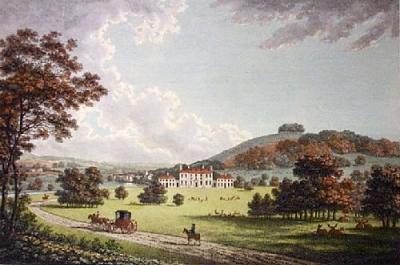
Godmersham Park

Godmersham Park

And yet, with such a rich brother, Jane and her sister and mother worried a great deal about money after the sudden death of Rev. George Austen in Bath in 1805. Three of the brothers rallied behind them. Edward’s initial pledge of £100 a year almost doubled his mother’s income of  £122 from a small South Seas fortune, and both Henry and Frank pledged £50 apiece per year to support their mother and sisters. Cassandra received a small income from Tom Fowle’s £1000, which he had bequeathed to her in his will.  Even so, the three women were forced to move in March to more affordable rented living quarters on Gay Street, and then to Southampton in 1806, where they, along with their friend Martha Lloyd, shared a house with Frank Austen and his new bride.

The move to the house in Castle Square, Southampton in 1807 brought much cheer to Jane. The house, she noted, was not in good repair but it had a large garden. Her accounts for 1807 show that from her allowance of £50 she spent £2.13.6 to hire a pianoforte.”- Soft and Loud, JASA

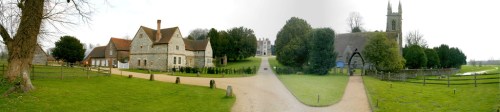
Panorama of Chawton

Panorama of Chawton

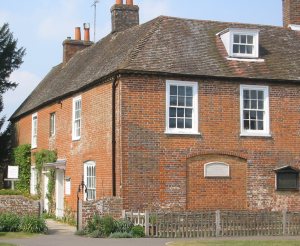
Edward finally came through for his mother and sisters. Four years after his father’s death, he refurbished Chawton Cottage and invited them to move in. It was in this cottage that Jane was at her most prolific, polishing off earlier versions of Pride and Prejudice and Sense and Sensibility and famously writing Mansfield Park, Emma, and Persuasion. In skimming through a variety of biographies, many authors treat Edward’s seeming parsimony with a hint of contempt. The Knights had a history of generosity towards their poorer Austen relatives. Thomas Knight, second cousin to Rev. George Austen, gave him two livings that were valued at £210 the year that Jane was born. At Steventon, the Austens also had land to farm, which was an important factor in their diet and maintaining their self-sufficiency. The Austens also took in boarding pupils, and by the time Rev. Austen retired , he was earning almost  £600 per year, the same amount that his eldest son, James, made towards the end of his life.

Jane, her sister and mother had fallen on hard times. Financially dependend on their families, they are forced to move in March to rented living quarters on Gay Street, and then to Southampton in 1806, where they, along with their friend martha Lloyd shared a house with Frank Austen and his new bride.
“The move to the house in Castle Square, Southampton in 1807 brought much cheer to Jane. The house, she noted, was not in good repair but it had a large garden. Her accounts for 1807 show that from her allowance of £50 she spent £2.13.6 to hire a pianoforte.” JASA Soft and Loud,
Finally, four years after his father’s death, Edward Austen Knight refurbished Chawton Cottage for his mother and sisters, and had them move in. The walled garden, designed by Edward Austen Knight on the advice of his sisters Jane and Cassandra, is being recreated to provide not only flowers but organically grown fruit, vegetables and herbs, some of which will be used in contemporary recipes to be prepared in the kitchens. The church where Jane’s mother and sister are buried sits halfway up the drive.(from Chawton site)There had always been generostiy from the Knights towards the Austens. .

Jane’s mother, Cassandra, who was related to the Leighs of Stoneleigh Abbey, placed a great hope that her rich childless brother, James Leigh-Perrot, would leave money to her eldest son James. While James Leigh-Perrot provided James with a clerical living and some supplementary cash, his property eventually went  not to James, but to his son, James Edward, who was Jane Austen’s biographer. James Leigh-Perrot left nothing to his sister Cassandra, even knowing that she lived on a small income. He might have supposed that her uber rich son, Edward, would take care of his mother, which, in a fashion he did. Why did Edward not contribute more to his mother and siblings?

This is mere conjecture on my part, but Edward did the best he could under the circumstances. Yes, he was rich beyond imagining, but his responsibilities were many and heavy. He inherited two large estates, which were the physical embodiment of his inheritance. The laws of primogentirue demanded that as the heir, he should keep everything intact, from the land, which provided the income, to the house and all the family heirlooms within it. The heir was merely a “keeper” of the estate and the family name, and his actions were proscribed. Edward was more a tenant than an owner, and he was duty bound to turn over his entire estate to his male heir. – The Country House, JASA.

Chawton Cottage

Chawton Cottage

Running these estates, with their attendant servants and necessary improvements, took an enormous, some would say crippling, amount of resources. In addition, Edward’s family was large. His first wife, Elizabeth, died after giving birth to their eleventh child. Add his seven brothers and sisters, his biological mother and adopted mother and her family, the Knight family, and the ever widening circle of nieces and nephews, and the even larger circle of aunts, uncles and cousins on both the biological and adopted sides, and you can imagine the pressures Edward must have felt all around.  Had he doled out what we would deem as adequate support to all the needy individuals in his extended family, Edward’s estate would soon have been frittered away.

Chawton House

Chawton House

One cannot fault Edward too much for moving prudently and cautiously, for he was obliged first to his immediate family and the need to provide for adequate dowries for his daughters and support for his younger sons. I do fault him for not helping Jane to repurchase her manuscript, Susan (renamed Northanger Abbey), for the measly sum of £10, so that she could pursue its publication, but for all we know she might have never applied to him for help.

I sometimes wonder if the Austen women were as destitute as people today conjecture. Unlike 90% of their countrymen, who rarely traveled outside of their immediate area, the Austens traveled frequently, visiting friends and relatives. They were able to keep two servants and supplement their diet with vegetables from their kitchen garden, and received an endless supply of milk from Edward’s cows. Jane secured a modest but extra income from her writing, and the three women lived off a yearly income of  £500 pounds, which was only  £100 less than Rev. George Austen earned, who had a family of eight to feed, in addition to his boarders. Jane’s eldest brother,  Rev. Frank Austen, managed to keep a carriage for his second wife on an income of  £600 per year. I am not saying that the three women were rich, by any means, for, like Elinor Dashwood, they lived frugally and prudently, but they did dine frequently with Edward and visited him over extensive periods of time at Godmersham Park, which must have been as luxurious an experience as any visit to a high end resort.

After Thomas Knight died, his widow, instead of waiting until her own death, handed over the family estates to Edward, who from 1798 lived the life of a country gentleman at Godmersham in Kent. When Mrs Knight herself died in 1812, Edward and his family, as stipulated in her will, took the name of ‘Knight’, prompting his eldest daughter Fanny (a favourite niece of Jane Austen’s) to write in her diary that now ‘we are therefore all Knights instead of dear old Austens How I hate it!!!!!’. Fanny’s aunt Jane wrote more calmly to her friend Martha Lloyd that ‘I must learn to make a better K.” – Janet Todd, Jane Austen in Context

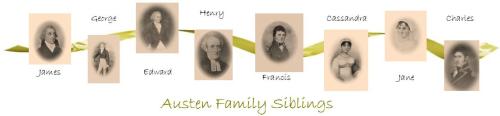
Edward was the Austen's third oldest child

Edward was the Austen's third oldest child

More on the topic:

Gentle reader: In honor of JASNA’s annual meeting in Philadelphia this week, this blog, Austenprose, and Jane Austen Today will be devoting posts to Jane Austen and her siblings. Look for new links each day.

Read Full Post »

Jane's Window View, copyright Keith Mallet

Jane's Window View, copyright Keith Mallet

Gentle Reader, Keith Mallett wrote to me to say that he visited his homeland of England for the first time in 35 years after moving to Australia. One of his fondest memories of the trip is of a visit to Chawton. When he was a teenager living in England he used to almost drive past the house on the way to and from boarding school each term, but “I have to admit Jane Austen was not high on my teenage reading list.”

We can sympathize, Keith. Not many teenage boys relate to Jane. Not many men do, either, so it is my pleasure to share your insights with my blog’s readers. I also thank you for giving me permission to publish your photograph. How apropos that is was raining that day, for I have often imagined Jane finding excuses to stay inside and write.  Keith wrote in his journal about Jane:

It can be taken for granted that I am a fan of Jane Austen’s writing – I find the acute social commentary woven into the fabric of the romances and intrigues of those Regency days quite fascinating, and wonder how much the novels reflect Jane’s own personality and desires. She would have been a fascinating person to meet. But sadly I was too late by 191 years. I could only tread the bare floorboards of the house, peer into the rooms that contained her life all those years ago and take a few photographs. But she was suddenly present as I looked out from the window of the bedroom she shared with her sister, Cassandra. She must have looked out through the rain-spattered panes many a time, perhaps pondering on the chances of walking on that day, or absently plotting the life of one of her creations. They were dedicated walkers, and I suspect even the dirty weather of my day there would not have deterred that walking. The bedroom window looks out over the back yard to the out-buildings: where the day-to-day domestic tasks would have been done: the baking, the washing, and drawing cool water from the depths of the well.

More About Chawton House (where Jane’s brother Edward lived) and Chawton Cottage (where Jane lived with her mother and sister):

Read Full Post »

« Newer Posts