Feeds:
Posts
Comments

Posts Tagged ‘Collins Hemingway’

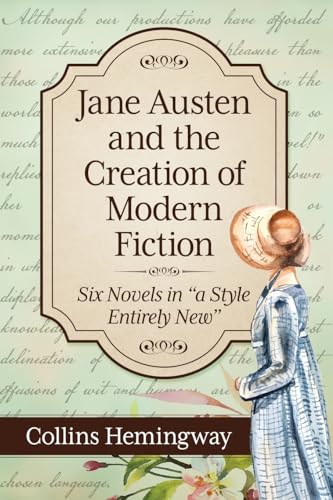
Jane Austen and the Creation of Modern Fiction: Six Novels in “a Style Entirely New,” explores Jane Austen’s development as a fiction writer.

by Brenda S. Cox

A few days ago I reviewed Collins Hemingway’s fascinating new book on the development of Austen’s writing techniques, Jane Austen and the Creation of Modern Fiction: Six Novels in “a Style Entirely New.”  Today we meet with the author to get his perspectives on the book.

Collins Hemingway began his analysis of Jane Austen’s writing techniques as he wrote a fiction trilogy speculating on the “lost years” of Austen’s life, The Marriage of Miss Jane Austen.

I asked Collins Hemingway to tell us more about Jane Austen and the Creation of Modern Fiction.

JAW: What led you to write this book, Collins?

Collins: I’ve read Austen all my life, but I did not read much commentary during my 25-year high-tech career. When I came back to Austen fulltime, I read a ton of Austen scholarship from the last 20 years. I noticed that there wasn’t much about her writing, as writing. Scholars would mention a technique and use it as a launch point for broader criticism. With rare exceptions, they would not analyze the technique itself or how it affected the reader. I saw this as an area in which I could add something new.

JAW: You have, of course, written a fiction series, The Marriage of Miss Jane Austen. How did your experiences writing fiction about Austen feed into your development of Jane Austen and the Creation of Modern Fiction?

Collins: Writing the novels led directly to this book, though it took several years of hard reading, notetaking, and writing to flesh out the meat over the bones. I have shared that story on my blog.

JAW: The book is full of great insights. For you, what was one of the most helpful, something that helped you see Austen’s novels in a new way?

Collins: After completing the fiction trilogy, I went a step further, going through each of Austen’s six novels line by line, noting everything of interest to a writer. I ended up with 20 to 30 pages of handwritten notes on each one. Then I began to consolidate various topics. For instance, I ended up with five pages of notes just on description, collated from all her books, including the juvenilia. Then I examined the patterns in different aspects of writing and tried to understand how the patterns fit within and between each book.

As the patterns began to organize themselves, I realized that there was a distinct trend from early to late. In each book, Austen learned something, then applied it in the succeeding books. Like Virginia Woolf examining the early works and the unfinished works, I began to see the internal structures of each book. (As my wife would caution—in my opinion.) I could see how Austen was feeling her way along in the early works, then painting like a master in the later ones.

JAW: You’ve pointed out the strengths and weaknesses of each of Austen’s novels. It appears that you see Emma as the most “perfect” novel, as other commentators do. But for you personally, which novel do you tend to enjoy re-reading the most, and why?

Collins: Depends on my mood. P&P for its sheer energy, and for Liz bowing to no one, ever. Emma for its magnificence, page by page. Persuasion for the depth of Anne’s feeling. MP, though it is in no way my favorite, when I just want to admire the structural purity and the work she put into it.

JAW: You talk about many techniques of modern fiction that Jane Austen helped to develop and show how they developed in her novels over time. Could you briefly list for us some of those techniques, so readers can see some of the treats they have in store?

Collins: She was a master of dialogue probably from the day she first picked up a quill pen. Description. Behavior. Character motivation and interaction. Complex plots (without castles, brigands, or shipwrecks.) Ever deeper and subtler ways to get into her characters’ minds.

JAW: What is one takeaway that you want readers to have when they finish reading your book?

Collins: What Austen accomplished would make any author proud. But the fact that she learned all that she did on her own, away from other writers, pulling the best from a small number of others (such as Richardson, in a very specific way), building on a few good things from tradition, figuring out the rest on her own—it’s astonishing. And she did it in her too short 41.5 years of life!

JAW: What was the most fun part of the book to write?

Collins: My breakthrough in really understanding the internals came through descriptions. They unlocked the issues in NA and S&S, showed how radically different P&P was from the earlier two, and became miraculously mature in MP. This was the most fun. Especially when I realized the difference in the way Austen treated Lady Russell and Anne as they entered Bath in Persuasion. It took my breath away to see what Austen had done.


You may want to read my review if you missed it earlier. This is a fascinating book if you want to better understand Jane Austen’s modern writing techniques and how she developed them herself. Jane Austen and the Creation of Modern Fiction is available from Amazon and from Jane Austen Books. Jane Austen Books is currently offering it at a substantial discount.


Brenda S. Cox is the author of Fashionable Goodness: Christianity in Jane Austen’s England. She also blogs at Faith, Science, Joy, and Jane Austen.
Read Full Post »

By Brenda S. Cox

I thoroughly enjoyed Jane Austen and the Creation of Modern Fiction: Six Novels in “a Style Entirely New,” by Collins Hemingway. As a fiction writer himself, Hemingway examines Austen’s novels, in the order she wrote them, to analyze the techniques she pioneered. He observes her abilities growing from novel to novel, as she experiments and succeeds in creating the worlds and characters we so love.

Collins Hemingway’s new book, Jane Austen and the Creation of Modern Fiction: Six Novels in “a Style Entirely New, gives fascinating insights into Austen’s development of modern techniques of fiction writing.

A New Style?

Did Jane Austen develop a new style of novel-writing? Her contemporary reviewers thought so. They felt compelled to give long contrasts between the previous style of novel-writing, full of intensity and improbability, with Jane Austen’s new realistic style. Sir Walter Scott in his 1815 review of Emma said Austen “draws the characters and incidents introduced more immediately from the current of everyday life.” Rev. Richard Whately wrote in his 1821 review of Northanger Abbey and Persuasion, “A new style of novel has arisen. . . . The substitute for these excitements [of unlikely adventures] . . . was the art of copying from nature as she really exists in the common walks of life.” Both these reviews are worth reading (follow the links above) to see how Austen’s contemporaries struggled to describe what she was, and wasn’t, doing in her novels.

The third volume of Austen’s Juvenilia includes a penciled note inside the front cover, “Effusions of Fancy by a very Young Lady consisting of Tales in a Style entirely new.” Peter Sabor says this inscription is written in Jane’s father’s handwriting, though others have speculated that it may have been written by Cassandra or even by Jane herself, tongue-in-cheek.

Author Collins Hemingway told me, “The epigram seems most likely to me to be from her father. . . . To me, the quotation is Mr. Austen enjoying and encouraging Jane’s raw power and comedy, her sheer audacity in sending up the pulp fiction of the day with her various teenage writings. I saw a strong parallel to her adult fiction. Her juvenilia showed that she understood that traditional fiction didn’t cut it. Her adult fiction shows that she learned how to write good novels—something new at the time.”

Jane Austen Learning (or Inventing) the Craft of Writing Fiction

Jane Austen and the Creation of Modern Fiction starts out with a preface for more academic readers (feel free to skip it if that’s not you), then an introduction for us all, which begins:

“I wrote this book so that people can read Jane Austen with fresh eyes. I wanted booklovers to view her not as a literary or cultural icon but as a writer, someone who puts words to paper to try to touch another person’s heart. I wanted people to see her as a human being who struggled to master her craft as anyone in any field, regardless of talent, must do. . . . As both a student of literature and a writer, I wanted to know how Austen affects readers. I wanted to know how she created remarkably  real people interacting in remarkably realistic situations. This is what writers care about, and what readers respond to.”

Yes.

Hemingway starts with an exploration of the context of Austen’s writing, how she “straddled the old and new literary order, ultimately pivoting the novel from improbable adventures to deep penetration of the minds of her heroines.” (These early chapters are necessarily a bit more difficult, as they compare Austen with her contemporaries, who most of us have not read—and here we can see why Austen is so much more accessible than other writers of her time!)

Then he brings us deep into our beloved Austen–following her development of description in her earliest novels, Northanger Abbey and Sense and Sensibility. In Pride and Prejudice, she continues to develop “pocket descriptions,” which are “pithy, telling details.” For example, Elizabeth Bennet’s jumping over stiles and puddles and arriving at Netherfield with “weary ancles” and “dirty stockings” is a pocket description that shows us a lot about Elizabeth.

Sense and Sensibility was originally written in the popular “epistolary” form, as a series of letters. Letters give a sense of distance, as the character is writing about events that have already happened, rather than the author drawing readers directly into events. A chapter analyzes how Austen made the transition from letters into narrative. For example, Edward Ferrars is a “blurry” presence in the early chapters, which are closer to the letter format. By the end of the novel, though, Austen has added vivid, immediate scenes. So, in the final proposal scene, we see Edward as “the very real and anguished presence of a human being.”

My favorite chapter is the one on “The Marvelous Complexity of Mansfield Park.” Hemingway’s discussion helps readers appreciate its elaborate scenes, complex characters, and interconnected plotlines. He particularly explores the depths of Fanny Price’s thoughts and feelings.

Fanny’s “responses, which for the most part only the reader observes, show her to be by far the most complex individual Austen ever creates. Outwardly, she is a saint. Inwardly, she is as confused and angry as any person who is regularly embarrassed or put down. Her raw feelings sometimes overpower her Christian charity and patience.” Austen even uses the furnishings of Fanny’s room to show her interior life. Fanny constantly examines her own motives, trying to find the right path.

Every chapter includes new insights into Austen’s novels, her writing techniques, and her development as an author.

Persuasion

One area of the book that Janeites might find a little uncomfortable is the section on Persuasion. Collins Hemingway discusses the revision process—authors generally rewrite their books multiple times. He points out several areas in Persuasion that could be considered imperfect. For example, Mrs. Smith is not quite consistent. Why does she encourage Anne to marry Mr. Elliot, then reveal how horrible he is? And why does Lady Russell mostly disappear from the second half of the book?

Austen might have fixed these issues with a major rewrite. (I suggest she also might have changed Charles Hayter’s name, so we wouldn’t have two adult characters named Charles, besides Charles Musgrove’s son Little Charles.) But Hemingway suggests that perhaps her health was failing already, and she did not have the time and energy for major revision. She had already replaced the original ending with the beautiful one we know and love. And, in “the quiet passion of Anne Elliot,” she had already given readers “a depth of character never seen before.”

If Austen had begun another revision to fix smaller structural issues, she might not have had a publishable version available when she died. So, Hemingway persuades us that Austen wrapped up the work, as it stood, to give the world another work of art and to help provide for her mother and sister after her death. As Hemingway states, “Like Emma, Jane is faultless despite her faults.”

Any lover of Austen will learn a lot from Jane Austen and the Creation of Modern Fiction. I particularly recommend it to writers (like myself), who will enjoy seeing Austen’s techniques and their development. Any of you who love digging deeper into Austen’s novels will find new delights here.

On Monday, we’ll interview the author to get his perspectives on the book.

Jane Austen and the Creation of Modern Fiction is available from Amazon and from Jane Austen Books. Jane Austen Books is currently offering it at a substantial discount.

Gentle readers, what aspect of Austen’s writing do you most admire? Her settings, characters, plots, style, humor, or something else?

Brenda S. Cox is the author of Fashionable Goodness: Christianity in Jane Austen’s England. She also blogs at Faith, Science, Joy, and Jane Austen.

Read Full Post »

marriage of jane-austen-coverBook announcement of The Marriage of Jane Austen by Collins Hemingway and a sweepstakes giveaway of a trip to England.

When Jane Austen said that everybody has the right to marry once in their lives for love, did she include herself? And how would this singular spirit deal with the complexities of marriage at a time in history that could be both exhilarating but also cruel to women?

The Marriage of Miss Jane Austen by Collins Hemingway reimagines the life of England’s archetypal female by exploring what might have happened if she had ever married. It shows how a meaningful, caring relationship would have changed her as a person and a writer.

This novel is the first set in Regency times to delve deeply into the psyche of a woman as she opens her heart to a true attachment with a man as independent, as passionate, and as complicated as she is herself

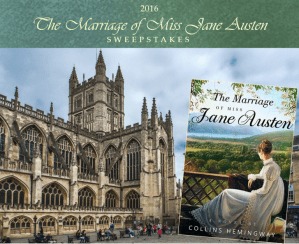
Marriage of Jane Austen_768x627The Marriage of Miss Jane Austen 2016 Sweepstakes

We’re excited to announce The Marriage of Miss Jane Austen 2016 Sweepstakes as a way to give back to the many Jane Austen fans in the US, Canada and Great Britain. You could win a Grand Prize trip to the UNESCO heritage city of Bath, England and more. Learn more in our press release and then enter the sweepstakes today!
Everybody should marry once for love—
even Jane Austen

About the Author:

Collins Hemingway’s approach to creative investigation in fiction is to dive as deeply into a character’s heart and soul as possible, to address the root causes of their behavior rather than to describe superficial attitudes and beliefs. This treatment, he believes, is at the heart of all good fiction, for it provides the only way to draw a complete, complex portrait of a human being that is so rewarding to readers. Hemingway’s sentiment regarding the importance of literature is only slightly mellower than that of Jane Austen, who observed that the gentleman or lady who fails to find pleasure in a good novel must be “intolerably stupid.”

Hemingway never lost his passion for the art of storytelling or for the rich history of Georgian-Regency England and the Napoleonic wars. In The Marriage of Miss Jane Austen, he revisits these early passions and brings them back to life.


Read Full Post »