 An immensely thick volume lay on my doorstep at the start of winter: Deirdre Le Faye’s 4th edition of Jane Austen’s Letters had arrived from Oxford University Press. It has taken me this long to peruse its 688 remarkable pages and savor them. According to the publicity materials, the reason Le Faye put out a 4th edition (the third edition came out in 1997) was in order to:
incorporate the findings of recent scholarship to further enrich our understanding of Austen and give us the fullest and most revealing view yet of her life and family. In addition, Le Faye has written a new preface, has amended and updated the biographical and topographical indexes, has introduced a new subject index, and had added the contents of the notes to the general index.
As in the third edition, Jane Austen’s letters are placed in the correct chronological sequence, with notations made about missing letters. Usually these missing letters were referred to in Jane’s correspondence.
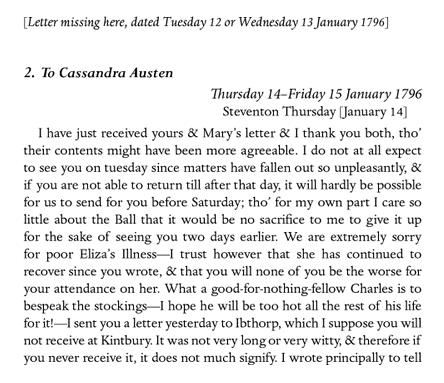
Portion of letter #2. Note the information about the missing letter. Image @Jane Austen's Letters
What sets Le Faye’s edition of Jane Austen’s letters apart from the other books I have on the topic is her meticulous information about the letters. Each come with its provenance and mention of the physical details, such as markings, watermarks, and postmarks. Each letter is also annotated. I recommend that the reader use two bookmarks, one for the letter and one for the annotation. Reading this book is quite a physical exercise, for it is heavy (over 2 lbs.) and thick, and one is forever flipping back and forth between the letters and their annotations. For example, Letter #2 sits on page 5, while its annotation can be found on page 369.
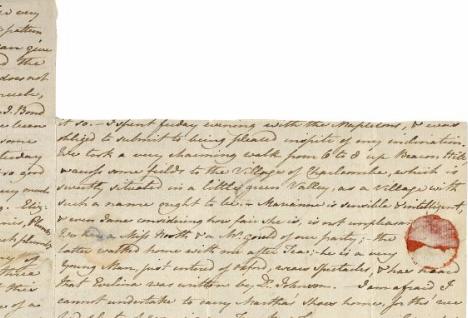
Letter from the Morgan Library exhibit. Note the portion that was cut out.
Jane Austen’s Letters, 4th Edition, is a must have for every serious Jane Austen fan and scholar. Through her letters, we learn so much about Jane, her relationships, and the world she lived in. Jane reserves her most informal, intimate voice for members of her family. In these letters she has no need to remain reserved. She lets her hair down, as it were, and provides us a glimpse of the routines she followed, the people she met, and her likes and dislikes without the filter that she would have reserved for strangers or in business situations. (Unfortunately, Cassandra acted like her filter, cutting out words, phrases and entire portions of Jane’s letters, and, worse, burning thousands of them.) One thing that is missing in this comprehensive book are the images of the letters themselves. I was lucky to view a number of them at the Morgan Library exhibit a few years back. Seeing the actual letters (as opposed to reading about their markings) would add enormously to our knowledge about Jane Austen as a letter writer.
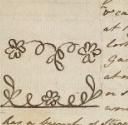
Jane draws a sample of the lace she's describing. Image from a letter at the Morgan Library Exhibit, 2009-10.
As I read Austen’s letters, I was struck by the mundane events she was recounting. These letters are really the 21st century equivalents of emails, phone calls, and text messages, designed to keep family members and friends apprised about events in one’s life. There are flashes of humor and wit, and many references to customs and events that are not generally known today. Jane writes casually about Caroline’s spinning wheel, which ladies in her day still used for spinning their own wool. Jane was proud of her sewing skills, and writes in September, 1796: “We are very busy making Edward’s shirts, and I am proud to say that I am the neatest worker of the party.” This single sentence is fraught with meaning. Ladies were always keeping their hands busy, and sewing made up a great part of their day. If they weren’t embroidering, they were mending. If they weren’t making something for themselves, they were working on the poor basket. And then there’s this little tidbit: Tailors made up men’s clothes, but it was the women in their families who made their shirts. Jane and Cassandra must have been always busy making shirts for their many brothers, especially after they were widowed. I am speaking of only two letters: there are over 160 more.

Deirdre Le Faye
Of all the books that have been sent to me for review, I must admit to having a particular liking for this one. It is as if Jane Austen is speaking directly to me. Deirdre Le Faye, with her vast scholarly knowledge on the topic, provides me with more than enough information to understand their background.
 I give this important book 4 1/2 Regency tea cups (out of 5) I wanted to give it 5 tea cups, but the format of the book is a bit unwieldy. For the 5th edition, perhaps the publishers will consider placing the annotation of the letter in a margin next to the text of the letter itself, along with an image of the letter, if such an image is important to our understanding of the letter (as the one above).
Product Details
Hardcover: 688 pages
Publisher: Oxford University Press, USA; 4 edition (December 1, 2011)
Language: English
ISBN-10: 0199576076
ISBN-13: 978-0199576074
Product Dimensions: 8.5 x 5.8 x 2.4 inches
Shipping Weight: 2.1 pounds (View shipping rates and policies)
 Sir Walter Elliot, of Kellynch-hall, in Somersetshire, was a man who, for his own amusement, never took up any book but the Barontage; there he found occupation for an idle hour, and consolation in a distressed one – Persuasion








 Jane Austen's World