This Jane Austen blog brings Jane Austen, her novels, and the Regency Period alive through food, dress, social customs, and other 19th C. historical details related to this topic.
Then, this YouTube video features both Chawton Cottage and Chawton House, and will take you on a walk past the beautifully preserved houses that Jane and Cassandra must have seen during their walks through the village.
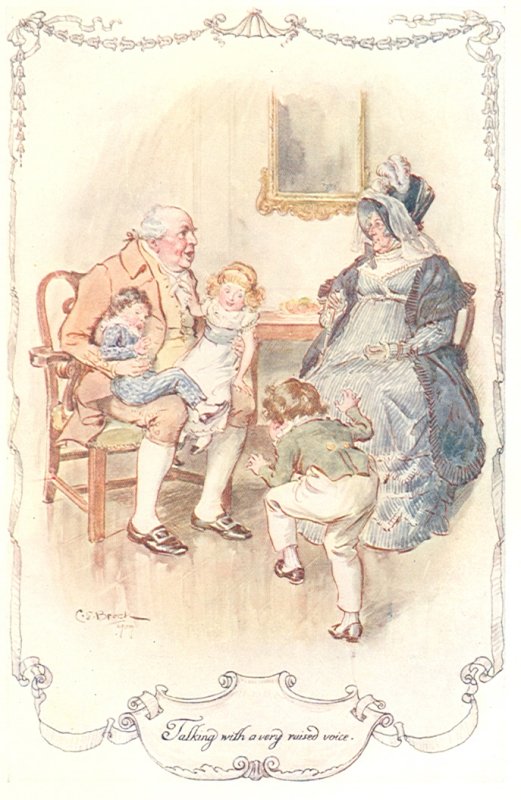
“Immediately surrounding Mrs. Musgrove were the little Harvilles, whom she was sedulously guarding from the tyranny of the two children from the Cottage, expressly arrived to amuse them. On one side was a table, occupied by some chattering girls, cutting up silk and gold paper; and on the other were tressels and trays, bending under the weight of brawn and cold pies, where riotous boys were holding high revel; the whole completed by a roaring Christmas fire, which seemed determined to be heard, in spite of all the noise of the others. . . .
Mrs. Musgrove . . . observ[ed] with a happy glance round the room, that after all she had gone through, nothing was so likely to do her good as a little quiet cheerfulness at home. . . .
” ‘I hope I shall remember, in future,’ said Lady Russell, as soon as they were reseated in the carriage, ‘not to call at Uppercross in the Christmas holidays.’ Every body has their taste in noises as well as in other matters . . .”—Persuasion, Vol. 2, chapter 2
The Musgrove family at Christmas
Jane Austen gives us only brief glimpses of Christmas in her world. Here Mrs. Musgrove and Lady Russell think very differently about what makes a pleasant Christmas. The Musgrove family are enjoying crafts, food, a Christmas fire, and children having fun and making noise.
Family and Friends
At Christmas, people gathered with friends and family, as we still do today. In Northanger Abbey, Catherine’s brother James met Isabella Thorpe when he went to spend the Christmas holidays with Isabella’s brother. In Pride and Prejudice, Elizabeth invites the Gardiners to join her and Darcy at Pemberley for Christmas. In Sense and Sensibility, Charlotte Palmer asks the Dashwood sisters to join her at Cleveland for Christmas.
In Emma, Emma’s sister and her husband come to visit for the holidays with their children. They are busy with friends during the mornings, and Mr. Weston insists that they dine with him one eventful evening.
Mr. Elton, at least, enjoys the occasion, saying:
“This is quite the season indeed for friendly meetings. At Christmas every body invites their friends about them, and people think little of even the worst weather. I was snowed up at a friend’s house once for a week. Nothing could be pleasanter. I went for only one night, and could not get away till that very day se’nnight.”—Emma, chapter 13
Mr. Elton drinks too much and proposes to Emma, who rejects him. She is therefore very glad on Christmas day to see
“a very great deal of snow on the ground. . . .The weather was most favourable for her; though Christmas Day, she could not go to church.”—Emma, chapter 16
The clear implication, though, is that Emma would naturally have gone to church on Christmas day. Churches generally had a good turn-out on Christmas. Communion was generally offered that day (one of only three or four times a year when country churches would offer Communion, also called the Lord’s Supper). Henry Crawford in Mansfield Park assumes that Edmund Bertram will only need to preach on the major holidays when many people attended church:
“A sermon at Christmas and Easter, I suppose, will be the sum total of sacrifice.”— Mansfield Park, chapter 23
Edmund, of course, plans to live in his parish and lead services and preach there every Sunday, not just on holidays.
For each church holiday, the Book of Common Prayer, handbook of the Church of England, prescribed specific prayers and Bible readings that would be the same every year. The “collect” prayer from the 1790 Book of Common Prayer for “the Nativity of our Lord, or the birth day of CHRIST, commonly called Christmas-day” is:
“Almighty God, who hast given us thy only begotten Son to take our nature upon him, and as at this time to be born of a pure Virgin; grant that we being regenerate, and made thy children by adoption and grace, may daily be renewed by thy Holy Spirit, through the same our Lord Jesus Christ, who liveth and reigneth with thee and the same Spirit, ever one God, world without end. Amen.”
Bible readings for the day were from the first chapter of the book of Hebrews and the first chapter of the book of John, both about the coming of Christ.
In a recent talk by Rachel and Andrew Knowles on “A Regency Christmas,” they pointed out that Christmas day, and the whole Christmas season, was a popular time for weddings in the churches. So perhaps that was Austen’s little joke, having Mr. Elton propose right before Christmas! Babies were also christened on that day, and Christmas was a time for ordaining new clergymen. Edmund Bertram goes to Peterborough for ordination during Christmas week. When he delays his return, Mary Crawford thinks he may be staying for “Christmas gaieties.”
Christmas Gaieties
Miss Bingley uses the same term when she writes to Jane Bennet:
“I sincerely hope your Christmas in Hertfordshire may abound in the gaieties which that season generally brings, and that your beaux will be so numerous as to prevent your feeling the loss of the three of whom we shall deprive you.”—Pride and Prejudice, chapter 21
What did those gaieties involve?
Customs that were consistent across the country were gathering with family and friends, eating a special meal, and giving gifts and money to the poor. Austen mentions a few additional traditions.
Regency Christmas celebrations usually involved a special meal with family and friends. Farmer Giles’s Establishment, Christmas day, 1800, by William Heath, 1830. Courtesy of The Lewis Walpole Library, Yale University
Gifts
Christmas was a time for charity, for giving gifts to the poor and to those in service occupations, like the local butcher. These gifts of money were called “Christmas boxes.” According to the Knowles’s research, newspapers even published lists of what certain wealthy people were giving to the poor at Christmas.
In families, it appears that gifts were given mainly to children. I found only one mention in Austen:
“On the following Monday, Mrs. Bennet had the pleasure of receiving her brother and his wife, who came as usual to spend the Christmas at Longbourn. . . . The first part of Mrs. Gardiner’s business on her arrival was to distribute her presents and describe the newest fashions. . . . The Gardiners stayed a week at Longbourn; and what with the Phillipses, the Lucases, and the officers, there was not a day without its engagement. Mrs. Bennet had so carefully provided for the entertainment of her brother and sister, that they did not once sit down to a family dinner.”—Pride and Prejudice, chapter 25
It’s not clear if Mrs. Gardiner brought gifts for everyone because it was Christmas, or if she was just bringing gifts because she was coming from London to the country on a visit.
Games
Many played games at Christmastime. Jane Austen wrote in a letter to Cassandra from Portsmouth, on Jan. 17, 1809 about a change in the fashions for Christmas games:
“I have just received some verses in an unknown hand, and am desired to forward them to my nephew Edward at Godmersham:
Alas! poor Brag, thou boastful game! What now avails thine empty name?
Where now thy more distinguished fame? My day is o’er, and thine the same,
For thou, like me, art thrown aside At Godmersham, this Christmas tide;
And now across the table wide Each game save brag or spec. is tried.
Such is the mild ejaculation Of tender-hearted speculation.”
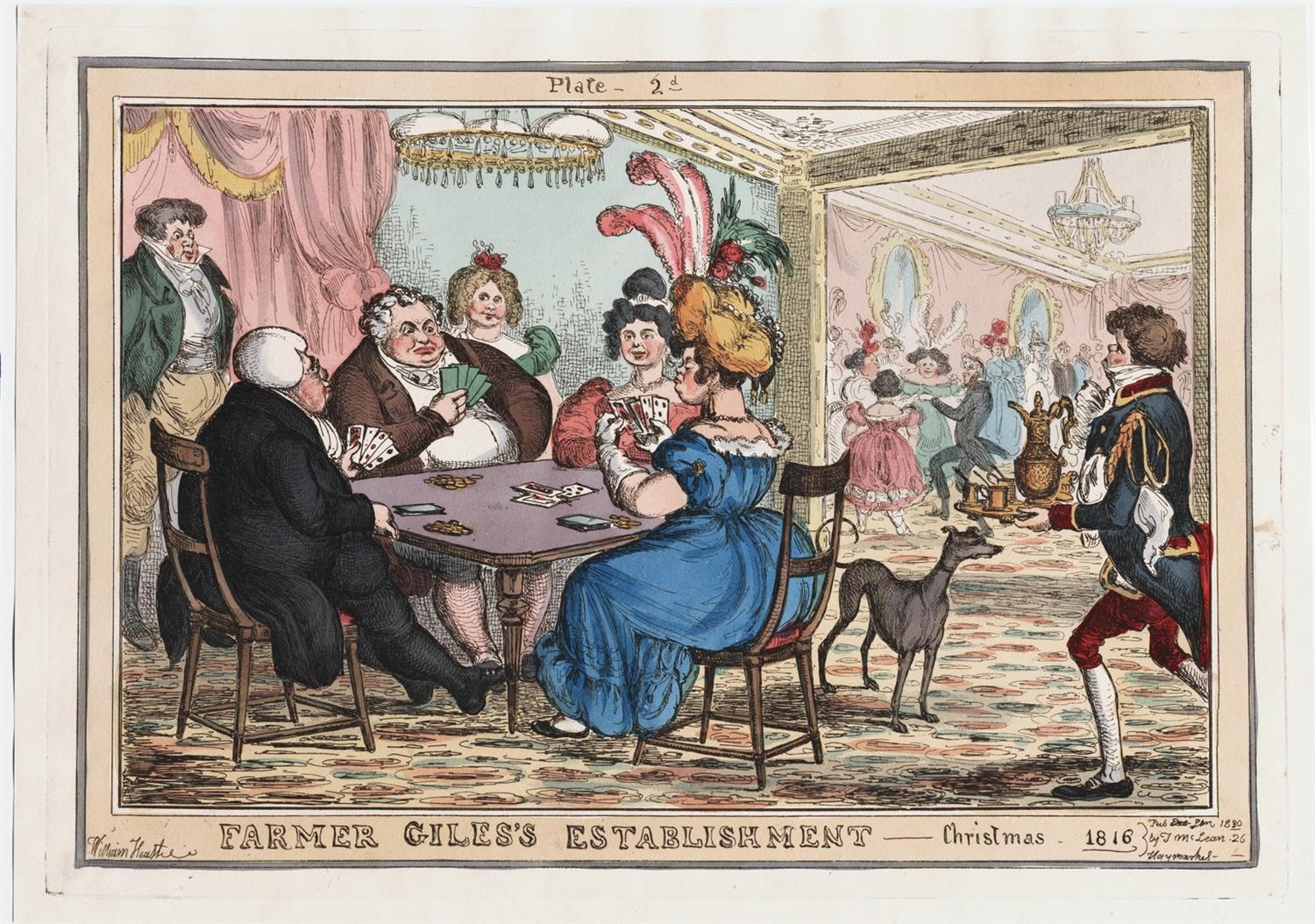
Card games and dancing were popular Christmas activities. Farmer Giles’s Establishment Christmas 1816 by William Heath, 1830. Courtesy of The Lewis Walpole Library, Yale University
Dancing
Austen’s characters dance at Christmastime. Sir Thomas Bertram holds a ball for Fanny Price during the Christmas holidays. Sir John Middleton hosts a Christmas dance, followed by a hunt the next morning:
“‘He [Willoughby] is as good a sort of fellow, I believe, as ever lived,’ repeated Sir John. ‘I remember last Christmas at a little hop at the park, he danced from eight o’clock till four, without once sitting down.’
“‘Did he indeed?’ cried Marianne with sparkling eyes, ‘and with elegance, with spirit?’
“‘Yes; and he was up again at eight to ride to covert.’”—Sense and Sensibility, chapter 9
Other Christmas Traditions
According to the Knowles, Christmas customs were different between city and country, and between various areas of the country. In some areas old customs like the Yule log and decorating with greenery were dying out, in other areas they were still going strong.
Whatever traditions your family keeps during this holiday season, may you experience much joy and deep peace.
If you want to find out more about specific Christmas customs in Austen’s England, check out any of these posts:
“This is quite the season indeed for friendly meetings. At Christmas every body invites their friends about them, and people think little of even the worst weather.”–Mr. Elton, Emma
I hope you are all enjoying the holidays. In Austen’s novels, Christmas is a time for parties and for family and friend to gather, just like today. It was also a day for attending church (see Emma ch. 16 and Mansfield Park ch. 23), after weeks of Advent when prayers focused on the coming of Christ. For more on the prayers and readings that Austen would have prayed and read for Advent and Christmas, see my post Advent with Jane Austen. You can also find many posts at this site (and others) on Christmas customs in Jane Austen’s England.
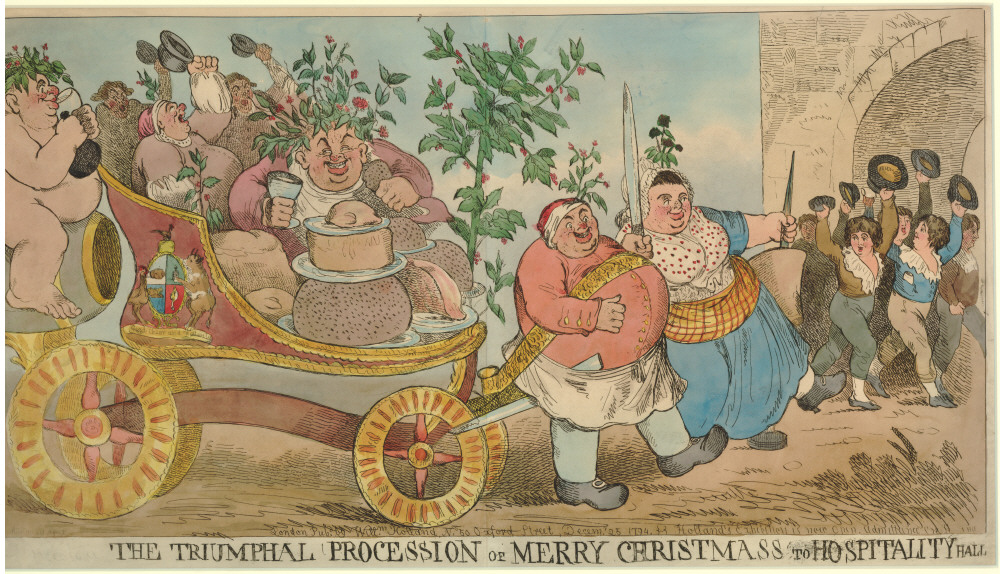
I recently gave a presentation on “Satirical Cartoons and Jane Austen’s Church of England” at JASNA’s Annual General Meeting (you can read it in this month’s Persuasions On-Line, or, if you are a JASNA member, you can watch it in the AGM on Demand). Today I’d like to share a few cartoons about Christmas in Austen’s England. (I didn’t find many; perhaps Christmas was not a popular subject for caricatures.)
In an earlier post about the Clerical Alphabet cartoon, I wrote about Richard Newton, a prolific young artist of the time. Newton drew the above cartoon in 1794, satirizing the general gluttony and drunkenness associated with Christmas. In The Triumphal Procession of Merry Christmas to Hospitality Hall, men on a carriage feast on large pieces of meat while behind them a naked man sits on a barrel, probably of wine or another alcoholic beverage.
Academics at Christmas
Christmas Academicks, Playing a Rubber of Whist, Thomas Rowlandson, 1803. Public domain via the Metropolitan Museum of Art.
University professors have a much more restrained celebration, though still not a devout one. Thomas Rowlandson’s The Christmas Academicks Playing a Rubber of Whist (1803) shows four academics playing cards, while a fifth stands nearby and a servant brings drinks. All are clergymen, probably fellows (professors or tutors) at the University of Oxford or Cambridge, who would be single clergymen. (Jane Austen’s father was a fellow at Oxford until he married.) As in many satirical cartoons of the time, the clergymen are pictured as overweight and self-indulgent. They are gambling and drinking, not in church.
Farmer Giles’s Establishment, Christmas day, 1800, by William Heath, 1830 Courtesy of The Lewis Walpole Library, Yale University
Farmer Giles: Christmas Through the Years
Some years later, in 1830, William Heath drew a series on Christmas as a political satire. It begins with a delightful version of an 1800 country Christmas, such as the Musgroves or Westons might have enjoyed in Austen’s novels.
Farmer Giles was a symbol of the unsophisticated country farmer. Here he feasts with his joyfulfamily at Christmastime. As we see in Austen’s novels, Christmas was a time for parties and feasts. Greenery decorates the fireplaceand the wife is slicing plum pudding. Farmer Giles is apparently prosperous and he becomes more so.
Farmer Giles’s Establishment Christmas 1816 by William Heath, 1830 Courtesy of The Lewis Walpole Library, Yale University
By 1816, the farmer has done well and moved up into fashionable society. This Christmas he and his wife are playing cards (gambling) while guests dance in the ballroom. However, they look much less happy than in the first print. The children are grown now, and looking on. The farmer’s hand appears to be bandaged for the gout, from overeating and excessive drinking.
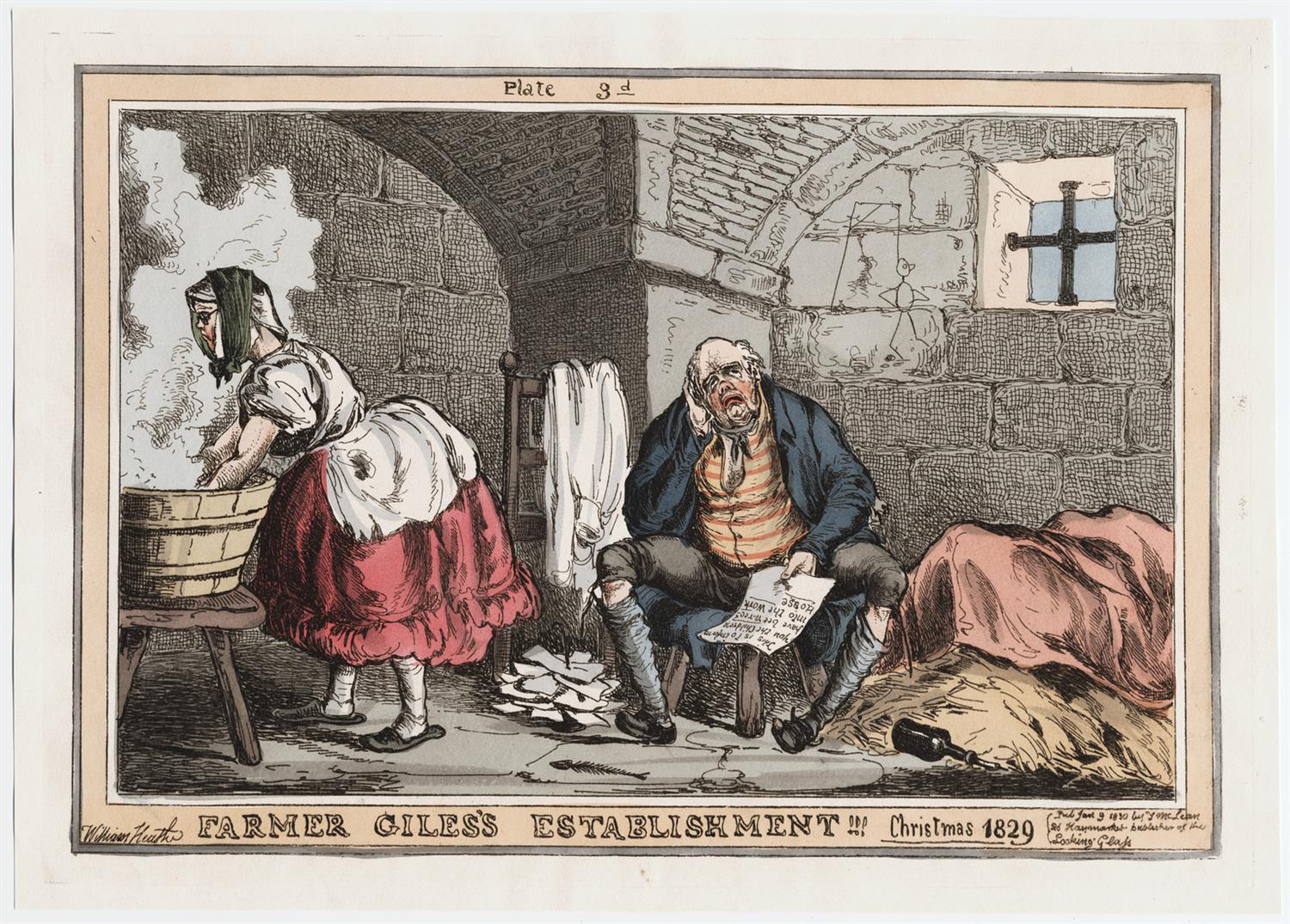
Farmer Giles’s Establishment!!! Christmas 1829 by by William Heath, 1830 Courtesy of The Lewis Walpole Library, Yale University
Their financial prosperity doesn’t last, though. The agricultural economy crashed.
In the third plate, Farmer Giles’ Establishment!!! Christmas 1829, the farmer is in a debtors’ cell. He holds a paper saying his children have been sent to the work house. His wife is doing laundry in a tub.
So this series becomes political satire, criticizing the government for its policies which led to an agricultural depression. A very sad Christmas.
The Merry Musgroves
But let’s return to Austen’s happier times.
The Musgroves and children at Christmas C.E. Brock, Persuasion, Volume 2, chapter 2
As Austen describes Christmas at the Musgroves, in Persuasion:
On one side was a table, occupied by some chattering girls, cutting up silk and gold paper; and on the other were tressels and trays, bending under the weight of brawn and cold pies, where riotous boys were holding high revel; the whole completed by a roaring Christmas fire, which seemed determined to be heard, in spite of all the noise of the others. . . .
Anne, judging from her own temperament, would have deemed such a domestic hurricane a bad restorative of the nerves, which Louisa’s illness must have so greatly shaken; but Mrs. Musgrove, . . . concluded a short recapitulation of what she had suffered herself, by observing, with a happy glance round the room, that after all she had gone through, nothing was so likely to do her good as a little quiet cheerfulness at home. . .
“I hope I shall remember, in future,” said Lady Russell, as soon as they were reseated in the carriage, “not to call at Uppercross in the Christmas holidays.”
Every body has their taste in noises as well as in other matters . . .
I hope this Christmas is just to your taste! Many blessings to you in the New Year.
Brenda S. Cox writes on Faith, Science, Joy, and Jane Austen. She is currently working on a book entitled Fashionable Goodness: Faith in Jane Austen’s England.
For more on satirical cartoons in Jane Austen’s England, see:
Keeping Within Compass Mike Rendell also shows and discusses many other fascinating cartoons from Austen’s era on this blog, but be aware that many are risque. I am indebted to Mike for posting on the Newton Clerical Alphabet cartoon that got me started looking at cartoons and the clergy.
For more on Christmas in Austen’s England, see:
Party Like the Musgroves, by Rachel Dodge, to have your own party like the Musgroves did in the passage above!
Happy Christmas! The Christmas season in the early 1800s was a time of festive balls, dinner parties, and parlor games as described in Christmas Regency Style and a Jane Austen Christmas. While Christmas decorations in the form of garlands and mistletoe were put up on Christmas Eve and a yule log was cut and burned, the custom of ornamenting christmas trees, swapping Christmas cards, and singing Christmas carols did not become widespread until the Victorian era.
Click on the links below to learn how Christmas was actually celebrated during Jane Austen’s and the Prince Regent’s time.
Fashionable Goodness: Christianity in Jane Austen's England is now available! By JAW contributor Brenda S. Cox. See Review. Available from Amazon and Jane Austen Books.
Available through December 31st, 2025. Click on image for details, and share this poster with other teachers and students!
The Obituary of Charlotte Collins by Andrew Capes
Click on image to read the story.
Comments
“My idea of good company…is the company of clever, well-informed people, who have a great deal of conversation.” – Jane Austen, Persuasion
Gentle readers: Please feel free to post your comments and continue the conversation! Due to SPAM, we will no longer accept comments on posts after 30 days of publication. In some instances, links will be removed from comments as well.
Administrators and Contributors
Vic Sanborn, founder of this blog, is supported by a team of talented and knowledgeable writers about Jane Austen and the Regency era. They are:
Tony Grant, who now contributes his photos from London and England
Click on their names to enter their own blogs.
In addition, we thank the many experts and authors who frequently contribute their posts and opinions, and who continue to do so freely or at our request.
Click here to enter the page. Topics include Regency fashion, historic foods, Jane Austen societies, British sites, related topics. Click on image.
May we suggest?
Hello, my name is Vic and I live in Maryland, USA. I have adored Jane Austen almost all of my life. I am a proud lifetime member of the Jane Austen Society of North America. This blog is a personal blog written and edited by me and my team. We do not accept any form of cash advertising, sponsorship, or paid topic insertions. However, we do accept and keep books and CDs to review.
If you would like to share a new site, or point out an error, please email us. (Yes, we are fallible. We'll own up to our mistakes and will make the corrections with a polite smile on our faces.) Write us at
Thank you for visiting this blog. Your comments and suggestions are most welcome.
Project Gutenberg: eBook of Stage-coach and Mail in Days of Yore, Volume 2 (of 2), by Charles G. Harper
STAGE-COACH AND MAIL IN DAYS OF YORE: A PICTURESQUE HISTORY
OF THE COACHING AGE, VOL. II, By CHARLES G. HARPER. 1903. Click on this link.










 Jane Austen's World